Undersized gas pipework is a hidden fault: the appliance still lights, but it's starved of gas, the pressure sags under load, and combustion suffers. Sizing pipe correctly is about delivering enough gas to every appliance at the same time without losing too much pressure on the way. This guide covers the sizing method and the installation rules that go with it. It's revision material — only a Gas Safe registered engineer may install gas pipework.
The one number that drives everything: 1 mbar
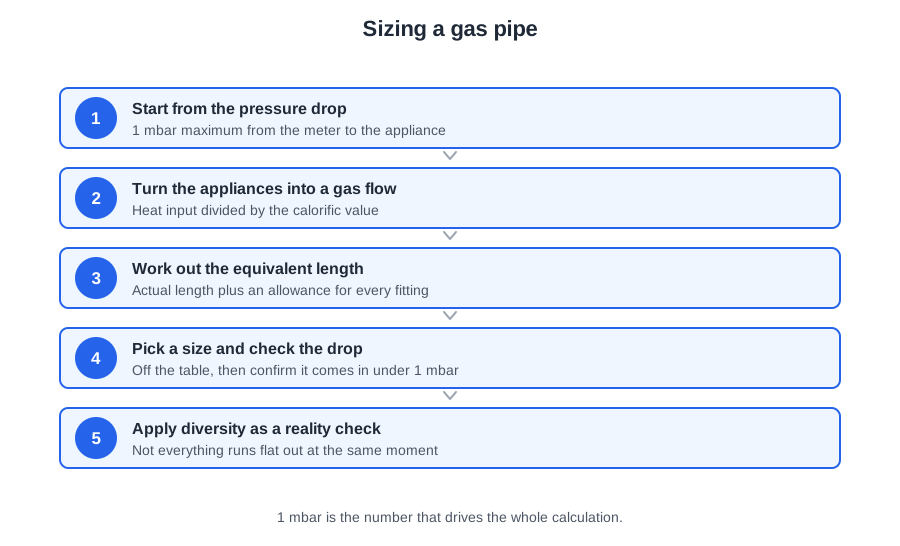
The supply arrives at roughly 21 mbar at the meter for natural gas. BS 6891 allows a maximum pressure loss of just 1 mbar from the meter outlet to any appliance at full demand. That tiny margin is what forces you to think about pipe diameter and length: the longer or narrower the run, the more pressure it drops. (For LPG the permitted drop is 2 mbar.)
Step 1 — turn appliances into a gas flow
Pipe-sizing tables work in gas flow (m³/h), so first convert each appliance's input. A handy approximation for natural gas is:
Gas flow (m³/h) ≈ appliance input (kW) × 0.095 (or kW ÷ 10.3)
So a 24 kW combi draws about 2.3 m³/h. Add up the flows for the appliances a given section must feed.
Step 2 — work out the equivalent length
Every bend, elbow and tee adds resistance, so you don't size on the straight measured length alone. Each fitting is given an equivalent length — a few extra "virtual" metres added to the measured run. Add the measured length and all the fitting allowances to get the total equivalent length for the section.
Step 3 — pick a size and check the drop
Take BS 6891's pipe-sizing table for your material (copper or steel), find the row for your flow rate and chosen diameter, and read off the pressure loss per metre. Multiply that by the total equivalent length:
Total pressure loss = loss per metre × total equivalent length
If the result is more than 1 mbar, the pipe is too small — step up a diameter and try again. In practice most domestic runs use 22 mm or 28 mm copper from the meter, reducing to 15 mm at individual appliance spurs.
Diversity — a sensible reality check
Not every appliance runs flat out at once. Diversity is the recognition that, in many installations, the simultaneous demand is less than the simple sum of all appliances. It's applied with care and judgement — never as an excuse to undersize a run that genuinely could see full demand. For straightforward domestic jobs, sizing for the realistic peak is the safe default.
Installation essentials
Sizing is only half the job. BS 6891 also governs how pipe is run and protected:
- Through walls: pipe passing through a wall is run in a continuous sleeve, sealed at the inner face with a flexible fire-resistant compound so any escape can't track into the cavity.
- No gas in unventilated voids: avoid running or jointing pipe in inaccessible, unventilated voids where a leak could collect. Where pipe must pass through a void, keep joints to a minimum and accessible.
- Protection: protect pipe from corrosion and mechanical damage; support it at the correct intervals so it can't sag or strain joints.
- Bonding: the installation must be main-bonded — the earth clamp is fitted to the consumer's pipe within 600 mm of the meter outlet, and before any branch or tee.
- Underground: buried pipe is polyethylene (MDPE), coloured yellow, laid at least 375 mm deep (450 mm under driveways/roads), with marker tape above. Above-ground internal pipe is not run in PE.
- Flexible tube: CSST/pliable corrugated tube is allowed internally when installed to its standard, bonded, and mechanically protected through walls and floors.
Finish with a tightness test
New or altered pipework is always tightness tested before it's commissioned, following IGEM/UP/1B. Sizing and installing the pipe correctly is what lets that test pass first time.
- Max drop: 1 mbar meter-to-appliance for natural gas (2 mbar LPG).
- Convert input to flow: m³/h ≈ kW × 0.095.
- Equivalent length: measured length + fitting allowances.
- Check: loss/metre × equivalent length must be ≤ 1 mbar, or size up.
- Typical sizes: 22/28 mm copper from the meter, 15 mm spurs.
- Sleeve & seal through walls; bond within 600 mm of the meter before any branch.
- Underground: yellow MDPE, ≥375 mm deep (450 under roads), marker tape; never PE above ground inside.
10-Question Mock Test
Click an option to see whether you got it right. Explanations appear instantly — no submitting at the end.
1 mbar for natural gas (2 mbar for LPG). 21 mbar is the supply pressure, not the permitted drop.
m³/h ≈ kW × 0.095, so 24 × 0.095 ≈ 2.3 m³/h.
Each fitting creates turbulence and resistance, expressed as an equivalent extra length added before reading the sizing table.
1.4 mbar exceeds the 1 mbar limit, so the pipe is undersized. Go up a size and check again.
Domestic runs are commonly 22/28 mm from the meter, reducing to 15 mm at appliance spurs.
The sleeve is sealed at the inner face with a flexible fire-resistant compound, so any escape can't track into the cavity.
The bond clamps to the consumer's pipe within 600 mm of the meter outlet, before any branch or tee.
Underground gas pipe is yellow MDPE, laid at least 375 mm deep (450 mm under roads) with marker tape. PE isn't used above ground inside.
Gas leaking into a sealed void can build up undetected. Keep joints minimal and accessible, and ventilate where required.
New or altered pipework is tightness tested and purged to IGEM/UP/1B before being commissioned.
Sizing tables make sense on the bench. Lock them in before the test.
PlumbMate drills the BS 6891 essentials — the 1 mbar rule, equivalent lengths, bonding and protection — with quizzes and spaced repetition mapped to the gas ACS tickets.
🔥 Open the gas course →Full ACS revision — CCN1, CPA1, CKR1, HTR1 & CENWAT · £29.99 for 60 days, or every course for a year at £59.99
Prefer to browse first? Back to the Gas Blog →