When you commission or service an appliance, you have to prove it's burning the right amount of gas — not too much, not too little. Two checks do that: measuring the pressures, and measuring the actual volume of gas the appliance pulls (the "gas rate"). This guide explains what each one tells you, the maths behind converting a gas rate into kilowatts, and the trap that catches people at assessment: thinking a correct burner pressure means the job is done. It's written for study and revision — only a Gas Safe registered engineer may work on a live appliance.
Three pressures, and one volume
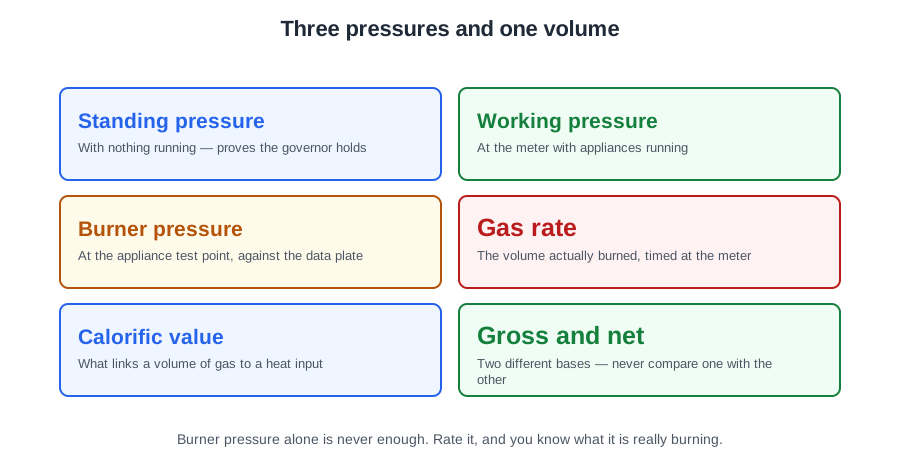
It helps to be precise about what you're measuring and where.
- Standing / inlet (working) pressure — the gas pressure arriving at the appliance with it running. For natural gas this should be around 20 mbar at the appliance, fed from a nominal 21 mbar at the meter (acceptable roughly 19–23 mbar).
- Working pressure drop — the loss between the meter and the appliance. BS 6891 limits this to 1 mbar for natural gas (2 mbar for LPG). More than that and the pipework is undersized.
- Burner pressure — the pressure at the burner test point, set to the figure on the appliance data plate or in the manufacturer's instructions.
- Gas rate — the actual volume of gas the appliance burns over time, measured at the meter. This is what converts to a heat input in kilowatts.
You measure pressures with a manometer (a U-gauge or electronic gauge, in calibration). You measure the gas rate with the meter and a stopwatch.
Why burner pressure alone is never enough
This is the heart of the topic. A correct burner pressure is reassuring, but it is not proof that the appliance is burning the right volume of gas. Here's why: the injector — the small drilled jet that meters gas into the burner — is what actually sets the rate at a given pressure. If that injector is partially blocked, or the wrong size has been fitted, the rate changes while the burner pressure can still read more or less normally.
So burner pressure and gas rate are two different windows onto the appliance. Burner pressure tells you the governor is delivering the right pressure; the gas rate tells you the right quantity of gas is actually being burned. To confirm an appliance is correctly set, you check both — and the gas rate is the definitive volume check. Over-gassing wastes fuel and can cause sooting, flame impingement and carbon monoxide; under-gassing leaves the appliance short of output. Either way it's a safety and performance issue, not just a number.
The calorific value link
Gas is sold and rated by the energy it contains, measured as calorific value (CV) — the heat released per cubic metre, in megajoules (MJ/m³). For UK natural gas the CV is around 39.5 MJ/m³ (it's a regulated range of roughly 38–41 MJ/m³, and the classic ACS gas-rate chart uses 38.76). It varies slightly day to day, which is why for sign-off you use the value published by the gas supplier.
The single most useful relationship to memorise is how CV converts a volume rate into power. Because 1 kW = 3.6 MJ/h:
kW (gross) = gas rate (m³/h) × CV (MJ/m³) ÷ 3.6
In other words, dividing the CV by 3.6 tells you the kilowatts in one cubic metre per hour of that gas. For natural gas, 39.5 ÷ 3.6 ≈ 10.97 kW per m³/h.
Gas rating an appliance: the procedure
For a metric meter (reading in m³), the method is straightforward:
- Isolate other loads. Turn off every other gas appliance and any pilot lights, so the meter only sees the appliance you're testing.
- Warm up. Run the appliance on full rate for about 10 minutes so it has reached steady operating conditions.
- Take a start reading from the meter and start a stopwatch.
- Time a set period — commonly 2 minutes — then take the finish reading. (Alternatively, time one full revolution of the meter's test dial.)
- Work out the rate: gas rate (m³/h) = (volume used ÷ time in seconds) × 3600.
- Convert to heat input: kW (gross) = gas rate × CV ÷ 3.6, then compare against the appliance data plate.
Rate = 0.040 ÷ 120 × 3600 = 1.2 m³/h.
Gross input = 1.2 × 39.5 ÷ 3.6 = 13.2 kW (gross).
If the data plate quotes a net figure, multiply gross by about 0.901 → ≈ 11.9 kW (net). Compare with the plate and accept it if it's within the manufacturer's tolerance.
Gross vs net — don't compare apples with pears
Older UK appliances were rated in gross heat input; modern data plates, following European appliance standards, usually quote net. They describe the same appliance — net simply leaves out the heat that would be recovered by condensing the water vapour in the products. For natural gas, net ≈ gross × 0.901. The classic mistake at assessment is calculating a gross figure from the meter and comparing it directly against a net data plate, then thinking the appliance is over-rated. Always convert so you're comparing like with like.
What "within tolerance" means
A measured input within roughly ±5% of the data-plate figure is normally acceptable — but always work to the manufacturer's stated tolerance, which takes precedence. If you're outside it, don't just adjust and move on: investigate. Check the standing and burner pressures, look for a blocked or incorrect injector, confirm the governor is working, and remember the CV itself varies. A rate that's wrong with correct pressures points you straight at the injector or governor.
A note on LPG
The method is the same, but the numbers differ. LPG has a far higher CV (propane ≈ 93 MJ/m³), and burner pressures are higher — typically about 37 mbar for propane and 28 mbar for butane. Regulator outlet pressure matters more on LPG, so verify it before timing a rate, or your figure will be wrong.
- Burner pressure ≠ proof of rate. A blocked or wrong injector changes the rate without necessarily changing the pressure — gas rating is the definitive volume check.
- The formula: kW (gross) = gas rate (m³/h) × CV ÷ 3.6.
- CV (NG): ≈ 39.5 MJ/m³ (regulated 38–41); use the supplier's published value for sign-off.
- Procedure: isolate other loads, warm up ~10 min, time (often 2 min), rate = vol ÷ time × 3600.
- Gross vs net: net ≈ gross × 0.901 — convert before comparing with the data plate.
- Tolerance: about ±5%, but follow the manufacturer's figure.
- Pressures: ~21 mbar at the meter (NG), max 1 mbar drop to the appliance (BS 6891).
10-Question Mock Test
Click an option to see whether you got it right. Explanations appear instantly — no submitting at the end.
The injector meters the gas. If it's partly blocked or the wrong size, the volume burned changes even though the pressure can still look right — so you confirm with a gas rate.
Because 1 kW = 3.6 MJ/h, gross input = gas rate (m³/h) × CV (MJ/m³) ÷ 3.6. Dividing CV by 3.6 gives the kW in one m³/h of that gas.
UK natural gas is about 39.5 MJ/m³ (regulated 38–41). 93 MJ/m³ is propane; 21 mbar is the supply pressure, not a CV.
Only the test appliance should be drawing gas, and it must be at steady running conditions (about 10 minutes) before you time the rate.
Rate = volume ÷ time in seconds × 3600 = 0.040 ÷ 120 × 3600 = 1.2 m³/h.
1.2 × 39.5 ÷ 3.6 = 13.2 kW gross. (Net would be about 11.9 kW.)
Gross and net describe the same appliance on different bases. For NG, net ≈ gross × 0.901. Convert so you're comparing like with like.
If pressures are right but the rate is wrong, suspect the component that meters the gas — the injector — or the governor setting the pressure.
BS 6891 allows a maximum 1 mbar drop from meter to appliance for natural gas (2 mbar for LPG). 21 mbar is the supply pressure at the meter.
Burning too much gas can overload combustion — sooting, flame impingement on the heat exchanger and incomplete combustion producing CO. The gas rate is a safety check, not just a performance one.
The maths is easy on paper. The pressure is in the room.
PlumbMate drills the calculations assessors love — gas rates, the kW formula, gross vs net — with quizzes, flashcards and spaced repetition mapped to the gas ACS tickets.
🔥 Open the gas course →Full ACS revision — CCN1, CPA1, CKR1, HTR1 & CENWAT · £29.99 for 60 days, or every course for a year at £59.99
Prefer to browse first? Back to the Gas Blog →