"Water heater" covers everything from a small over-sink unit to a pressurised cylinder serving a whole house. The gas side is familiar — flueing, ventilation, gas rate, combustion — but hot water adds two big safety themes: Legionella and, on pressurised systems, unvented safety. This guide pulls them together. It's study material; only a Gas Safe registered engineer may work on the gas — and unvented cylinder work additionally requires G3 competence.
Types of gas water heater
- Instantaneous — heats water on demand as it flows, with no storage (e.g. a combi's hot water).
- Single-point — an instantaneous heater serving one outlet (e.g. an over-sink heater).
- Multipoint — an instantaneous heater serving several outlets from one unit.
- Storage — heats and stores a volume of hot water in a cylinder, ready for use.
Legionella: store hot, deliver safe
Stored water in the 20–45 °C range lets Legionella bacteria multiply. The control is temperature: store at ≥60 °C and distribute so the water is ≥50 °C at the outlets within about a minute. The cylinder thermostat is therefore set to a minimum of 60 °C — never reduce it below that on a stored system.
The scald conflict — and the TMV
Storing at 60 °C protects against Legionella but is hot enough to scald. The resolution is a thermostatic mixing valve (TMV) downstream of the cylinder, which blends in cold to limit the temperature at the tap — commonly to a maximum of around 48 °C at baths — while the stored water stays hot. Store hot, deliver safe.
Unvented hot water: the layers of protection
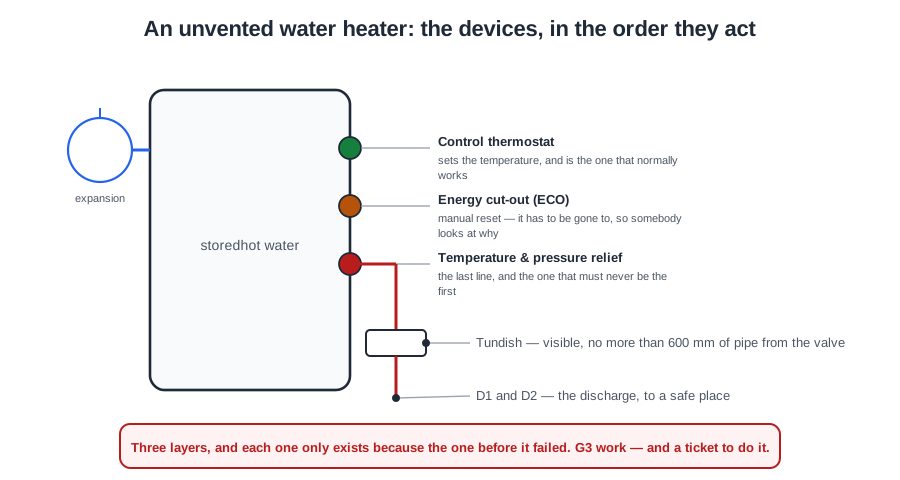
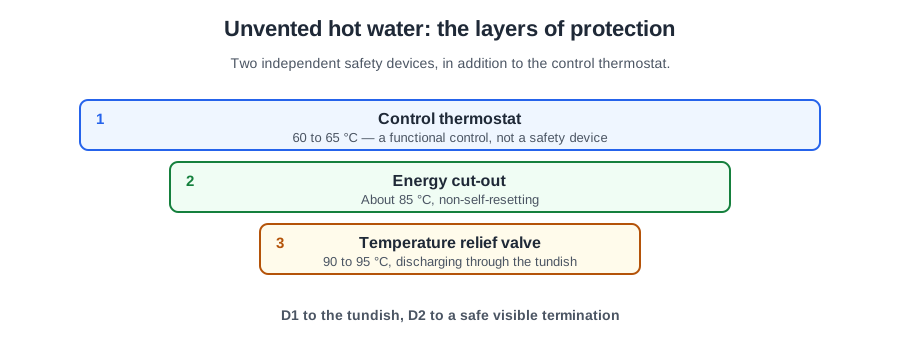
An unvented cylinder is sealed and fed at mains pressure — no open vent or loft tank. That convenience brings stored energy that must be controlled, so G3 requires layered safety devices, typically:
- A pressure-reducing valve and an expansion vessel (or air gap) to handle pressure and the expansion of heated water.
- An expansion relief valve for over-pressure.
- A temperature & pressure relief valve (T&P) — the last line — typically releasing at around 90–95 °C or about 7 bar.
- A thermal cut-out (high-limit) that cuts the heat source if the thermostat fails.
Tundish and discharge (D1 / D2)
If a relief valve operates, the hot water must go somewhere safe and visible. A tundish (a visible air break) is fitted within 600 mm of the safety valve so a discharge can be seen. From there the discharge pipe runs: D1 from the valve to the tundish, then D2 from the tundish to a safe termination — D2 being at least one pipe size larger than D1 and ending where a sudden discharge of near-boiling water can't scald anyone.
- Types: instantaneous, single-point, multipoint, storage.
- Legionella: store ≥60 °C, deliver ≥50 °C at outlets within ~1 min; risk zone 20–45 °C.
- TMV limits outlet temperature (≈48 °C at baths) for scald protection — store hot, deliver safe.
- Unvented = sealed, mains pressure; needs layered G3 safety devices.
- T&P relief valve ≈90–95 °C / ≈7 bar is the last line; thermal cut-out backs up the thermostat.
- Tundish (visible air break) within 600 mm; D1→D2, D2 a size larger, to a safe place.
- G3 competence required for unvented work; a weeping tundish = a fault to investigate.
10-Question Mock Test
Click an option to see whether you got it right. Explanations appear instantly — no submitting at the end.
A multipoint serves several outlets; a single-point serves just one.
It heats water on demand with no storage vessel — a combi's hot water works this way.
The 20–45 °C range is the danger zone — which is why we store hotter than that.
Store at ≥60 °C and distribute ≥50 °C at outlets within about a minute for Legionella control.
A TMV downstream of the cylinder limits the delivered temperature while storage stays hot — store hot, deliver safe.
It's sealed and mains-fed, so G3 requires layered safety devices to control the stored energy.
The T&P valve is the last line, typically ≈90–95 °C or ≈7 bar — verify against the cylinder data.
Within 600 mm and visible, so a discharge can be seen and there is an air break in the discharge. That 600 mm figure is Approved Document G, paragraph 3.54 — “no more than 600mm of pipe between the valve outlet and the tundish” — which is the Building Regulations requirement. You may also see 500 mm quoted: that comes from the 1999 Water Regulations guidance (G19.3) and the withdrawn BS 6700, which ask for the tundish to be vertically as near as possible and in any case within 500 mm.
D2 is at least one size larger than D1 and terminates safely and visibly, with no scald risk.
Unvented work requires G3 competence because releasing pressure from a sealed cylinder is hazardous.
Store hot, deliver safe — and never skip the G3 ticket.
PlumbMate drills water-heater and unvented safety with quizzes and spaced repetition mapped to the gas ACS tickets.
🔥 Open the gas course →Full ACS revision — CCN1, CPA1, CKR1, HTR1 & CENWAT · £29.99 for 60 days, or every course for a year at £59.99
Prefer to browse first? Back to the Gas Blog →