CENWAT covers central heating boilers and water heaters — the bread and butter of domestic gas work. It pulls in nearly everything from CCN1 (flueing, ventilation, gas rate, combustion) and adds the system side: controls, condensate and commissioning. This guide maps the topic and links to a full guide on each part. You need CCN1 plus CENWAT, and only a Gas Safe registered engineer may carry out the work.
Boiler types
The main families: a combi gives heating and instantaneous hot water from one unit; a system boiler has the pump and expansion vessel built in and feeds a cylinder; a regular (heat-only) boiler uses external components. Almost all new boilers are condensing and room-sealed. Read the full guide to boiler types →
Sealed vs open-vented systems
A sealed system is pressurised, with a diaphragm expansion vessel and a pressure relief valve (typically set at 3 bar). An open-vented system uses a feed-and-expansion cistern and an open vent pipe — it admits air, so is more corrosion-prone. Knowing which you're on shapes filling, expansion and safety.
Condensate
A condensing boiler cools the flue products below their dew point (around 55 °C) to recover latent heat, producing an acidic condensate (pH around 3–6) that must be drained in corrosion-resistant plastic — never copper or steel. Read the full guide to condensate handling →
Interlock and controls
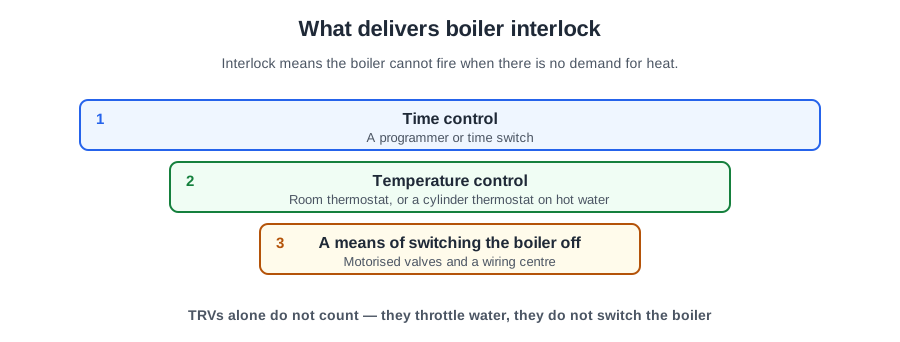
Boiler interlock means the boiler can't fire when there's no heat demand — achieved by the room thermostat, cylinder thermostat and motorised valves working together. TRVs alone do not provide interlock. Read the full guide to boiler interlock & controls →
Benchmark commissioning
Commissioning to the MIs and the Benchmark checklist proves the boiler is set up correctly — gas rate, combustion (links to CPA1), controls and water treatment — and the signed log supports the warranty. Read the full guide to Benchmark commissioning →
Water heaters
Instantaneous, storage and multipoint water heaters each deliver hot water differently, with their own flueing, ventilation and safety needs. Stored water is kept around 60 °C to limit Legionella; mains-pressure unvented systems need layered safety controls and a competent (G3) installer. Read the full guide to water heaters →
- Standard: BS 6798; water treatment BS 7593; commission to MIs + Benchmark.
- Types: combi, system, regular — almost all condensing and room-sealed.
- Sealed system: expansion vessel + PRV (typically 3 bar). Open-vented: F&E cistern + vent.
- Condensate: acidic (pH ~3–6); plastic only; external runs short, insulated, ≥30 mm internal (32 mm pipe).
- Interlock: room/cylinder stats + motorised valves. TRVs alone don't provide it.
- Cylinder stored ~60 °C to limit Legionella; unvented needs G3.
- Commission to Benchmark; check gas rate and combustion (CPA1).
10-Question Mock Test
A sweep across CENWAT. Click an option to see whether you got it right — explanations appear instantly.
BS 6798 covers installation of gas-fired boilers of net input not exceeding 70 kW.
A combi gives both heating and instantaneous hot water, usually mains-fed with no storage cylinder.
By cooling products below the dew point (~55 °C), the water vapour condenses and its latent heat is recovered.
A sealed-system PRV is typically set at 3 bar, discharging to a safe, visible external point.
Condensate is acidic (pH ~3–6), so it's run in plastic — never copper or steel. External runs are short, insulated and ≥30 mm internal (32 mm pipe).
Interlock stops the boiler firing with no demand, via room/cylinder stats and motorised valves working together.
TRVs give local radiator control but don't switch the boiler off — interlock needs the room/cylinder stats and valves.
About 60 °C is hot enough to limit Legionella but not so hot as to scald.
Benchmark is the commissioning checklist/log completed and signed at commissioning and left with the customer.
Unvented hot water needs layered temperature/pressure safety controls and a G3-competent installer — separate from gas registration.
CENWAT is the big one. PlumbMate keeps it all straight.
Boiler types, controls, condensate, commissioning — drilled with quizzes and spaced repetition mapped to the gas ACS tickets.
🔥 Open the gas course →Full ACS revision — CCN1, CPA1, CKR1, HTR1 & CENWAT · £29.99 for 60 days, or every course for a year at £59.99
Prefer to browse first? Back to the Gas Blog →