An analyser reading is only useful if you do the right thing with it. When CO or the CO/CO₂ ratio comes back out of limits, you have a defined path: confirm it, find the cause, fix it, retest — and if it can't be brought within limits, classify the appliance so nobody is left with a CO risk. This guide walks that path. It's study material; only a Gas Safe registered engineer may carry out the work.
Step 1 — make sure the reading is real
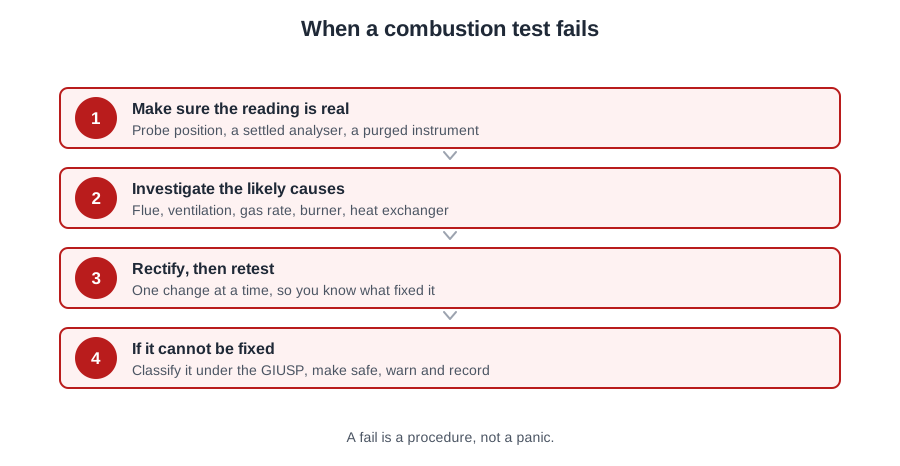
Before chasing a fault, rule out the analyser and the method. Is it in calibration? Did it zero properly in fresh air? Is the probe at the right sampling point and depth, with a clean filter, empty water trap and no leaks diluting the sample? A surprising number of "fails" are a tired sensor or a split hose. Confirm the appliance is at the right test condition and let the reading stabilise.
Step 2 — investigate the likely causes
A high CO/CO₂ ratio means incomplete combustion. Common causes to work through (against the manufacturer's instructions):
- Gas rate / pressure wrong — over- or under-gassed; check the gas rate and burner pressure.
- Air supply restricted — blocked air inlet, dirty filter or fan fault starving the burner of air.
- Flue fault — recirculation of products, a blocked or leaking flue, or poor terminal position.
- Burner / injector / heat exchanger — sooted, partially blocked or distorted components disturbing the flame.
- Combustion-air contamination — chemicals or dust drawn into the burner.
Step 3 — rectify, then retest
Put right what you found and retest to BS 7967 to confirm the appliance is now within limits. Note that just after disturbing debris, a reading can be temporarily elevated before settling — run on and re-check. If it now passes, complete commissioning, record the readings (on the Benchmark log for a boiler) and cap the test point.
Step 4 — if it can't be fixed
If combustion can't be brought within limits, contact the manufacturer's technical line for further guidance. Where it still can't be resolved, the appliance must not be left in a dangerous state: make it safe, then classify it under the GIUSP (Immediately Dangerous or At Risk as appropriate). With permission, disconnect it (ID) or turn it off (AR), attach a DANGER DO NOT USE label, issue a warning notice, record and advise in writing.
- Verify first: calibration, fresh-air zero, sampling point, filter, water trap, leaks, test condition.
- Investigate causes: gas rate/pressure, air supply, flue, burner/injector/heat exchanger, contamination.
- Rectify and retest to BS 7967; allow disturbed debris to settle.
- Pass: complete commissioning, record on Benchmark, cap the test point.
- Can't fix: manufacturer guidance, then classify under the GIUSP — don't leave it dangerous.
- Ambient CO: NDIR needed for ambient CO₂.
- Fumes / alarm / illness: make safe, call 0800 111 999.
10-Question Mock Test
Click an option to see whether you got it right. Explanations appear instantly — no submitting at the end.
Rule out the analyser and method first — many "fails" are a tired sensor, dilution leak or wrong sampling.
Too much CO relative to CO₂ means combustion is incomplete — investigate the cause.
Restricted air, wrong gas rate, flue faults and sooted/blocked components are typical causes.
Always retest after rectification to prove the appliance now meets the limits.
Disturbed debris can lift a reading briefly; run on and re-check before judging.
Finish commissioning, log the readings (Benchmark for a boiler) and cap the sampling point.
Get manufacturer advice; if still unresolved, classify under the GIUSP and don't leave it dangerous.
Follow the GIUSP: permission, warning notice, record and written advice.
Calculated-CO₂ is fine for flue products but not ambient room CO₂ — that needs NDIR.
Safety first: make safe and call 0800 111 999. Get anyone affected into fresh air and seek medical help.
A fail is a procedure, not a panic. Know the steps cold.
PlumbMate drills the CPA1 decision path — verify, investigate, rectify, retest, classify — with quizzes and spaced repetition mapped to the gas ACS tickets.
🔥 Open the gas course →Full ACS revision — CCN1, CPA1, CKR1, HTR1 & CENWAT · £29.99 for 60 days, or every course for a year at £59.99
Prefer to browse first? Back to the Gas Blog →