CPA1 — Combustion Performance Analysis — is about using an electronic flue gas analyser (FGA) to look "inside" the flame: measuring what the appliance is actually producing and judging whether combustion is safe and efficient. It's usually taken alongside CCN1. This guide maps the topic and links to a full guide on each part. It's revision material; only a Gas Safe registered engineer may carry out the work.
What the analyser measures
An FGA samples the flue products and reports carbon monoxide (CO), carbon dioxide (CO₂), oxygen and flue temperature, and calculates the CO/CO₂ ratio and efficiency. CO is the dangerous one — toxic, colourless, odourless, the product of incomplete combustion. CO₂ is a normal product of complete combustion, used as the reference in the ratio.
Using the instrument correctly
Reliable readings depend on good technique: zero the analyser in fresh air before use, let it warm up, check the water trap and filter, and sample at the manufacturer's purpose-designed point. Read the full guide to using a flue gas analyser →
The CO/CO₂ ratio — the heart of CPA
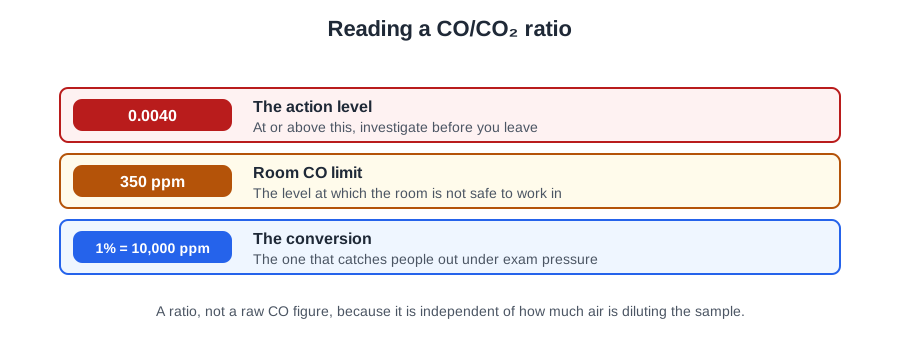
The single most important reading is the CO/CO₂ ratio. Why a ratio rather than raw CO? Because extra air or a sample leak dilutes CO and CO₂ together, so the ratio between them stays largely unaffected by dilution — making it a far more reliable indicator of combustion quality than CO alone. Where no manufacturer figure applies, BS 7967 sets an action level of about 0.004 (often written 0.0040); above it, combustion is unacceptable. Read the full guide to the CO/CO₂ ratio →
Looking after the analyser
An analyser is only trustworthy if it's maintained and calibrated. Sensors age, filters clog and water traps fill; the instrument needs periodic calibration (typically certified annually) to give valid results. Note that analysers which calculate CO₂ from oxygen are fine for flue products but are not suitable for measuring ambient CO₂ in a room — that needs an NDIR sensor. Read the full guide to analyser care & calibration →
Acting on the result
A reading is only useful if you act on it. If combustion is out of limits, you investigate, rectify, and retest to BS 7967; if it can't be brought within limits, you classify the appliance under the GIUSP and don't leave it in a dangerous state. Read the full guide to handling a failed combustion result →
- Standard: BS 7967 (2015); analyser to BS EN 50379-3.
- Zero in fresh air, warm up, sample at the manufacturer's point.
- CO/CO₂ ratio is the key indicator — largely unaffected by dilution.
- Action level ≈ 0.004 where no manufacturer figure applies; MIs take precedence.
- CO = incomplete combustion, toxic and odourless; CO₂ = the reference.
- Calculated-CO₂ analysers aren't valid for ambient room CO₂ (need NDIR).
- Out of limits: rectify and retest; if not resolvable, classify under the GIUSP.
10-Question Mock Test
A sweep across CPA1. Click an option to see whether you got it right — explanations appear instantly.
BS 7967 covers the use of flue gas analysers and the CO/CO₂ ratio.
Zero in fresh air so the sensors start from a known clean baseline.
CO forms when combustion is incomplete. It's toxic, colourless and odourless.
Dilution lowers CO and CO₂ together, so the ratio between them stays steady — a more reliable measure of combustion quality.
About 0.004 (0.0040). Above it, combustion is unacceptable — but a manufacturer's stated figure takes precedence.
1% = 10,000 ppm, so to convert a CO reading in ppm to a percentage you divide by 10,000.
Sample at the appliance's purpose-designed test point per the manufacturer's instructions.
Calculated-CO₂ is proven for flue products but not for measuring ambient room CO₂ — that requires an NDIR sensor.
Sensors age and drift, so an analyser must be calibrated (typically certified annually) for its readings to be trusted.
If it can't be rectified, classify under the GIUSP — combustion producing excess CO is a safety issue.
The ratio, the action level, the fixes. Drill them until they're automatic.
PlumbMate turns CPA1 into quick-recall practice — readings, limits and the right response — mapped to the gas ACS tickets.
🔥 Open the gas course →Full ACS revision — CCN1, CPA1, CKR1, HTR1 & CENWAT · £29.99 for 60 days, or every course for a year at £59.99
Prefer to browse first? Back to the Gas Blog →