An open-flued gas fire takes combustion air from the room and pushes its products of combustion up the chimney. If that flue doesn't draw — or the fire spills products back into the room — the danger is carbon monoxide. Two tests prove it's safe: the flue flow test and the spillage test. This guide covers both as you'd apply them to a fire. It's study material; only a Gas Safe registered engineer may carry out the work.
Inspect before you test
First look the system over: correct flue type and size, sound joints, a liner where the chimney needs one, no blockage, and a suitable terminal. A catchment space should be present where required to catch debris. Tests confirm what a good inspection suggests — they don't replace it.
The flue flow test
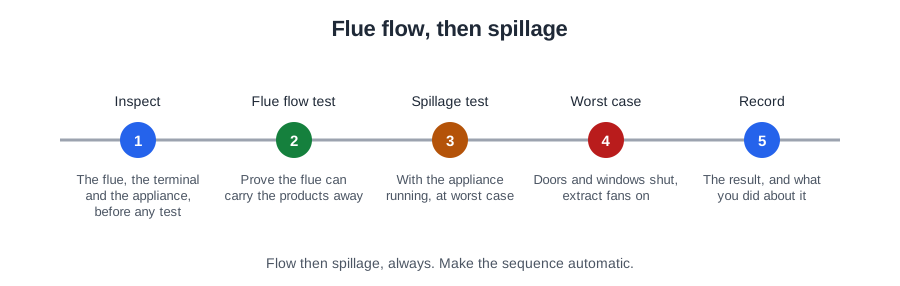
The flue flow test proves the empty flue draws and is clear along its whole length, before you rely on the fire. With the appliance off (or before it's connected), warm the flue if needed to establish a draught, then introduce smoke from a smoke pellet at the appliance position. The smoke should be drawn up and discharge cleanly at the terminal, with none escaping back into the room. If it doesn't clear, the flue is blocked or not drawing and must be put right before going further.
The spillage test
The spillage test proves the running fire clears its products. The method to BS 5440-1:
- Light the fire and run it until it's up to temperature — about 5 minutes.
- Hold a lit smoke match at the edge of the draught diverter / spillage point and watch that the smoke is drawn in (up the flue), not pushed out into the room.
- Repeat under worst-case conditions — windows and doors shut and any extract fans running — because these can pull the flue into reverse.
- If spillage is detected, run on a further 10 minutes and re-check (the flue may just need to warm through). If it still spills, switch off and don't leave the fire in use.
Reading a spillage result
If the fire only spills with windows shut but is fine with them open, the room has insufficient ventilation — adding the correct air supply may resolve it. But if it spills regardless, the cause is usually poor flue performance, which no amount of ventilation will fix; the flue itself must be put right. Always interpret the result against the manufacturer's guidance.
- Inspect first: flue type/size, joints, liner, terminal, catchment space.
- Flue flow test: empty flue draws and is clear (smoke pellet) before relying on the fire.
- Spillage test: run ~5 min, smoke match at the draught diverter, smoke drawn in not out.
- Worst case: repeat with doors/windows shut and extract fans on.
- If it spills: run on 10 min and re-check; still spilling → switch off, don't leave in use.
- Spills only when closed up → ventilation; spills regardless → flue fault.
- Persistent spillage = unsafe situation under the GIUSP.
10-Question Mock Test
Click an option to see whether you got it right. Explanations appear instantly — no submitting at the end.
Products spilling back can contain CO — the reason these tests are safety-critical.
A smoke pellet shows the unobstructed flue draws and discharges at the terminal before relying on the fire.
A smoke pellet provides the smoke for the flue flow test; a smoke match is used at the draught diverter for spillage.
Run it about 5 minutes to get up to temperature so the flue is working before you test for spillage.
You watch the draught diverter: the smoke should be drawn in (up the flue), not pushed into the room.
An extractor can overcome the flue's draught and cause spillage, so you test that realistic worst case.
Continued spillage is unsafe — switch off, don't leave it in use, and act under the GIUSP.
Spilling only when closed up suggests insufficient ventilation; the correct air supply may resolve it.
Spillage independent of ventilation points to poor flue performance, which must be rectified at the flue.
Inspect first, prove the empty flue draws (flow test), then prove the running fire clears its products (spillage test).
Flow then spillage, always worst-case. Make the sequence automatic.
PlumbMate drills the HTR1 flue tests with quizzes and spaced repetition mapped to the gas ACS tickets.
🔥 Open the gas course →Full ACS revision — CCN1, CPA1, CKR1, HTR1 & CENWAT · £29.99 for 60 days, or every course for a year at £59.99
Prefer to browse first? Back to the Gas Blog →