HTR1 covers gas fires and space heaters — radiant and convector fires, decorative fuel-effect fires, inset live-fuel-effect fires, flueless heaters and catalytic heaters. Many are open-flued and fitted into a builder's opening, so flueing, hearths and ventilation come together here. This guide maps the topic and links to a full guide on each part. You need CCN1 plus HTR1, and only a Gas Safe registered engineer may carry out the work.
Appliance types
A radiant/convector fire heats by glowing elements and warmed air. A DFE (decorative fuel-effect, ≤20 kW) and an ILFE (inset live-fuel-effect) are designed to burn with a deliberately yellow, luminous flame picture — the opposite of most appliances, where yellow tipping warns of trouble. A catalytic or other flueless heater burns into the room and relies on ventilation and an ODS.
Flue flow and spillage testing
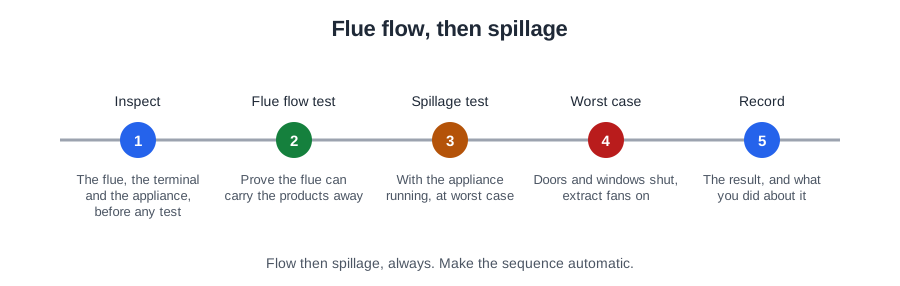
Open-flued fires must clear their products. You prove the empty flue draws (flue flow test), then prove the running appliance doesn't spill (spillage test), repeated with extract fans running. Read the full guide to flue flow & spillage testing →
DFE and ILFE fires
These decorative fires have specific chimney, catchment-space and ventilation needs, and a flame picture set up to the manufacturer's pattern. Read the full guide to DFE & ILFE fires →
Flueless heaters and the ODS
A flueless heater puts its products into the room, so it carries an atmosphere-sensing / oxygen-depletion device (ASD/ODS) that shuts it down before the air vitiates. Combined with room ventilation, this is what keeps a flueless appliance safe. Read the full guide to flueless heaters & the ODS →
Hearths, clearances and closure plates
A fire fitted to an opening needs a non-combustible hearth, correct clearances to combustibles, a sealed closure/register plate, and a catchment space for debris where required. Read the full guide to hearths, clearances & closure plates →
- Standard: BS 5871 (Parts 1–4); MIs take precedence.
- DFE/ILFE burn deliberately yellow — that's by design, not a fault.
- Open-flued fires: flue flow test then spillage test (with extract fans on).
- Flueless heaters need room ventilation and a working ASD/ODS.
- Hearth, closure plate, catchment space, clearances per BS 5871/MIs.
- Sleeping accommodation: >12.7 kW net must be room-sealed; smaller needs an ASD.
- Spillage or failed ODS = unsafe situation under the GIUSP.
10-Question Mock Test
A sweep across HTR1. Click an option to see whether you got it right — explanations appear instantly.
BS 5871 covers fires, convector heaters, fire/back boilers, ILFE and DFE appliances.
DFE and ILFE fires are designed to burn yellow and luminous — by design, not a sign of a fault.
BS 5871-3 covers DFE appliances of heat input not exceeding 20 kW.
The flue flow test (smoke pellet) proves the unobstructed flue draws and discharges at the terminal.
Extract fans can pull the flue into reverse, so the test repeats under that worst-case condition.
The ODS shuts the heater down before the air vitiates and combustion products build up.
A hearth is a non-combustible base of defined size (per BS 5871/MIs) protecting the floor and nearby combustibles.
The closure/register plate seals the opening and carries the flue connection, with any relief opening the appliance specifies.
Above 12.7 kW net (14 kW gross) in sleeping accommodation, the appliance must be room-sealed.
A catchment space of specified volume collects debris falling from the chimney so it can't obstruct the appliance.
Fires bring flue, hearth and ventilation together. Master them as one.
PlumbMate drills HTR1 — appliance types, spillage testing, hearths and the ODS — with quizzes and spaced repetition mapped to the gas ACS tickets.
🔥 Open the gas course →Full ACS revision — CCN1, CPA1, CKR1, HTR1 & CENWAT · £29.99 for 60 days, or every course for a year at £59.99
Prefer to browse first? Back to the Gas Blog →