Two kinds of "real-flame look" gas fire come up in HTR1, and they're easy to confuse: the DFE (decorative fuel-effect) and the ILFE (inset live-fuel-effect). Both are designed to look like a coal or log fire, but they're built and installed differently. This guide draws the distinction and the key install points. It's study material; only a Gas Safe registered engineer may carry out the work.
The deliberately yellow flame
Both fires burn with a luminous yellow flame picture on purpose — that's what makes them look like burning coal or wood. On almost every other gas appliance, yellow tipping warns of incomplete combustion; on a DFE/ILFE it's the intended effect. That makes correct flueing, ventilation and fuel-bed layout even more important, because the appliance is designed to run "rich".
The fuel bed must be exact
The artificial coals, logs or ceramics — the fuel bed — are part of the appliance's design, not decoration to arrange by eye. The manufacturer specifies the exact number and position of pieces. Add coals, remove them, or place them wrong and you disturb combustion, which can cause sooting and carbon monoxide. A typical instruction reads: "designed to operate correctly with the coals supplied — never add to them or change them."
DFE: decorative fuel-effect
A DFE is essentially an open gas fire sitting in a fireplace opening or basket, with the products passing fairly freely up the chimney. It's open-flued, simple in construction, and usually needs a minimum of about 100 cm² of purpose-provided ventilation (per the MIs), because it's relatively inefficient and puts a lot of warm products up the flue. It relies on a working chimney and passes a spillage test.
ILFE: inset live-fuel-effect
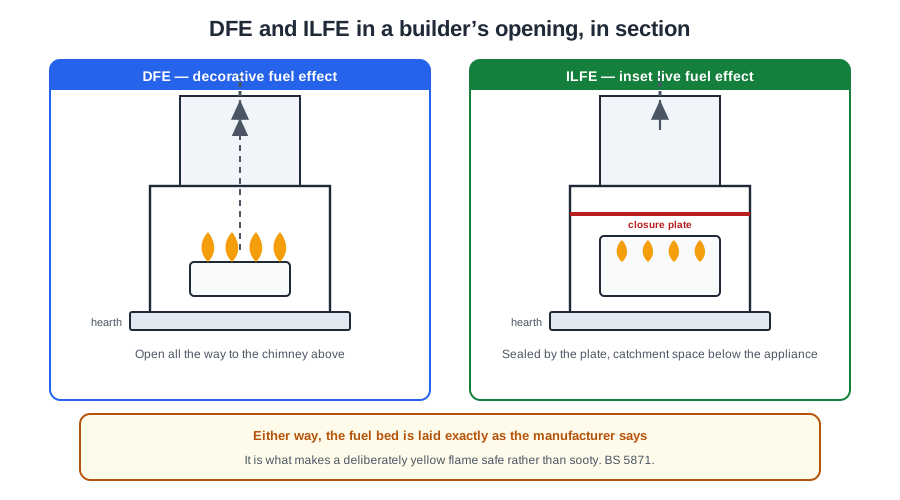
An ILFE looks similar but is built differently: it incorporates a heat exchanger and restricts the passage of products between the firebed and the chimney, so it's more efficient and gives more heat to the room. Because it's inset into a builder's opening, it needs a catchment (debris collection) space — for an ILFE, a minimum of around 12 dm³ (12 litres) where the fire insets fully (per BS 5871-2 / the MIs). Some are "cassette" fires fitted to a lined chimney.
Commissioning either type
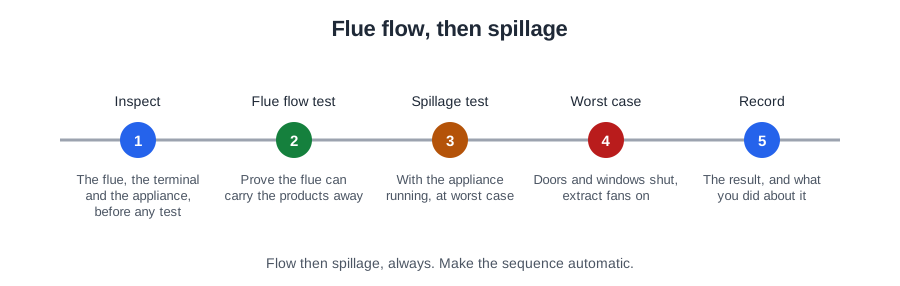
Inspect the chimney and catchment space, lay the fuel bed exactly to the instructions, confirm ventilation, check the gas rate and flame picture against the MIs, and carry out flue flow and spillage tests. Hand the instructions to the customer and tell them not to rearrange the coals.
- DFE = open-flued decorative fire, ≤20 kW, BS 5871-3; ≈100 cm² ventilation (per MIs).
- ILFE = has a heat exchanger, restricts products, more efficient, BS 5871-2.
- Both burn yellow by design — not a combustion fault as it would be elsewhere.
- Fuel bed exactly per MIs: right number, right positions — wrong layout causes CO.
- ILFE catchment space ≈ 12 dm³ where fully inset (per BS 5871-2 / MIs).
- Commission: inspect, lay fuel bed, ventilation, gas rate, flame picture, flue/spillage tests.
- Spillage/sooting = unsafe situation under the GIUSP.
10-Question Mock Test
Click an option to see whether you got it right. Explanations appear instantly — no submitting at the end.
Decorative fuel-effect — an open-flued fire designed to look like a solid-fuel fire.
BS 5871-3 covers DFE appliances of heat input not exceeding 20 kW.
These fires burn yellow deliberately; on most other appliances yellow tipping would signal incomplete combustion.
The fuel bed is part of the design — the exact number and positions matter; wrong layout can cause CO.
Disturbing the fuel bed upsets combustion, leading to sooting and CO.
A DFE is an open-flued fire that passes products fairly freely up the chimney.
A DFE normally needs a minimum of around 100 cm², unless the manufacturer states otherwise.
An ILFE incorporates a heat exchanger and restricts products between firebed and chimney, giving more heat to the room.
BS 5871-2 indicates a minimum debris catchment volume of around 12 dm³ where fully inset — verify against the MIs.
These fires burn yellow in real chimneys, so spillage or sooting is dangerous — classify under the GIUSP.
DFE or ILFE, the fuel bed is sacred. Know why.
PlumbMate drills the HTR1 fire types with quizzes and spaced repetition mapped to the gas ACS tickets.
🔥 Open the gas course →Full ACS revision — CCN1, CPA1, CKR1, HTR1 & CENWAT · £29.99 for 60 days, or every course for a year at £59.99
Prefer to browse first? Back to the Gas Blog →