Fitting a fire to a fireplace opening pulls several builders' details together: a fire-proof base, safe distances to anything that can burn, a plate to seal the opening into the chimney, and somewhere for debris to fall. Get them right and the installation is safe and tidy; get them wrong and you risk fire or a blocked appliance. This guide covers each. It's study material; only a Gas Safe registered engineer may carry out the work.
The hearth
A hearth is a solid, non-combustible base that protects the floor and nearby combustibles from heat and any dropped material. Typical requirements: non-combustible material at least about 12 mm thick, with the top surface at least about 50 mm above the surrounding floor (or surrounded by a raised edge/fender of similar height), fitted symmetrically about the fire opening and of a minimum size set by the standard and MIs. A hearth may not be needed where every part of the flame or incandescent material is high enough above the floor (around 225 mm for certain appliances) — but always confirm against the appliance's instructions.
Clearances to combustibles
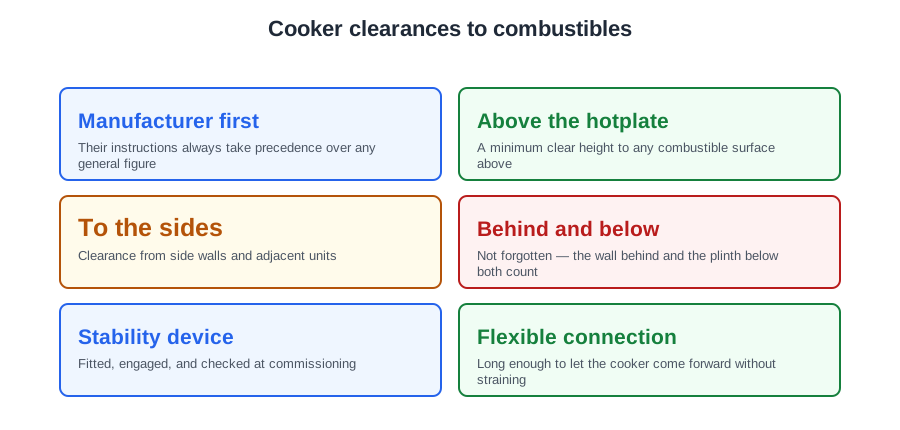
Heat radiates and rises, so combustible materials must be kept clear of the fire. Manufacturers give minimum distances — for example, a common figure is keeping combustible side walls at least around 500 mm from the radiant heat source, with stated clearances to any shelf or mantel above. Soft furnishings, certain wall coverings and decorations placed too close can scorch even below the strict clearance, so advise the customer too. Where a clearance can't be met, a non-combustible shield may be required.
The closure / register plate
When a fire is fitted to a builder's opening, a closure (register) plate seals the opening into the chimney. It does several jobs: it prevents room air being lost up the chimney except through the appliance, it carries the flue connection, and — where the appliance specifies — it includes a defined relief opening so the flue draws correctly. It must be sealed to the opening with suitable, non-combustible/heat-resistant materials and be removable for inspection where required.
The catchment space
Bits of mortar, soot and debris can fall down a chimney over time. A catchment (debris collection) space below the flue connection collects that material so it can't block the appliance or its flueway. For an inset live-fuel-effect fire, a minimum of around 12 dm³ (12 litres) is typically required where the fire insets fully (per BS 5871-2 / the MIs). Always provide the volume the standard and appliance call for.
- Hearth: non-combustible, ≈12 mm thick, top ≈50 mm above floor, symmetrical, min size per BS 5871/MIs.
- 225 mm flame-height exception may remove the hearth need for some appliances — verify.
- Clearances: keep combustibles clear (e.g. ≈500 mm to a radiant source); shield if needed.
- Advise the customer about soft furnishings and decorations near the fire.
- Closure/register plate seals the opening, carries the flue connection and any relief opening.
- Catchment space collects falling debris; ≈12 dm³ for a fully inset ILFE (per BS 5871-2/MIs).
- Defects (missing hearth, close combustibles, poor seal, no catchment) → GIUSP.
10-Question Mock Test
Click an option to see whether you got it right. Explanations appear instantly — no submitting at the end.
It's a solid, non-combustible base protecting the floor and combustibles from heat and dropped material.
Around 12 mm thick non-combustible material is typical — confirm against BS 5871 and the MIs.
Around 50 mm above the floor, or surrounded by a raised edge/fender of similar height.
For some appliances, if the flame/incandescent material is high enough above the floor a hearth isn't required — verify with the MIs.
Around 500 mm to a combustible side wall is a common figure — always confirm the specific MI clearance.
Soft furnishings and some wall coverings can scorch even below the strict clearance — advise keeping them clear.
It seals the opening into the chimney, provides the flue connection, and includes any relief opening the appliance specifies.
It collects mortar, soot and debris falling from the chimney so they can't obstruct the appliance.
Around 12 dm³ where fully inset (BS 5871-2 / the MIs).
These can lead to fire, spillage or a blocked flue — addressed and classified under the GIUSP.
Hearth, clearance, plate, catchment — the builders' details that keep a fire safe.
PlumbMate drills the HTR1 fireplace details with quizzes and spaced repetition mapped to the gas ACS tickets.
🔥 Open the gas course →Full ACS revision — CCN1, CPA1, CKR1, HTR1 & CENWAT · £29.99 for 60 days, or every course for a year at £59.99
Prefer to browse first? Back to the Gas Blog →