When you find a gas fault, you need a consistent way to decide how serious it is and exactly what to do about it. That's what the Gas Industry Unsafe Situations Procedure (GIUSP) gives you — a shared decision framework every Gas Safe engineer follows, so the same fault is treated the same way by everyone. This guide explains the classifications and the actions. It's revision material; only a Gas Safe registered engineer may act on gas faults.
The two classifications
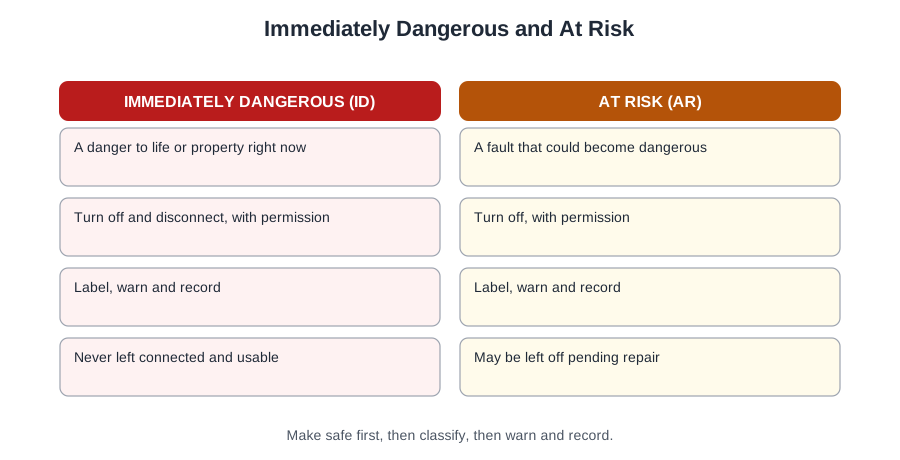
Immediately Dangerous (ID) — an installation or appliance that, if used, is or would be an immediate danger to life or property. Examples: a flue spilling products into a room, an open flue with no combustion ventilation, or a loose connection on a communal flue. An ID situation must not be left in use.
At Risk (AR) — one or more faults that could, in the future, become a danger. The appliance isn't an immediate threat, but it shouldn't continue in use until put right. Many real faults are AR rather than ID.
If something is unsafe but doesn't meet the bar for either, you still advise the customer in writing of the non-compliance and recommend it's corrected — you simply don't apply a formal classification to it.
The procedure: make safe first
The overriding duty is to make the situation safe. In practice that follows a clear order:
- If it is a danger right now, make it safe first (turn it off or isolate it), then classify the fault as ID or AR.
- Seek the responsible person's permission for the action the classification calls for: to disconnect an ID appliance or installation, or to turn off an AR one.
- If permission is given: disconnect it (ID) or turn it off (AR), attach a DANGER DO NOT USE label, issue a warning notice, record it, and advise the responsible person in writing.
- If permission is refused on an AR situation: you can't force it off, but you must issue the warning notice, advise them clearly of the danger, and ask them to sign it to confirm they accept responsibility, then record and report as the procedure requires.
- If it's ID and permission to disconnect is refused: the situation can't be left as-is. You issue the warning notice, advise them of the danger, and inform the gas emergency service provider, the National Gas Emergency Service, who hold powers of entry and disconnection that you do not.
A few named exceptions. IGEM/G/11 lists a few At Risk situations where turning off wouldn't remove the risk. The usual example is a property built over the gas service pipe (the transporter's pipe, before the ECV): closing the ECV doesn't isolate it, so you don't turn it off or attach a DANGER DO NOT USE label. Record it on the warning notice, advise the responsible person and report it to the gas transporter, who must resolve it; a smell or leak makes it a gas escape (Immediately Dangerous). Built-over installation pipework after the ECV is not an exception: it gets the normal AR action.
Warning notices and records
When you disconnect or turn off an appliance under the GIUSP, you attach a DANGER DO NOT USE label to it and issue a warning notice, which the responsible person signs; leave a copy with the customer, and keep your own record. This protects the customer — who knows not to switch it back on — and protects you, by documenting the unsafe situation and the action taken.
Where RIDDOR fits — and where it doesn't
RIDDOR (the Reporting of Injuries, Diseases and Dangerous Occurrences Regulations) is a separate legal reporting duty. Certain serious gas incidents — for example a death or major injury, or a dangerous gas fitting — are reportable to the HSE under RIDDOR. It's important not to confuse it with the immediate make-safe duty: GIUSP is what you do on site; RIDDOR is a reporting obligation that may follow. Registered businesses also report certain dangerous fittings to Gas Safe Register.
Judgement matters
Classifying isn't box-ticking. The same physical fault can be ID in one setting and AR in another depending on whether the appliance is in use, who's exposed, and how immediate the danger is. The procedure gives you the framework; your competent judgement applies it. When in genuine doubt, treat the situation cautiously and make it safe.
- GIUSP = IGEM/G/11. Two classes only: ID and AR. NCS withdrawn as a class in 2015.
- ID: immediate danger to life/property — must not be left in use.
- AR: fault(s) that could become dangerous — shouldn't continue in use.
- Always seek permission: disconnect an ID, turn off an AR; DANGER DO NOT USE label, warning notice, record and advise in writing.
- AR refused: warning notice, advise, and get a signature accepting responsibility.
- ID refused: warning notice, and inform the gas emergency service provider (National Gas Emergency Service, 0800 111 999).
- RIDDOR is a separate reporting duty to the HSE — don't confuse it with the on-site make-safe action.
10-Question Mock Test
Click an option to see whether you got it right. Explanations appear instantly — no submitting at the end.
Two — Immediately Dangerous and At Risk. NCS was withdrawn as a formal class in 2015.
ID means immediate danger to life or property if used — it must not be left in use.
AR covers faults that aren't an immediate threat but could become dangerous, so the appliance shouldn't continue in use.
NCS is no longer a formal class. You still advise the customer of non-compliances, but you don't classify them as NCS.
Making the situation safe comes first. Classification, permission, labelling and reporting follow.
Make the situation safe first, then seek the responsible person's permission for the action the classification calls for: to disconnect an Immediately Dangerous appliance, or to turn off an At Risk one. Then attach a DANGER DO NOT USE label, issue a warning notice, record it and advise in writing.
You can't force an AR appliance off, but you warn clearly, get a signature accepting responsibility, and record/report it.
An ID situation can't be left as-is. Issue the warning notice, advise them, and inform the gas emergency service provider on 0800 111 999: they hold powers of entry and disconnection that you do not.
A DANGER DO NOT USE label is attached and a warning notice issued, a copy left with the customer, and the action recorded — protecting both the customer and you.
GIUSP is what you do on site; RIDDOR is a separate legal reporting duty to the HSE for certain serious incidents.
ID or AR? Get the classification right, every time.
PlumbMate drills the GIUSP decisions and the actions that follow, with quizzes, flashcards and spaced repetition mapped to the gas ACS tickets.
🔥 Open the gas course →Full ACS revision — CCN1, CPA1, CKR1, HTR1 & CENWAT · £29.99 for 60 days, or every course for a year at £59.99
Prefer to browse first? Back to the Gas Blog →