CCN1 — Core Domestic Gas Safety — is the foundation qualification. Everything else (cookers, fires, boilers) sits on top of it, and you can't hold an appliance ticket without it. It's assessed under the ACS (Accredited Certification Scheme), normally re-taken every five years. This guide is the map: a short tour of each area, with a link to a full guide where you need the depth. It's study material — passing it, and being on the Gas Safe Register, is what makes gas work legal.
1. Gas emergencies and the ECV
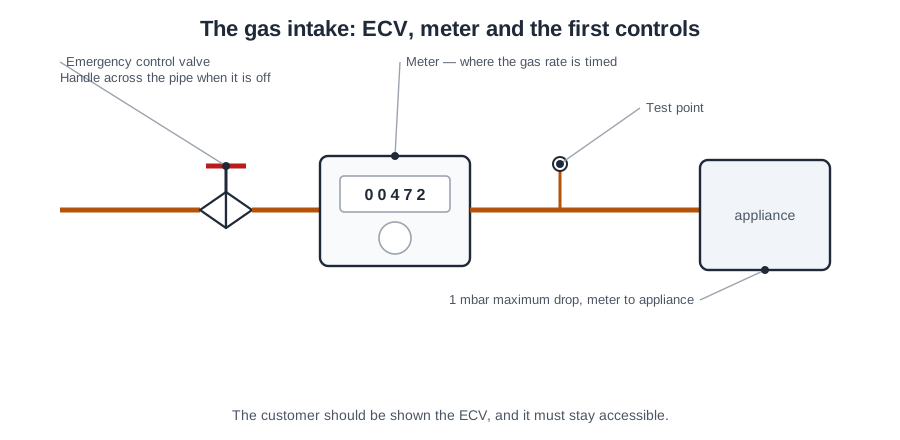
The first thing to know cold: what to do when there's a smell of gas or suspected CO. Make the area safe — turn off at the emergency control valve (ECV), avoid ignition sources, ventilate — and call the National Gas Emergency Service on 0800 111 999. Every consumer must have an accessible ECV with a notice nearby.
2. Gas properties and combustion
Natural gas is mostly methane, lighter than air, with a flammable range of roughly 5%–15% in air. Complete combustion needs the right air; starve it and you get carbon monoxide — toxic, colourless and odourless. Understanding why combustion goes wrong underpins ventilation, flueing and combustion analysis.
3. Tightness testing and purging
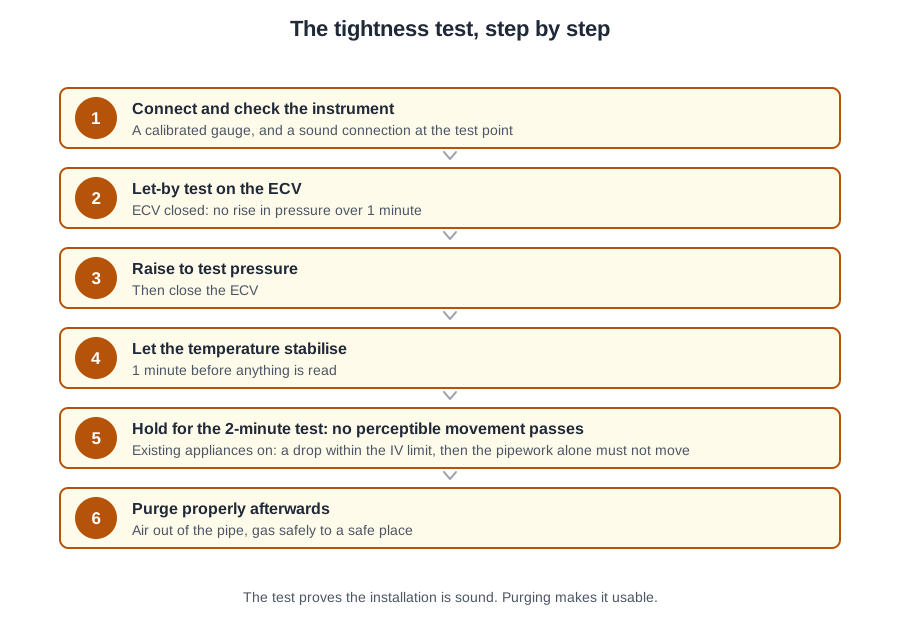
Before gas goes into any installation, you prove the pipework holds pressure. The procedure changed in 2026: IGEM/UP/1B Edition 4 bases the permissible drop on Installation Volume and adds a pipework-only retest. Read the full guide to tightness testing & purging →
4. Gas rate and burner pressure
You confirm an appliance burns the right amount of gas by measuring pressures and gas rate. Burner pressure alone never proves it — a blocked injector changes the rate without moving the pressure. Read the full guide to gas rates & burner pressure →
5. Ventilation
Appliances need air for combustion (and, when open-flued, for the flue). Open-flued appliances get the first 7 kW from adventitious air, then 5 cm²/kW above that. Read the full guide to ventilation requirements →
6. Installing gas pipework
Pipework is sized to BS 6891 so no appliance loses more than 1 mbar, then sleeved, protected, bonded and tested. Read the full guide to pipe sizing & installation →
7. Flues and chimneys
A flue must clear the products of combustion to outside. You prove it with a flue flow test and a spillage test. Read the full guide to flues: types, inspection & testing →
8. Unsafe situations
When you find a fault, the GIUSP (IGEM/G/11) tells you how to classify and act — Immediately Dangerous or At Risk. Read the full guide to unsafe situations & the GIUSP →
- Law: GSIUR 1998 under HSWA 1974; registration via Gas Safe Register (replaced CORGI, April 2009).
- Emergencies: make safe at the ECV; call 0800 111 999.
- Tightness test: IGEM/UP/1B Edition 4 — Installation-Volume based, mandatory 1 Oct 2026.
- Gas rate: kW (gross) = m³/h × CV ÷ 3.6; burner pressure alone isn't proof.
- Ventilation: open-flued = (net − 7 kW) × 5 cm²/kW.
- Pipework: BS 6891, max 1 mbar drop to any appliance.
- Flues: flue flow + spillage tests. Unsafe: GIUSP = ID or AR.
10-Question Mock Test
A quick sweep across the whole CCN1 syllabus. Click an option to see whether you got it right — explanations appear instantly.
GSIUR 1998 is the principal gas law, sitting under the Health and Safety at Work etc. Act 1974.
Gas Safe Register replaced CORGI as the registration body in April 2009.
For a gas escape or a situation you can't make safe, make safe as far as possible and call 0800 111 999.
Natural gas burns between roughly 5% (LEL) and 15% (UEL) gas in air. Purging exists to move quickly through this band.
Edition 4 moved from meter-based drops to a volume-based method using the calculated Installation Volume.
kW (gross) = gas rate (m³/h) × CV (MJ/m³) ÷ 3.6.
Natural infiltration (~35 cm²) is taken to cover the first 7 kW; you size a vent for the input above that.
1 mbar for natural gas (2 mbar for LPG).
The spillage test, with the appliance running, proves products go up the flue and don't spill into the room.
Two classes — ID and AR. NCS was withdrawn as a formal class in 2015.
CCN1 is a big syllabus. PlumbMate makes it stick.
Video lessons, quizzes and spaced-retrieval revision mapped to every part of the core gas ticket — built by a gas tutor.
🔥 Open the gas course →Full ACS revision — CCN1, CPA1, CKR1, HTR1 & CENWAT · £29.99 for 60 days, or every course for a year at £59.99
Prefer to browse first? Back to the Gas Blog →