A gas cooker is a flueless (Type A) appliance — its products of combustion go straight into the kitchen. So unlike a flued boiler, its ventilation isn't sized on kilowatts; it's sized on the volume of the room, because a bigger room dilutes the products more. This guide gives the figures and the rules around them. It's study material; only a Gas Safe registered engineer may carry out the work.
The room-volume table
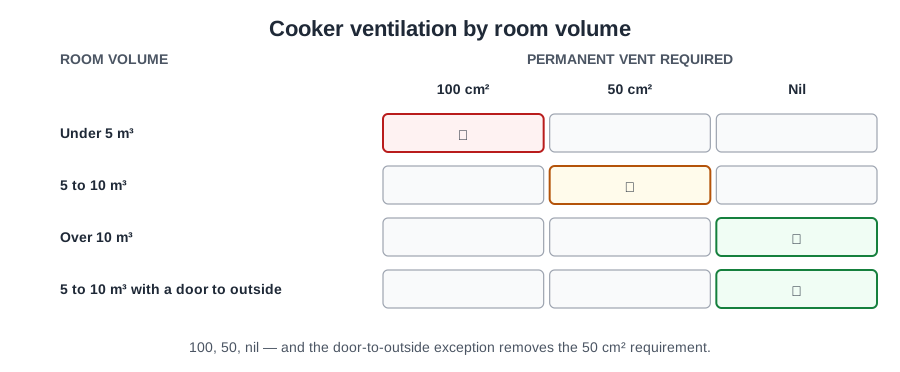
For a domestic oven, hotplate, grill (or any combination), the minimum permanent free area of ventilation is:
- Room volume under 5 m³ → 100 cm² permanent vent
- Room volume 5 to 10 m³ → 50 cm² permanent vent
- Room volume over 10 m³ → nil permanent vent required
In every case the room must also have an openable window (or equivalent opening — an adjustable grille, louvre, hinged panel, etc.) direct to outside air. Work out room volume the obvious way: length × width × height.
The door-to-outside exception
If the room has a door that opens directly to outside, no permanent vent opening is required (the door provides the air path). This is a common point that trips people up — a back door straight to the garden changes the answer.
The bedsit limit
A cooking appliance (unless it's just a single-burner hotplate or boiling ring) must not be installed in a bedsitting room of less than 20 m³. It's a safety floor for rooms that are also slept in, where products building up overnight would be especially dangerous.
Internal kitchens and air-tight homes
A kitchen with no opening to outside (an internal kitchen), or a very air-tight modern home, needs special attention — purge ventilation such as an extractor ducted outside, and reference to the Building Regulations and the relevant Gas Safe guidance. Don't assume the basic table covers these cases.
- Cooker = flueless; ventilation is sized on room volume, not kW.
- Under 5 m³ → 100 cm²; 5–10 m³ → 50 cm²; over 10 m³ → nil.
- An openable window (or equivalent) to outside is required in every case.
- Door direct to outside → no permanent vent needed.
- Bedsit: no cooker (beyond a single boiling ring) in a bedsit under 20 m³.
- Internal/air-tight kitchens need purge ventilation and Building Regs reference.
- Source figures from BS 5440-2 Table 6 / MIs; shortfalls are GIUSP issues.
10-Question Mock Test
Click an option to see whether you got it right. Explanations appear instantly — no submitting at the end.
Being flueless, a cooker's ventilation is sized on room volume, not heat input.
Under 5 m³ → 100 cm². The smaller the room, the larger the vent needed to dilute products.
5–10 m³ → 50 cm².
Over 10 m³ → nil permanent vent (but an openable window is still required).
An openable window or equivalent opening to outside is required in every case.
9.4 m³ is in the 5–10 m³ band → 50 cm², plus an openable window.
A door direct to outside provides the air path, so no permanent vent opening is required.
Not in a bedsit under 20 m³ (unless it's just a single-burner hotplate/boiling ring).
Internal/air-tight kitchens need purge ventilation and Building Regulations guidance — the basic table isn't enough.
Insufficient ventilation for a flueless cooker is classified under the GIUSP, usually At Risk.
100, 50, nil. Lock the cooker ventilation table in.
PlumbMate turns the figures examiners test into quick-recall practice mapped to the gas ACS tickets.
🔥 Open the gas course →Full ACS revision — CCN1, CPA1, CKR1, HTR1 & CENWAT · £29.99 for 60 days, or every course for a year at £59.99
Prefer to browse first? Back to the Gas Blog →