It is a criminal offence to work on gas appliances in the UK unless you're on the Gas Safe Register. Boilers, fires, hobs, cookers, meters — all off-limits until you're registered. Here's exactly how to get on the register in 2026, what it costs, and what it unlocks.
This guide is aimed mainly at plumbing apprentices planning their next move and at career-changers mapping out the full pathway. If you're a Level 2 plumbing learner, it's still worth a read — Gas Safe is the gateway to most of the £45,000+ salaries in the trade, and knowing what you're working toward helps the earlier slog make sense.
What Gas Safe actually is
Gas Safe is the official register of gas engineers legally allowed to work on gas appliances in the UK, the Isle of Man and Guernsey. It replaced the older CORGI scheme in 2009 and is run on behalf of the Health and Safety Executive (HSE).
Being "Gas Safe registered" isn't one qualification — it's three things working together:
- The right underlying qualification or training programme (plumbing NVQ, gas services NVQ, or an approved Managed Learning Programme — see Step 1)
- A set of ACS assessments proving your practical competence on specific appliances
- An annual registration with Gas Safe itself, which issues your ID card
If any of the three lapses, you're off the register. Full stop.
Step 1: The prerequisite qualification (or training programme)
You can't walk in off the street and start doing ACS assessments. You need an underlying qualification and documented gas experience first — but there's more than one way to get there, and the right route depends on where you're starting from.
Route 1: The plumbing pathway
This is the most common route for PlumbMate readers. You qualify as a plumber first and add gas afterwards.
- What you need: a Level 3 NVQ Diploma in Plumbing and Domestic Heating
- What you don't: a Level 2 plumbing qualification on its own is not enough for this route
Route 2: The gas services pathway
If you're going straight into gas rather than coming through general plumbing, you can take an NVQ in Gas Services Installation and Maintenance at Level 2 or Level 3. This is usually an apprenticeship with a Gas Safe registered employer rather than a general plumbing firm.
Route 3: The Managed Learning Programme (MLP)
For experienced tradespeople moving into gas without an existing NVQ, the MLP is a structured training programme designed to meet ACS entry requirements. It's longer and more involved than ACS alone because it builds in the underlying theory an NVQ student would already have covered.
The 25-week requirement everyone forgets
On top of whichever route you take, new entrants need a minimum of 25 weeks of supervised gas site experience, documented and signed off by a Gas Safe registered operative. This catches a lot of people out — even once your NVQ or MLP is finished, you still need real time on real gas jobs under someone else's registration before you can sit your initial ACS assessments.
There is no shortcut. Every year I get a Level 2 plumbing student asking whether they can skip ahead and just do a quick gas course to start earning the big money. The answer's always the same: no. Whichever route you take, the prerequisite qualifications and the 25 weeks of supervised experience aren't technicalities — they're there because working on gas without the underlying theory and hands-on time is genuinely dangerous, insurance wouldn't cover you, and you'd fail ACS anyway.
Step 2: The ACS assessments
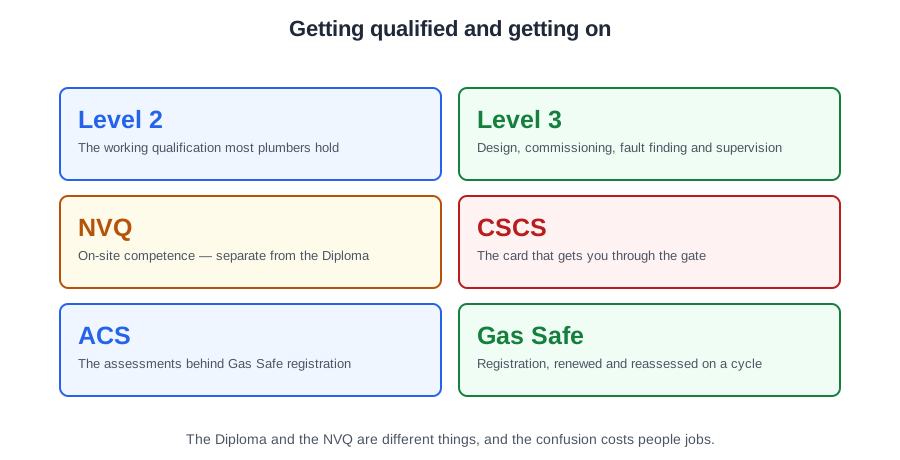
ACS stands for the Accredited Certification Scheme. It's the practical and theoretical gas testing that proves you can safely work on specific types of appliance.
You take ACS at an approved assessment centre. The assessments are modular — you sit the categories you want to be signed off on. For domestic gas work, the core set looks like this:
- CCN1 — Core Domestic Gas Safety (the foundation; required for everything else)
- CENWAT — Central heating boilers and water heaters
- CKR1 — Cookers and hobs
- HTR1 — Fires and wall heaters
- MET1 — Gas meters
- CPA1 — Combustion Performance Analysis (commonly needed alongside CCN1)
Commercial, LPG and catering categories are separate tickets you can add later as you specialise.
ACS is not a one-off. You have to retake the assessments every five years to stay current. Letting ACS expire is one of the most common ways plumbers drop off the register without meaning to.
Step 3: Registering with Gas Safe
Once you've passed the relevant ACS assessments, you apply to Gas Safe itself.
The application asks for:
- Your qualification certificates
- Your ACS certificates
- Proof of identity and business details
- Public liability insurance
- Payment of the registration fee
Gas Safe then issues you an ID card showing your engineer number and the categories you're qualified to work on. Customers can check that number on the Gas Safe website — and more and more homeowners are doing exactly that before letting anyone near their boiler.
Registration is annual, so there's a fee every year to stay on the register.
Typical costs and timelines
| Item | Typical cost | Notes |
|---|---|---|
| Prerequisite NVQ (plumbing L3 or gas services L2/L3) | Free via apprenticeship, otherwise varies | Via apprenticeship route |
| Managed Learning Programme (MLP) | Varies significantly | For new entrants without an NVQ |
| 25 weeks supervised site experience | Paid if via apprenticeship | Required for all new entrants |
| ACS assessments (CCN1 + core categories) | A few hundred to over £1,000 | Depends on centre and categories taken |
| Gas Safe initial registration | Annual fee | Confirm current figure on gassaferegister.co.uk |
| Public liability insurance | From ~£150/year | Required for registration |
| ACS reassessment (every 5 years) | Similar to initial | Budget for it well in advance |
Realistic timeline from starting your prerequisite training to your first day of legal gas work is around 18 months to 3 years, depending on your route and whether you're earning while you learn on an apprenticeship.
What Gas Safe unlocks for your earnings
This is the reason most people put in the work to get there.
- Gas Safe engineers working for larger firms typically see total packages of £45,000+ once experienced
- Boiler installations pay £1,500–£3,500 per job; a competent self-employed engineer can turn around several a week in peak season
- Adding MCS certification for heat pumps on top of Gas Safe is currently the highest-paying combination in the trade — the £7,500 Boiler Upgrade Scheme grant has created sustained demand for qualified installers
For the full earnings picture, see the 2026 plumber salary guide.
The common mistake: letting ACS expire
Gas Safe registration is annual. ACS runs on a five-year cycle. Every year, plumbers find themselves off the register not because they missed an insurance renewal or an annual fee — but because their ACS expired and they didn't realise.
Put your ACS expiry date in a calendar the moment you pass, and book your reassessment at least three months before the deadline. Assessment slots fill up, and there is no grace period. The day your ACS expires, you stop being legally allowed to work on gas, regardless of how long you've been doing the job.
So, is it worth the effort?
For any plumber serious about a long-term career, yes. Gas Safe is the single qualification that moves you from "plumber" to "heating engineer," and it's a genuine shortage skill — retirements are currently outpacing new entrants to the register.
The route to get there isn't trivial. But the qualifications stack sensibly on top of one another, the pathway is well-signposted, and the earnings ceiling above Gas Safe is higher than most people starting out realise.