The question comes up in every apprentice intake and at every career-change open day: should you stop at Level 2 and start earning, or push through to Level 3? Short answer — Level 2 gets you on site; Level 3 gets you a career, a Gold CSCS card, and access to the heat pump work that pays the best rates in the trade right now.
This post leans slightly toward apprentices and career-changers deciding whether the extra year is worth it. If you've already made up your mind, skip straight to the comparison table.
What Level 2 and Level 3 actually cover
The jump from Level 2 to Level 3 is the jump from domestic plumber to heating engineer.
Level 2 is the foundation. You learn cold water systems, sanitation, hot water basics, pipework, and how to install bathrooms and kitchens safely. You become a competent plumber — but not yet a technical specialist.
Level 3 is where the trade opens up. You move into system design: full central heating, electrical principles for pumps and controls, heat-loss calculations, and the environmental technologies — solar thermal, unvented systems, heat pumps — that dominate new installations in 2026.
A rough way to hold the two in your head: Level 2 is about fixing and installing. Level 3 is about designing and commissioning. Different jobs, different pay, different ceiling.
In almost every case, Level 2 is a prerequisite for Level 3 — you'll need to complete Level 2 first before you can move up.
Diploma vs NVQ: the confusion that costs people jobs
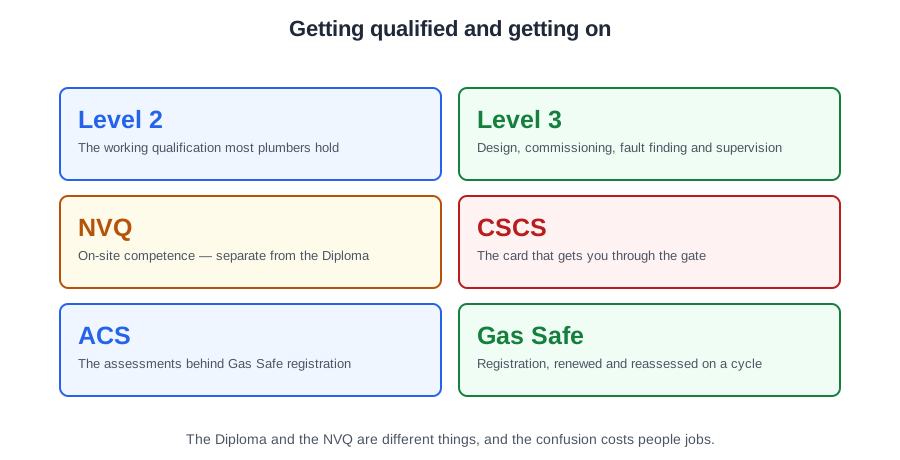
Before you choose a level, you need to understand the two types of qualification that sit at each level. This is the single most common mistake I see in class.
The Diploma (the "knowledge" route)
The Diploma is a college-based qualification. You sit in classrooms and workshops, cover the theory, and demonstrate set tasks in a controlled environment. A Level 2 Diploma proves you know what you're doing. It does not prove you can do it on a live site under real-world pressure.
You cannot get a Blue or Gold CSCS card on a Diploma alone — and without one of those cards, most major employers won't even put you through the gate.
The NVQ (the "competence" route)
The NVQ is work-based. You build a portfolio of real jobs on real sites, assessed by an expert watching you work. This is what makes you "fully qualified" in the eyes of larger contractors and firms like British Gas.
How the two routes combine in practice
You don't have to do the Diploma first. If you've got an employer willing to take you on and an assessor willing to sign off your portfolio, you can go straight into an NVQ and pick up the theory as you work. That's the quickest route if you can line it up — usually a standard 3–4 year apprenticeship.
In practice, though, most career-changers start with the Diploma, because you need the theory and workshop time to become employable in the first place. The good news is that a completed Diploma knocks time off your apprenticeship: a Level 2 Diploma typically reduces your apprenticeship by one year, and a Level 3 Diploma by two years. The college time isn't lost — it's front-loaded.
For apprentices who already have an employer from day one, the Diploma and NVQ are normally bundled into the apprenticeship as a package. For career-changers building their own route in, Diploma-first is often the most realistic way to get started.
What Level 2 actually lets you do
Level 2 is the entry point. Most apprentices and career-changers start here, and it turns a complete novice into a useful member of a plumbing team.
You'll learn:
- Pipe bending in copper and plastic
- Cold water systems and storage
- Bathroom and kitchen installations
- Basic sanitation and drainage
- Hot water principles
You won't yet be able to:
- Legally work on gas boilers (you'd need Gas Safe registration on top)
- Sign off on full central heating system installations
- Install heat pumps under the current grant schemes
At Level 2 you work as a plumbing improver. Typical pay sits at around £26,000 – £32,000 once newly qualified. That's a respectable starting wage — but it's also your ceiling if you stop here.
What Level 3 unlocks
Level 3 is where the salary curve turns sharply upward, because it gives you access to work that simply isn't available to Level 2 plumbers.
The technical leap
You move from labourer to technician. The core additions are:
- Complex central heating — designing and commissioning full systems, not just connecting into existing ones
- Electrical principles — wiring pumps, motorised valves, zone controls and thermostats
- Environmental technologies — solar thermal, unvented systems, and (crucially) air source heat pumps
The "Green Premium"
This is the biggest single reason Level 3 is worth the extra year in 2026. The Boiler Upgrade Scheme is paying £7,500 toward air source heat pump installs, and demand for properly qualified installers is strong. Moving into ASHP work straight after Level 3 is currently adding £5,000 – £10,000 a year on top of what a general maintenance plumber earns.
At Level 3 plus Gas Safe, you're typically looking at £45,000 – £55,000+ as an experienced engineer, and more again on the self-employed side.
Level 2 vs Level 3: side-by-side
| Feature | Level 2 | Level 3 |
|---|---|---|
| Typical role | Plumbing improver | Lead / heating engineer |
| Core focus | Maintenance and basic installs | System design and commissioning |
| CSCS card | Blue (Skilled Worker) | Gold (Advanced Craft) |
| Gas Safe pathway | Possible but requires extra study | Standard route via ACS |
| Typical pay (2026) | £26,000 – £32,000 | £45,000 – £55,000+ |
| Heat pump work | No | Yes |
The common mistake: "I'll just do Level 2 and start earning"
Every year, a few apprentices decide to stop at Level 2 because they want to get on the tools and bring in a proper wage. Two or three years later, a fair number of them are back at the college door asking to start Level 3.
The reason is always the same. Level 2 pays reasonably well for the first few years, but the ceiling comes into view quickly. You watch your Level 3 colleagues quote for boiler swaps, commission heat pumps, and take home noticeably more. You realise the difference isn't only about money — it's about the kind of work you get to do.
The extra year of Level 3 feels expensive when you're starting out. It rarely feels expensive five years later.
So which one should you do?
If you're committed to plumbing as a long-term career, Level 3 is the obvious choice. You earn more, the work is more interesting, and you're positioned for the renewables projects the UK is pouring money into.
If you're still testing whether the trade suits you, Level 2 is a sensible first step — but go in knowing it's a stepping stone, not a destination.
And if you're a career-changer without an employer yet, the Level 2 Diploma is usually the most realistic starting point. It builds your theory and workshop skills, makes you employable, and shortens your apprenticeship by a year once you land a placement.