Staring at your course material for four hours on a Sunday feels like revision. By Tuesday morning, your brain has quietly deleted most of it. This is the forgetting curve at work — a pattern cognitive scientists have been documenting for over a century — and the single most effective way to beat it is a technique called spaced repetition.
This post is aimed at Level 2 plumbing learners looking for a revision method that actually sticks. If you're looking for the wider exam-technique picture, pair this with the how-to-pass Level 2 guide.
What spaced repetition is
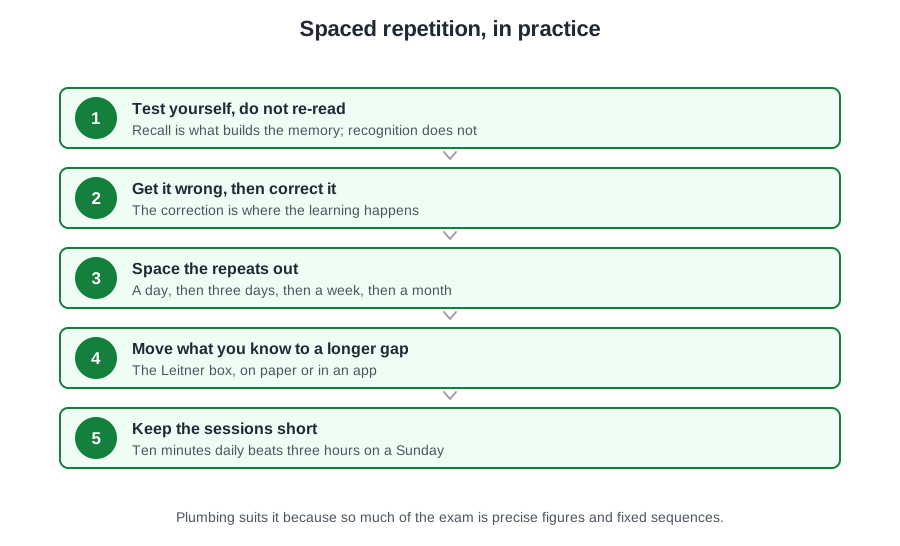
Spaced repetition is a learning technique that involves reviewing information at increasing intervals, timed to match the moments your brain is about to forget it. Instead of cramming the same fact ten times in one session, you revisit it on a schedule that might look something like this:
- Review 1: later the same day
- Review 2: one day later
- Review 3: three days later
- Review 4: a week later
- Review 5: a month later
Each time you successfully recall a fact, the memory trace becomes stronger and the rate of forgetting slows down. Each time you fail to recall it, you reset the clock — and that's exactly what you want, because you've identified something that needs more work.
Why it's particularly effective for plumbing
Level 2 theory is a heavy lift for memory because it combines three very different types of information, all of which have to be at your fingertips in the exam:
- Logic and reasoning — how a secondary circulation system works, why you'd choose an indirect cold water system over a direct one.
- Arbitrary numbers and regulations — minimum pipe clip spacings, backflow fluid categories, maximum flow rates from a given appliance.
- Visual recognition — electrical symbols, pipework schematics, component identification.
Spaced repetition is particularly effective for the middle category — the "just got to know it" facts that don't have a logical why behind them. These are the facts that slip out of your memory fastest precisely because your brain doesn't have anything to hook them to. Spaced repetition drills them into your long-term memory, so when a regulations question appears in the exam, the answer is just there.
How to apply it: the paper method (Leitner)
If you prefer physical cards, the Leitner box system is the classic way to spaced-repetition revise. You need three or four boxes and a stack of blank cards.
- Box 1: cards you practise every day — the stuff you find hardest.
- Box 2: cards you practise every three days.
- Box 3: cards you practise once a week.
- Box 4: cards you practise once a month.
Rules of the system:
- New cards start in Box 1.
- If you get a card right, it moves forward one box.
- If you get it wrong, it goes straight back to Box 1 — regardless of which box it was in.
That last rule is the magic of Leitner: it automatically forces the cards you're weakest on into your most frequent review pile, and frees up your time from the stuff you already know.
How to apply it: the micro-session method
Most plumbing students are busy. You're on site, in the van, at college, or trying to spend time with your family in the evening. Two-hour revision blocks aren't realistic for most of us.
The good news: spaced repetition doesn't need two-hour blocks. Three well-placed ten-minute sessions across a day will out-perform a single hour at the kitchen table.
A sample schedule:
- Morning commute: 10 minutes on water regulations.
- Lunch break: 10 minutes on scientific principles.
- Before bed: 10 minutes on electrical safety.
The frequency and the active nature of each session are what makes it work — not the total duration.
The non-negotiable: active recall
Spaced repetition only works if you're using active recall. This is the single most misunderstood part of revision technique, and the reason students who "study for hours" still fail exams.
- Passive revision is reading the sentence "the minimum trap seal depth for a WC is X mm" and moving on.
- Active recall is looking at a prompt — "What is the minimum trap seal depth for a WC?" — and forcing your brain to produce the answer before you check it.
Passive reading feels productive and is almost useless. Active recall feels harder — because it is — and works. Every flashcard, mock question, or revision prompt you build should make your brain produce the answer, not recognise it.
What good flashcards look like
The format matters. Keep each card to one prompt, one answer. Don't put a whole chapter on a card.
| Prompt | Answer |
|---|---|
| What does pressure equal? | Density × acceleration due to gravity × height (P = ρgh) |
| What is the sequence for safe isolation? | Prove, test, prove |
| How does an indirect hot water cylinder heat the water? | Via a coil (heat exchanger) from the primary side — the primary water never mixes with the domestic hot water |
| Where is the expansion relief valve fitted on an unvented system? | On the cold feed, before the cylinder and after the check valve |
Build your cards from your own course material, in your own words. The act of writing the card is itself a revision session — and a card you've written yourself is worth three you copied from someone else's notes.
Where to start
Don't try to convert your whole syllabus into flashcards in a single weekend. Pick one unit you find manageable — health and safety or common processes are usually good starting points — and build twenty cards for it. Review them daily for a week, see the method working, and then expand into the harder material.
Starting with an "easy win" unit builds the habit before you tackle the science and electrical material, where spaced repetition makes the biggest difference.
How PlumbMate puts this into practice
The principles above are what spaced repetition looks like in theory. Here's how PlumbMate actually implements them:
- Flashcards, not essays. Every question is one prompt, one answer — the format research has consistently shown works best for active recall.
- Wrong answers are logged. When you get a question wrong, it goes into a dedicated collection that resurfaces more frequently in your future sessions. The questions you're struggling with get more attention; the ones you already know don't waste your time.
- The 3× rule. To clear a card from your "still working on it" pile, you need to get it right three times. One lucky guess isn't enough — three consistent correct answers means you actually know it.
- Explanations on every question. Whether you answer correctly or not, you see why the correct answer is right and why each of the distractors is wrong. This is the difference between memorising answers and understanding the material — and it's what helps you recognise the same distractor patterns when they appear in the real exam.