The practical units are where most Level 2 plumbing students feel confident. The theory exams are where they come unstuck. These are the ten mistakes that show up year after year in the exam hall — the ones that separate a first-time pass from a resit.
This post is aimed at current Level 2 learners. If you're still deciding whether to start the course, begin with the become-a-plumber guide. If you want the wider revision framework rather than the specific pitfalls, the how-to-pass Level 2 guide pairs with this one.
1. Mixing up the units
Losing marks on a calculation you got right is the most frustrating way to fail a question — and it happens constantly.
The classic trap is pressure. One bar equals 100,000 pascals (or 100 kilopascals). Get the arithmetic right but select the answer in bars when the question asked for pascals, and the distractor swallows your mark.
Fix: check the units before you look at the numbers. Circle the required unit in the question stem before you start calculating.
2. Getting direct and indirect systems backwards
Under exam pressure, students regularly invert these — and the confusion is doubled because the words "direct" and "indirect" mean different things depending on whether you're talking about cold water or hot water.
Cold water systems are about where the water comes from:
- Direct cold: the rising main feeds every cold outlet directly.
- Indirect cold: the rising main feeds the kitchen tap (for drinking water) and a cold water storage cistern; the cistern then feeds the other cold outlets and the cold feed to the hot water cylinder.
In both cold water systems, the kitchen tap comes direct from the rising main — that's the drinking water point.
Hot water systems are about how the water is heated:
- Direct hot: the water you use is heated directly by the heat source — for example, a combi boiler, or an electric immersion element sitting in the cylinder.
- Indirect hot: the water you use is heated indirectly via a heat exchanger — typically a coil inside the cylinder. Primary hot water from the boiler flows through the coil and transfers its heat to the domestic hot water without the two ever mixing.
This is where students regularly lose marks: they assume "indirect hot" means the cylinder is fed from a storage cistern. It doesn't. "Indirect" on the hot water side is about the heat exchanger, not the supply route. Get this straight and a whole block of exam questions becomes easy marks.
3. Botching the safe isolation sequence
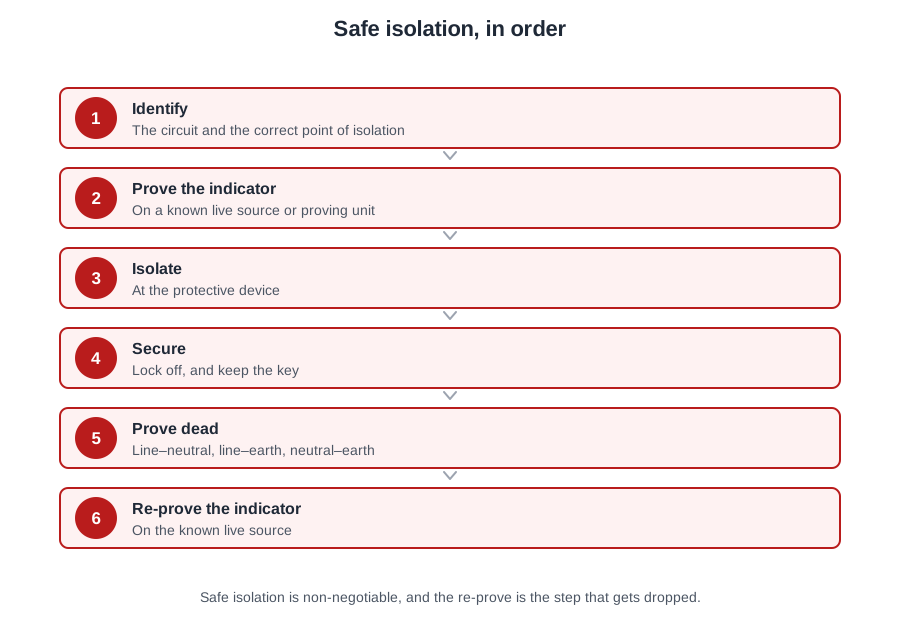
This is the one that triggers an automatic fail in practical electrical assessments, and it comes up in theory too.
The sequence is prove, test, prove:
- Prove your voltage indicator on a known live source
- Test the circuit you're about to work on
- Prove the voltage indicator again on the known live source
If the answer skips any of those three steps — or reorders them — it's a distractor. The logic is that if your indicator breaks between step 1 and step 3, you need to know before you trust its "dead" reading.
4. Skim-reading the question stem
The exam is littered with question stems containing NOT, EXCEPT, MAXIMUM, and MINIMUM. Miss one of those words and you'll pick the first right-looking answer you see and get the question wrong.
"Which of these is NOT a property of low carbon steel?" — if you skim, you'll pick "ductility" because ductility is a property, and the question asked which one isn't.
The other version of this trap is the "which comes first / which comes last" question for a multi-step process — safe isolation, draining down, filling a system, commissioning a boiler. All four answer options are usually genuine steps in the process, which is exactly why the question is hard. If you don't register that the stem asked for the first step, any of the four will look plausible. The distractors aren't wrong — they're just in the wrong place in the sequence.
Fix: read every question stem twice before you look at the answer options. Circle the word that tells you what kind of answer you're looking for — not, first, last, maximum, minimum. It takes five seconds. It saves whole marks.
5. Using "site logic" in the exam
This is the mistake I see most often from apprentices who are already working on site.
Your boss might do things a certain way because it's quick, because the customer won't pay for the proper fix, or because "it's always worked before." The exam doesn't care. The exam tests the correct method, to current regulations, in a perfect world.
Fix: when you're answering exam questions, answer from the course material — not from what you watched on a Friday afternoon rush job. There's time to learn the site variations later. Right now, learn the answer the exam is looking for.
6. Spending too long on one calculation
The science block catches people out because the questions take longer than multiple-choice on cold water fittings. Burn fifteen minutes on one volume calculation and you leave yourself no time for ten easy health and safety questions at the end.
Fix: the three-pass technique.
- Pass 1: answer every question you know instantly. Skip the rest.
- Pass 2: come back to the calculations.
- Pass 3: review the whole paper for mis-clicks and second-guessed answers.
You'll get more marks from finishing the paper than from perfecting one hard question.
7. Revising from out-of-date materials
Level 2 syllabuses have been updated in recent years to include foundational low-carbon heating content — heat pump principles, low-temperature heating systems, water conservation figures from Part G of the Building Regulations. Revision notes from 2022 or 2023 will leave gaps in the sustainability strand.
Fix: use your current course material as your primary source, and cross-check any older notes against it. If a topic is in the course material, it can be in the exam.
8. Confusing the T&P valve with the expansion relief valve
Unvented hot water storage systems come up reliably, and the safety devices trip people up constantly. Two valves, two different jobs, two different fitting locations:
- Expansion relief valve — handles the normal pressure rises as the water heats and expands. Fitted before the cylinder and after the check valve, on the cold feed pipework.
- Temperature and pressure relief valve (T&P) — the last line of defence, which opens if both temperature and pressure exceed safe limits. Fitted on the cylinder itself.
Two good ways to keep them straight:
- If a question asks about the device that prevents the cylinder exploding when all other safety controls have failed, the answer is the T&P valve.
- If a question asks about the device dealing with routine expansion as the water heats up, it's the expansion relief valve.
Examiners also like asking where each valve is fitted, so learn the location alongside the function. A correct "what it does" answer with the wrong location costs you the mark just as cleanly.
9. Getting siphonage and back-pressure the wrong way round
Drainage questions often cover trap seal loss. Two main causes, often confused:
- Siphonage — negative pressure pulls the trap water out (either from the appliance emptying itself, or from another appliance creating suction)
- Back-pressure (compression) — positive pressure pushes the trap water out
Both empty the trap, but the mechanism is opposite. Questions frequently test which of the two is happening in a specific scenario. Learn the difference and the marks are there for the taking.
While you're at it, learn your minimum trap seal depths from the course material — those come up every year and are easy marks for anyone who's memorised them.
10. Leaving the exam early
Online multiple-choice exams run for sixty to ninety minutes depending on the unit. Plenty of students finish in forty and walk out feeling confident.
Don't. On a computer-based exam it's unnervingly easy to mis-click — to scroll past a question, to accidentally change an answer you already locked in. Use the full time. Go through every question one last time. One corrected mis-click can be the difference between a pass and a resit.
Success is a system
Passing Level 2 isn't about being the smartest student in the room. It's about being methodical: master the maths, learn the regs, practise the exam format, read every question twice. The students who pass first time aren't the ones who revised the hardest the night before — they're the ones who built consistent revision habits over the whole course.