Most Level 2 plumbing students don't fail because they can't bend copper. They fail because they got tripped up by the science unit, sat the electrical assessment underprepared, or fluffed the online multiple-choice exam they thought would be the easy bit. This guide walks through how to pass Level 2 first time, based on what actually trips people up in the classroom.
This post is aimed at current Level 2 learners and career-changers about to start the course. If you're still deciding whether to do Level 2 at all, start with the become-a-plumber guide.
Know where the real risk lies
There's a predictable pattern to who passes and who doesn't. Students tend to sail through the practical workshop assessments — soldering, bending, installations — because that's what they signed up for and what they practise most.
The units that catch people out are the ones most new learners underestimate:
- Scientific principles (pressure, heat transfer, material properties)
- Electrical principles (safe isolation, bonding, basic circuit theory)
- Cold water and water regulations (where "boring" turns into exam questions)
If you're going to allocate extra revision time, allocate it to those three. Everything else — in most cases — looks after itself.
Conquering the science unit
Ask any Level 2 cohort which topic they fear most and you'll get the same answer. Scientific principles is where people lose marks, because you can't bluff your way through a pressure calculation.
The three concepts you need to genuinely understand (not just memorise):
Force and pressure. You need to be able to calculate water pressure at the base of a column — pressure equals density times acceleration due to gravity times height (P = ρgh). Know the formula, know the units (pascals, kilograms per cubic metre, metres per second squared, metres), and know why the answer has to be in those units.
Heat transfer. Conduction, convection, radiation. In 2026, questions increasingly push beyond "what is it?" into applications — why heat pumps rely on low-temperature emitters, why hot water rises in a cylinder, why foam pipe lagging works.
Properties of materials. Thermal expansion comes up every year. If a copper pipe is five metres long and the water temperature rises by sixty degrees, how much does it expand? If you can't answer that from memory by the end of the course, keep revising.
The lecturer's tip: don't read formulas, apply them. If you've got an indirect cold water system at home, look at your cold water storage cistern in the loft, measure the height down to a bathroom basin tap or bath tap, and calculate the pressure yourself. (Not the kitchen tap — that's fed direct from the rising main, even in an indirect system, because it's drinking water.) Theory only sticks when you attach it to something physical you can see.
The electrical unit: safe isolation is non-negotiable
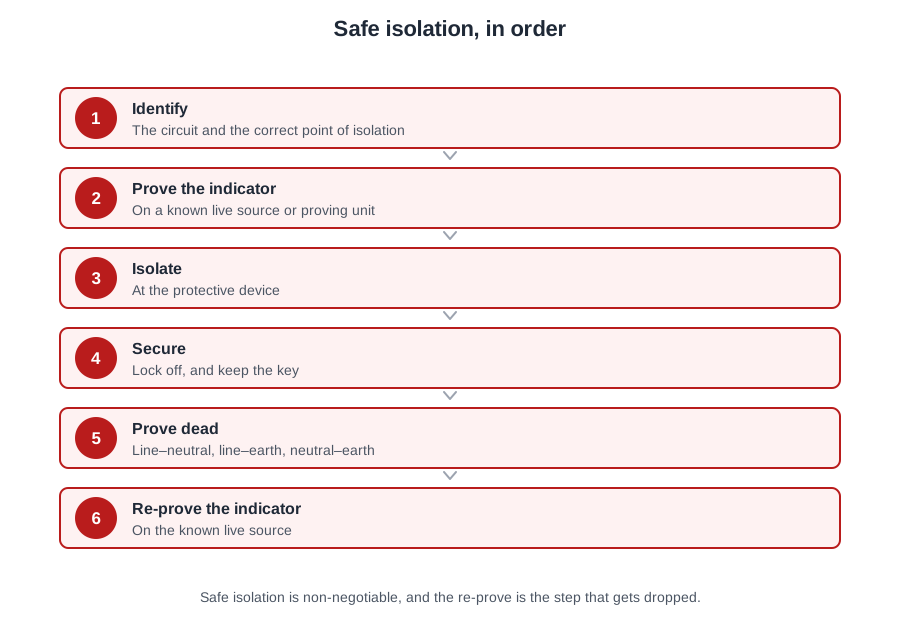
You're training as a plumber, not an electrician — but Level 2 plumbing includes electrical principles because modern heating systems are full of pumps, motorised valves, and controls.
Three things carry the most exam weight:
Safe isolation. There is a defined procedure — proving dead with an approved voltage indicator, locking off, testing the tester. Get the sequence wrong in a practical assessment and you're looking at a fail on that unit, regardless of how well the rest of the job went. Learn the steps in order, in your sleep.
Earthing and bonding. Understand why metal pipework gets bonded. Know the difference between main protective bonding (at the consumer unit) and supplementary bonding (in wet areas). This regularly shows up in multiple-choice questions with very similar-looking distractors.
Basic circuit theory. Ohm's Law — voltage equals current times resistance — will come up. It's one of the most reliable marks on the paper, so don't let it go.
Cold water and water regs: the "boring" stuff that trips people up
Direct vs indirect cold water systems is foundational and easy marks. Direct systems feed every outlet from the rising main; indirect systems feed a storage cistern first and most outlets draw from there. Know the layouts, know why the UK historically used indirect, know the advantages of each.
Water regulations are where students lose marks they shouldn't. Backflow prevention — air gaps, check valves, the fluid categories 1 through 5 — comes up reliably and is worth proper revision time. If you can explain which backflow protection you'd use on a WC cistern versus an outside tap, you're in good shape.
How to beat the online multiple-choice
Most Level 2 units end with an online multiple-choice exam of around forty questions in sixty to ninety minutes. The test is designed with distractors — wrong answers that look plausible.
Four habits that reliably lift marks:
- Eliminate first, choose second. Two of the four options are usually obviously wrong. Cut them immediately, then decide between the remaining two.
- Check the units. A classic distractor gives the right number in the wrong unit — millimetres where it should be metres, newtons where it should be kilonewtons. The number looks familiar, the unit is wrong.
- Flag and move on. If a calculation is eating more than two minutes, flag it and come back at the end. You'll lose more marks staring at one hard question than you will on the five easy ones you didn't reach.
- Read the full question twice. Examiners often front-load the key detail ("the indirect cold water system…") in a way that changes the answer completely if you skim past it.
The practical portfolio: measure twice, solder once
Your portfolio captures the workshop tasks — pipe bending, pipe jointing, installations. Three things keep assessors happy:
- Measurements are measurements. If the drawing specifies 150mm, it means 150mm, not "about 150". Close enough doesn't pass.
- Solder joints should look clean. Excess flux causes green corrosion staining around joints over time; too much solder looks amateurish. Aim for a clean silver ring and nothing more.
- Write your portfolio notes as you go. Leaving them until the end of term means rushing them, forgetting details, and missing evidence you needed.
The 2026 sustainability strand
Level 2 syllabuses have broadened over the last few years to include foundational knowledge of low-carbon heating. You won't be installing heat pumps at this level — that's a Level 3 specialism — but you're expected to understand:
- How a heat pump differs from a gas boiler, in principle
- Why low-temperature heating systems need different emitters
- Basic water conservation (flow rates, efficient appliances)
Don't overweight this strand in your revision, but don't ignore it either. A handful of questions across the course will test it.
A study routine that actually works
The single biggest predictor of a first-time pass isn't intelligence — it's consistency. Ten minutes of active recall every day beats a three-hour cram the night before the exam, every time.
What that looks like in practice:
- Read the relevant section once, slowly.
- Close the book and write down everything you remember.
- Check what you missed and add it to tomorrow's review.
- Drill practice multiple-choice questions daily — little and often, not in big blocks.
Passive reading feels productive but doesn't build exam recall. Active testing does.