Most plumbing complaints aren't about technical work — they're about communication. A customer who feels informed, respected, and kept up to date will forgive minor issues; a customer who feels ignored, rushed, or disrespected will complain even about perfectly-executed work. Level 2 expects you to know the difference between a quote and an estimate, when to communicate verbally versus in writing, what customer service standards look like in practice, and the statutory rights customers have when things go wrong.
This post is the third in the Level 2 Communicating With Others sub-cluster. For the others, see the construction roles, workplace documents, employment and conflict resolution posts.
Why this matters more than students think
The course material makes this explicit: the main reason for complaints is often around communication and/or a poor attitude to the work. Not poor workmanship. Not late delivery. Communication.
This has a practical consequence for how you work:
- The best technical work doesn't save you from a bad communication reputation
- A plumber who's slightly less skilled but communicates well gets more repeat business than a better plumber who doesn't
- Good customer service is the biggest single factor in a plumbing business's reputation
So the "communication skills" part of Level 2 isn't a soft bolt-on to the technical content — it's the commercial foundation that makes a plumbing career viable.
Verbal vs written communication — when to use each
The first big distinction. Some communications work fine verbally; others need to be in writing.
Verbal communication is appropriate for:
- Positioning of components — where exactly to put a radiator or shower tray
- Things the customer needs to do before the job — e.g., clearing out the airing cupboard
- Simple problems or straightforward complaints — quick issues that can be resolved on the spot
Written (formal) communication is required for:
- Giving a quote — the price needs to be on paper for reference
- Confirming the work (done by the customer accepting the quote in writing)
- Major alterations to the specification or quote — changes of scope need evidence
- Confirming specification/quotation changes (done by the customer)
- Commissioning reports or job records — kept by the customer for future reference
- Dealing with complicated problems or complaints — written records protect both parties
The guiding principle: if a permanent record of the communication is needed, use written. If the communication is simple, time-sensitive, and doesn't need a record, verbal is fine.
Which one of the following must be confirmed in writing? A quotation for installing a new bathroom — prices need a paper record. Not an appointment time (verbal is fine), not radiator positioning (verbal), not an estimate (though estimates are often written, they don't legally need to be).
Formal vs informal
A related but different distinction. Both verbal and written communication come in formal and informal versions.
Most formal method of communication: a written letter. Not face-to-face conversation (less formal), not telephone (verbal), not email (less formal than a letter despite being written).
Levels of formality, most to least:
- Written letter — formal, signed, typically printed on company letterhead
- Email — written but less formal than a letter; quicker
- Telephone conversation — verbal; allows immediate clarification but no permanent record
- Face-to-face conversation — most personal; allows body language and tone
Advantages of emails over letters:
- Quicker to send and receive
- Can include attachments easily
- Records automatically
- Enables asynchronous communication
Advantages of written letters over emails:
- More formal
- Physical record that's harder to lose
- Suits official communication (contract terms, legal matters)
- Doesn't get lost in a crowded inbox
One advantage of written communication over oral: it can be a permanent record of a discussion. Verbal communication is quicker and allows instant feedback, but it leaves no record for later reference.
Quotations vs estimates
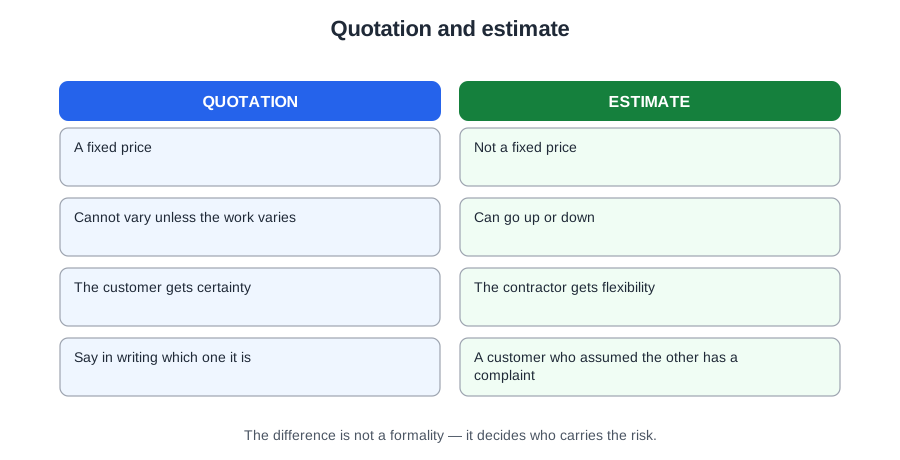
One of the most reliably-tested distinctions in the whole Comms unit.
A quotation is an exact specification of price for a job. A fixed price, typically with a time limit during which the price is guaranteed.
What a quote should include:
- Detailed specification of the work
- Make, model, style, colour, size, and quantity of materials
- Cost of labour
- Total price
- Time limit (e.g., "valid for 30 days")
- What is and isn't included
Why detail matters: if you quote for "a Worcester boiler" without specifying the model, and the customer thinks they're getting the top-of-the-range model while you've priced the entry-level one, you've got a disagreement. Specifying the exact model prevents that.
It's as important to state what's NOT included as what is included. "Install new bathroom suite" could mean: just swap the suite for you; or install whirlpool bath + tiles + decoration for the customer. Explicit scope prevents misunderstanding.
An estimate is a "ballpark" figure — a rough guess at the cost before the exact scope is known.
Why estimates are useful:
- Gives the customer a rough idea of cost before full planning
- Accounts for the variables inherent to construction work (things take longer or shorter than expected)
- Can be upgraded to a quote once the scope is clear
The key legal distinction: a quote is a binding price (typically for a time limit); an estimate is not. If you quote £2,000 for a bathroom and the job costs you £2,500, you're stuck with £2,000. If you estimate £2,000 and the job costs £2,500, you can charge the actual cost (with appropriate explanation).
Which one of the following details the ROUGH cost of proposed work? Estimate. A quotation (A) is an exact price; a variation order (B) is a change to an existing contract; a purchase order (C) is for ordering materials.
Invoices and statements
After the work is done, billing documents come into play.
Invoice. A formal bill stating:
- What work was done or materials supplied
- The date
- The amount owed
- Payment terms (when payment is due)
- How to pay
Statement. Summary of outstanding invoices, typically sent monthly. Shows all invoices issued and any payments received. A quick reference for the customer to see what they owe.
Invoices and statements together make up the financial paper trail of a completed job.
Handover information
When work is complete, specific information needs to be handed over to the customer. Level 2 expects you to know this category.
Handover information typically includes:
- Operating instructions for the newly installed appliance (e.g., boiler, heating controls)
- Commissioning records showing the system was tested and handed over in working order
- Warranty documentation for the appliances
- Benchmark certificates (for gas appliances)
- Installation certificates (for unvented cylinders, electrical work)
- Service schedule — when the next service is due
Which one of the following MUST be handed over to the customer after installing a new boiler? Operating instructions for the newly installed boiler. Not the mounting template (that was for installation, not the user), not time sheets (that's internal company paperwork), not the materials list (same).
Statutory cancellation rights
Once a customer signs a contract for work, they have specific legal rights to cancel — and to claim against you if the work is poor quality.
The Supply of Goods and Services Act 1982 protects consumers against bad workmanship or poor service provision. Key statutory rights (these don't have to be specifically mentioned in the contract but CAN'T be excluded):
- The supplier will carry out the service with reasonable care and skill
- The work will be carried out in reasonable time (unless a timeframe has been specifically agreed)
- The work will be carried out at reasonable cost (unless cost has been specifically agreed)
If any of these statutory terms are breached, the customer can:
- Cancel the job
- Pursue you for damages if the job is not to a reasonable standard or completed within a reasonable time
Cooling-off period: customers can also cancel a contract within a specific period (typically 14 days after signing for work not yet started) without needing a reason. The exact period depends on where the contract was signed and under what circumstances.
Practical implication: your work needs to be of reasonable standard, completed in reasonable time, at reasonable cost. These are baseline legal expectations, not just nice-to-haves.
Customer service policy
Many plumbing companies have a formal Customer Service Policy documenting their service standards. The policy typically includes:
- Complaints procedure — how customers can raise issues and how the company responds
- Response times — how quickly the company will respond to enquiries or callouts
- Standards expected of staff — behaviour, punctuality, hygiene
- Quality commitments — workmanship standards, materials quality
A customer service policy will most likely include the complaints procedure. Not work start and finish times (those are on the programme of works), not price of materials (that's on quotes/invoices), not staff qualifications (that's on company documents or individual CVs).
Employer expectations — customer service standards
The course material sets out specific expectations employers have for staff working with customers:
Timekeeping. Turn up to each job on time, or let the customer know in advance if you'll be late. A plumber who shows up late without notice destroys trust for the rest of the project.
Personal hygiene and clothing. Wear clean clothes and maintain personal hygiene. Clean overalls carrying the company name and logo give the most positive company image — smarter than jeans and a t-shirt, more appropriate than trousers, smart shirt and tie (which would actually look odd on a construction site), and worlds better than "no formal dress code."
Open communication with the customer. Treat customers, colleagues, and the public with respect. Maintain a polite manner at all times.
Explain systems. At handover, explain how the installed system works — how to use the heating programmer, how to turn off an isolation valve, what to do if there's a leak.
Good standard of work. Keep pipework and soldering neat and tidy. Ensure appliances are firmly fixed.
Tidy up. One of the most common complaints about tradespersons is leaving a mess. Take unused materials away. Clean up at the end of each day.
The image of a plumbing business is most improved when its operatives respond promptly and politely to the customer. Not referring everything to the office (creates frustration), not avoiding direct contact (seems rude), not telling the customer what they want to hear (creates future disappointment).
The most positive company image comes from clean overalls carrying the company name and logo. Punctual start and finish times also contribute. Extended lunch breaks, rushed work, and leaving jobs part-finished all damage the image.
Communicating with people who need adaptation
Level 2 expects you to recognise that different customers need different communication approaches.
Customers with physical disabilities (impaired hearing or vision):
- Verbal communication should be supported by written communication when dealing with a customer with impaired hearing. You can still talk, but backing it up with written notes ensures the message is clear.
- For customers with impaired vision, verbal communication may need to be supplemented with audio recordings or tactile cues rather than written notes.
Customers with learning difficulties:
- Use simple language and avoid technical jargon unless necessary
- Check understanding by asking the customer to explain back what you've said
- Be patient — don't rush explanations
- Written backup can help but use simple language in the writing too
Customers with language differences (including dialects, accents, foreign language, or English as a second language):
- Speak clearly, not loudly
- Use simple words and short sentences
- Use diagrams, pictures, or pointing to supplement verbal explanation
- Written communication can help if the customer reads the language better than they understand it spoken
Effective verbal communication — listening and speaking
Effective verbal communication is based on two key factors: listening AND speaking.
Not listening and looking. Not listening and recording. Not speaking and writing. Listening and speaking.
The listening part is often the one plumbers underrate. Customers frequently have important information about their system's history, previous issues, or specific concerns — and they'll tell you if you listen. A plumber who talks over the customer or rushes straight to fixing the visible problem often misses context that would have made the job easier.
Verbal communication consists of speaking and listening — the two-way process.
Advantages of verbal communication
Verbal communication is quicker than written. You can convey a message and get feedback in seconds rather than waiting for a reply. This is the main advantage verbal has over written.
But verbal communication is:
- Less formal (harder to take as definitive)
- Open to misinterpretation (no written record to check)
- Not a permanent record (disputes become one person's word against another)
So verbal works for simple, time-sensitive communication where a record isn't needed. For anything significant, follow up with written confirmation.
Common exam traps
Trap 1: Quote = exact fixed price; Estimate = rough ballpark figure.
Trap 2: Written communication required for quotes, contract confirmation, major alterations, commissioning reports, complicated complaints.
Trap 3: Verbal works for radiator positioning, simple issues, pre-job preparation.
Trap 4: Most formal communication = written letter. Not email (less formal), not face-to-face.
Trap 5: Email advantage over letter = quicker.
Trap 6: Effective verbal = listening AND speaking. Not looking, not recording.
Trap 7: Manufacturer's instructions for new boiler = essential handover documentation.
Trap 8: Customer service policy includes complaints procedure.
Trap 9: Supply of Goods and Services Act 1982 — reasonable care and skill, reasonable time, reasonable cost.
Trap 10: Best company image = clean overalls with logo; punctual timings; prompt polite responses.
Trap 11: Impaired hearing = support verbal with written communication.
Quick revision summary
Before the mock test, eight things you need to be able to produce from memory:
- Quote = exact fixed price + specification; Estimate = rough ballpark figure
- Written required for: quotes, contract confirmation, major alterations, commissioning reports, complicated complaints
- Verbal works for: component positioning, simple problems, pre-job prep
- Most formal method: written letter (more formal than email or face-to-face)
- Effective verbal = listening + speaking (the two key factors)
- Manufacturer's operating instructions must be handed over for a new boiler
- Supply of Goods and Services Act 1982: reasonable care, reasonable time, reasonable cost (can't be excluded from contract)
- Best customer service image: clean branded overalls + punctuality + prompt polite responses + tidy site
📝 10-Question Mock Test
Click an option to see whether you got it right. Explanations appear instantly — no submitting at the end.
A rough cost assessment, accounting for the variables in construction work. Quotation (A) is an exact price. Variation order (B) is a change to an existing contract. Purchase order (C) orders materials from suppliers.
Prices for significant work need to be in writing — both as a reference for the customer and as protection for the company. Appointment times (A) and radiator positioning (B) work fine verbally. Informal estimates (D) can be given verbally, though typical practice is to write them down.
The most formal of the four options. Signed, printed on letterhead, physically sent — suits contract and legal communication. Email (D) is less formal; telephone (B) and face-to-face (A) are both verbal and less formal.
The two-way process of verbal communication. Options B, C and D mix incompatible activities — writing isn't part of verbal communication, and listening-and-looking is closer to observation than communication.
The core advantage of email — near-instant delivery, rapid replies. Options B (more formal) is wrong — emails are less formal than letters. Options C and D are incorrect.
The core advantage of written over oral. Instant feedback (B) is actually an advantage of verbal, not written. Written isn't more informal (C) — it's generally MORE formal. Taking longer (D) is a disadvantage, not an advantage.
If the customer can't hear clearly, written backup ensures the message gets through. Options B, C and D don't describe communication impairments that written backup would directly address.
The specific recommendation from the course material. Referring to the office (A) creates frustration. Avoiding contact (B) seems rude. Telling them what they want to hear (C) creates future disappointment.
Professional, identifiable, and practical for plumbing work. Jeans and t-shirt (B) look unprofessional. Smart shirt and tie (C) is inappropriate for physical work. No dress code (D) gives no consistency.
Essential handover documentation — the customer needs to know how to operate their new boiler. Mounting template (B) was for installation. Time sheets (C) are internal company records. Materials lists (D) aren't typically handed to customers.
How PlumbMate puts this into practice
Customer communication content is heavy on specific distinctions (quote vs estimate; verbal vs written; formal vs informal) — spaced repetition handles this kind of content particularly well.
- Flashcards, not essays. One prompt, one answer — the format that research has consistently shown works best for active recall.
- Wrong answers are logged. Every question you get wrong goes into a dedicated collection that resurfaces more frequently in future sessions.
- The 3× rule. You need to get a question right three times before it clears — one lucky guess isn't enough.
- Explanations on every question. Like the ones above, but on every single question in the app.