Plumbers work in teams — with other trades on site, with supervisors, with managers, sometimes with apprentices they're training. How well that communication works affects everything from site safety to project timelines to customer satisfaction. Level 2 tests you on the communication methods available, how to adapt communication to different needs, how to handle conflicts when they arise, and what happens to an organisation when communication breaks down.
This post is the fifth and final deep-dive in the Level 2 Communicating With Others sub-cluster. For the others, see the construction roles, workplace documents, customer communication and employment posts.
Why working relationships matter
One of the main principles of good working relationships among site workers is effective communication.
Not regular refreshment breaks (A — those help morale but aren't the principle). Not membership in a professional body (C — an individual matter). Not stringent staff management (D — can actually create friction).
Effective communication is the core principle because:
- Tasks get allocated correctly — everyone knows what they're doing
- Hazards get identified and addressed — problems surface early
- Conflicts get resolved before escalating — small issues don't become big ones
- Customers get consistent information — the company looks professional
- Projects run on time — delays caused by miscommunication are minimised
The communication skills you build aren't just "nice to have" — they're the foundation of every successful working relationship on site.
Communication methods — review
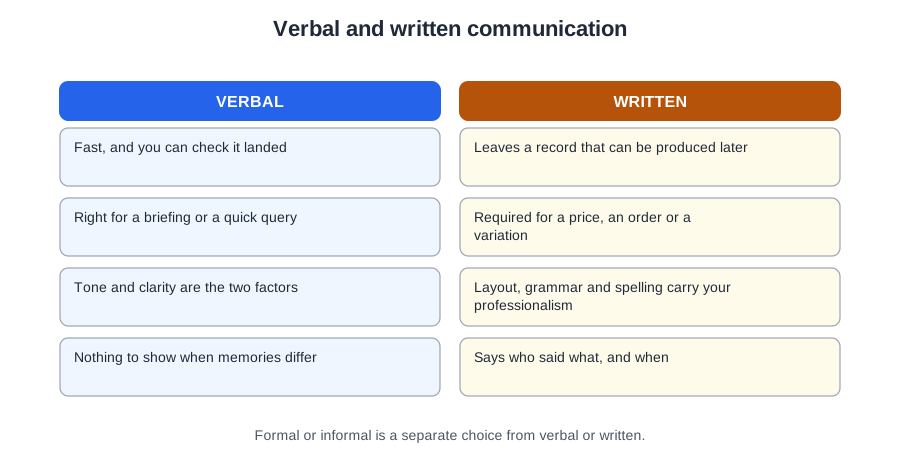
Covered in detail in the customer communication post, but worth recapping here with a focus on site-to-site communication rather than customer-facing.
Oral (verbal) communication:
- Face-to-face conversations on site
- Telephone conversations
- Toolbox talks and briefings
- Informal chats during the workday
Written communication:
- Email — quick, records automatically, suits most business correspondence
- Letter — the most formal method; signed physical document on letterhead
- Fax — older technology, rarely used now but still appears on some exam specifications
- Text messages / instant messaging — informal; suits quick updates
Different situations call for different methods. Formal matters use written letters. Urgent operational matters use phone calls. Quick coordination uses text or instant messages.
Effective verbal communication — the two factors
Effective verbal communication is based on two key factors: listening and speaking.
Not listening and looking. Not listening and recording. Not speaking and writing.
Why listening is so often underrated:
- It's assumed to happen automatically — everyone thinks they're good at listening, but most people aren't
- Rushing to respond cuts off the information you need
- "Listening to reply" vs "listening to understand" — the first one is common, the second one is rare
Practical improvements to listening:
- Let the other person finish before responding
- Ask clarifying questions rather than making assumptions
- Summarise what you've heard back to check you've understood correctly
- Pay attention to tone and context, not just words
Why speaking clearly matters:
- Ambiguous instructions lead to wrong work
- Jargon that the listener doesn't understand causes confusion
- Fast speech without pauses gives no time for processing
- Mumbled words get lost
When to use verbal vs written
Same principle as with customers: if a permanent record is needed, use written. For quick operational coordination, verbal is faster.
Verbal is appropriate for:
- Quick task allocation ("Can you finish the second floor today?")
- Spot checks on work progress
- Tool or material requests
- Simple clarifications
- Daily briefings
Written is appropriate for:
- Major design or specification changes
- Documented problems that might become formal disputes
- Formal complaints or grievances
- Commissioning records and test results
- Any communication that needs to be referenced later
Communicating with people who need adaptation
Level 2 expects you to adapt your communication for different needs. Three main categories.
Customers or colleagues with physical disabilities:
- Impaired hearing — support verbal communication with written communication; face the person when speaking; speak clearly without exaggerating; use written notes for key information
- Impaired vision — describe things in words rather than pointing; use audio alternatives to written notes; use tactile cues where appropriate
- Mobility issues — don't assume limitations; ask what help is needed rather than assuming
People with learning difficulties:
- Use simple language — avoid technical jargon unless necessary
- Check understanding — ask them to explain back what you've said
- Be patient — don't rush explanations
- Break information into smaller chunks — one concept at a time
- Use diagrams or pictures where helpful
Language differences (including dialects, accents, foreign language, English as a second language):
- Speak clearly, not loudly — volume doesn't help with comprehension
- Use simple words and short sentences
- Avoid slang or regional expressions
- Use diagrams or pictures to supplement verbal explanation
- Written communication can help if the person reads the language better than understands it spoken
- Allow extra time for processing
- Be patient with accents — theirs and your own
Effects of poor communication
When communication breaks down, the consequences are real and measurable. Level 2 tests the specific effects.
Effects between operatives:
- Tasks done incorrectly or twice
- Missed deadlines
- Materials ordered incorrectly or not at all
- Safety incidents from unclear instructions
- Workplace tension and personal conflicts
- Conflict on-site between fellow workers is most likely to result in a reduction in work output
Not an increase in output (C — obviously wrong). Not a reduced level of accidents (A — conflict tends to increase accident risk). Not an increase in wages paid (D — unrelated).
Effects between operatives and management:
- Breakdown of trust
- Grievances and disputes
- Reduced motivation and productivity
- Higher staff turnover
- Formal complaints and tribunal proceedings
Effects company-to-customer:
- Customer complaints
- Loss of repeat business
- Reputational damage
- Negative reviews
- Lost revenue
Common causes of conflict on site
Conflicts arise for predictable reasons. Knowing the common causes helps you spot them early.
Conflicts between customers and operatives:
- Misunderstanding about scope of work (what's included vs not included)
- Price disputes (quote vs final invoice)
- Quality concerns about workmanship
- Timing issues (work taking longer than expected)
- Communication failures (not keeping the customer updated)
Conflicts between co-workers:
- Unequal workload distribution
- Personality clashes
- Disagreements about methods
- Competition for resources or recognition
- Miscommunication about responsibilities
Conflicts between supervisors and operatives:
- Unfair task allocation
- Unreasonable time pressures
- Unclear expectations
- Lack of recognition for good work
- Unfair pay structures (one of the main causes specifically tested)
Resolving conflicts — the approach
Different conflicts need different approaches, but the general principles apply across the board.
Step 1: Address the issue early. Small problems become big problems if left unaddressed. A 15-minute conversation today can prevent a formal dispute next month.
Step 2: Listen to all sides. Don't assume you know what's happening. Give each party the chance to explain their perspective.
Step 3: Identify the actual issue. Surface arguments often cover deeper concerns. "He's always late" might actually be "I feel disrespected when he doesn't show up on time."
Step 4: Agree on actions. What specific actions will each party take to resolve the issue? Written agreements work better than verbal ones for significant conflicts.
Step 5: Follow up. Did the actions happen? Is the conflict resolved? If not, what's the next step?
When to escalate
Sometimes conflicts can't be resolved between the parties directly. Escalation paths:
Operative-to-operative conflict:
- Try to resolve directly first
- If unsuccessful, involve the supervisor
- If still unsuccessful, raise a formal grievance
Conflict with supervisor:
- Discuss directly if possible (supervisors have responsibilities too)
- If direct discussion doesn't work, escalate to their manager
- Use the formal grievance procedure if necessary
Conflict with the company:
- Raise through the grievance procedure
- Involve ACAS for conciliation or advice (covered in the employment post)
- Escalate to an employment tribunal as a last resort
Conflict with a customer:
- Listen fully to the complaint
- Acknowledge their concerns without admitting fault prematurely
- Offer to investigate and respond within a specific timeframe
- Follow the company's complaints procedure (from the customer service policy)
- Involve management for anything beyond routine complaints
Qualities that ensure respect and cooperation
Level 2 tests specific personal qualities that work well on site.
One quality that would ensure the respect and cooperation of other site workers is helpfulness.
Not violence (A — criminally wrong). Not submission (B — being walked over doesn't command respect). Not rudeness (D — the opposite of what you want).
Helpfulness specifically:
- Offer to help colleagues when you can
- Share knowledge and techniques with less experienced workers
- Support the team when someone's struggling
- Don't hoard information or tools
Other qualities that build good working relationships:
- Respect for colleagues, supervisors, and customers
- Reliability — doing what you say you'll do
- Honesty — including admitting mistakes
- Patience — especially with apprentices and learners
- Professionalism — keeping personal issues separate from work
The role of ACAS in conflicts
Covered in detail in the employment post, but worth recapping here.
ACAS (Advisory, Conciliation and Arbitration Service):
- Provides impartial advice about employment matters
- Offers conciliation to help parties reach agreement without court
- Provides arbitration — binding decisions that resolve disputes outside the courts
- Publishes codes of practice on handling disciplinary and grievance issues
ACAS is the go-to organisation for employment disputes. Before a case can go to an employment tribunal, ACAS involvement is typically required.
Common exam traps
Trap 1: Effective working relationships = effective communication. Not breaks, not professional body membership, not strict management.
Trap 2: Conflict on site = reduction in work output. Not increase; not reduced accidents.
Trap 3: Effective verbal = listening + speaking. Not listening + looking; not listening + recording.
Trap 4: Respect and cooperation = helpfulness. Not violence, submission, or rudeness.
Trap 5: Impaired hearing customers = support verbal with written communication.
Trap 6: Main reason for management/operative breakdown = unfair pay structures. Not enforcing PPE or CSCS (those are legal/standard requirements).
Trap 7: Written communication = permanent record. The main advantage over oral.
Trap 8: Most formal method = written letter. Not email, phone, or face-to-face.
Trap 9: Email advantage over letter = speed.
Trap 10: ACAS is for employment dispute resolution, not CIPHE/CSCS/BPEC (which are other bodies).
Quick revision summary
Before the mock test, eight things you need to be able to produce from memory:
- Good working relationships = founded on effective communication
- Conflict on site = reduces work output (always)
- Effective verbal communication = listening AND speaking (not other combinations)
- Respect and cooperation = helpfulness (specific course material answer)
- Communication adaptation for: physical disabilities (impaired hearing = written backup), learning difficulties (simple language, check understanding), language differences (simple words, diagrams, not louder volume)
- Effects of poor communication: between operatives (reduced output, errors), operatives-management (breakdown, grievances), company-customer (complaints, lost business)
- Escalation path for conflicts: direct → supervisor → grievance procedure → ACAS → tribunal
- Main quality for respect on site: helpfulness
📝 10-Question Mock Test
Click an option to see whether you got it right. Explanations appear instantly — no submitting at the end.
The core principle behind good working relationships. Options A, C and D all have some value but aren't the fundamental principle.
Conflict distracts workers, delays decisions, and reduces cooperation — all reducing output. Options A (reduced accidents) is the opposite — conflict often increases accident risk. Option C (increased output) is obviously wrong. Option D (wages) is unrelated to conflict outcomes.
Effective verbal communication is a two-way process of listening AND speaking. Options A (sighing), C (hearing — a passive process, not active listening), and D (doing) don't describe the two-way communication process.
The specific quality identified in the course material. Helping colleagues builds respect and cooperation. Options A (violence) and D (rudeness) are the opposite. Option B (submission) doesn't command respect.
Written backup ensures the message gets through when hearing is impaired. Options B (impaired vision — written wouldn't help if they can't see it), C and D require different adaptations (simpler language; pictures/diagrams).
The main advantage of email — near-instant delivery. Options B (more formal — actually letters are more formal), C (less understood — not specifically an advantage), D (word count — not the main advantage).
The standard escalation path when direct resolution fails. Option A (refuse to work) is unprofessional and may breach contract. Option C (court immediately) skips several reasonable steps. Option D (social media) is unprofessional and potentially defamatory.
The correct approach to language barriers. Option A (louder) doesn't help — volume isn't the issue. Option B (jargon) makes things harder. Option D (avoid verbal) isn't practical or necessary.
Poor communication with customers causes complaints, negative reviews, and lost repeat business. Options A, B and D are effects of GOOD communication, not poor.
The standard first step — a quick conversation often resolves small issues before they escalate. Options A (grievance), C (ACAS) and D (tribunal) are escalation steps that come later if direct resolution fails.
How PlumbMate puts this into practice
Communication content mixes general principles with specific course material phrases (helpfulness, reduction in work output, listening + speaking). Spaced repetition handles both together.
- Flashcards, not essays. One prompt, one answer — the format that research has consistently shown works best for active recall.
- Wrong answers are logged. Every question you get wrong goes into a dedicated collection that resurfaces more frequently in future sessions.
- The 3× rule. You need to get a question right three times before it clears — one lucky guess isn't enough.
- Explanations on every question. Like the ones above, but on every single question in the app.