You've got legal rights as an employee, and your employer has legal rights too. The Equality Act protects you from discrimination on specific grounds. The Employment Relations Act sets out how dismissals and redundancies must be handled. ACAS provides independent advice and dispute resolution. Level 2 expects you to know the specific acronyms (ACAS stands for what, exactly?), the protected characteristics under the Equality Act, and the notice periods for redundancy — because the exam tests these as specific facts, not general knowledge.
This post is the fourth in the Level 2 Communicating With Others sub-cluster. For the others, see the construction roles, workplace documents, customer communication and conflict resolution posts.
Why employment law matters at Level 2
Employment content might feel far from the technical side of plumbing, but the exam tests it directly — and the knowledge has real-world value:
- Knowing your rights protects you in practice. If your employer tries to dismiss you without proper process, you need to know the Employment Relations Act exists and what it requires.
- Knowing ACAS exists means you know where to get help with workplace disputes.
- Knowing the Equality Act protects you and your colleagues from workplace discrimination.
The content is fact-based — specific acronyms, specific notice periods, specific protected characteristics. All testable directly on exam papers.
The contract of employment — must be written
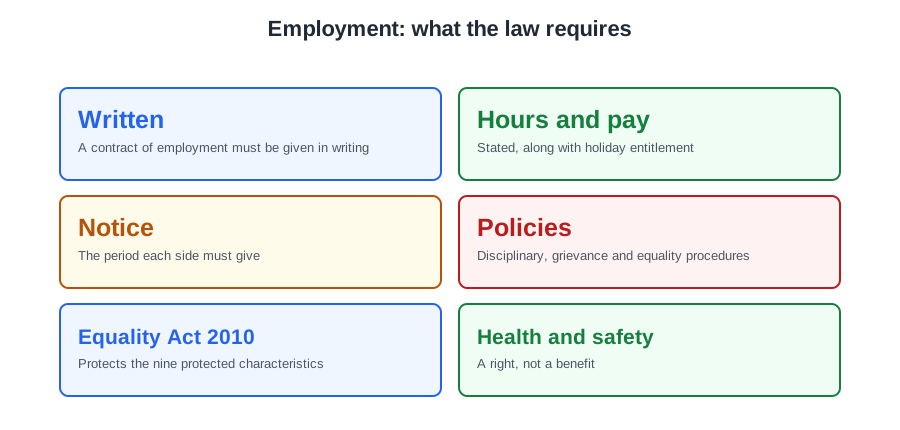
Your contract of employment must be in writing. Not a verbal agreement, not an email, not a text message — a written contract.
Why written contracts matter:
- Evidence of what was agreed — prevents one party later claiming something different
- Legal clarity — ambiguous terms can't be interpreted in different ways
- Enforceability — employment tribunals rely on the written terms
- Protection for both parties — employer and employee both know their obligations
The most appropriate method of communication for producing an employee's terms and conditions of employment is a written contract. Not a verbal contract (A — no record), not email (B — less formal, and not specifically a "contract" format), not text message (D — definitely not formal enough).
What's typically in a contract of employment
- Job title and description
- Date employment started
- Hours of work
- Rate of pay (hourly or salary) and payment frequency
- Holiday entitlement
- Notice periods for termination (by either side)
- Sick pay arrangements
- Pension arrangements
- Disciplinary and grievance procedures
- Company rules and policies
Company policies and procedures
Beyond the contract itself, company policies govern the day-to-day working relationship. Three specific policy areas Level 2 expects you to recognise:
Behaviour. How employees should conduct themselves at work — with customers, colleagues, and the public. Typically includes respect, professionalism, no harassment or discrimination, and appropriate workplace conduct.
Timekeeping. Expected start and finish times, lateness procedures, break arrangements. "Timekeeping" as a policy item isn't just being on time — it's a clear record of what's expected and what happens if expectations aren't met.
Dress code. What employees should wear. For plumbers, this typically means clean overalls with company logo (covered in the customer communication post's image section).
Why these policies matter: they set consistent expectations across the company. Without them, disagreements about what's acceptable can't be easily resolved — there's no reference point.
Limits to personal authority
A plumber's authority to make decisions depends on their qualifications and role:
Apprentices. Limited authority. Work under supervision of a qualified plumber. Can't sign off work, make independent decisions on significant matters, or work on safety-critical tasks without supervision.
Level 2 qualified staff. Can work independently on most domestic tasks covered by the Level 2 syllabus. Limited authority on more complex work (unvented cylinders, commercial systems, gas appliances).
Level 3 qualified staff. Wider scope of authority. Can take on more complex installations, signing off work, and some supervisory responsibilities.
Supervisors and management. Can make decisions about scheduling, task allocation, customer relationships, and minor contract variations. The specific scope depends on the role.
Why this matters: knowing the limits of your authority prevents you from making decisions you shouldn't — and helps you know when to escalate.
Supervisor and management responsibilities
Supervisors and managers have specific responsibilities that go beyond technical work:
- Allocating tasks appropriately to team members
- Training and developing team members
- Monitoring performance and addressing issues
- Handling grievances from team members
- Making decisions within the authority delegated to them
- Liaising with clients on behalf of the company
The specific responsibilities vary by role, but the principle is consistent: as you move up the hierarchy, you take on more decision-making and people-management responsibility.
Employment legislation — the key areas
Level 2 expects you to recognise several specific employment rights protected by law.
Sick pay. Statutory Sick Pay (SSP) is the minimum legal entitlement. Paid by the employer for a specified period of absence due to illness. Many employers offer more generous "contractual sick pay" in the contract itself.
Holiday entitlement. Under the Working Time Regulations, employees are entitled to a minimum of 5.6 weeks paid holiday per year (including bank holidays, depending on employment terms). Full-time employees typically get 28 days including bank holidays; part-time pro-rata.
Working hours. The Working Time Regulations set maximum working hours — typically 48 hours per week on average. Employees can opt out of this limit but cannot be forced to. Specific breaks and rest periods are also required.
Maternity leave. Up to 52 weeks' statutory maternity leave for eligible mothers, with 39 weeks statutory maternity pay. Protection from dismissal during pregnancy and maternity leave.
Paternity leave. 1 or 2 weeks' statutory paternity leave, with statutory paternity pay for eligible fathers or partners.
Holiday pay, sick pay, maternity/paternity — all are statutory minimums. Employers can offer better terms but cannot offer less than the statutory minimums.
The Equality Act — protected characteristics
The Equality Act 2010 protects people from workplace discrimination on specific grounds. Level 2 expects you to recognise the protected characteristics.
Age. Discrimination on grounds of age is illegal. You can't be paid less or given worse conditions because you're younger or older. Limited exceptions apply (e.g., retirement age in specific roles).
Disability. Employers must make "reasonable adjustments" for disabled employees. This might mean adapting the workplace, providing specific equipment, or adjusting working hours.
Race. Discrimination on grounds of race, colour, nationality, or ethnic/national origin is illegal.
Religion. The Equality Act protects against discrimination based on religion or belief. Limited exemptions exist (e.g., appointment of a church minister where a specific faith is required).
Gender. Discrimination on grounds of whether you are male or female is illegal. Less favourable treatment of women on grounds of pregnancy or maternity leave counts as gender discrimination.
Sexual orientation. The Equality Act applies to discrimination on grounds of orientation towards the same sex (lesbian or gay), the opposite sex (heterosexual), and both sexes (bisexual). Also provides civil partnership protection equivalent to marriage for employment rights.
Marriage and civil partnership and gender reassignment are additional protected characteristics under the full Equality Act, though Level 2 focuses on the main six above.
Data protection
Your personal data is protected by law. Employers must handle employee data (addresses, bank details, health information, performance records) securely and only use it for legitimate purposes.
The Data Protection Act 2018 (which incorporates the UK GDPR) sets out:
- What data employers can collect (only what's necessary)
- How data must be stored (securely, accessible only to authorised personnel)
- How long data can be kept (only as long as needed)
- Your rights to access your own data and request corrections
- Employer obligations to notify you of data breaches
For Level 2, you need to recognise data protection as a form of legislation that applies to working in the industry (alongside equal opportunities, H&S, and employment).
Dismissal and redundancy
The Employment Relations Act lays down guidelines for dismissal and redundancy procedures.
Key requirements:
- Employers must provide fair and reasonable grounds for dismissal — you can't be dismissed arbitrarily
- Companies must have a fair disciplinary and grievance procedure — so issues can be raised and handled properly
- Employees can refer employment disputes to an employment tribunal — including disputes about dismissal, redundancy, discrimination
This is the foundation of UK employment protection. Without the Employment Relations Act, employers could dismiss employees for any reason or no reason at all.
Notice periods for dismissal — the specific rules
Statutory minimum notice periods apply based on length of service:
| Length of service | Minimum notice period |
|---|---|
| 1 month – 2 years | 1 week |
| 2–12 years | An additional week per year of service |
| 12+ years | Minimum 12 weeks |
Worked examples:
- Employed for 5 years: 5 weeks' notice (1 week for first 2 years + 1 week per year after = 5 weeks)
- Employed for 9 years: 9 weeks' notice (1 week per year from year 2 to year 9 = 9 weeks)
- Employed for 15 years: 12 weeks' notice (the 12-week cap kicks in)
Why these rules matter: they protect employees from being suddenly out of work without time to find alternative employment. They also give employers predictability — you know what you owe an employee you're making redundant.
Some employers offer more generous contractual notice periods; those override the statutory minimum as long as they're equal to or greater than the statutory amount.
Disciplinary and grievance procedures
Companies must have formal procedures for:
Disciplinary action — when an employer has a problem with an employee's conduct or performance. Typical stages:
- Informal discussion — raise the issue verbally
- Formal verbal warning — recorded on file
- Written warning — official document
- Final written warning — last chance
- Dismissal — if the issue isn't resolved
Grievance procedure — when an employee has a problem with the employer, a colleague, or working conditions. Typical stages:
- Informal discussion with the line manager
- Formal written grievance — submitted to HR or management
- Grievance meeting — employee and employer discuss the issue formally
- Decision and response — employer's formal response
- Appeal — if the employee isn't satisfied with the response
Both procedures protect both parties — the employer from unfounded complaints, and the employee from unfair treatment.
ACAS — the Advisory, Conciliation and Arbitration Service
ACAS = Advisory, Conciliation and Arbitration Service.
Not "Advising, Counselling and Arbitration Service." Not "Association of Plumbing and Heating Contractors." Not "Association of Councillors and Arbitrator Suppliers."
Specifically: Advisory (gives advice), Conciliation (helps people reach agreement), Arbitration (makes binding decisions in disputes).
What ACAS does:
- Provides impartial advice about workplace conflicts and employment law
- Offers conciliation to help employers and employees reach agreement without going to court
- Provides arbitration to resolve disputes outside the courts
- Publishes codes of practice on disciplinary and grievance procedures, time off work, etc.
ACAS is the go-to organisation for employment disputes — before a dispute goes to an employment tribunal, ACAS typically becomes involved to try to resolve it through conciliation.
Which organisation provides information about potential conflicts in employment matters? ACAS. Not CIPHE (Chartered Institute of Plumbing and Heating Engineering — a professional body, not an employment advice body). Not CSCS (Construction Skills Certification Scheme — a card scheme for site access). Not BPEC (a training body).
Arbitration — what it actually is
Arbitration is a method of resolving disputes outside the courts.
Not "impartial advice about conflict at work" (that's advisory services). Not "an informal meeting to settle disputes between colleagues" (that's conciliation or informal mediation). Not "taking an employer to court" (that's litigation, the opposite of arbitration).
How arbitration works:
- Both parties agree to use arbitration
- An independent arbitrator (neutral third party) hears both sides
- The arbitrator makes a binding decision
- The decision is legally enforceable, just like a court judgment
- Typically quicker and cheaper than going to court
ACAS is one body that provides arbitration services; private arbitration services exist too. Trade unions sometimes offer arbitration for disputes between their members and employers.
Employment tribunals
If disputes can't be resolved through internal procedures, ACAS conciliation, or arbitration, an employee can take the dispute to an employment tribunal — a specialist court that handles employment disputes including:
- Unfair dismissal
- Discrimination claims
- Unpaid wages or holiday pay
- Breach of contract
- Whistleblowing protection
Employment tribunals are less formal than civil courts but are legally binding. ACAS involvement is typically required before a claim can proceed to tribunal.
Common exam traps
Trap 1: ACAS = Advisory, Conciliation and Arbitration Service. Not Advising, not Association.
Trap 2: Arbitration = resolving disputes outside the courts. Not advice; not informal meetings; not court litigation.
Trap 3: Contract of employment must be WRITTEN. Not verbal, not email, not text.
Trap 4: Notice periods — 1 week for 1-2 years; +1 week per year for 2-12 years; 12 weeks for 12+.
Trap 5: Equality Act protected characteristics — age, disability, race, religion, gender, sexual orientation.
Trap 6: The Employment Relations Act sets out dismissal and redundancy procedures.
Trap 7: Main causes of breakdown between management and operatives — unfair pay structures, poor communication, broken promises. NOT enforcing PPE (this is a legal requirement) or enforcing the CSCS scheme (also standard).
Trap 8: Maternity/paternity leave is statutory. Employers can't reduce below the statutory minimum.
Trap 9: Disciplinary and grievance procedures must exist by law.
Trap 10: Data Protection covers personal employee data.
Quick revision summary
Before the mock test, eight things you need to be able to produce from memory:
- Contract of employment must be WRITTEN — not verbal, not email, not text
- Four legislation areas: data protection, equal opportunities, H&S, employment
- Equality Act protected characteristics: age, disability, race, religion, gender, sexual orientation
- Employment Relations Act: fair dismissal, disciplinary/grievance procedures, employment tribunal right
- Statutory notice periods: 1 week (1-2 yrs); +1 week/year (2-12); 12 weeks min (12+)
- ACAS = Advisory, Conciliation and Arbitration Service
- Arbitration = resolving disputes outside the courts
- Main cause of management/operative breakdown: unfair pay structures (not PPE or CSCS)
📝 10-Question Mock Test
Click an option to see whether you got it right. Explanations appear instantly — no submitting at the end.
Employment terms and conditions must be in writing — both for legal clarity and enforceability. Verbal contracts (A) leave no record. Email (B) can be formal but isn't the specific "contract" format. Text message (D) is definitely insufficient.
The specific full name. Option A ("Advising, Counselling") is the common wrong answer. B and D are plausible-sounding but incorrect alternatives.
The specific employment advice body. CIPHE (A) is the professional body for plumbing and heating engineers. CSCS (C) is the Construction Skills Certification Scheme. BPEC (D) is a plumbing/heating training body.
The correct definition. Option A is advisory services (also provided by ACAS but not arbitration specifically). Option C is more like mediation or informal resolution. Option D is litigation — the opposite of arbitration.
Using the rule: 1 week for the first 2 years + 1 additional week per year from year 2 to year 5 = 5 weeks total.
12 years or more of continuous service = minimum 12 weeks' notice (the statutory cap). Option D (15 weeks) is incorrect — the cap is 12 weeks regardless of how long beyond 12 years the employment extends.
Not a protected characteristic. Age (A), sexual orientation (B), and race (D) are all protected characteristics under the Equality Act 2010.
The specific Act covering dismissal and redundancy procedures. The Health and Safety at Work Act (A) is about workplace safety. The Equality Act (C) is about anti-discrimination. CDM Regulations (D) are construction-specific safety.
Pay disputes are a major cause of workplace conflict. Option A would be welcomed by workers. Options B (PPE) and C (CSCS) are legally required and standard — enforcing them is expected, not a cause of breakdown.
Disciplinary procedures handle conduct issues; grievance procedures handle employee complaints. Both together are required by the Employment Relations Act. Options B, C and D describe different things.
How PlumbMate puts this into practice
Employment content is heavy on specific acronyms, rules, and protected characteristics — exactly the kind of fact-dense material spaced repetition handles best.
- Flashcards, not essays. One prompt, one answer — the format that research has consistently shown works best for active recall.
- Wrong answers are logged. Every question you get wrong goes into a dedicated collection that resurfaces more frequently in future sessions.
- The 3× rule. You need to get a question right three times before it clears — one lucky guess isn't enough.
- Explanations on every question. Like the ones above, but on every single question in the app.