Communications is the Level 2 unit most students underestimate — and the one where that underestimation costs the most marks. It looks like "soft skills" that any reasonable person should know. Actually, it's a mixture of construction industry structure, specific paperwork, consumer law, employment law, the Equality Act, ACAS procedures, and precise course material phrasings like "helpfulness" and "reduction in work output." Students who prepare properly pass it comfortably. Students who coast on common sense tend to score lower than they expected.
This guide covers the whole unit at single-page summary depth, with links out to the five deep-dive posts that handle each topic in full.
Why Communications deserves more attention than students give it
Three reasons students underestimate Communications — and one insight that makes the content easier to organise.
First, it feels like common sense. Most of the content sounds like general workplace behaviour — be polite, communicate clearly, don't discriminate, handle conflicts calmly. So students assume they'll pick it up naturally and don't revise it systematically. But the exam doesn't test whether you act politely — it tests whether you know the specific course material answers. "Respect and cooperation" doesn't earn a mark unless you know the specific word "helpfulness." Conflict reduces "work output" — not some other plausible-sounding outcome.
Second, there's more specific testable content than students realise. Ten site management roles to recognise. Six protected characteristics under the Equality Act. Three types of planning document (Job Spec / Schedule / Programme of Works). Three categories of manufacturer's instructions. Specific notice periods for redundancy. The exact acronym expansion for ACAS. The formal ranking of communication methods (written letter most formal, email less so, verbal least). Each of these is a specific testable fact.
Third, the content is genuinely different from the rest of the syllabus. Unlike heating, drainage, cold water, or processes — which all test technical plumbing knowledge — Communications tests consumer law, employment law, site management structure, and organisational behaviour. If you revise it the same way you revise heating, you miss the mark. The revision approach has to be tuned to the content.
The key insight that makes the unit manageable: Communications maps to three connected domains.
- WHO — the people around you (site management team, trades, visitors, customers)
- WHAT — the documents and rights that structure your work (job specs, quotes, contracts, legislation)
- HOW — the way information moves between people (communication methods, conflict resolution)
Learn those three domains, and every exam question becomes "which domain is this testing?" That's a far easier starting point than treating the whole unit as a sea of disconnected facts.
The five areas you need to master
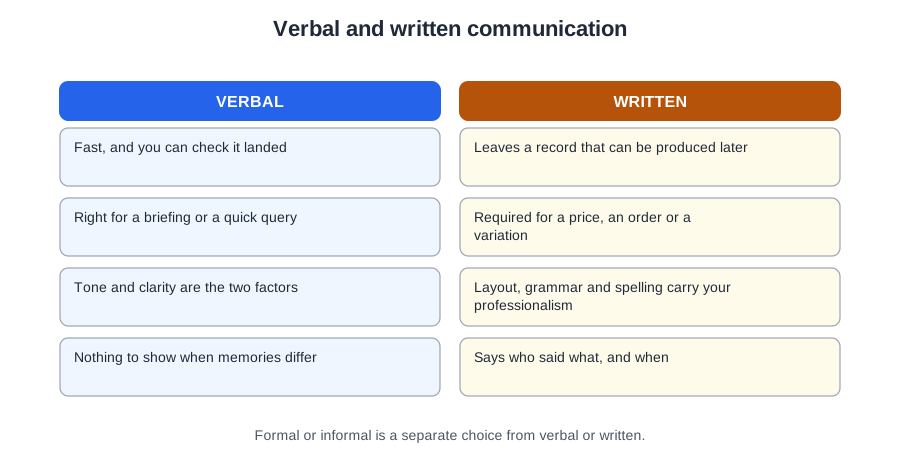
Level 2 Communications breaks into five main blocks. Each has its own deep-dive post; the summaries below give you enough to locate your gaps.
1. Construction roles and site structure
The WHO of the unit — understanding who you work with and for.
Core facts:
- Site management team (10 roles): architect, project manager/clerk of works, structural engineer, surveyor, building services engineer, quantity surveyor, buyer, estimator, contracts manager, construction manager
- Trades that report to site management: subcontractors, site supervisor, trade supervisor, bricklayer, joiner, plasterer, tiler, electrician, H&V fitter, gas fitter, decorator, groundworker
- Site visitors (inspectors): building control, water, HSE, electrical services
- Site manager = in overall charge of on-site operations and safety; uses schedule of work
- Foreman (site supervisor) = liaises with site manager; passes on tasks to trades
- Site engineer = does setting out; short-term planning; risk assessment input
- Setting out = marking out where the building is going to be
- First fix = pipework/wiring before plastering; second fix = visible finished fixtures
- Programme of works phases: setting out → foundations → walls → roof → first fix → internal walls → second fix → commissioning → snagging
For the full deep-dive plus mock test, see the construction roles post.
2. Workplace documents, drawings and information
The WHAT of the unit — the paperwork that structures the job.
Core facts:
- Legislation = law; guidance = best practice (British Standards, Codes of Practice, manufacturer's instructions)
- Three planning documents: Job Specification (WHO + standard), Schedule (WHAT per property), Programme of Works (WHEN)
- Manufacturer's instructions = installation + service & maintenance + user; NOT parts pricing
- Five drawing types: site plan, floor plan (1:50), section (1:50), elevation, component (1:50 or 1:20)
- Schematic diagrams show how systems work, not physical dimensions
- Written sizes take precedence over scale interpretation
- Materials ordering flow: requisition → buyer orders → delivery advice note → invoice
- Invoice purpose = track payments
- Building contract = legally binding; estimates and work programmes alone are not
For the full deep-dive plus mock test, see the workplace documents post.
3. Customer communication and customer service
How to deal with customers professionally — the commercial foundation of the job.
Core facts:
- Main reason for complaints = communication and attitude (not technical work)
- Verbal communication for: component positioning, simple issues, pre-job preparation
- Written communication required for: quotes, contract confirmation, major alterations, commissioning reports, complicated complaints
- Most formal method = written letter (more formal than email or face-to-face)
- Email advantage over letter = quicker
- Written advantage over oral = permanent record
- Effective verbal = listening AND speaking (not listening + looking or recording)
- Quote = exact fixed price + full spec; Estimate = ballpark figure
- Handover to customer after new boiler = operating instructions
- Customer service policy includes complaints procedure
- Supply of Goods and Services Act 1982: reasonable care and skill, reasonable time, reasonable cost — CAN'T be excluded from contract
- Best company image: clean branded overalls + punctuality + prompt polite responses + tidy site
- Impaired hearing customer = support verbal with written communication
For the full deep-dive plus mock test, see the customer communication post.
4. Employment, equality and contracts
The legal framework around your employment.
Core facts:
- Contract of employment must be WRITTEN — not verbal, email, or text
- Four legislation areas: data protection, equal opportunities, H&S, employment
- Equality Act protected characteristics: age, disability, race, religion, gender, sexual orientation
- Employment Relations Act lays down dismissal and redundancy procedures
- Statutory notice periods: 1 week (1–2 years); +1 week per year (2–12 years); 12 weeks minimum (12+ years)
- Worked examples: 5 years = 5 weeks; 9 years = 9 weeks; 15+ years = 12 weeks (capped)
- ACAS = Advisory, Conciliation and Arbitration Service (NOT "Advising, Counselling")
- Arbitration = resolving disputes outside the courts
- Main cause of management/operative breakdown = unfair pay structures
- Disciplinary and grievance procedures required by law
- Limits to personal authority: apprentices (limited), L2, L3, supervisor, manager (increasing)
- Company policies: behaviour, timekeeping, dress code, contract of employment
For the full deep-dive plus mock test, see the employment post.
5. Effective communication and conflict resolution
The HOW of the unit — day-to-day communication skills and what happens when they fail.
Core facts:
- Good working relationships principle = effective communication (not breaks, not management)
- Effective verbal communication = listening AND speaking
- Respect and cooperation from colleagues = helpfulness (specific course material answer)
- Conflict on site = reduction in work output (not increase; not reduced accidents)
- Communication adaptation categories:
- Physical disabilities (impaired hearing = support verbal with written; impaired vision = audio/tactile)
- Learning difficulties (simple language, check understanding)
- Language differences (simple words, short sentences, diagrams — NOT louder volume)
- Three types of conflict: customer/operative, co-worker, supervisor/operative
- Effects of poor communication:
- Between operatives: reduced output, errors, safety incidents
- Operatives and management: breakdown of trust, grievances, tribunals
- Company to customer: complaints, lost business, reputational damage
- Escalation path: direct resolution → supervisor → grievance procedure → ACAS → employment tribunal
For the full deep-dive plus mock test, see the communication and conflict resolution post.
Four exam-technique habits that apply across the whole unit
Memorise the specific course material phrases — don't paraphrase them. "Helpfulness" for respect and cooperation. "Reduction in work output" for the effect of conflict. "Listening and speaking" for effective verbal communication. "Unfair pay structures" for management/operative breakdown. "Operating instructions" for boiler handover. These specific phrases come up as the correct answers among plausible distractors. Getting the exact wording right is often the difference between a marked-correct and a marked-incorrect answer.
Learn the acronyms cold. ACAS = Advisory, Conciliation and Arbitration Service. Not "Advising, Counselling." Not "Association." These exact expansions are tested directly. Same with other abbreviations that appear across the syllabus (HSE, RIDDOR, COSHH, WRAS) — commit the specific words to memory, not a general sense of what they mean.
Use the three domains (WHO / WHAT / HOW) to classify questions. A question about site managers is WHO. A question about Job Specs is WHAT. A question about handling a conflict is HOW. Classifying each question first makes the correct answer easier to find — you're scanning a smaller set of facts rather than the whole unit.
For the document questions, use the WHO/WHAT/WHEN framing. Job Specification tells you WHO is responsible and the standard; Schedule tells you WHAT fits in each property; Programme of Works tells you WHEN work is done. These three are reliably confused on exam papers because they sound similar. The three-word framing prevents confusion.
Building a revision routine that actually works
The research on revision is overwhelming and consistent: spaced repetition beats cramming, active recall beats re-reading, and little-and-often beats long weekend sessions. Every credible study on student learning over the last fifty years points to the same conclusions.
In practical terms:
- Use flashcards, not re-reading. Passive reading feels productive and is nearly useless for exam recall. Active recall — forcing your brain to produce the answer before checking it — is what builds long-term memory.
- Little and often. Three ten-minute sessions across the day beat one thirty-minute block, and both beat a three-hour cram the night before.
- Revisit at increasing intervals. If you get a fact right today, don't retest it tomorrow — test it in three days. If you get it right again, test it in a week. This is the spacing that beats the forgetting curve.
- Focus on what you don't know. There's no point drilling yourself on the stuff you already know cold. Spend your time on the material you keep getting wrong.
For the full treatment of this method, see the spaced repetition guide — which also covers how PlumbMate operationalises it.
A recommended revision order
Communications is a smaller unit than the main technical clusters. Three weeks gives you time to cover the content properly without overkill.
Week 1: Construction Roles + Workplace Documents (posts 1–2). The framework of WHO you work with and WHAT paperwork structures the job. Tables of roles and the three planning documents (Job Spec / Schedule / Programme of Works) are the fact-dense parts that benefit most from flashcard drill.
Week 2: Customer Communication + Employment (posts 3–4). Two content-heavy posts covering customer-facing professional standards and the legal framework around employment. The Supply of Goods and Services Act, quote-vs-estimate distinction, ACAS acronym, Equality Act protected characteristics, and notice period calculations all live in this week.
Week 3: Communication and Conflict + Mock Tests (post 5 + all five mocks). The final deep-dive plus comprehensive mock-test practice. Aim for 8/10 on each of the five mocks before considering yourself ready. End the week doing the 10-question mock tests from across all five deep-dives.
If you've got less than three weeks, compress but keep the order. If you've got more, spend extra time on the specific course material phrases and acronyms — these are the highest-return targets for additional study.
Communications is the unit where exact wording matters most
Most Level 2 units reward understanding the concept — if you know boilers run on condensing combustion and why, you can reason your way to most boiler questions. Communications is different. The correct answer is often a specific phrase, and the wrong answers are plausible-sounding alternatives designed to catch out students who "sort of know it."
That's why the revision method matters more in Communications than elsewhere. Loose familiarity with the content won't get you full marks. Cold memorisation of the specific phrasings will. Flashcards with the exact course material wording are the fastest path to exam-ready recall — reading through the posts once won't do it.
The good news: the unit is smaller than most, the content is self-contained, and three weeks of consistent spaced-repetition work covers it thoroughly. Put the effort in, and it's a reliable source of marks. Coast on common sense, and it's where you'll lose them.
How PlumbMate puts this into practice
PlumbMate covers the full Level 2 Communications syllabus with spaced repetition built in — exactly the method described in the revision section above.
- Flashcards, not essays. One prompt, one answer — the format that research has consistently shown works best for active recall.
- Wrong answers are logged. Every question you get wrong goes into a dedicated collection that resurfaces more frequently in future sessions.
- The 3× rule. You need to get a question right three times before it clears — one lucky guess isn't enough.
- Explanations on every question. So you learn the logic rather than memorising answers.