A discharge stack is the vertical pipe that carries waste and soil from every floor of a building down to the underground drainage. Get the stack right — proper sizing, proper venting, proper branch connections — and the whole system works reliably. Get it wrong and you'll get blocked pipes, broken trap seals, and sewer smells inside the building. Level 2 expects you to know the four main stack systems, how to size them, how to connect to them, and how to prevent the most common failures.
This is the second post in the Level 2 drainage sub-cluster. For the others, see the traps and trap seal loss, materials and jointing, underground drainage, rainwater and guttering, and testing and maintenance posts.
The four stack systems
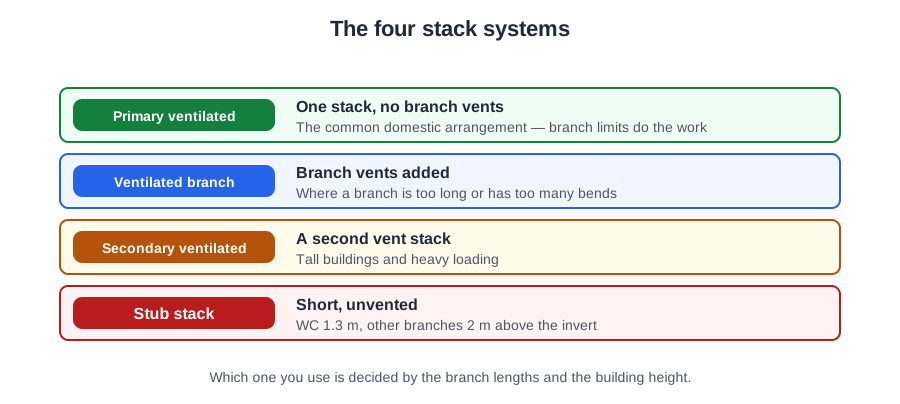
Four standard system designs. Level 2 expects you to identify each from a diagram and know what distinguishes them.
Primary ventilated stack system. The most common domestic arrangement. A single vertical stack takes all the discharge (soil and waste combined) and is vented to atmosphere at the top — above the roofline. Branch pipes from individual appliances connect directly into the stack, but no separate ventilation pipework runs to each appliance. Works when branches are relatively short and compliant with the branch length rules.
Secondary ventilated stack system. Same as a primary ventilated stack, but with an additional ventilating stack running alongside the main discharge stack. The ventilating stack connects to each branch pipe close to the trap, letting air in to prevent siphonage. Used in larger installations or where branch lengths would otherwise be too long.
Ventilated branch discharge system. Takes the same principle further — each branch pipe has its own vent pipe. Used where individual branches are long or where appliances are remote from the main stack. More pipework than a primary stack but handles complex layouts.
Modified one-pipe system. An older design combining soil and waste discharge into a single stack, with the ventilating stack connecting back into the main discharge stack at the top rather than venting separately. Less common in new installations.
Stub stacks are a separate case — covered below.
Stack sizing and vent requirements
The single most-tested rule: a stack must be at least as big as the largest connection to it. If you've got a basin with a 32mm outlet and a WC with a 110mm outlet connected to the same stack, the stack must be at least 110mm.
Other key figures:
- Stack vent (the dry portion above the highest branch connection) must be at least 75mm minimum
- Vent outlet position: at least 900mm above any opening into the building within 3 metres of it (Approved Document H, para 1.31) — so an opening more than 3m away imposes no height at all, and one closer than that must be cleared by 900mm
- Birdcage fitted to the vent outlet to prevent birds nesting inside
- Vent cowl fitted where the vent is exposed to wind (prevents waving out — see the traps post)
Why the 900mm and the 3m? Because the vent releases sewer gases at its top and those gases must not drift back into the building. Read it as one rule rather than two: the 900mm only applies to openings within 3 metres, which is why getting the terminal higher and getting it further away are both ways of satisfying it. And it is any opening — window, door, air intake — not just windows.
Stub stacks and air admittance valves
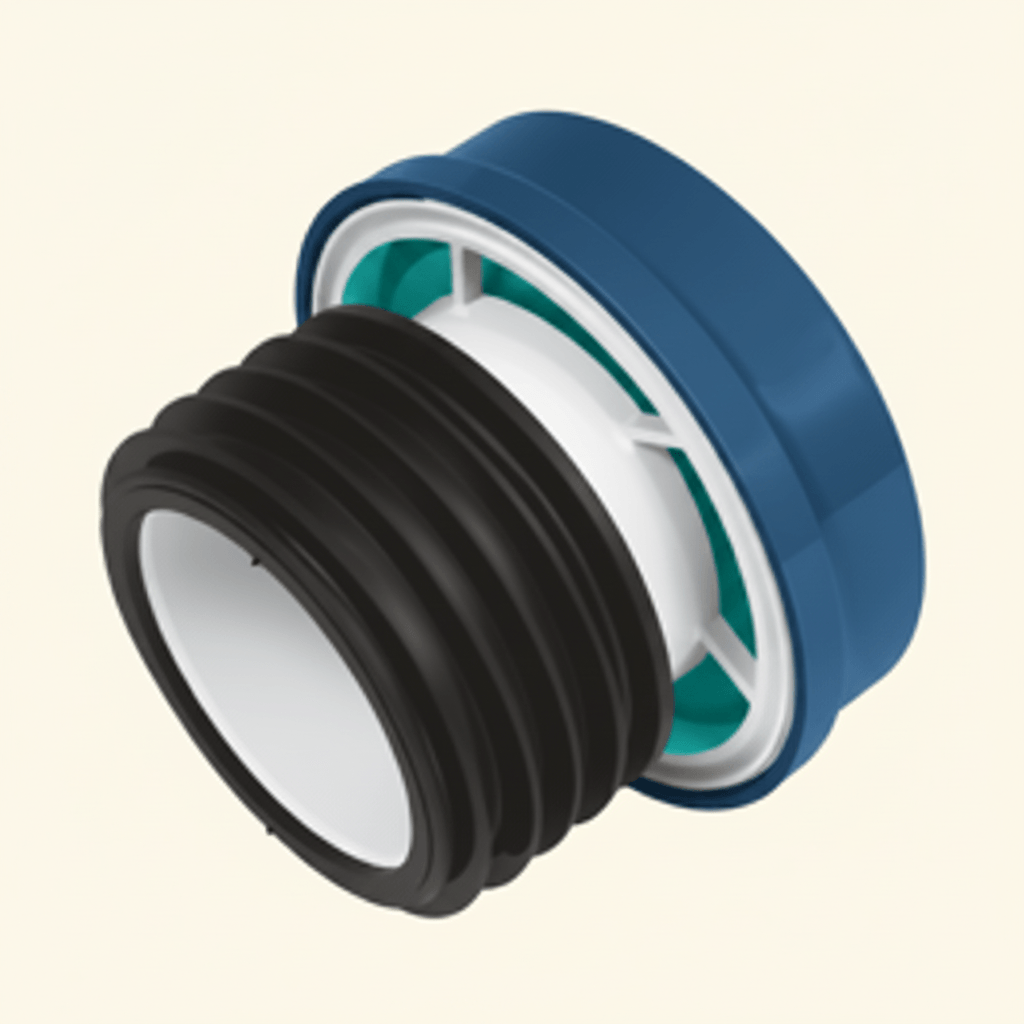
A stub stack is a short vertical stack that doesn't extend up through the roof — it's sealed at the top with an air admittance valve (AAV) instead of venting to atmosphere. The AAV lets air in when pressure drops (preventing siphonage) but doesn't let air (or smells) out.
Useful when a full roof-vented stack isn't practical — for example, in a ground-floor extension with no route for a vent pipe to the roof, or a basement toilet.
Key rules for stub stacks:
- AAV must be fitted above the spillover level of the highest appliance connected to the stub stack
- Adequate ventilation must be available around the AAV so it can draw air
- No connected WC may have a floor level more than 1.3m above the invert of the connection or drain — note this is the floor the WC stands on, not the crown of its trap
- No other branch may have its centreline more than 2m above that same invert
Both figures come from Approved Document H, paragraph 1.30, and both are measured from the same datum: the invert — the inside bottom — of the connection or drain the stub stack discharges into. You will see the 1.3m quoted as "the crown of the WC trap" in a lot of trade material. That is not what the document says, and a trap crown sits a couple of hundred millimetres above the floor, so the two are not interchangeable.
These limits exist because a stub stack doesn't have the atmospheric pressure relief of a normal roof-vented stack. Discharging water from too high would create pressure fluctuations the AAV can't cope with.
Connections to the stack: branch pipes and crossflow
Branch pipes are the horizontal (or near-horizontal) pipes from appliances to the stack. Two design issues matter most: length and connection spacing.
Maximum branch length depends on the appliance and its trap size. Typical figures you'll meet in the course material:
- WHB (32mm outlet): maximum 1,700mm (or longer if vented)
- Specific figures vary by trap size and gradient; use the published tables
Crossflow is the problem that forces the branch connection rules. If two branch pipes enter the stack opposite each other, the discharge from one can flow across and enter the other — causing pressure fluctuations and potential trap seal loss on the opposite branch.
Crossflow exclusion zones from the course material:
- 82mm stack: 90mm exclusion zone directly opposite a branch connection
- 110mm stack: 110mm exclusion zone
- For a 110mm soil branch (WC) discharging into the stack, the exclusion zone opposite extends to 200mm
Alternatives to exclusion zones:
- Connect branches at 90° to each other around the stack (rather than directly opposite)
- Use a soil manifold — a single fitting with multiple inlets on different sides that handle the discharge properly
Base of the stack rules
The base of the stack is where the vertical stack meets the underground drainage. This is a pressure-sensitive point because water rushing down the stack compresses air at the base, and that compression can push seals out of ground-floor appliances (the compression mechanism from the traps post).
Rules the course material specifies:
- Long-radius bend at the bottom — minimum radius 200mm
- The stack must be adequately supported at the base
- On buildings up to 3 storeys: the lowest branch connection must be at least 450mm above the invert of the drain at the base
- On buildings over 3 storeys: the minimum distance increases to 750mm
- On buildings over 5 storeys: ground floor appliances should not be connected to the main discharge stack at all — they should discharge separately (usually via a dedicated ground-floor stack or direct to the drain)
These distances give the compression pressure room to dissipate before reaching the first trap. Shorter distances would mean the ground-floor traps take the full compression wave and lose their seals.
Connection to gullies
Most appliances (except WCs and urinals) can discharge into a gully rather than into a stack. A gully is an external fitting connected to the underground drain with its own water seal.
Key rule for connections to gullies:
- The waste pipe must discharge below the gully grid (so debris doesn't wash out) but above the water seal (so the pipe isn't sitting submerged in waste water)
Too high and splashing out of the gully causes staining and smells. Too low and the pipe sits in the waste water, which causes slow drainage and potential siphonage problems.
Materials and pipe sizes
Sanitary pipework is typically sized at 32mm, 40mm, 50mm, 82mm, and 110mm. Standard applications:
- 32mm: wash hand basin, bidet
- 40mm: bath, shower, kitchen sink, washing machine, dishwasher
- 50mm: larger waste appliances, some commercial
- 82mm: commercial waste (rare in domestic)
- 110mm: WC discharge, main discharge stack
Most modern installations use plastic (PVC, uPVC, MuPVC, ABS, or polypropylene) — covered in detail in the materials and jointing post.
Common exam traps
Trap 1: Stack vent minimum size (75mm). Not the same as the stack diameter. The stack diameter might be 110mm, but the dry portion of the vent above the highest branch connection only needs to be 75mm minimum (with practical installations usually matching the stack for simplicity).
Trap 2: Vent outlet position. 3m horizontal from any opening OR 0.9m above the highest opening. This is a specific figure, not a judgement call.
Trap 3: Base-of-stack distances. 450mm up to 3 storeys; 750mm over 3 storeys. Exam questions give you a building height and expect you to know which figure applies. Over 5 storeys, don't connect ground floor appliances at all.
Trap 4: Long radius bend at the base (minimum 200mm). Not 100mm, not 300mm — specifically a minimum of 200mm radius.
Trap 5: Stub stack AAV position. Above the spillover level of the highest appliance connected to the stub stack. Not above the floor, not above the trap — above the spillover level.
Trap 6: Gully discharge rule. Below the grid, above the water seal. Both parts matter; examiners test whether you know both.
Quick revision summary
Before the mock test, seven things you need to be able to produce from memory:
- Four stack systems: primary ventilated, secondary ventilated, ventilated branch discharge, modified one-pipe
- Stack sizing rule: at least as big as the largest connection to it; stack vent minimum 75mm
- Vent outlet position: 3m horizontal from openings OR 0.9m above the highest opening; birdcage + vent cowl if exposed
- Stub stacks use an AAV above the spillover level of the highest appliance
- Base of stack: 200mm minimum radius bend; 450mm above invert up to 3 storeys; 750mm above 3 storeys
- Gully discharge: below the grid, above the water seal
- Crossflow exclusion: 200mm opposite a 110mm soil branch; 90mm for 82mm stack; 110mm for 110mm stack
📝 10-Question Mock Test
Click an option to see whether you got it right. Explanations appear instantly — no submitting at the end.
Minimum 75mm for the dry portion of the stack vent. The stack itself below the highest branch might be bigger (110mm if it carries WC discharge), but the vent only needs to be 75mm. Smaller options would risk pressure problems; larger is unnecessary.
The governing rule — a stack must be at least as big as its largest input. Any smaller and the stack would be the bottleneck. Options A, B and D describe rules that don't exist.
The base bend must be at least 200mm radius. A 100mm radius is too tight — it would cause flow problems and increase compression pressure. The other three options are all 200mm or larger and therefore acceptable.
A two-storey property is "up to three storeys" in the course material's categories, so the 450mm minimum applies. Option A is too small; Option D is the figure for the over three storeys category.
A four-storey property is "over three storeys", so the distance increases to 750mm. This extra height allows the compression pressure from more floors above to dissipate before it reaches the lowest branch.
Both parts matter. Below the grid prevents splashing out; above the seal keeps the pipe clear of waste water. Too high (A, D) means splashing; into the seal (C) means the pipe is submerged.
The AAV must be above the highest point water could reach if an appliance overflowed — otherwise the valve itself could get submerged and fail. Below floor or below appliance levels would defeat the purpose entirely.
The simplest and most common design — single stack, no separate ventilating pipework, vented at the top. Secondary ventilated (A) adds a second ventilating stack; ventilated branch discharge (D) adds vent pipework to each branch; modified one-pipe (C) is an older variant with specific connection arrangements.
Vent cowls deflect wind away from the vent outlet so no low-pressure area forms at the top of the stack. A birdcage (A) is a separate component that prevents birds nesting. Neither C nor D is the vent cowl's purpose.
A 110mm soil branch requires a 200mm exclusion zone opposite the connection to prevent crossflow. Options A and B are exclusion zones for smaller branches (90mm for 82mm stacks; 110mm for 110mm stacks with smaller branches). 150mm is a distractor.
How PlumbMate puts this into practice
Stack sizing, vent rules, and base-of-stack distances are exactly the kind of content spaced repetition clears fastest — lots of specific numbers that need to be at your fingertips.
- Flashcards, not essays. One prompt, one answer — the format that research has consistently shown works best for active recall.
- Wrong answers are logged. Every question you get wrong goes into a dedicated collection that resurfaces more frequently in future sessions.
- The 3× rule. You need to get a question right three times before it clears — one lucky guess isn't enough.
- Explanations on every question. Like the ones above, but on every single question in the app.