Rainwater systems are less glamorous than boilers and showers, but every property you ever work on has them — and they cause real damage when they fail. A leaking gutter or undersized downpipe sends water running down a wall, eroding mortar, soaking into brickwork, and eventually damaging foundations. Level 2 expects you to know gutter profiles, bracket types, fall ratios, clip spacings, and how to fit and maintain a rainwater system to a standard that lasts.
This is the fifth post in the Level 2 drainage sub-cluster. For the others, see the traps, stack systems, materials and jointing, underground drainage, and testing and maintenance posts.
Why rainwater systems matter
If a roof's worth of rainwater just ran off the eaves, it would erode the ground below, damage the foundations, and splash up the walls with every shower. The gutter catches that water as it runs off the roof and channels it to a single collection point (the running outlet), where it flows down a rainwater pipe and into the drainage system — typically a gully.
Get the sizing, falls and fixings right and the system lasts decades. Get it wrong and you'll be back on site fixing the same installation year after year.
Gutter profiles
Four main gutter shapes you'll meet at Level 2:
1. Ogee. A decorative shape with a moulded front face — traditional appearance, often used on period properties or where architectural character matters. Typically paired with square downpipes.
2. Half round. The classic curved profile. Simpler than ogee but very functional. Typically paired with round downpipes.
3. Square. A flat-bottomed, flat-fronted profile. Modern, clean appearance. Typically paired with square downpipes.
4. Deepflow (high capacity). A deeper gutter that carries more water per metre length. Used on large roofs or areas of heavy rainfall where standard gutters would overflow. Typically paired with round downpipes.
Matching rule of thumb: ogee and square gutters usually run into square downpipes; half round and deepflow usually run into round downpipes. Adaptors exist to convert between shapes, but matching the shapes is simpler and cleaner.
Gutter materials
Historically, gutters were made from:
- Cast iron — durable but heavy and prone to rust without regular painting
- Asbestos — common on mid-20th-century buildings; no longer installed, and removal requires specialist trained operatives
- Lead — seen on period properties, now rare
- Aluminium — used on some installations, cut with a hacksaw rather than a wood saw
Today, almost all new rainwater systems are PVC-u plastic. Lightweight, corrosion-proof, and cheap. The downside: all plastics degrade with UV exposure over time, and most plastic gutter systems have a design life of around 20–30 years.
Gutter brackets
Three main bracket types:
Fascia brackets. The most common type. Screwed to a fascia board (a timber board running along the edge of the roof). Used on almost every new-build domestic installation.
Rafter brackets. Screwed directly onto the roof rafters. Two sub-types:
- Top rafter brackets — screwed to the top face of the rafter
- Side rafter brackets — screwed to the side face of the rafter
Used where there's no fascia board, or where the fascia board doesn't provide adequate support.
Drive-in brackets. Hammered into the brickwork. Only used where neither rafter nor fascia brackets are an option — usually on older properties without a proper fascia. Least common in new installations.
Fixings: use alloy or stainless steel screws to avoid rust staining the gutter or wall.
Bracket and clip spacing
The figures that turn up in exam questions. Memorise them.
Gutter brackets:
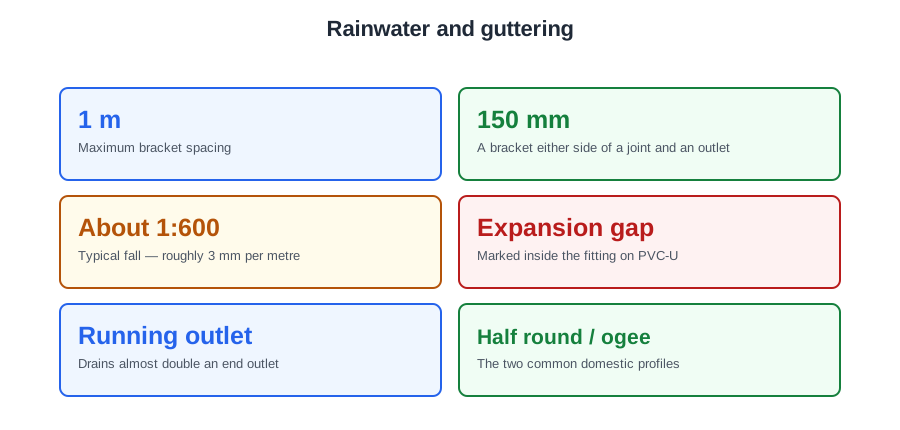
- Standard installation: maximum 1000mm (1 metre) between brackets
- Heavy snow or wind exposure: reduce to 750mm maximum
- Support within 150mm of every fitting (union, angle, stop end, running outlet)
Rainwater downpipe clips (68mm pipe is the common domestic size):
- Vertical: maximum 2.0m apart
- Horizontal: maximum 1.2m apart
Full rainwater clip spacings table (from the course material):
| Pipe size | Vertical | Horizontal |
|---|---|---|
| 55mm | 1.2m | 0.6m |
| 61mm | 2.0m | 1.2m |
| 68mm | 2.0m | 1.2m |
| 82mm | 2.0m | 1.2m |
| 110mm | 2.0m | 1.2m |
Note: 55mm pipe has notably closer clip spacing than the larger sizes because it's less rigid.
Fall, layout, and why they matter
A gutter can in theory be fitted level, but a minimum fall of 1:600 (one millimetre of drop per 600mm of horizontal run) is recommended to ensure water flows towards the running outlet rather than pooling or going stagnant.
Worked example: a 4,200mm roof with a 1:600 fall needs the running outlet to be 7mm below the end bracket (4,200 ÷ 600 = 7).
Laying to a fall has two effects:
- Water flows faster towards the outlet — the gutter handles more water before it overflows
- Smaller gutter capacity is needed for the same effective roof area — you can use a smaller, cheaper gutter with a fall than you could with a level installation
Positioning the running outlet matters too. An outlet in the middle of a gutter run can serve a larger roof area than the same outlet at the end of the run, because water from both sides has a shorter distance to travel. Centre-outlet layouts are common on long roofs or where capacity is marginal.
Angles reduce effective capacity. Every corner angle in a gutter run adds turbulence, slows water down, and reduces the effective roof area the gutter can serve. Minimise the number of angles where you can.
Thermal expansion
Plastic gutters expand and contract with temperature — around 0.06mm per metre per 1°C for PVC-u. That sounds small but over a 14m run and a 15°C temperature swing, that's 14 × 15 × 0.06 = 12.6mm of movement. Enough to crack a rigid joint.
The fix: allow 10mm of expansion gap at every gutter fitting (unions, angles, stop ends, running outlets). Most modern gutter fittings have an "insert gutter to here" mark that sets the correct gap automatically. If a union is leaking and hasn't been fitted with the expansion allowance, the fix is to unclip the gutter length, push it along 5mm, and re-fix — or replace the fitting with an expansion union.
Fitting a rainwater system: the workflow
The course material's sequence for fitting a gutter:
- Check the scaffold or working platform for damage and make sure it's safe
- Work out where the downpipe will drop, and fit the end bracket as high as possible at the far end of the roof
- Fit the running outlet above the downpipe position, using a plumb line to get it directly over
- Use the correct fall ratio (1:600 minimum) to work out how far below the end bracket the running outlet must sit
- Tie a string line between the running outlet and end bracket to show the correct height for intermediate fascia brackets
- Work out where unions, angles, and stop ends will go, and fit fascia brackets within 150mm of each side of each fitting
- Fit the rest of the fascia brackets at maximum 1000mm centres (750mm in snow/wind areas)
- Fit the gutter — push into each fitting to the "insert to here" mark to leave 10mm expansion gap
- Connect unions, angles, stop ends — again with expansion gap
- Check roof felt is running into the gutter all along the roof
- Fit downpipe clips using a plumb line, maximum 2m vertical spacing for 68mm pipe
- Fit the downpipe into the clips; measure and fit the offset between gutter and downpipe
- If discharging to a gully, fit a shoe at the bottom of the downpipe to direct water into the gully
- Visual inspection for faults, then test by pouring water in at the highest point and checking it runs away cleanly
Testing a rainwater system
No water-pressure test for rainwater — it's a gravity system.
The test method: put a hose on the roof (or pour water in at the highest point of the gutter) and visually check the water runs to the outlet and down the downpipe without any leakage or backing up. That's it.
If water discharges over the top of the gutter during heavy rain, the most likely cause is insufficient gutter capacity — the gutter is too small for the roof area. The fix is to replace the gutter system with one that has increased capacity (deepflow, typically).
Rainwater harvesting
Collecting rainwater from a roof and storing it for later use. The key Level 2 fact:
Untreated rainwater should only be used for toilet flushing. Not for drinking, not for cooking, not for filling sinks. Without treatment, rainwater may carry bacteria from bird droppings and airborne debris — safe for toilets, not safe for anything else.
Maintenance
Rainwater systems need regular checks but very little intervention if properly installed:
- Visual inspection at agreed intervals
- Cleaning of silt and debris from the gutter — the usual maintenance task, especially in autumn (leaves) and around trees
- Check gutter brackets — look for ones that have come loose or broken
- Check unions and joints for leaks
- Repaint fascia board when removing old gutter and before reinstalling — good practice every 10–15 years
- Replace rainwater pipe sections if cracked
When replacing existing gutters fixed to a fascia board, repainting the fascia is usually part of the job — the wood has been shielded by the gutter for years and may need protection before the new gutter goes on.
PPE for gutter work
This is where rainwater systems get genuinely unpleasant. Bird droppings, leaves, and silt build up in gutters, and bird droppings in particular may contain parasites that can damage your eyes and lungs if you inhale or ingest the dust.
PPE essentials for gutter maintenance:
- Face mask (respirator) — protects the respiratory system from dust and parasites
- Goggles — protects the eyes from splashes and debris
- Waterproof gloves — protects hands from dirty water and contamination
- Protective clothing — protects skin from contamination
Access equipment:
- Stand-off fitted to the top of a ladder prevents damage to the gutter and keeps the ladder safely away from the wall face
- Mobile scaffold is safer than ladders for any extended work
Common exam traps
Trap 1: Rainwater use. Untreated rainwater = toilet flushing only. Not drinking, not cooking, not filling sinks. Questions test this directly.
Trap 2: Gutter bracket spacing. 1000mm standard, 750mm for heavy snow/wind exposure. Both figures come up.
Trap 3: Fall ratio. Minimum 1:600 recommended. Not 1:200, not 1:700 — specifically 1:600.
Trap 4: Central outlet advantage. A central running outlet serves a larger roof area than an end outlet. Some exam questions ask this by inversion, so read carefully.
Trap 5: Gutter capacity for heavy rain overflow. If water discharges over the gutter rim in heavy rain, the gutter capacity is too small — replace with higher-capacity system. Not "reduce capacity", not "remove brackets".
Trap 6: 10mm expansion gap at fittings. Plastic expands significantly; missed expansion gap is a classic cause of leaks.
Trap 7: Stand-off for ladders. Stand-off — not step-off, push-off, or rest-off. Exam questions with spelling-variant distractors reliably catch students who haven't memorised the specific term.
Quick revision summary
Before the mock test, seven things you need to be able to produce from memory:
- Four gutter profiles: ogee, half round, square, deepflow (high capacity)
- Gutter bracket spacing: 1000mm standard, 750mm for heavy snow/wind; within 150mm of fittings
- Downpipe clip spacing: max 2.0m vertical, 1.2m horizontal (for 68mm pipe)
- Gutter fall: minimum 1:600 recommended
- Expansion gap at fittings: 10mm (for PVC-u, 0.06mm/m/°C)
- Rainwater harvesting: untreated rainwater for toilet flushing only
- Gutter maintenance PPE: face mask, goggles, waterproof gloves (bird dropping parasites); stand-off on ladder
📝 10-Question Mock Test
Click an option to see whether you got it right. Explanations appear instantly — no submitting at the end.
Standard domestic rainwater downpipe size. Options A and B are much too small for any realistic roof area; C (55mm) exists in the course material clip spacing table but is less common domestically than 68mm.
Maximum 1000mm (1 metre) between gutter brackets on a standard installation. Reduces to 750mm in snow/wind areas (see Q3). Option A (500mm) would work but is over-specified; option D (1500mm) is too wide and would let the gutter sag.
Heavy snow or high wind exposure requires closer bracket spacing — 750mm maximum — to handle the additional load and movement. This comes up reliably in exam questions.
Fittings (unions, angles, stop ends, running outlets) need a support bracket within 150mm on each side. Without close support, the weight of water can distort the fitting and cause leaks. Options B through D are all too far to provide adequate support near a fitting.
Maximum horizontal clip spacing for a 68mm pipe is 1.2m (1200mm). Vertical is 2.0m (which explains option D as a distractor — it's the vertical figure, not horizontal).
12m ÷ 600 = 0.02m = 20mm. A simple fall calculation: the vertical drop is the run divided by the fall ratio denominator. Options A, C and D are all numerically plausible distractors if you forget the formula.
Untreated rainwater may carry bacteria from bird droppings and airborne debris — safe enough for toilet flushing, not safe enough for anything that contacts food, skin, or wholesome water. Treated rainwater (with appropriate filtration and disinfection) can be used for more, but untreated is toilets only.
If water discharges over the rim in heavy rain, the gutter simply can't carry enough water — you need a larger gutter (typically a deepflow replacement). Option A (incorrect fall) might cause pooling but wouldn't produce heavy-rain overflow. D is the opposite of the actual problem.
Face masks (respirators) protect the respiratory system from inhaled dust — the route bird dropping parasites take into the body. Goggles (C) protect the eyes but don't prevent ingestion. Safety boots (B) and hard hats (D) aren't relevant to this specific hazard.
A stand-off is fitted to the top of a ladder to keep the ladder away from the gutter (preventing damage to the gutter) and the wall face. The other options (step-off, push-off, rest-off) are plausible-sounding distractors that aren't real equipment names.
How PlumbMate puts this into practice
Rainwater systems are a fact-heavy topic — lots of specific figures that have to be at your fingertips. Spaced repetition clears these faster than any other revision technique.
- Flashcards, not essays. One prompt, one answer — the format that research has consistently shown works best for active recall.
- Wrong answers are logged. Every question you get wrong goes into a dedicated collection that resurfaces more frequently in future sessions.
- The 3× rule. You need to get a question right three times before it clears — one lucky guess isn't enough.
- Explanations on every question. Like the ones above, but on every single question in the app.