The smell test is the simplest way to know a drainage system is working: if you can't smell the sewer, the traps are doing their job. Every basin, bath, shower, sink, WC and washing machine in a property relies on a small amount of water sitting in a trap to keep the sewer gases where they belong — in the sewer. Lose that water seal and the smells come up through the plughole. Understanding traps, how they fail, and how to prevent the failures is the foundation of everything else in drainage.
This post is the first in the Level 2 drainage sub-cluster. For the others, see the stack systems, materials and jointing, underground drainage, rainwater and guttering, and testing and maintenance posts.
What a trap actually does
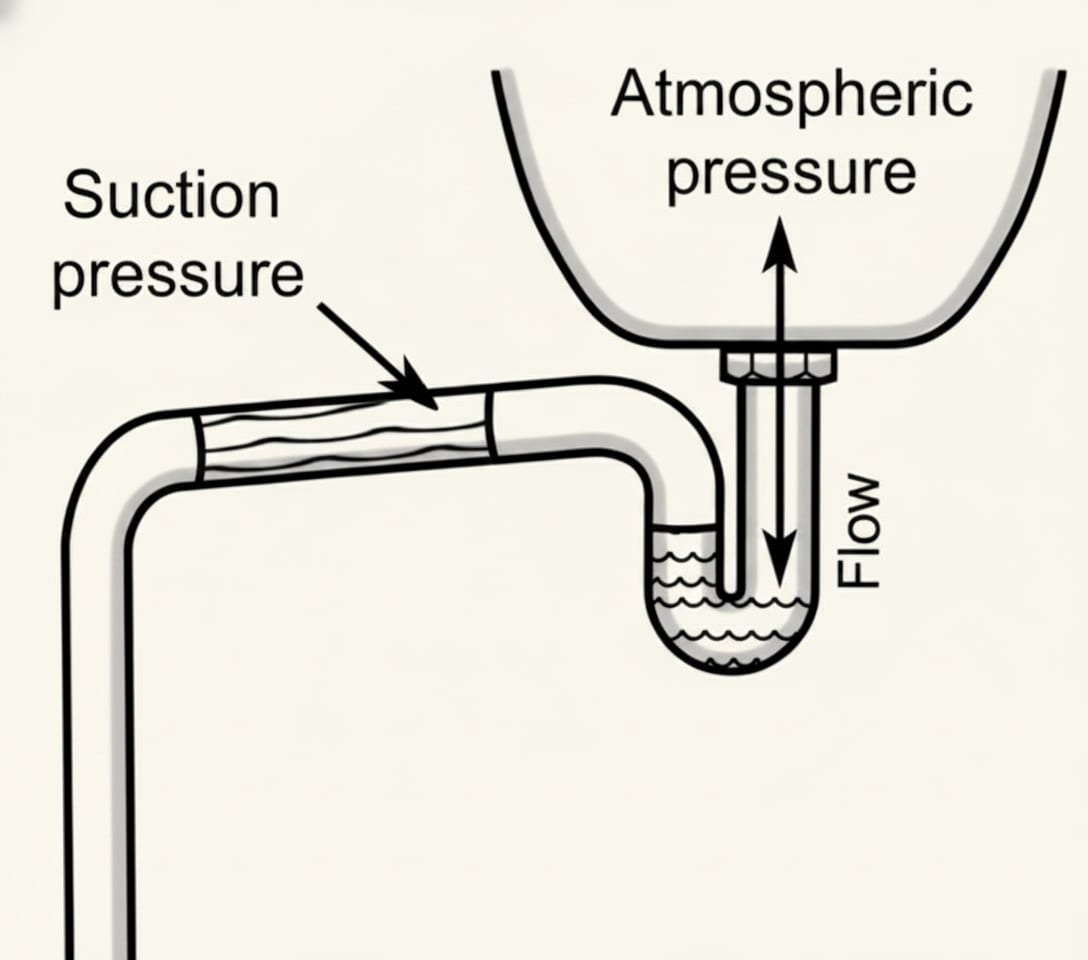
A trap is a deliberate low point in the discharge pipe where water sits and forms a seal. When water discharges from the appliance above, it flows through the trap and down the pipe. A small amount of water always stays behind in the trap, blocking the pipe against sewer gases rising up.
The seal depends on keeping water in the trap. Anything that empties it, pushes it out, or lets it evaporate breaks the seal. The rest of this post is about the ways that happens — and how to prevent each one.
The six main trap types
Six standard trap shapes, plus one clever alternative.
S trap. Looks like an S held sideways. Used where the pipe needs to drop down after the trap — typically on older installations with wall outlets below the appliance. A compact variation called the straight-through trap is designed for pedestal basins where space is tight. Because S traps are compact, they're more susceptible to trap seal loss than deeper designs.
Bottle trap. A good general-purpose trap — the easiest of all trap types to clean out because the lower section unscrews. But it can also block easily, so it shouldn't be used where lots of particles flow through it (like a kitchen sink).
P trap. Looks like a P held sideways. The most common trap type, used where the discharge pipe runs horizontally away from the appliance. A variation called the extended P trap (or washing machine trap) has a longer inlet to accept the hose from a washing machine or dishwasher.
Running trap. Used where there isn't enough space for a trap directly under the appliance — the trap is set in the pipe downstream.
Shower trap. Designed for showers, with access for cleaning from above (no need to get under the shower tray).
Bath trap. Designed for baths — slim profile to fit under the bath with the limited clearance available.
Self-sealing valve. Technically not a trap at all. It uses a collapsible membrane that opens when water flows through and closes when flow stops, forming an airtight seal. Because it doesn't rely on a water seal, it's not susceptible to any of the trap seal loss mechanisms described below.
Trap sizes and minimum trap seal depths
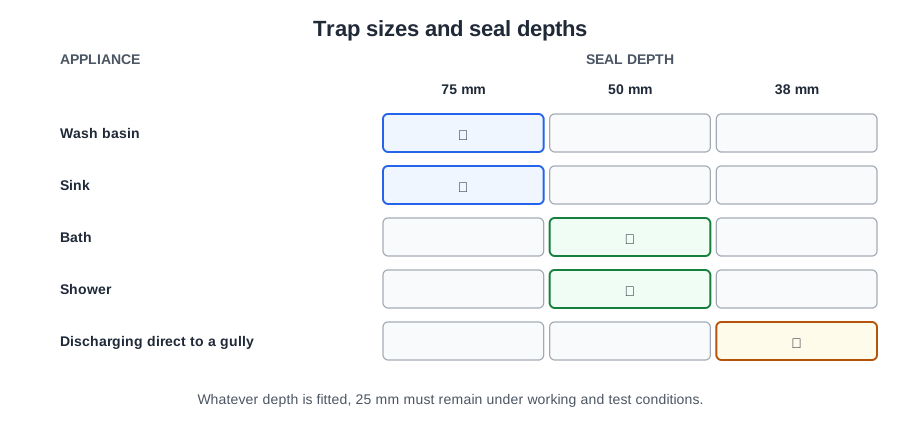
The course material table you need to know. Trap size = pipe diameter at the trap. Seal depth = the vertical distance of water sitting in the trap.
| Appliance | Minimum trap size | Min seal (to stack) | Min seal (to gully) |
|---|---|---|---|
| Wash hand basin | 32mm | 75mm | 75mm |
| Bidet | 32mm | 75mm | 75mm |
| Bath | 40mm | 50mm | 38mm |
| Shower | 40mm | 50mm | 38mm |
| Kitchen sink | 40mm | 75mm | 75mm |
| Dishwasher | 40mm | 75mm | 38mm |
| Washing machine | 40mm | 75mm | 38mm |
| WC pan (<80mm outlet) | 75mm | 50mm | N/A |
| WC pan (>80mm outlet) | 100mm | 50mm | N/A |
The rules worth calling out from the table:
- The standard trap seal is 75mm for an appliance connected to a primary ventilated stack — which in practice is almost all of them. Appliances discharging to a gully have their own separate requirements.
- Baths and showers are allowed a 50mm seal because they're "flat-bottomed appliances" — after water discharges, the slight fall on the base means the last of the water trickles into the trap, refilling it if any seal has been lost.
- WC pans are also allowed a 50mm seal, but for a different reason: the pipe is so large — 75mm or 100mm — that it is very unlikely ever to run full bore. It is a full-bore discharge that drags a seal out, so a pipe that cannot fill does not need the deeper seal.
- The same logic gives the general rule: if the discharge pipe is over 50mm diameter, a 50mm seal is acceptable, because larger pipes are less prone to self-siphonage and induced siphonage. The WC is simply the case you meet most often.
So the short version is: 50mm for WCs, baths and showers; 75mm for everything else on a stack.
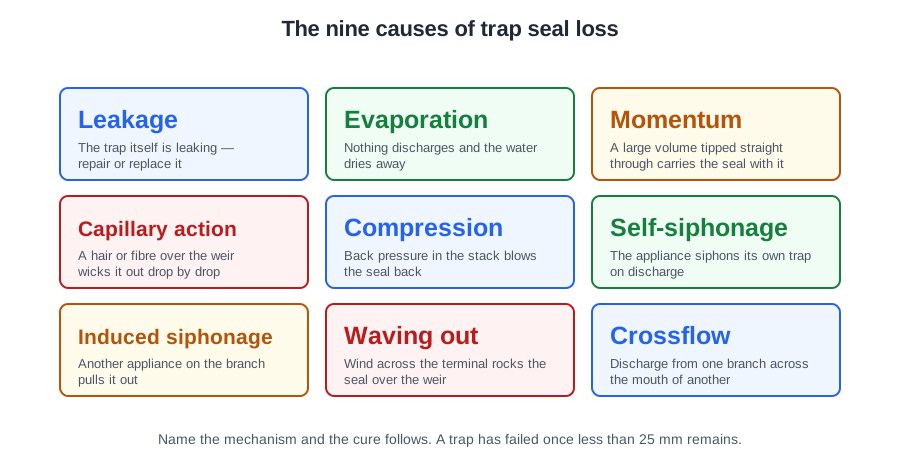
The nine causes of trap seal loss
This is the heart of the topic and the most reliably tested content in the whole drainage unit. Learn the nine causes, the mechanism of each, and the remedy.
1. Leakage. The simplest cause — water leaks from the trap joint, and there's no seal left. Remedy: repair or replace the trap.
2. Evaporation. Most common in appliances that haven't been used for a long time (a holiday home, an unused guest bathroom). The water in the trap slowly evaporates and the smell returns. Remedy: run water into the appliance to refill the trap. This is also why decommissioning an appliance requires removing the trap and associated pipework back to the stack — evaporation would otherwise leave an unused dead leg of pipe venting sewer gases into the property.
3. Momentum. Water discharging fast and straight into a trap can push the seal water through with it, leaving the trap empty. Remedy: slow the water down before it reaches the trap — typically by changing the pipe layout so there's a gentler approach.
4. Capillary action. String, hair, or rags caught in the trap act like a wick, drawing water up and over the lip by capillary action (the same force that pulls water up a paper towel when you dip one end in water). Remedy: clean out the trap.
5. Compression. Positive pressure build-up at the base of the stack. When lots of water rushes down from upper floors, it compresses the air below it and pushes the pressure back up through the nearest appliance traps — forcing sewer gases through. Remedy: raise the affected connection higher above the base of the stack. This is why the course material specifies minimum distances between the lowest branch connection and the invert of the drain — to leave enough room to absorb compression pressure without reaching the first trap.
6. Self-siphonage. When an appliance discharges, its water fills the pipe and pushes the air ahead of it, creating negative pressure behind. That negative pressure "pulls" the water in the trap through into the pipe, emptying the seal. Remedy: fit an anti-siphon valve (which lets air in to counter the negative pressure) or ensure the pipework is properly vented.
7. Induced siphonage. Same mechanism as self-siphonage, but caused by a different appliance discharging. Example: a bath and a basin share a branch pipe. When the bath discharges, its water creates negative pressure that sucks the basin trap through. Remedy: anti-siphon valve or separate the branches.
8. Waving out. Caused by wind blowing over the top of the vent pipe. The wind creates low pressure above the vent, which pulls the trap seals out. Remedy: fit a vent cowl to the top of the stack — it deflects the wind so no low-pressure area forms at the vent outlet.
9. Crossflow. When branch discharge pipes connect to the stack too close to each other, the discharge from one can cause pressure fluctuations that affect the trap seal on the other branch. Remedy: follow the exclusion zone rules for branch connections — typically a 200mm exclusion zone opposite a 110mm pipe discharging into a stack. Crossflow prevention is covered in more detail in the stack systems post.
See it happen: break a trap seal yourself
Cause 6 above is the one people find hardest to picture, because nothing about it is visible from outside the pipe. So here is the actual simulator from the Level 2 course — the same one our learners use. Pick a cause, press ▶ Play, and watch the seal go. Then change the branch length or the fall and watch it hold.
No account needed. Nothing to install.
That is one of eight simulators, alongside 750 interactive tasks across Levels 1, 2 and 3. They save your score when you are signed in. Try the lot free for 14 days — no card needed.
Anti-siphon traps and air admittance valves
Most of the siphonage-based trap seal loss mechanisms can be prevented with one of two components:
- Anti-siphon trap — a trap with a built-in valve that opens to let air in when negative pressure develops, breaking the siphon before the seal is lost. All of the standard trap types are available in an anti-siphon version.
- Air admittance valve (AAV) — a similar principle on the pipe run rather than the trap itself. Particularly useful where access to a trap is difficult, or where a ventilated stack isn't practical (see the stacks post for more on stub stacks with AAVs).
Both work by admitting air into the pipework when pressure drops, equalising the pressure before the trap seal is affected.
Performance testing traps
Every trap you install needs a performance test. The process:
- Fill the appliance with water and let it drain fully
- Once drained, check the depth of seal remaining with a dip stick or small transparent tube
- The seal must be at least 25mm deep after discharge
- Repeat the test at least three times, refilling the trap between tests
- Take the lowest seal depth as the significant result
If multiple appliances share a branch, test them individually first, then simultaneously (to check for induced siphonage). Trap seals must be at least 25mm in both cases.
Common exam traps
Trap 1: Two different reasons for a 50mm seal — don't merge them. Only baths and showers are "flat-bottomed": they trickle water back into the trap after discharge, and that is why they're allowed 50mm. WC pans also get 50mm, but because of their large bore, which will not run full. Basins and sinks get neither allowance and need 75mm, even though a sink might look flat-bottomed to you.
Trap 2: Bottle trap on a kitchen sink. Bottle traps block easily and shouldn't be used where lots of particles flow through — so NOT on a kitchen sink. This is a reliable multiple-choice question.
Trap 3: Minimum seal after performance test. 25mm minimum seal remaining. Not 50mm, not 75mm — the test is about confirming the seal hasn't been destroyed, not that it's at full depth.
Trap 4: Self vs induced siphonage. Self = the appliance's own discharge breaks its own seal. Induced = a different appliance's discharge breaks the trap seal on a shared branch. Questions test which mechanism is which, so read carefully.
Trap 5: Waving out remedy. Vent cowl, not extending the vent or adding AAVs. Exam questions test whether you know the specific remedy for the specific cause.
Quick revision summary
Before the mock test, seven things you need to be able to produce from memory:
- Standard trap seal depth = 75mm on a primary ventilated stack; 50mm for WCs, baths and showers (and anything on a discharge pipe over 50mm)
- Six trap types: S, bottle, P, running, shower, bath (plus self-sealing valve as an alternative)
- Nine causes of trap seal loss: leakage, evaporation, momentum, capillary action, compression, self-siphonage, induced siphonage, waving out, crossflow
- Self-siphonage = own discharge; induced siphonage = another appliance's discharge
- Anti-siphon trap or AAV prevents siphonage-based failures
- Waving out remedy = vent cowl
- Performance test: minimum 25mm seal remaining after 3 repeated tests
📝 10-Question Mock Test
Click an option to see whether you got it right. Explanations appear instantly — no submitting at the end.
That's the trap's entire purpose. Options A, C and D describe things traps don't do — waste flow isn't meaningfully slowed, debris is handled by other components (or passes through), and noise reduction isn't the point.
Bottle traps block easily because of their internal geometry — fine for bathrooms, bad for kitchens where food particles and grease are flowing through. The other three trap types are all acceptable for kitchen sinks.
Standard trap seal depth for a wash hand basin connected to a stack is 75mm. The 50mm allowance applies to flat-bottomed appliances (baths and showers), and to appliances on a discharge pipe over 50mm diameter — which is why a WC pan also gets 50mm. A basin is neither. 25mm (A) is the minimum after a performance test — not the design minimum.
The slight fall on a bath or shower base means water drains gradually, with the last of it trickling into the trap and refilling any lost seal. This compensates for the shallower 50mm seal being used.
The water from the basin itself creates negative pressure behind it as it discharges, which sucks the trap seal through into the pipe. "Self" because the appliance that suffers the seal loss is the same one that caused it. Option D (induced) is the same mechanism but caused by a different appliance.
Water from one appliance creates negative pressure that pulls the seal out of a different appliance's trap on the same branch. Classic example: a basin and bath share a branch pipe, and the basin's trap loses its seal when the bath discharges.
Wind blowing over the vent outlet creates low pressure at the top of the stack, and that low pressure propagates down and pulls trap seals out. None of the other options describe wind-driven seal loss.
A vent cowl deflects the wind so no low-pressure area forms at the vent outlet. Anti-siphon valves (A) address different mechanisms (self/induced siphonage). Increasing the vent height (B) doesn't necessarily fix the wind problem. Bottle traps (D) don't help at all.
Minimum acceptable seal after a performance test. The test discharges the appliance fully and then checks what's left — a shallow seal remaining is acceptable; no seal at all isn't. Full design seal depth (75mm) isn't expected after test — some is allowed to disappear.
Self-sealing valves don't rely on a water seal at all — they use a collapsible rubber membrane that opens under flow and closes when flow stops. Because there's no water seal to lose, the standard trap seal loss mechanisms don't apply.
How PlumbMate puts this into practice
Trap seal loss causes and remedies are exactly the kind of content spaced repetition handles best: nine specific mechanisms, each with a specific remedy, all reliably testable.
- Flashcards, not essays. One prompt, one answer — the format that research has consistently shown works best for active recall.
- Wrong answers are logged. Every question you get wrong goes into a dedicated collection that resurfaces more frequently in future sessions.
- The 3× rule. You need to get a question right three times before it clears — one lucky guess isn't enough.
- Explanations on every question. Like the ones above, but on every single question in the app.