Drainage is the unit students reliably underestimate. It's not as technically intimidating as heating or electrical, and it doesn't get the coverage on plumbing TikTok that boilers and showers do. So revision tends to get pushed back until the week before the exam — and then there are suddenly nine causes of trap seal loss, four stack systems, two different soundness tests, and a whole parallel rainwater system to learn. The good news is that the content is genuinely learnable in a sensible timeframe if you start early and treat it with the respect it deserves.
This guide is the single-page overview: what the unit covers, which concepts matter most, where students reliably lose marks, and how to build a revision routine that makes the material stick. Each of the six main topics has its own deep-dive post with a full 10-question mock test and explanations — this page links out to all of them.
Why drainage feels harder than it is
There are three reasons students over-estimate how hard this unit is — and one key insight that makes the whole subject much more tractable.
First, the vocabulary is unfamiliar. Crossflow, induced siphonage, waving out, compression, capillary action — these are words you don't meet in any other unit. It can feel like learning a new language. The good news: every term names something simple. Once you know what waving out actually is (wind blowing over the vent), the name stops feeling technical.
Second, the mechanisms are invisible. You can't see a trap seal being sucked through a pipe by negative pressure. You can't see air being compressed at the base of a stack. Topics you can't watch in action are harder to learn than topics you can. Drawing simple diagrams of each mechanism — just arrows showing where the water goes and where the air goes — makes them far more memorable.
Third, the material is heavy on specific numbers. Trap seal depths, pipe sizes, distances from the invert, clip spacings, vent clearances, test pressures. Students try to reason these out as if they were principles when they're actually facts to drill. Spaced repetition clears them fastest.
The key insight that unlocks everything: every rule in drainage follows from one of two underlying principles:
- Keep sewer gases out of the building — water seals, traps, vent pipes, vent positions, AAVs on stub stacks
- Move waste and water away cleanly — pipe sizes, falls, smooth curves, long radius bends, appropriate gradients
Every specific figure in the course material exists because something goes wrong if it's ignored — either sewer gases end up inside or water stops flowing. If you can classify a rule by which principle it protects, the rule itself is easier to remember.
The six areas you need to master
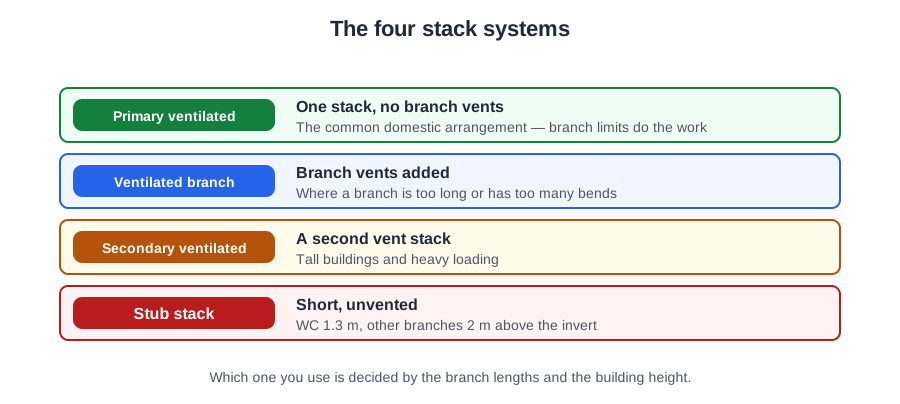
Level 2 drainage breaks down into six main blocks. Each one has its own deep-dive post; the summaries below give you enough to decide where your gaps are.
1. Traps and trap seal loss
The foundational topic. Understand this and everything else in the unit makes more sense. Miss it and nothing else sticks.
The core facts:
- Six main trap types: S, bottle, P, running, shower, bath — plus the self-sealing valve (which uses a collapsible membrane and doesn't rely on a water seal at all)
- Standard trap seal depth: 75mm on a primary ventilated stack; 50mm for WCs, baths and showers (and anything on a discharge pipe over 50mm)
- Nine causes of trap seal loss: leakage, evaporation, momentum, capillary action, compression, self-siphonage, induced siphonage, waving out, crossflow
- Self-siphonage: the appliance's own discharge breaks its own trap seal (fix: anti-siphon valve)
- Induced siphonage: another appliance's discharge breaks the trap seal (fix: anti-siphon valve)
- Waving out: wind over the vent creates low pressure at the top of the stack (fix: vent cowl)
- Performance test: discharge appliance fully, check with dipstick that at least 25mm seal remains, repeat 3 times
For the full treatment plus a 10-question mock test, see the traps and trap seal loss deep-dive.
2. Stack systems and branch pipework
How the discharge pipework gets from every appliance down to the underground drain. Lots of specific sizing rules that examiners test reliably.
The numbers to commit to memory:
- Four stack systems: primary ventilated, secondary ventilated, ventilated branch discharge, modified one-pipe — plus stub stacks with AAVs
- Stack sizing rule: stack must be at least as big as the largest connection to it
- Stack vent minimum: 75mm; outlet positioned 3m horizontal from any opening OR 0.9m above the highest opening
- Birdcage on the vent outlet; vent cowl if exposed to wind
- Stub stack: AAV fitted above the spillover level of the highest appliance
- Base-of-stack bend: 200mm minimum radius
- Lowest branch connection: at least 450mm above invert on buildings up to 3 storeys; 750mm on buildings over 3 storeys; ground floor appliances on buildings over 5 storeys should not be connected to the main stack at all
- Crossflow exclusion: 200mm opposite a 110mm soil branch; 90mm for 82mm stack; 110mm for 110mm stack
- Gully discharge: below the grid, above the water seal
For the full deep-dive and mock test, see the stack systems and branch pipework post.
3. Pipe materials, jointing and fittings
The practical "how do you physically connect the pipework" block. Three jointing methods, five common plastics, and a set of special fittings worth knowing.
The core facts:
- Five drainage plastics: PP (polypropylene), ABS, PVC, uPVC, MuPVC
- ABS is most susceptible to UV damage — becomes brittle in sunlight
- Polypropylene cannot be solvent welded — only pushfit or compression
- Three jointing methods:
- Solvent weld: permanent chemical bond; dry-assemble first, apply to pipe and fitting, quarter turn on insertion, hold 30 seconds; solvent cement is a COSHH hazard
- Pushfit (ring seal): cut square, chamfer, deburr, silicone lubricant, push home, pull out 10mm for expansion
- Compression: rubber seal tightened by nut; ideal for connecting pipes of slightly different diameters (e.g. PP to ABS)
- Oil-based materials damage plastic — never use linseed oil putty on plastic pipework
- Fittings should use smooth swept curves for low-pressure waste flow
For the deep-dive and mock test, see the pipe materials, jointing and fittings post.
4. Underground drainage systems
Below-ground pipework is a smaller block at Level 2, focused on system types and connections rather than detailed installation.
The core facts:
- Three underground systems: separate, partially separate, combined
- Combined system: foul water and surface water in one pipe — every rainwater pipe needs a gully trap at the base
- Separate system: two pipes; surface water discharges to a stream, river, or soakaway
- Partially separate: hybrid, some surface water in the main sewer, some separate
- Gully discharge rule: waste pipes discharge below the grid but above the water seal
- WCs and urinals cannot discharge to a gully — soil stack or direct to drain only
For the deep-dive plus mock test, see the underground drainage and gullies post.
5. Rainwater and guttering systems
The parallel system — catching rainwater off the roof and taking it to the drainage without eroding the building. Lots of specific figures around bracket and clip spacings.
The numbers to commit to memory:
- Four gutter profiles: ogee, half round, square, deepflow (high capacity)
- Gutter bracket spacing: 1000mm maximum standard; 750mm in heavy snow/wind exposure; support within 150mm of every fitting
- Downpipe clips (for 68mm domestic): 2.0m maximum vertical; 1.2m maximum horizontal
- Gutter fall: 1:600 minimum recommended
- Expansion gap: 10mm at every gutter fitting (PVC-u expands about 0.06mm per metre per °C)
- Rainwater harvesting: untreated rainwater is for toilet flushing only — not drinking, not cooking
- Gutter maintenance PPE: face mask (parasites in bird droppings), goggles, waterproof gloves
- Stand-off on the ladder to protect the gutter during maintenance
For the deep-dive plus mock test, see the rainwater and guttering post.
6. Drainage testing and maintenance
The end of the commissioning chain and the ongoing maintenance schedule. Heavy on specific procedures.
The core facts:
- Plastic above-ground sanitary pipework is soundness tested with AIR (not water) — at 38mm water gauge, held for minimum 3 minutes
- Smoke testing must NOT be used on plastic — the smoke damages the plastic; use soap solution instead
- Performance test: discharge appliance, measure seal with dipstick or transparent tube, minimum 25mm remaining, repeat 3 times, take the lowest seal depth as the result
- Maintenance schedule lists the works to be carried out; maintenance record logs what's been done
- Four blockage tools: force cup (basins/sinks/WCs), gulley grab (gullies), drain rods (below-ground), drain auger (flexible pipework)
- Permanent decommissioning: cap the pipe as far back as possible (typically to the stack) to prevent stagnation
- Open-ended pipework on a live system is sealed with stop ends — not tape, not plugs, not crimping
For the deep-dive plus mock test, see the testing and maintenance post.
Four exam-technique habits that apply across the whole unit
Before you dive into the revision itself, four habits worth building now. These apply across the whole drainage unit and they're the difference between students who know the material and students who can show they know it in a 40-question multiple-choice exam.
Draw the trap seal loss mechanisms from memory. Every one of the nine causes has a characteristic mechanism — water pushing, wind sucking, pressure compressing, capillary climbing. Draw each one as a simple diagram with arrows for water movement and arrows for air movement. Once you can sketch them, the remedies follow naturally — and remedies are what examiners test.
Memorise the specific numbers; don't try to derive them. Trap seal depths (75mm, 50mm, 25mm), pipe sizes (32, 40, 50, 82, 110), distances (450mm, 750mm, 200mm, 3m, 0.9m), clip spacings (1000mm, 750mm, 2.0m, 1.2m), test pressures (38mm water gauge, 3 minutes). These are facts. Flashcards clear them fastest.
Know which test goes with which pipework. Water pipework (in other units) is tested with water at 1.5× working pressure. Plastic above-ground sanitary pipework is tested with air at 38mm water gauge for 3 minutes. Keep these separate in your head — it's a classic trap where students apply the water-test answer to a drainage question.
Pair every fault with its remedy. Waving out → vent cowl. Compression → raise the connection height. Self-siphonage → anti-siphon valve. Capillary action → clean the trap. Exam questions test this pairing reliably — either giving you the cause and asking for the remedy, or giving you the remedy and asking what problem it addresses.
Building a revision routine that actually works
The research on revision is overwhelming and consistent: spaced repetition beats cramming, active recall beats re-reading, and little-and-often beats long weekend sessions. Every credible study on student learning over the last fifty years points to the same conclusions.
In practical terms:
- Use flashcards, not re-reading. Passive reading feels productive and is nearly useless for exam recall. Active recall — forcing your brain to produce the answer before checking it — is what builds long-term memory.
- Little and often. Three ten-minute sessions across the day beat one thirty-minute block, and both beat a three-hour cram the night before.
- Revisit at increasing intervals. If you get a fact right today, don't retest it tomorrow — test it in three days. If you get it right again, test it in a week. This is the spacing that beats the forgetting curve.
- Focus on what you don't know. There's no point drilling yourself on the stuff you already know cold. Spend your time on the material you keep getting wrong.
For the full treatment of this method, see the spaced repetition guide — which also covers how PlumbMate operationalises it.
A recommended revision order
Drainage is the same size as heating — larger than science or electrical — so give yourself more time than you might first expect. If you've got six weeks to the exam and you're starting from scratch, here's a sensible sequence:
Week 1: Traps and trap seal loss. The foundational topic. Understand the nine mechanisms and their remedies before moving on. Everything else in the unit applies or extends these concepts.
Week 2: Stack systems and branch pipework. Applies trap seal mechanisms at scale — stack sizing, vent positioning, crossflow, base-of-stack rules. Lots of specific figures.
Week 3: Materials, jointing and fittings. The practical installation content. Three jointing methods, five plastics, common fittings. Fact-heavy but highly drillable.
Week 4: Underground drainage and gullies. Short topic relative to the others. Three system types, gully rules, and the WC-can't-go-to-gully point. A good week to consolidate material from weeks 1–3 in parallel.
Week 5: Rainwater and guttering. A parallel system with its own components but many of the same principles (falls, clipping, expansion). Heavy on specific numbers — bracket spacings, fall ratios, clip spacings.
Week 6: Testing and maintenance. The closing block — commissioning, testing, blockages, decommissioning. Specific procedures with specific numbers. Also a natural point to cross-link back to the testing content from other units.
Mock tests and weakness-targeting. Do the 10-question mock tests in all six deep-dives. Anything you get wrong, mark and re-drill. The last week isn't for learning new material — it's for turning wobbly knowledge into exam-ready knowledge.
If you've got less than six weeks, compress the schedule but keep the order. If you've got more, spend the extra time on mock questions rather than re-reading notes.
Don't overthink it
Drainage looks like a pile of disconnected rules and unfamiliar words. It isn't. It's a small number of systems (traps, stacks, underground, rainwater) governed by two principles (keep sewer gases out, move waste away cleanly) with specific numbers attached to the rules that make each system work. Every figure in the course material exists because something fails if you ignore it.
The students who pass first time aren't the ones who've memorised a list of disconnected numbers. They're the ones who understood the underlying logic of each system, drilled the specific figures consistently, and used active recall instead of re-reading.
How PlumbMate puts this into practice
PlumbMate covers the full Level 2 drainage syllabus with spaced repetition built in — exactly the method described in the revision section above.
- Flashcards, not essays. One prompt, one answer — the format that research has consistently shown works best for active recall.
- Wrong answers are logged. Every question you get wrong goes into a dedicated collection that resurfaces more frequently in future sessions.
- The 3× rule. You need to get a question right three times before it clears — one lucky guess isn't enough.
- Explanations on every question. So you learn the logic rather than memorising answers.