Three major H&S topics that don't fit neatly into the other posts but all come up reliably in Level 2 exams. Fire safety is particularly relevant to plumbers because we use naked flames (blowtorches) more than most trades. Manual handling affects every plumber every day — cylinders, radiators, cast-iron baths, boxes of fittings. And noise-induced hearing loss is a growing concern in construction that often doesn't reveal itself until decades after the exposure.
This post is the sixth and final deep-dive in the Level 2 Health and Safety sub-cluster. For the others, see the legislation, risk assessment and accidents, PPE and signs, hazardous substances, and working at height and excavations and confined spaces posts.
Fire triangle
Fire needs three things to burn:
- Oxygen (from the air)
- Heat (ignition source and continued heat)
- Fuel (the burning material)
Remove any one of the three and the fire goes out. This is the fundamental principle behind every fire-fighting technique — removing fuel (starving), removing heat (cooling), or removing oxygen (smothering).
The fire triangle is sometimes tested by name: "A fire needs three basic things to burn, this is referred to as the..." — answer is the fire triangle. Not "burning circle", not "pyramid of fire", not "fire quadrant."
Six classes of fire
Different fuels require different fire-fighting approaches. The six classes you need to know:
| Class | Type of fuel | Examples |
|---|---|---|
| Class A | Solids | Wood, paper, plastic, curtains, sofas |
| Class B | Flammable liquids | Paraffin, petrol, oil, paint |
| Class C | Flammable gases | Propane, butane, methane, LPG |
| Class D | Metals | Aluminium, magnesium, titanium |
| Class E | Electrical fires | Cabling, computers, consumer units |
| Class F | Cooking oils and fats | Chip pan fires |
Memory aid (fuel by state): A = solid; B = liquid; C = gas; D = metal (specialised solids); E = electrical; F = cooking fats (specialised liquids). The classification helps you pick the right extinguisher.
Fire extinguisher colours and uses
UK fire extinguisher colour coding is standardised. Every extinguisher is mostly red with a coloured band (or label) indicating the type. Memorise this table — exam questions test extinguisher-to-fire matching directly.
| Extinguisher type | Colour band | Use on |
|---|---|---|
| Water | Red (plain red body) | Class A only |
| Foam | Cream | Class A and B |
| CO₂ | Black | Class B and electrical |
| Powder (ABC) | Blue | Classes A, B, C and electrical |
| Wet chemical | Yellow | Class F (cooking fats) |
Key exam points from the course material:
- A red fire extinguisher (plain) = water — used on wood/solid fires
- Red with a black band = CO₂ — used on electrical fires (and Class B)
- Red with a cream band = foam — used on petrol/flammable liquids
- Red with a blue band = powder — used on multiple classes
Critical: ABC Powder extinguisher should NOT be used on:
- Class D fires (metals) — powder can react dangerously with burning metals
- Class F fires (cooking oils) — powder can spread the burning oil
Powder is versatile (A, B, C, electrical) but not universal — the metal and cooking oil exceptions catch students out on exam questions.
Fire scenario questions
The course material tests practical fire scenarios. Classification practice:
- Petrol fire → Class B (flammable liquid)
- LPG fire → Class C (flammable gas)
- Wood and rags fire → Class A (solids)
- Magnesium fire → Class D (metal)
- Burst gas main fire → Class C (flammable gas)
What extinguishers for a burst gas main fire? The best approach for a gas fire is actually to shut off the gas supply (remove the fuel from the fire triangle). If that's not possible, dry powder can help suppress the flames, but a gas fire should generally be left for the fire service — the priority is evacuation.
Emergency procedure — site propane cylinder fire
The course material's specific question: "What should be the sequence of action if a fire occurs in a site propane cylinder store?"
Correct sequence: Raise the alarm → move to a safe distance → phone the emergency services.
Not:
- Attempt to put out with an extinguisher first (propane cylinder fire could BLEVE — boiling liquid expanding vapour explosion)
- Move the LPG to a safe location (handling a burning cylinder is extremely dangerous)
- Attempt extinguishing before raising the alarm
The principle: for serious fires involving pressurised cylinders, explosives, or anything where attempting to extinguish could endanger the person, evacuate first and call the professionals. Small fires on a workbench are different — a fire extinguisher within arm's reach is the right response.
The PASS method for extinguisher use
If you're using a fire extinguisher:
- P — Pull the safety pin
- A — Aim the nozzle at the base of the fire
- S — Squeeze the handle
- S — Sweep from side to side
Key safety points:
- Use the correct extinguisher for the situation — wrong type can make things worse (water on oil = fire spreads; CO₂ incorrectly used = freeze burns or asphyxiation)
- Don't fight a fire that's already bigger than you can handle — evacuate and call 999
Hot work in plumbing
Plumbers use naked flames (blowtorches) more than most trades. Specific precautions:
- Clear the area of flammables before soldering (wood shavings, paper, rags, insulation)
- Use a heat-proof mat behind the joint being soldered
- Remove insulation for at least 300mm from a pipe before soldering — hot metal can ignite lagging material
- Keep an extinguisher to hand when soldering — ready immediately, not in the van
- Dampen the area after soldering — residual heat can start a fire later
- Don't leave the site for an hour after soldering — smouldering fires can develop while you're away
Fire escape routes must be kept clear. If you're working in a corridor that's a fire escape route, your tools and equipment must not block it. Fire escapes clear of obstructions save lives.
LPG safety
LPG (Liquefied Petroleum Gas) covers propane (red bottle) and butane. Widely used by plumbers for blowtorches.
LPG key facts:
- Heavier than air — if there's a leak, gas sinks to the ground, collects in low areas (excavations, cellars, drains)
- Stored and used upright — prevents liquid rather than gas being discharged
- Dust caps protect threads during storage
- LPG is most dangerous in excavations because of the heavier-than-air property — gas collects and pools in low areas
Working with an LPG blowtorch — the main danger is fire. Not poisonous fumes (some exposure but not the main risk), not cold burns (only on contact with liquid LPG escaping at pressure), not toxic gases.
Gas bottle colours
UK industrial gas bottles are colour-coded by content:
- Propane (LPG) — red
- Butane (LPG) — blue (older) or various (some modern bottles vary)
- Acetylene — maroon
- Oxygen — black
- Nitrogen — grey
When assembling oxy-acetylene equipment, check both cylinders, both gauges, and all hose connections for leakage. Not just one cylinder, not just hose connections — everything.
Manual Handling Operations Regulations
Manual handling injuries are one of the largest categories of workplace injury in the UK. The regulations require employers to reduce manual handling risks.
The hierarchy of controls applies:
- Avoid manual handling where possible — can the task be done mechanically?
- Assess the risk — weight, distance, shape, stability, environment, individual capability
- Reduce the risk — mechanical aids, team lifting, breaking loads into smaller parts
- Train workers in safe lifting techniques
Before lifting — what to consider
Before lifting a load:
- The weight of the load — can you actually lift it?
- The path you have to travel — any obstructions, slippery surfaces, narrow doorways, stairs?
- Can the task be done mechanically? — trolleys, pallet trucks, lifting gear
- Your own physical condition — any recent back injuries?
All four considerations matter — the course material's answer to "What should you consider before lifting a load?" is all of the above.
How much is too much?
The real rule is that you must not lift more than you are comfortable lifting. There is no legal maximum weight in the Manual Handling Operations Regulations, and that is deliberate — the same load is easy for one person and an injury waiting to happen for another, depending on build, health, the height you are lifting from, how far you have to carry it and whether you can get close to it.
The figures usually quoted as a guideline are:
- 25kg for men
- 16kg for women
Both assume the ideal case: the load held close to the body, at around waist or knuckle height, with no twisting or carrying. They are a filter for deciding when to look harder at a lift, not a permit up to that weight and a ban above it. You may safely handle more than the guideline, or you may need to handle considerably less — a 20kg boiler held out at arm's length above your head is a far worse lift than 25kg held against your waist.
If it does not feel comfortable, it is too heavy: get a trolley, split the load, or get a second pair of hands.
Safe lifting technique
The standard technique:
- Assess the load before lifting
- Feet apart, one foot slightly forward for balance
- Bend the knees, keep the back straight
- Grip the load firmly
- Lift smoothly using the legs, not the back
- Keep the load close to your body
- Avoid twisting — turn with your feet, not your waist
- Set the load down carefully using the same technique in reverse
When a load is too heavy
If a load is too heavy to carry, use a trolley. Not rolling it along the ground (damages the load and the floor). Not leaving it for someone else (potentially creating a manual handling risk for them). Not dragging it along (damages both load and worker's back).
Heavy loads should be divided into lighter loads where possible. Not carried on the shoulder, not dragged, not left until help arrives. If a load genuinely can't be divided or mechanically handled, team lifting with multiple people is the alternative.
Reporting previous injuries
If you've suffered from back injuries in the past and your new job requires manual handling: inform your supervisor before starting. Not "carry on and tell them if you get hurt again"; not "pretend there's no problem"; not "always ask a colleague for help."
Your employer needs to know about pre-existing conditions to assess risk and make reasonable adjustments. Hiding a previous injury puts you at greater risk of re-injury and makes the employer's risk assessment invalid.
If you have an idea for a safer way of carrying a load: bring it to your supervisor's attention. Don't just do it your own way; don't ignore your idea; don't let colleagues decide.
If you're injured carrying a load: tell your supervisor or employer immediately. Not just your working companion; not your doctor first; not "carry on as best you can."
Using a trolley — still manual handling?
Yes, using a trolley is still manual handling. The Manual Handling Regulations apply to any transport of a load by bodily force — pushing, pulling, lifting, lowering. A trolley reduces the load on your body but doesn't eliminate it; bad trolley technique (pulling, using wrong posture, overloading) still causes injuries.
Control of Noise at Work Regulations
Hearing is a delicate sense and noise-induced hearing loss is permanent — if your hearing is lost, it is lost forever. The regulations exist to prevent this.
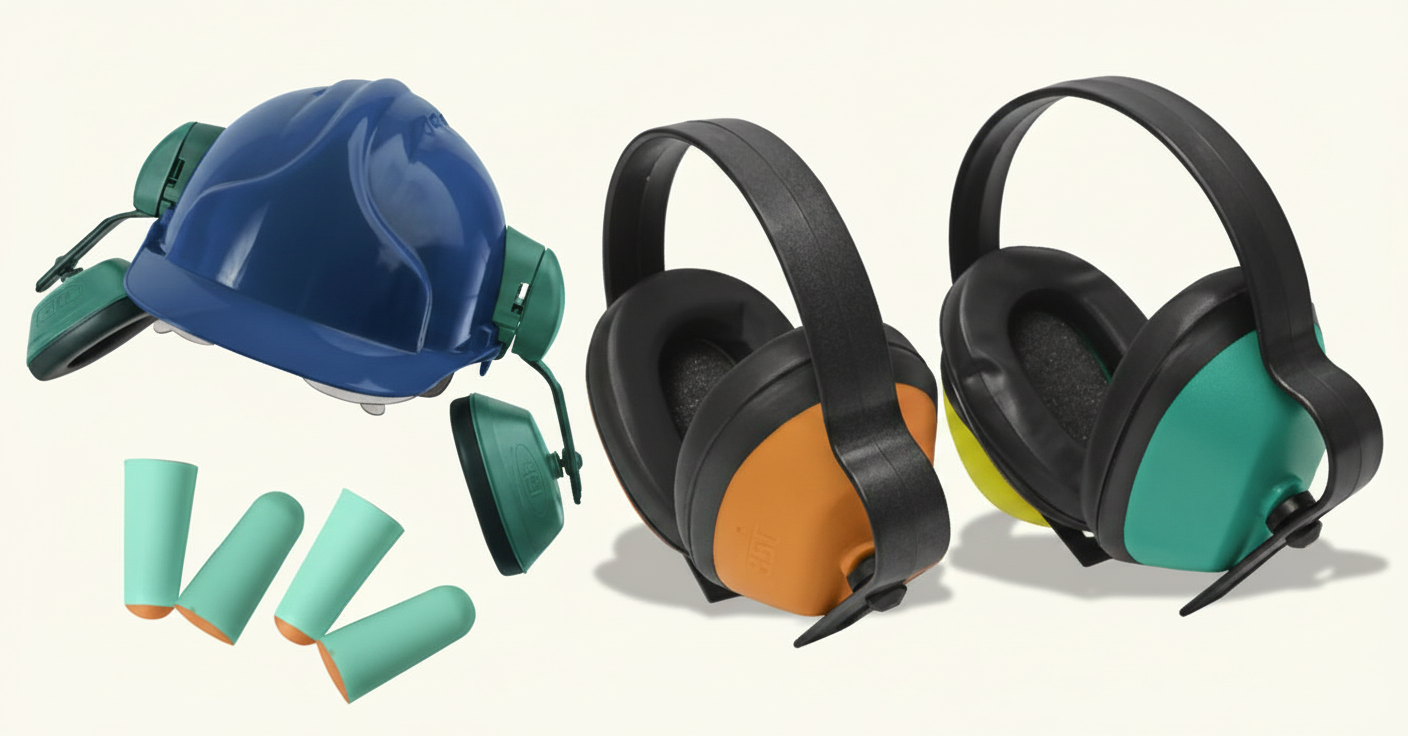
The two key thresholds:
- 80dB — hearing protection must be available on request
- 85dB — hearing protection must be provided (and use is mandatory in the affected area)
The 2-metre conversation test: if surrounding noise prevents you from hearing someone talking to you (without them raising their voice) from 2 metres away, noise levels are approaching the action thresholds — request hearing protection.
Tinnitus
Tinnitus = permanent ringing or buzzing in the ears. Caused by damage to the inner ear from excessive noise or sudden loud sounds. Can range from mildly annoying to severely disabling (affecting sleep, concentration, mood).
Tinnitus is permanent — once you have it, there's no cure. Prevention through hearing protection is the only effective strategy.
Hand-Arm Vibration Syndrome (HAVS) and Vibration White Finger (VWF)
Vibrating tools (drills, grinders, breakers, sanders) transfer vibration through the grip to the hands and arms, causing nerve and blood vessel damage over time.
Symptoms:
- Numbness and tingling in fingers
- Whitening of fingers (reduced blood flow — hence "white finger")
- Reduced grip strength
- Pain in the hands, particularly in cold conditions
Progression is usually gradual — early symptoms may be temporary; later stages are permanent and can lead to disability.
Prevention:
- Don't grip tools too tightly — minimum grip needed to control the tool
- Hold the tool close to the body (not at arm's length, which increases vibration transfer)
- Use the minimum force needed — let the tool do the work
- Rotate tasks — don't do vibrating work all day every day
- Use vibration-reducing gloves
- Maintain tools — worn bearings increase vibration
- Keep hands warm — cold worsens the circulation effects
The standard advice for using vibrating tools: don't grip too tightly. Not hold at arm's length; not use more force; not hold more tightly.
Running cables — general electrical safety awareness
From the course material, a specific rule for running cables (relevant to plumbing work that touches electrical systems):
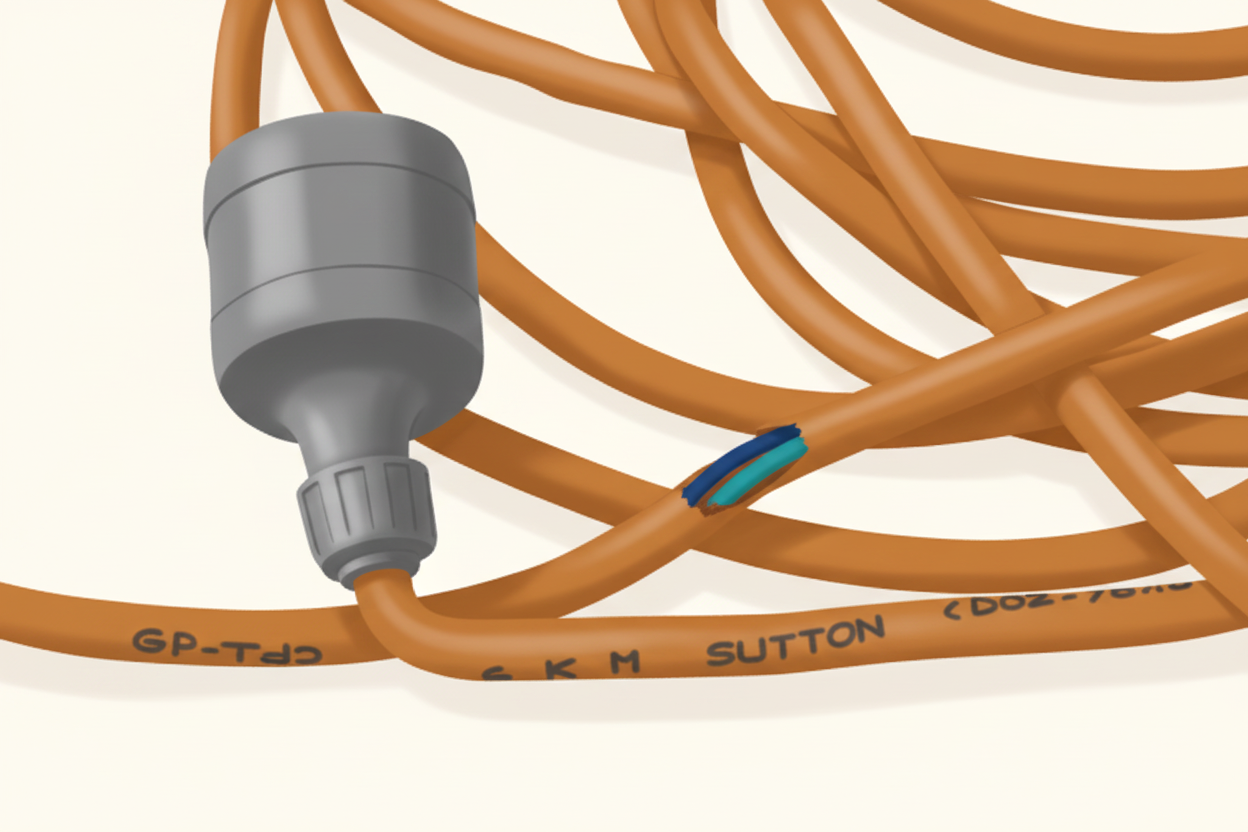
- Cables at least 50mm away from wall or floor surfaces (to protect against nails and screws) OR
- Cables protected by conduit or trunking
- Where a cable passes through metalwork, use a rubber bush or grommet — metal edges can damage soft insulation
This comes up in the electrical principles cluster in more detail but appears on H&S papers because of the fire risk from damaged cables.
Welfare facilities on site
Under the CDM Regulations (covered in the legislation post), the main contractor must provide welfare facilities — toilets, washing facilities, rest areas.
If the toilets on your construction site are always dirty: make sure you can tell someone who can sort it out. Not ignore the problem; not clean them yourself; not use cafés or pubs nearby. Welfare is the main contractor's responsibility; report to them or the site manager.
Common exam traps
Trap 1: Fire triangle = Oxygen + Heat + Fuel. Three things, each removable to extinguish.
Trap 2: Six classes of fire (A/B/C/D/E/F). Not five — E is specifically electrical in the UK classification.
Trap 3: ABC Powder NOT on metals or cooking oils. Versatile but not universal.
Trap 4: LPG/propane cylinder fire response: raise alarm → safe distance → emergency services. Don't try to extinguish.
Trap 5: Noise thresholds: 80dB = available on request; 85dB = must be provided.
Trap 6: Tinnitus is permanent. No cure.
Trap 7: Vibrating tools — don't grip too tightly. Minimum grip to control the tool.
Trap 8: LPG heavier than air — dangerous in excavations. Gas pools in low areas.
Trap 9: Use a trolley for heavy loads. Not drag, not leave, not roll.
Trap 10: All loads considered: weight + path + mechanical options + your condition.
Trap 11: Report previous back injuries before starting manual handling work.
Trap 12: Gas bottles: propane = red, acetylene = maroon, oxygen = black, nitrogen = grey.
Quick revision summary
Before the mock test, eight things you need to be able to produce from memory:
- Fire triangle: Oxygen + Heat + Fuel
- Six classes of fire: A solids, B liquids, C gases, D metals, E electrical, F cooking oils
- Extinguisher colours: red/water (A), cream/foam (A+B), black/CO₂ (B+electrical), blue/powder (A+B+C+electrical), yellow/wet chemical (F)
- ABC Powder NOT on Class D (metals) or Class F (cooking oils)
- LPG cylinder fire: raise alarm → safe distance → emergency services
- Noise thresholds: 80dB available / 85dB provided; tinnitus is permanent
- Vibrating tools: don't grip too tightly; rotate tasks; use vibration-reducing gloves
- Manual handling: assess weight + path + mechanical options + own condition; report previous injuries before starting
📝 10-Question Mock Test
Click an option to see whether you got it right. Explanations appear instantly — no submitting at the end.
The three sides of the fire triangle: Oxygen, Heat, Fuel. Wood (A) is an example of a fuel, not the category itself. Blowtorch (B) is an example of a heat source. Nitrogen (C) is actually fire-suppressing because it displaces oxygen.
Petrol is a flammable liquid → Class B. Class A is solids, C is gases, D is metals. Getting petrol wrong (it's liquid not solid) is a reliable error to avoid.
Wood and rags are solids → Class A. Classic Class A materials: wood, paper, plastic, fabric, cardboard. The most common class of fire in most environments.
Cream band = foam extinguisher. Foam works on Class A and B — so most effective on petrol (B) from the options given. Water (red/plain) would be used on wood. Electrical and gases need different extinguishers.
Black band = CO₂ extinguisher. CO₂ is the standard choice for electrical fires because it doesn't conduct electricity (unlike water). CO₂ also works on Class B fires (flammable liquids).
ABC Powder works on Classes A, B, C and electrical but NOT metals (Class D) — powder can react dangerously with burning metals. Metal fires require specialist Class D extinguishers. Options A (wood), B (gases) and C (electrical) are all fire types where ABC Powder would be appropriate.
A propane cylinder in a fire could BLEVE (boiling liquid expanding vapour explosion) — potentially catastrophic. Don't attempt to fight or move the cylinder; evacuate and call the professionals.
At 85dB, hearing protection must be provided and used. At 80dB, protection is available on request. Above 85dB is mandatory; below 80dB doesn't require protection under the regulations.
Tight gripping increases vibration transfer through the hands. Minimum grip needed to control the tool is the goal. Options B (arm's length) makes control worse and doesn't reduce vibration. Options C and D are the wrong direction entirely.
Mechanical aids are the standard response to loads too heavy to carry safely. Rolling (B) damages the load and the floor; leaving for someone else (C) transfers the manual handling risk; dragging (D) damages both load and worker's back.
How PlumbMate puts this into practice
Fire, manual handling and noise content is heavy on specific colour codes, threshold figures and classifications — exactly the kind of content spaced repetition handles best.
- Flashcards, not essays. One prompt, one answer — the format that research has consistently shown works best for active recall.
- Wrong answers are logged. Every question you get wrong goes into a dedicated collection that resurfaces more frequently in future sessions.
- The 3× rule. You need to get a question right three times before it clears — one lucky guess isn't enough.
- Explanations on every question. Like the ones above, but on every single question in the app.