Health and Safety legislation is the foundation the rest of the H&S unit is built on. You need to know which acts and regulations apply, what the HSE does, who the Local Authority enforce, what an improvement notice is, and what your responsibilities are as an employee. Get this right first and the rest of the unit becomes manageable — get it wrong and every later topic gets harder than it should.
This post is the first in the Level 2 Health and Safety sub-cluster. For the others, see the risk assessment and accidents, PPE and signs, hazardous substances, working at height and confined spaces, and fire safety and other risks posts.
Why legislation matters
Most of the rules you'll meet in plumbing exist because someone died before the rule existed. Construction is one of the most dangerous industries in the UK — falls from height, electrocution, asbestos exposure, manual handling injuries, carbon monoxide poisoning. The legislation is the statutory framework that keeps the number of injuries and deaths as low as possible.
From an exam perspective: Level 2 expects you to know the names of the key pieces of legislation (including their acronyms), who enforces them, what each one covers at a high level, and the specific responsibilities each places on you and your employer.
Legislation vs guidance
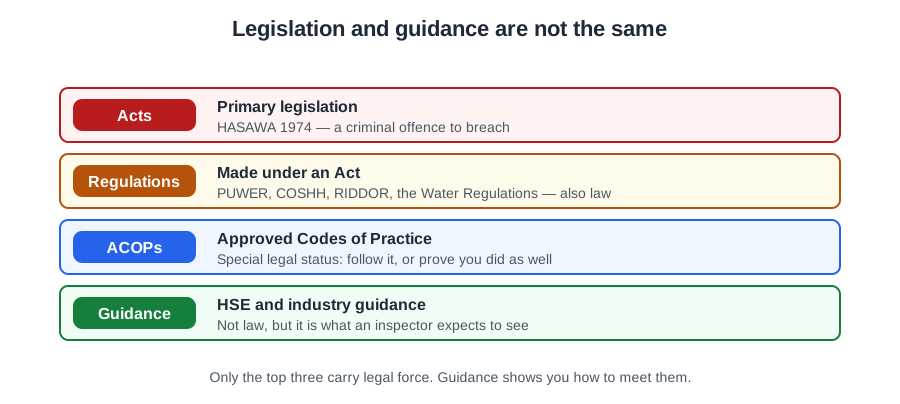
A distinction worth getting clear from the start:
Legislation = law. Acts (like the Health and Safety at Work Act) and Regulations (like the CDM Regulations) are statutory — breaking them can lead to prosecution, fines, or imprisonment. Legal documents finish with the word "Act" or "Regulations."
Guidance = best practice. British Standards (BS), European Standards (EN) and manufacturer installation instructions are not law. Following them typically means you exceed the minimum legal requirements, but they aren't legally binding by themselves.
One important exception — the Approved Code of Practice (ACoP). An ACoP is published by the HSE and carries a special legal status. It is still not a regulation, but if you are prosecuted for breaching the law that ACoP covers, and you did not follow it, you have to prove you achieved the same standard by some other means. In practice, treat an ACoP as the way to comply unless you can demonstrate something equally effective.
Why both matter. If you follow the guidance, you almost certainly comply with the legislation. But legislation is the bottom line — courts enforce Acts and Regulations, not British Standards.
The Health and Safety at Work Act (HASAWA)
The foundational piece of UK safety legislation — passed in 1974, still the basis of all workplace safety law. The full name: Health and Safety at Work Act 1974, usually abbreviated HASAWA or HSWA.
Scope: applies to all places of work. Not just construction sites — offices, factories, shops, hospitals, farms. Every workplace in the UK.
What it sets out:
- Employer responsibilities towards employees and the public
- Employee responsibilities for their own safety and the safety of others
- The principle of "reasonably practicable" — employers must reduce risks "so far as is reasonably practicable" (balancing risk vs cost/effort)
The 5-employee rule: any company employing 5 or more people must have a written Health and Safety Policy. The policy contains three sections:
- General policy on health and safety at work — the company's commitment and aims
- Responsibility section — who is responsible for specific actions
- Arrangements section — what the company does in practice to achieve the policy aims
Arrangements might include: staff training, safety signs, PPE, anti-slip flooring, improved lighting, replacing hazardous chemicals with safer alternatives.
Employer responsibilities under HASAWA
The employer's duties — what they must provide and ensure:
- Safe working environment — maintained premises, safe access and egress
- Safe equipment — maintained, checked, fit for purpose
- Safe systems of work — proper procedures for dangerous tasks
- Relevant training before employees carry out work
- Risk assessments for hazardous activities
- PPE free of charge where needed (see the PPE post for detail)
- Welfare facilities — toilets, rest areas, washing facilities
- Information and supervision — workers know the risks and someone is responsible for overseeing
Employee responsibilities under HASAWA
Your duties as an employee. This part gets tested directly.
- Take reasonable care for your own health and safety, and that of others affected by your actions
- Cooperate with your employer on health and safety matters
- Report hazards — to the employer (or a foreman/supervisor on a construction site)
- Report accidents and injuries — in the accident report book; serious ones to HSE under RIDDOR (covered in post 2)
- Use PPE and equipment as instructed and trained
- Don't misuse or damage safety equipment provided for your protection
Both employers AND employees can be prosecuted under HASAWA for breaching the law. Questions sometimes frame this as "who could be prosecuted?" — the answer is employers and employees (not members of the public, not site visitors, not unauthorised persons).
The CDM Regulations (Construction (Design and Management) Regulations)
Specifically for construction work. Sets out the responsibilities of every role in a construction project, from client to worker.
The key roles under CDM:
Client — the person or company who commissions and pays for the project (e.g. the homeowner having an extension built, or a developer building a housing estate). Responsibilities:
- Check competence and resources of designers and contractors
- Ensure suitable management arrangements for the project
- Ensure welfare facilities are in place (toilets, changing areas, washing facilities)
- Provide pre-construction information to designers and contractors
Designers (architects, structural engineers, services engineers). Responsibilities:
- Eliminate hazards and reduce risks during design
- Provide information about remaining risks
Contractors (main contractor and subcontractors). The main contractor is in overall charge of the site. Responsibilities:
- Plan, manage, and monitor work
- Check competence of appointees and workers
- Train own employees
- Provide information to workers
- Ensure welfare facilities (toilets, rest areas) — this is specifically the main contractor's responsibility
- Provide PPE to employees
Workers (everyone on site, including you). Responsibilities:
- Check own competence
- Cooperate with others and coordinate work for everyone's safety
- Follow risk assessments and method statements
- Report obvious risks (this is a reliably-tested responsibility)
The two "principal" roles
Where a project has more than one contractor — which is most jobs you will work on — CDM 2015 requires the client to appoint two extra duty holders. They are not the same as the designer and contractor roles above; they are coordinating roles that sit over the top of them.
- Principal Designer — plans, manages and monitors the pre-construction phase, and coordinates health and safety during design. Appointed in writing by the client.
- Principal Contractor — plans, manages and monitors the construction phase, coordinates the contractors on site, and draws up the construction phase plan. This is the "main contractor in overall charge of the site" — and it is the Principal Contractor who is responsible for site welfare facilities.
Who enforces safety legislation
Two bodies, each with different areas:
The Health and Safety Executive (HSE). Enforces safety law in:
- Construction sites
- Schools and hospitals
- Heavier industry — oil rigs, mines, farms, manufacturing
The Local Authority. Enforces safety law in:
- Retail (shops, warehouses)
- Hotels and catering
- Offices
- Consumer/leisure industries (care homes, gyms, beauticians, pubs, night clubs)
For plumbing specifically, you'll most often encounter the HSE because most plumbing work is either on construction sites or in buildings covered by HSE jurisdiction (schools, hospitals).
HSE powers — inspectors and notices
HSE inspectors can enter any workplace at any time without advance warning. They have significant legal powers.
Two main enforcement notices they can issue:
Improvement notice — issued when a workplace is not fully compliant with safety regulations, but there is no immediate danger to people. Gives a specified time period to fix the issue.
Prohibition notice — issued when there is a situation of immediate danger. All work must stop in the affected workplace until the issue is corrected. The most serious enforcement action short of prosecution.
Memory aid: Improvement = fix it in your own time. Prohibition = stop now.
Inspectors can also prosecute offenders for breaches of the law. Fines can reach hundreds of thousands of pounds; in the most serious cases, custodial sentences are possible.
Other major pieces of safety legislation
Level 2 expects familiarity with several other Acts and Regulations — covered in detail in later posts in this cluster:
- Management of Health and Safety at Work Regulations 1999 — requires risk assessments; five or more employees triggers written policy requirement (with HASAWA)
- Personal Protective Equipment at Work Regulations 1992 — PPE must be provided free, fit for purpose, replaced if damaged (see PPE post). Amended in 2022: since 6 April 2022 the duty to provide PPE extends beyond employees to “limb (b)” workers — casual and short-term workers on site get the same protection
- Control of Substances Hazardous to Health (COSHH) Regulations 2002 — hazardous chemicals and substances (see hazardous substances post)
- Control of Asbestos Regulations 2012 — specific to asbestos (see hazardous substances post)
- Control of Lead at Work Regulations 2002 (CLAW) — specific to lead (see hazardous substances post)
- Reporting of Injuries, Diseases and Dangerous Occurrences Regulations 2013 (RIDDOR) — accident and incident reporting (see risk and accidents post)
- Work at Height Regulations 2005 — ladders, scaffolds, fall prevention (see working at height post)
- Manual Handling Operations Regulations 1992 — lifting and carrying (see fire/manual handling post)
- Control of Noise at Work Regulations 2005 — hearing protection (see fire/manual handling post)
- Confined Spaces Regulations 1997 — working in enclosed spaces (see working at height post)
- Health and Safety (First-Aid) Regulations 1981 — first aid provision (see risk and accidents post)
- Provision and Use of Work Equipment Regulations 1998 (PUWER) — work equipment must be suitable, maintained and used only by trained people (see power tools post)
- Electricity at Work Regulations 1989 — electrical safety, including safe isolation
Acronyms you need fluent
H&S is acronym-heavy. The ones you'll meet reliably:
| Acronym | Full name |
|---|---|
| HASAWA (or HSWA) | Health and Safety at Work Act 1974 |
| HSE | Health and Safety Executive |
| CDM | Construction (Design and Management) Regulations |
| COSHH | Control of Substances Hazardous to Health |
| CLAW | Control of Lead at Work Regulations |
| RIDDOR | Reporting of Injuries, Diseases and Dangerous Occurrences Regulations |
| PPE | Personal Protective Equipment |
| RPE | Respiratory Protective Equipment |
| SDS (older: MSDS) | Material Safety Data Sheet |
| VWF | Vibration White Finger |
| HAVS | Hand-Arm Vibration Syndrome |
Exam questions test acronym meanings directly — "what does COSHH stand for?" is a standard question type.
Common exam traps
Trap 1: HASAWA applies to all workplaces. Not just construction. Every place of work in the UK.
Trap 2: 5 or more employees = written policy. Specifically 5. Not 10, not 20.
Trap 3: HSE enforces construction and heavier industry; Local Authority enforces retail and hospitality. Construction-heavy answers go to HSE.
Trap 4: Both employers AND employees can be prosecuted under HASAWA. Not just employers.
Trap 5: Improvement vs prohibition notice. Improvement = fix it in time; no immediate danger. Prohibition = stop work now; immediate danger.
Trap 6: Main contractor provides welfare facilities under CDM. Not the subcontractor, not the HSE, not the local authority. The main contractor.
Trap 7: Legislation vs guidance (and where ACoPs sit). Approved Codes of Practice are the middle ground — not regulations, but you must prove an equally effective alternative if you ignore them. Acts and Regulations are law. British Standards and Codes of Practice are guidance — following them doesn't replace legal compliance.
Trap 8: Workers' CDM duty to report obvious risks. Reliably tested. "According to CDM Regs, who should report any risks they see on a building site?" — everyone on site, from top to bottom.
Quick revision summary
Before the mock test, seven things you need to be able to produce from memory:
- HASAWA = foundational act, applies to all workplaces, 5+ employees = written H&S policy with three sections (general policy / responsibility / arrangements)
- Employer duties: safe workplace, safe equipment, training, PPE free, welfare facilities, risk assessments
- Employee duties: take reasonable care, cooperate, report hazards, use PPE correctly
- Both employers AND employees can be prosecuted under HASAWA
- HSE = construction, schools, hospitals, heavy industry; Local Authority = retail, offices, hospitality
- Improvement notice = fix it (no immediate danger); Prohibition notice = stop work (immediate danger)
- CDM Regulations: roles are Client → Designer → Main Contractor → Workers; main contractor provides welfare facilities; everyone reports obvious risks
📝 10-Question Mock Test
Click an option to see whether you got it right. Explanations appear instantly — no submitting at the end.
The foundational UK safety legislation from 1974. Also referred to as HSWA. Option A is a plausible-sounding alternative but not the correct name; C and D are distractors.
The HASAWA places responsibilities on both employers and employees. Option A (HSE) is the enforcement body, not the responsible party. Site managers and customers have roles but aren't the two-party responsibility framework of HASAWA.
Both have enforcement powers, though they cover different sectors. In construction the HSE is the primary enforcer, but the Local Authority can also enforce in certain settings. Options A and B are partial answers; D isn't an enforcement body.
Specifically required when a company employs 5 or more people. The policy must contain three sections: general policy, responsibility, and arrangements. A Safety Officer (A) might be appointed but isn't a HASAWA requirement. HSE Approval (C) isn't a concept. CSCS (D) is a card scheme for individual workers.
HASAWA places duties on both parties, and both can be prosecuted for breaches. Members of the public (A), site visitors (B), and unauthorised persons (D) aren't subject to HASAWA prosecution (though they might face other legal consequences).
Employers must ensure employees are trained before carrying out work. This is a specific duty under HASAWA. The other options aren't HASAWA requirements at all.
The CDM Regulations place a duty on every person on site — client, designer, main contractor, subcontractors, individual workers — to report obvious risks they see. Safety is everyone's responsibility.
Under CDM, the main contractor is responsible for providing welfare facilities (toilets, washing, rest areas) on site. The subcontractor (A) might have specific duties for their workers but overall welfare is the main contractor's job. The HSE (B) is the enforcer; local authorities (C) aren't typically involved in site welfare.
No immediate danger = improvement notice, giving the workplace time to correct the issue. Prohibition notice (B) is for immediate dangers. Cease and desist (C) and "warning notice" (D) aren't the specific HSE enforcement terms.
Immediate danger = all work must stop until the issue is corrected. The most serious enforcement action short of prosecution. Improvement notice (A) is for non-urgent issues. The other options aren't HSE enforcement terms.
How PlumbMate puts this into practice
H&S legislation is acronym-heavy and fact-dense — exactly the kind of content spaced repetition handles best.
- Flashcards, not essays. One prompt, one answer — the format that research has consistently shown works best for active recall.
- Wrong answers are logged. Every question you get wrong goes into a dedicated collection that resurfaces more frequently in future sessions.
- The 3× rule. You need to get a question right three times before it clears — one lucky guess isn't enough.
- Explanations on every question. Like the ones above, but on every single question in the app.