Plumbers deal with hazardous substances every day — flux, solvents, drain cleaner, system cleanser, cement, silica dust from drilling, and sometimes asbestos or lead when working on older properties. Most of these hazards are controlled under COSHH, but three specific substances — asbestos, lead, and radioactive materials — have their own dedicated regulations because the risks are severe and long-lasting. Level 2 expects fluency on all of them.
This post is the fourth in the Level 2 Health and Safety sub-cluster. For the others, see the legislation, risk assessment and accidents, PPE and signs, working at height and confined spaces, and fire safety posts.
COSHH — the main framework
COSHH = Control of Substances Hazardous to Health. The regulations that cover most hazardous substances used in the workplace.
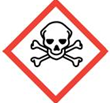
Scope: COSHH covers virtually every hazardous substance a plumber will encounter — solvents, flux, fuels, cleaning products, dust, fumes from engines — except asbestos, lead, and radioactive substances, which have their own specific regulations.
Employer duties under COSHH:
- Risk assessment for every hazardous substance workers are exposed to
- Information, instruction, and training on the risks and controls
- Provision of control measures — ventilation, extraction, PPE
- Monitoring — measuring exposure levels where relevant
- Health surveillance — where exposure could cause disease over time
Your duties as an employee:
- Follow COSHH assessments and procedures
- Use the control measures provided — extraction, ventilation, PPE
- Report problems — faulty equipment, damaged PPE, spills
- Report health symptoms — skin problems, breathing difficulties, any signs of occupational disease
COSHH data sheets
Every hazardous substance should have a COSHH data sheet. The current name for it is a Safety Data Sheet (SDS) — that is the term used under the CLP and REACH regulations and the one printed on the sheets you will be handed today. You will still hear and see the older name Material Safety Data Sheet (MSDS), and exam questions may well use it; the two mean the same document. Available from the supplier on request.
Information on the sheet:
- Product name and hazard classification
- Hazardous ingredients and concentrations
- First aid measures
- Fire-fighting measures
- Accidental release handling
- Safe handling and storage
- Exposure controls and PPE requirements
- Physical and chemical properties
- Toxicological information
- Ecological information
- Disposal considerations
Exam question framing: "Where can you find information about hazardous substances?" or "Where would you find information about chemicals found on a work site?" — the answer is always the COSHH data sheet (MSDS). Not your contract of employment, not the HSE poster, not your timesheet.
EH40 — workplace exposure limits
EH40 is an HSE publication listing workplace exposure limits (WELs) for hundreds of substances. Your employer uses EH40 to check whether the airborne concentrations of specific substances on a job are below the legal maximums.
What EH40 relates to: workplace exposure limits — not fire safety, not tool storage, not accident reporting.
For most Level 2 work you won't open EH40 yourself — but you need to know what it is and what it's for. Questions test this directly: "What does EH40 relate to?" — workplace exposure limits.
Unlabelled containers
If you find an unlabelled container of chemicals on site:
- Do NOT smell it — inhalation risk
- Do NOT open it — splash or vapour risk
- Do NOT dispose of it — could be toxic, could react dangerously
- Do NOT taste it — obvious
- DO report it to your supervisor
Unlabelled containers could hold anything from soapy water to concentrated acid. Reporting lets someone with the right PPE and training identify and dispose of the contents safely.
If you decant a hazardous substance into a different container, label both containers correctly. Removing the label from a half-empty container or leaving the new container unlabelled is a serious safety hazard — the next person handling it won't know what they're dealing with.
Specific hazards plumbers encounter
Sensitisers. Substances that build up allergic reactions over time. Common plumbing sensitisers: flux, solvents, oils, cement. All can cause dermatitis (inflammation of the skin). Prevention: correct gloves, overalls, avoid skin contact, report any dry skin to your employer early.
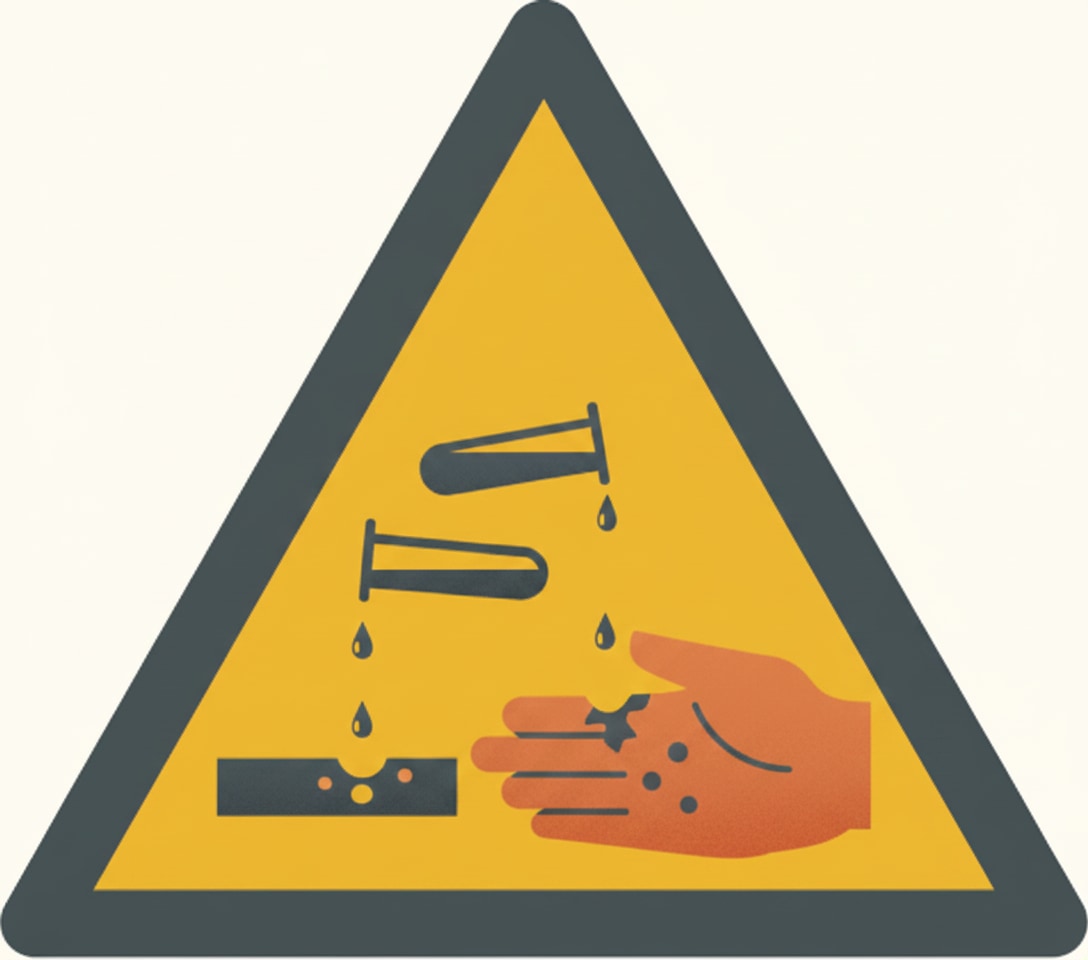
If packaging says "SENSITISER": it means you could become allergic to the substance and have allergic reactions. Not that it needs mixing with water; not that it's safe without PPE; not that you should avoid it entirely.
Wet cement, mortar, and concrete. Cause chemical burns and dermatitis due to high alkalinity. Always wear waterproof gloves when handling wet cement.
Solvents. Used in plumbing for cleaning, jointing, and surface prep. Best protection when working with solvents: avoid skin contact (using correct chemical-resistant gloves). Barrier cream alone isn't sufficient; a dust mask doesn't protect the hands.
Engine oil and other mineral oils. Cause skin problems (dermatitis and, over decades, skin cancer). Not heart disease, not breathing problems directly, not vibration white finger (which is a different condition).
Fibreglass insulation ("glass wool"). Classified as an irritant — causes itching and skin inflammation; fibres becoming airborne can irritate the throat. Wear long sleeves, gloves, and a dust mask.
Barrier cream. Creates a layer on the skin that reduces chemical absorption. Apply before you start work — not after, not as first aid, not when you can't find your gloves. Barrier cream is a supplementary measure, not a replacement for proper PPE.
Dust — a major hazard
Dust is one of the biggest occupational disease risks in construction. The major dust types plumbers encounter:
Silica dust. From drilling or cutting brick, concrete, cement, tile, mortar. Silica dust is the second-biggest cause of occupational lung diseases after asbestos. Classified as a hazardous substance under COSHH.
Cement dust. From mixing or handling dry cement. Causes chemical irritation and dermatitis.
General construction dust. From sanding, grinding, cutting, demolition work.
Wood dust. From cutting and sanding timber. Can cause asthma and (for hardwood dust) nasal cancers.
Controlling dust
The control hierarchy applies — eliminate or reduce before resorting to PPE.
Best practice for dust-generating tasks:
- Use dust extraction — on-tool extraction (vacuum attached directly to the power tool), local exhaust ventilation, or general ventilation
- Wet cutting / water suppression — drilling and cutting tools with integrated water delivery; dampen dusty areas before sweeping
- Plus appropriate PPE — FFP3 dust mask, goggles, hearing protection
For drilling, cutting, sanding, or grinding, the best protection is a combination: dust extraction or wet cut, plus an FFP3 rated dust mask, plus hearing protection and impact goggles. A disposable mask without the other measures isn't adequate for long-term health protection.
When sweeping up dust afterwards:
- Dampen the area first to keep dust from becoming airborne
- Ensure ventilation
- Keep PPE on until the job is fully complete
Don't just sweep dry dust — you'll re-suspend the same particles you were trying to protect against.
On-tool extraction
On-tool extraction = a dust extraction system connected directly to the power tool, capturing dust at source before it becomes airborne.
Before using on-tool extraction: check that the extraction filters are clean and the unit is actually extracting dust. A blocked filter or a failed unit provides no protection while making workers think they're safe — worse than no extraction at all because of the false sense of security.
Asbestos
Asbestos is a naturally-occurring fibrous mineral. Used extensively in UK construction until 1999 (when all asbestos use was finally banned), asbestos was added to insulation, cement, pipework lagging, floor tiles, ceiling tiles, and cistern bodies.
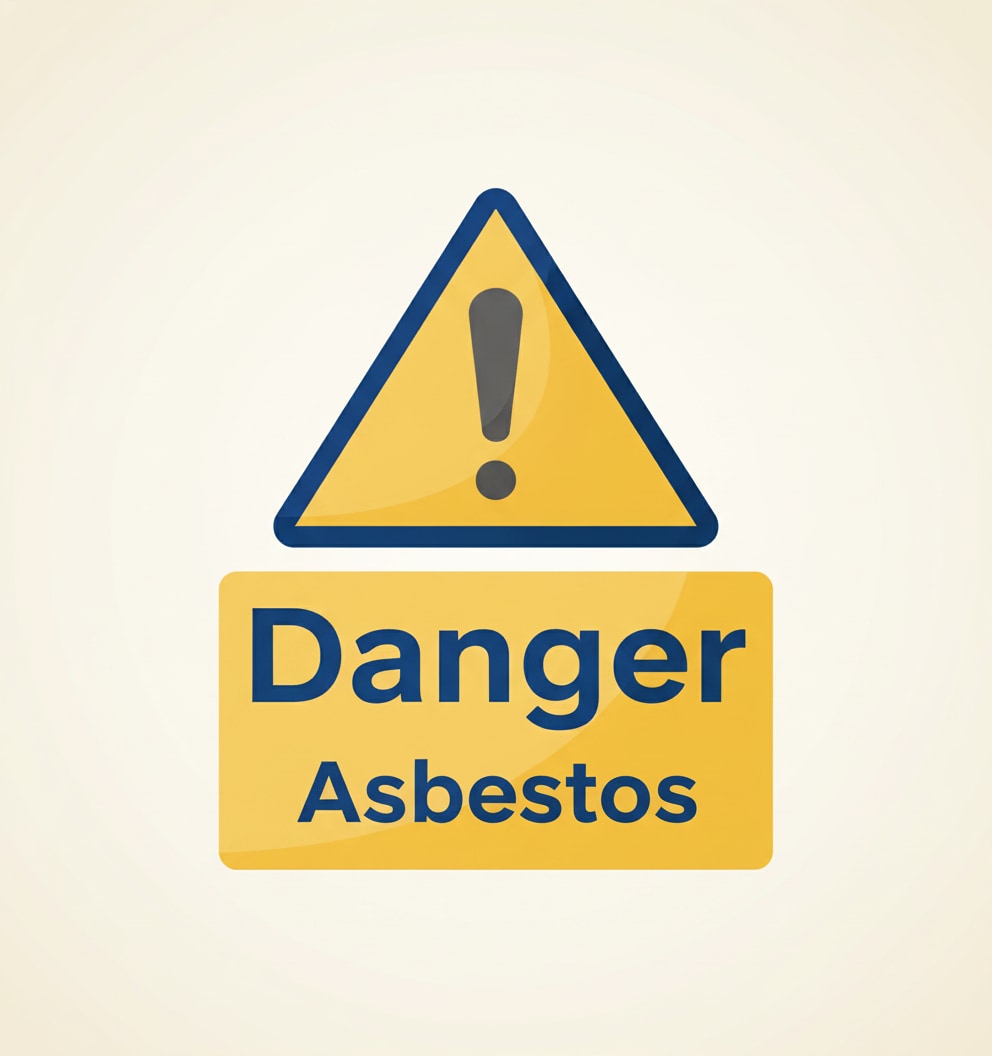
Why asbestos is dangerous: the microscopic fibres are inhaled, lodge in the lungs, and cause diseases that can emerge 20–50 years later:
- Asbestosis — scarring of lung tissue
- Mesothelioma — cancer of the lining of the lungs, chest or abdomen; almost always fatal
- Lung cancer — increased risk, particularly with smoking
- Pleural plaques — thickening of the membrane around the lungs
Asbestos is classified under the chronic health hazard COSHH symbol because the effects accumulate silently over decades.
Three main types of asbestos, each with a natural colour:
- White asbestos (Chrysotile) — the most widely used commercially
- Brown asbestos (Amosite) — more hazardous than white
- Blue asbestos (Crocidolite) — the most hazardous
All three types are dangerous; none are safe to disturb. Testing to identify the specific type requires specialist laboratory analysis.
Where you'll meet asbestos
In older properties (built before the year 2000), plumbers may encounter asbestos in:
- Cold water storage cisterns — grey, cement-like appearance
- Pipework lagging — wrapped insulation around hot water pipes and boilers
- Artex-type textured ceiling coatings
- Floor tiles and adhesives
- Ceiling tiles
- Roof sheets (cement sheeting, corrugated)
- Soffits and fascia boards
- Partition walls
- Flue pipes on older boilers
The Control of Asbestos Regulations
The specific regulations covering asbestos. Key points:
- Never disturb suspected asbestos unless you're trained and licensed
- Any work on licensed asbestos products requires an HSE-licensed asbestos contractor
- Lower-risk work on non-licensed asbestos (cement sheets, some floor tiles) requires specific training but can sometimes be done by competent workers
- If you suspect asbestos on a job, stop work and inform your supervisor
Practical consequence for plumbers: you'll rarely (if ever) work directly with asbestos yourself. What matters is recognising it on a job, stopping work, and getting the right people in.
If you're asked to work on a property built before 2000 where a cistern might be asbestos, typical responses:
- Check when the property/cistern was installed
- Note appearance — grey, cement-like, sometimes with cloth-like fibres on the surface
- Stop work if uncertain; don't sand, cut, drill, or break
- Alert the client and your supervisor
Lead — the Control of Lead at Work Regulations (CLAW)
Lead is poisonous. Accumulates in the body over years, causing damage to the brain, nervous system, kidneys, and reproductive system. Symptoms of lead poisoning can take a long time to develop and are often mistaken for other illnesses.
How lead enters the body:
- Through the tiniest of cuts if you touch lead with broken skin
- Through vapours — lead welding, soldering, cutting with heat
- Through dust — sanding lead paint, working with old lead pipework that's corroded
Where plumbers meet lead: lead pipework on older properties (pre-1970s), lead flashing on roofs, lead paint on historic decoration, old solder joints using leaded solder.
Protection when working with lead
The best protection: correct PPE and safe working practices. The course material's specific recommendations:
- Barrier cream — helps protect against lead penetrating through skin contact
- Goggles and correct ventilation — essential for lead welding (prevents inhalation and eye exposure)
- Proper washing facilities — wash hands and face before eating, drinking, or smoking (prevents ingestion)
- Overalls — prevent lead dust transferring to clothing and home
The most effective method for lead welding indoors: a portable electric fan providing adequate ventilation. A full-face welding mask is also needed but the ventilation is the primary control — without it, lead fumes concentrate in the working area regardless of what the welder is wearing.
Modern work practice: lead-based solder is no longer allowed on hot or cold water systems (banned to prevent lead leaching into drinking water). Use lead-free solder only.
Common exam traps
Trap 1: Asbestos, lead, and radioactive substances have their own regulations. COSHH covers most hazardous substances EXCEPT these three.
Trap 2: COSHH data sheet = chemical hazard information. Not the contract of employment, not the HSE poster, not the RIDDOR assessment.
Trap 3: EH40 = workplace exposure limits. Not fire safety, not tool storage, not accident reporting.
Trap 4: Silica dust = second-biggest cause of occupational lung disease (after asbestos). Requires FFP3 rating dust mask.
Trap 5: Wet cement causes chemical burns and dermatitis. Not dizziness, not muscle aches, not arc eye.
Trap 6: Best protection for solvents = avoid skin contact. With correct gloves. Barrier cream alone isn't enough.
Trap 7: Barrier cream applied BEFORE you start work. Not after, not as first aid.
Trap 8: Unlabelled containers — report to supervisor. Don't smell, open, dispose of, or taste.
Trap 9: Three asbestos types = white (chrysotile), brown (amosite), blue (crocidolite). All dangerous.
Trap 10: Lead welding indoors — portable electric fan is the most effective ventilation method.
Quick revision summary
Before the mock test, eight things you need to be able to produce from memory:
- COSHH covers most hazardous substances except asbestos, lead, and radioactive
- COSHH data sheet — Safety Data Sheet (SDS), formerly MSDS = where to find hazard info
- EH40 = workplace exposure limits publication
- Unlabelled containers: report to supervisor; don't touch
- Silica dust = 2nd biggest cause of occupational lung disease; FFP3 mask required
- Dust control: extraction/wet cut + FFP3 mask + goggles + hearing protection
- Asbestos types: white (chrysotile), brown (amosite), blue (crocidolite); chronic health hazard; requires specialist removal
- Lead (CLAW Regs): enters through cuts, vapours, dust; barrier cream, goggles, ventilation, washing facilities
📝 10-Question Mock Test
Click an option to see whether you got it right. Explanations appear instantly — no submitting at the end.
The correct meaning of COSHH. Options A ("homes"), B (grammatically incorrect) and C ("containment") are plausible-sounding distractors.
COSHH specifically covers hazardous substances — chemicals, dust, fumes, biological agents. Options A, B and D are other H&S topics with their own regulations.
The specific source of chemical hazard information. Signing-on sheets, contracts, and HSE posters don't contain chemical-specific information.
EH40 is the HSE publication listing safe airborne concentration limits for hundreds of hazardous substances. Options A, B and D describe other H&S topics.
Unlabelled chemicals could be dangerous; smelling, disposing, or ignoring are all unsafe responses. Reporting lets someone trained handle the substance properly.
The comprehensive answer — engineering controls (extraction/wet cut) PLUS PPE (FFP3 mask, goggles, hearing protection). Options A and B are partial answers; C uses an inadequate mask.
Wet cement is strongly alkaline — it causes chemical burns on contact, particularly on skin that's in prolonged contact (inside boots, under knee pads). It also causes dermatitis. Options A, C and D aren't cement-specific effects.
Using correct chemical-resistant gloves to prevent solvent absorption through the skin. Options A (dust mask) protects respiratory system not skin. Option C (barrier cream only) is supplementary, not sufficient. Option D is unrelated.
Barrier cream creates a protective layer on the skin that reduces chemical absorption. Needs to be in place before contact. Options B, C and D don't make sense for preventive skin protection.
Lead fumes concentrate in poorly-ventilated spaces. A fan providing adequate air movement is the primary control — without ventilation, lead exposure builds up regardless of other protective measures. A face mask is also required (B), but alone isn't enough.
How PlumbMate puts this into practice
Hazardous substances content mixes general principles (control hierarchy, COSHH) with specific facts (asbestos types, lead ventilation, FFP3 ratings). Spaced repetition handles both together.
- Flashcards, not essays. One prompt, one answer — the format that research has consistently shown works best for active recall.
- Wrong answers are logged. Every question you get wrong goes into a dedicated collection that resurfaces more frequently in future sessions.
- The 3× rule. You need to get a question right three times before it clears — one lucky guess isn't enough.
- Explanations on every question. Like the ones above, but on every single question in the app.