Health and Safety is the Level 2 unit with the highest real-world stakes. Construction is one of the most dangerous industries in the UK — every year, people die because corners get cut on site. The H&S unit is the legal and practical framework that keeps those numbers as low as possible, and Level 2 tests it rigorously through its own dedicated exam. Students who pass first time are the ones who took it seriously as a genuine subject rather than "common sense stuff."
This guide covers the whole unit at single-page summary depth, with links out to the six deep-dive posts that handle each topic in full.
Why Health and Safety is different from the other units
Three things make H&S distinctive — and one insight that makes the whole unit click.
First, H&S has its own exam. Unlike Cold Water or Heating where the material gets tested alongside related topics, Health and Safety is assessed separately. That means you revise it in its own focused window, and the paper tests specifically what's covered in this cluster — no cold water content mixed in, no heating content dilute the questions. Every question on the H&S paper comes from the six topics below.
Second, H&S is fact-dense and acronym-heavy. HASAWA, CDM, COSHH, CLAW, RIDDOR, PPE, RPE, EH40, VWF, HAVS, FFP3. Most units have 5–10 acronyms that matter; H&S has more than 20. Plus specific figures — 5 employees, 7 days, 80dB, 85dB, 950mm, 1:4 ratio, 1m above access point, Class 1 ladders only, FFP3 for silica, six fire classes, five sign categories. These need to be memorised because they're not derivable from first principles.
Third, students underestimate H&S because they think it's "common sense." It isn't. There's a specific legal framework, specific responsibilities under each regulation, specific procedures for specific hazards, and specific numerical thresholds. "Common sense" alone doesn't tell you that the RIDDOR threshold is 7 days, that FFP3 is required for silica dust, or that a Class 1 ladder is rated to 175kg. These are facts that need learning.
The key insight that unlocks the whole unit: every H&S rule comes from one of three sources, and once you can classify a rule by its source, the rule becomes easier to remember.
- Statutory legislation (Acts and Regulations) — enforceable by law; breaches lead to prosecution
- Recognised best practice (British Standards, Codes of Practice, HSE guidance) — not law but expected; following them typically means you exceed the legal minimum
- Hazard physics and biology — the actual mechanisms by which things hurt people (fire triangle, Legionella growth range, asbestos fibre embedding in lungs, frequency ranges that damage hearing)
Legislation changes when Parliament changes it. Best practice changes when standards bodies update them. But the physics and biology don't change — gravity still pulls people off ladders, fire still needs oxygen, 85dB still damages hearing whether or not anyone says so. Understanding the underlying mechanisms makes the specific rules more memorable because you understand why they exist.
The six areas you need to master
Level 2 Health and Safety breaks into six main blocks. Each has its own deep-dive post; the summaries below give you enough to locate your gaps.
1. Safety legislation and enforcement
The legal framework the rest of the unit is built on.
Core facts:
- HASAWA (Health and Safety at Work Act) = foundational legislation; applies to all workplaces
- 5 or more employees = written H&S policy with three sections (general policy / responsibility / arrangements)
- Employer duties: safe workplace, safe equipment, training, PPE free, welfare facilities, risk assessments
- Employee duties: take reasonable care, cooperate, report hazards, use PPE correctly
- Both employers AND employees can be prosecuted under HASAWA
- HSE enforces construction/schools/hospitals/heavy industry; Local Authority enforces retail/offices/hospitality
- Improvement notice = fix it (no immediate danger); Prohibition notice = stop work (immediate danger)
- CDM Regulations: Client → Designer → Main Contractor → Workers; main contractor provides welfare facilities; everyone reports obvious risks
- Legislation (Acts/Regulations) = law; Guidance (BS/CoP) = best practice
For the full deep-dive plus mock test, see the legislation and enforcement post.
2. Risk assessment, accidents and first aid
The process for preventing incidents, recording them, and responding to them.
Core facts:
- Risk assessment BEFORE the task begins — identifies hazards and controls; tells you how to do the job safely
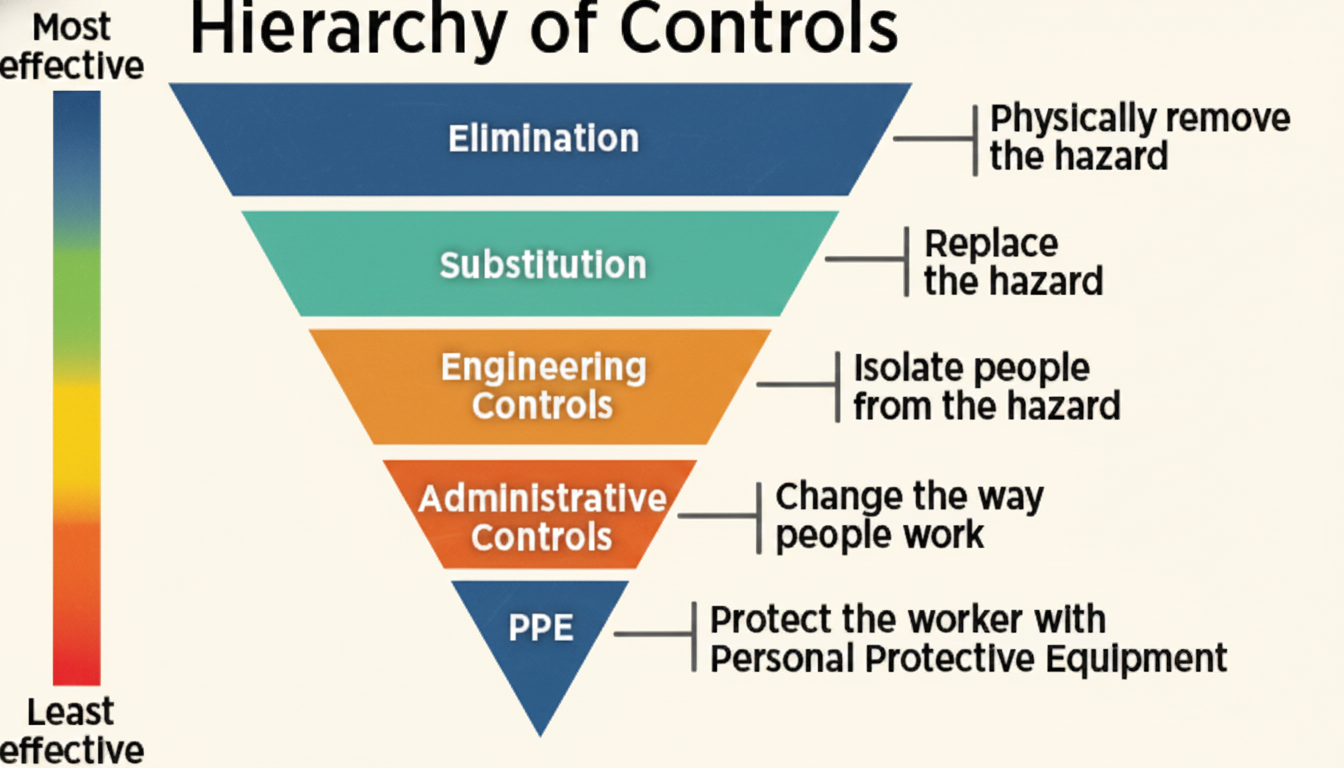
- Control hierarchy: eliminate → substitute → engineering → administrative → PPE (last)
- Method statement = how the job will be done, step by step
- Every accident recorded in the accident report book — no exceptions
- RIDDOR = Reporting of Injuries, Diseases and Dangerous Occurrences Regulations
- RIDDOR 7-day rule: injuries keeping workers off >7 days are reportable to HSE
- RIDDOR also reports: deaths, major injuries, occupational diseases, dangerous occurrences (even with no injuries)
- Accident investigation = find causes to prevent recurrence, not to blame
- Occupational diseases: dermatitis, asthma, HAVS/VWF, tendonitis, work cancers, Weil's disease (rats/livestock urine)
- First aid box: no tablets or medicines (allergy risk); every workplace must have one
For the deep-dive plus mock test, see the risk assessment and accidents post.
3. PPE and safety signs
How we protect individuals and communicate hazards on site.
Core facts:
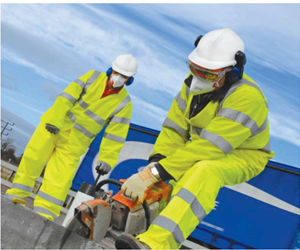
- PPE is a last line of defence — after eliminating, substituting, engineering, admin controls
- PPE at Work Regs: employer supplies free, ensures fit for purpose, replaces damage; employee maintains, stores, uses correctly
- Types of PPE: hard hat, goggles, ear defenders, dust mask/respirator, gloves (various), safety boots, hi-vis, harness, life jacket
- Dust mask wear time: 1 hour max (non-powered); powered masks can be worn longer
- FFP3 for silica, asbestos, lead
- Five sign categories:
- Warning: yellow triangle
- Prohibition: red circle with diagonal line
- Mandatory: blue circle
- Information/Safe Condition: green rectangle
- Fire: red rectangle
- COSHH hazard symbols: flammable, explosive, toxic, corrosive, oxidising, harmful/irritant, chronic health hazard, dangerous to environment, gas under pressure
- Unlabelled containers: don't touch, don't smell; report to supervisor
- Hazard info source: COSHH data sheet (MSDS)
For the deep-dive plus mock test, see the PPE and safety signs post.
4. Hazardous substances (COSHH, asbestos, lead)
The chemicals, dusts, and materials that cause occupational illness.
Core facts:
- COSHH covers most hazardous substances except asbestos, lead, radioactive (those have their own regulations)
- COSHH data sheet (MSDS) = where to find chemical hazard info
- EH40 = HSE publication listing workplace exposure limits
- Silica dust = 2nd biggest cause of occupational lung disease after asbestos; FFP3 mask required
- Dust control: extraction/wet cut + FFP3 mask + goggles + hearing protection (all four, not just one)
- Sensitisers (build up allergic reactions): flux, solvents, oils, cement — cause dermatitis
- Wet cement causes chemical burns and dermatitis
- Best solvent protection: avoid skin contact with correct gloves (not barrier cream alone)
- Barrier cream: apply BEFORE starting work
- Three asbestos types: white (chrysotile), brown (amosite), blue (crocidolite) — all dangerous; never disturb if uncertain
- Lead (CLAW Regs): enters through cuts, vapours, dust; protection = barrier cream, goggles, ventilation, washing facilities
- Lead welding indoors: portable electric fan is the most effective control
For the deep-dive plus mock test, see the hazardous substances post.
5. Working at height and confined spaces
Two of the highest-risk topic areas in Level 2 H&S.
Core facts:
- "Working at height" = any distance above or below ground where a fall could injure; still the biggest cause of workplace deaths
- Ladder classes: Class 1 = 175kg (only class for site use); Class 2 = 150kg; Class 3 = 125kg (domestic). Current standard is BS EN 131 (Professional / Non-professional), but the exam still uses the class system
- Ladder setup: check damage → 1:4 ratio / 75° angle → tie at top → 1m above access point → 3 points of contact → 30-minute max
- User checks ladder before every use; formal inspection by competent person every 7 days
- Don't paint ladders — paint hides defects
- Step ladders: face the work; belt line not above top step
- Scaffold types: independent (stands alone), putlog (uses building wall); handrail minimum 950mm
- Mobile tower scaffold: toe boards fitted; lock wheels; never move with people/tools on
- Edge protection on flat roofs; brick guards on scaffold platforms
- Fragile roofs: crawling boards only
- Working over water: harness and lanyard + life jacket (two PPE items)
- Confined Spaces Regs three-part rule: avoid entry → safe system of work → emergency arrangements before work starts
- Person outside confined space = rescue plan initiator in an emergency
- Blowtorch in confined space = fume inhalation risk; blowtorch in cramped loft = fire damage risk
For the deep-dive plus mock test, see the working at height post and the excavations and confined spaces post.
6. Fire safety, manual handling, noise and other risks
The remaining major topics.
Core facts:
- Fire triangle: Oxygen + Heat + Fuel (remove one to extinguish)
- Six classes of fire: A (solids), B (liquids), C (gases), D (metals), E (electrical), F (cooking oils)
- Extinguisher colours: red/water (A), cream/foam (A+B), black/CO₂ (B+electrical), blue/powder (A+B+C+electrical), yellow/wet chemical (F)
- ABC Powder NOT on Class D (metals) or Class F (cooking oils)
- Propane cylinder fire response: raise alarm → safe distance → emergency services. Don't try to extinguish.
- Gas bottles: propane = red, acetylene = maroon, oxygen = black, nitrogen = grey
- PASS method: Pull, Aim, Squeeze, Sweep
- Hot work precautions: heat-proof mat, remove insulation 300mm, extinguisher to hand, dampen after, don't leave site for 1 hour
- Manual handling assessment: weight + path + mechanical options + your own condition (all four considered)
- Heavy loads: use a trolley (and a trolley IS still manual handling)
- Report previous back injuries before starting manual handling work
- Noise thresholds: 80dB = available on request; 85dB = must be provided
- Tinnitus is permanent — no cure; prevention through hearing protection is the only option
- Vibrating tools (HAVS/VWF): don't grip too tightly; rotate tasks; use vibration-reducing gloves
For the deep-dive plus mock test, see the fire safety and other risks post.
Four exam-technique habits that apply across the whole unit
Learn the acronyms cold. HASAWA, CDM, COSHH, CLAW, RIDDOR, PPE, RPE, EH40, VWF, HAVS, FFP3. Each one is a direct question opportunity — "what does RIDDOR stand for?" Flashcards clear these faster than any other method. Make one card per acronym; drill until they're automatic.
For every hazard, apply the control hierarchy. Eliminate → substitute → engineering controls → administrative controls → PPE. This sequence is the answer to hundreds of H&S questions. When you're asked "what's the best way to protect against [hazard]?", the answer is almost always the highest step in the hierarchy that's actually available — not PPE alone (which is last resort).
Memorise the specific numbers; don't try to derive them. 5 employees triggers written policy. RIDDOR = 7 days. 80dB and 85dB are the noise thresholds. 1:4 ratio for ladders. 1m above access point. 3 points of contact. 30-minute max on a ladder. 950mm scaffold handrail. Class 1 ladder = 175kg. FFP3 for silica/asbestos/lead. None of these can be derived — they need to be memorised.
Read the question carefully — context matters in H&S. The same basic activity (using a blowtorch) has different primary risks in different contexts (fume inhalation in a confined space vs fire damage in a cramped loft). The question tells you the context; your job is to match the context to the correct hazard. Reading the question in full, twice, before picking an answer catches most of these.
Building a revision routine that actually works
The research on revision is overwhelming and consistent: spaced repetition beats cramming, active recall beats re-reading, and little-and-often beats long weekend sessions. Every credible study on student learning over the last fifty years points to the same conclusions.
In practical terms:
- Use flashcards, not re-reading. Passive reading feels productive and is nearly useless for exam recall. Active recall — forcing your brain to produce the answer before checking it — is what builds long-term memory.
- Little and often. Three ten-minute sessions across the day beat one thirty-minute block, and both beat a three-hour cram the night before.
- Revisit at increasing intervals. If you get a fact right today, don't retest it tomorrow — test it in three days. If you get it right again, test it in a week. This is the spacing that beats the forgetting curve.
- Focus on what you don't know. There's no point drilling yourself on the stuff you already know cold. Spend your time on the material you keep getting wrong.
For the full treatment of this method, see the spaced repetition guide — which also covers how PlumbMate operationalises it.
A recommended revision order
H&S is typically revised in a focused window before its dedicated exam. Three weeks is usually enough if you use the time well.
Week 1: Legislation + Risk Assessment + PPE and Signs (posts 1–3). The foundational framework. Legal structure, risk assessment process, PPE rules, and the sign colour-coding system. Get the acronyms and the five sign categories locked in this week — they unlock many questions on the paper.
Week 2: Hazardous Substances + Working at Height + Fire Safety (posts 4–6). The specific hazard areas with detailed rules. The three heaviest content weeks of the unit — work through one post per 2 days, with mock test on the third day of each cycle.
Week 3: Mock tests and weakness-targeting. Do the 10-question mock tests in all six deep-dives. Anything you get wrong, mark and re-drill. This is the week that turns wobbly knowledge into exam-ready knowledge. Aim for 8/10 minimum on each mock before considering yourself ready.
If you've got less than three weeks, compress the schedule but keep the order. If you've got more, spend the extra time on mock questions rather than re-reading notes.
Take it seriously
H&S has the longest list of specific rules of any Level 2 unit, but each rule exists for a reason. Someone, at some point, died in a way that the rule now prevents. The specific 7-day RIDDOR threshold, the specific FFP3 requirement for silica, the specific Class 1 ladder on site rule — each of these was put in place because of people who went to work one day and didn't come home.
Students who pass H&S first time aren't the ones with perfect "common sense." They're the ones who respected the subject enough to learn the specific legislation, drilled the specific figures consistently, and used active recall instead of re-reading. The stakes make that effort worth it — both for the exam and for the career afterwards.
How PlumbMate puts this into practice
PlumbMate covers the full Level 2 Health and Safety syllabus with spaced repetition built in — exactly the method described in the revision section above.
- Flashcards, not essays. One prompt, one answer — the format that research has consistently shown works best for active recall.
- Wrong answers are logged. Every question you get wrong goes into a dedicated collection that resurfaces more frequently in future sessions.
- The 3× rule. You need to get a question right three times before it clears — one lucky guess isn't enough.
- Explanations on every question. So you learn the logic rather than memorising answers.