Before work starts, you assess the risks. When something goes wrong, you know what to record and who to tell. While the work continues, you know where the first aid kit is and what to do if someone is injured. These three topics — risk assessment, accident reporting, and first aid — sit together because they cover the full "what could go wrong and what do we do about it" cycle.
This post is the second in the Level 2 Health and Safety sub-cluster. For the others, see the legislation, PPE and signs, hazardous substances, working at height and confined spaces, and fire safety posts.
Risk assessment — before the task begins
A risk assessment is a systematic look at what could cause harm on a specific task and what needs to be in place to prevent it. Required under the Management of Health and Safety at Work Regulations.
Critical timing: the risk assessment must be completed before the task begins. Not partway through. Not at break time. Before.
The standard five-step process:
- Identify the hazards — what could cause harm? (Falls from height, electrical shock, manual handling, dust, chemicals, fire, etc.)
- Decide who might be harmed and how — workers, visitors, members of the public, vulnerable individuals
- Evaluate the risks and decide on control measures — how likely is the harm? How serious? What can we do about it?
- Record the findings — written document; must exist for the job
- Review the assessment — update if circumstances change
A risk assessment tells you how to do a job safely. That's the course material's specific answer to "what does a risk assessment do?" — not what time to start, not where the first aid kit is, not how to keep the place clean.
Method statement
Closely related to a risk assessment. A method statement sets out step-by-step how a job will be done safely, in sequence. Typically produced alongside the risk assessment for higher-risk work.
- Risk assessment = what could go wrong and how we control it
- Method statement = how we actually do the job, step by step
Workers must follow both documents when carrying out the work. Under CDM, following risk assessments and method statements is specifically listed as a worker responsibility.
Control measures — the hierarchy
When a risk is identified, the standard hierarchy of controls applies — most effective first:
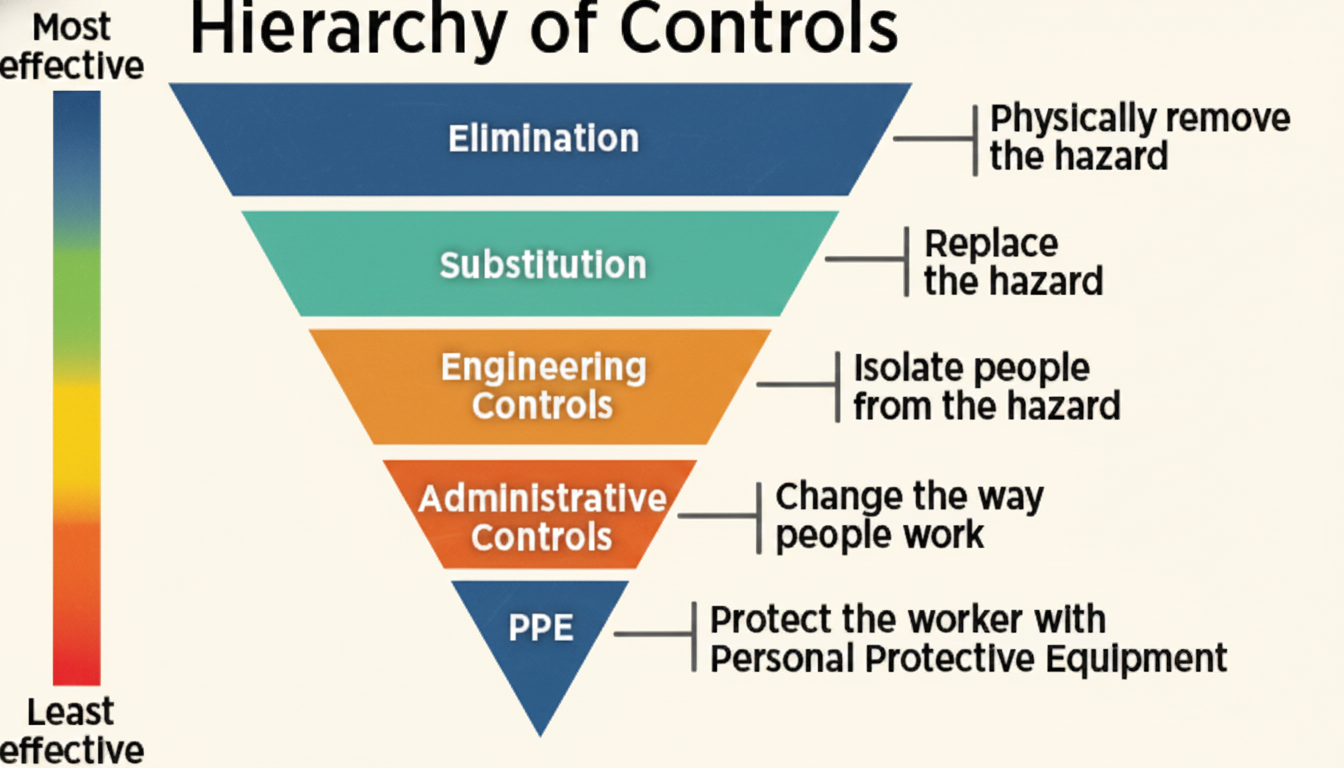
- Eliminate the hazard — can we avoid doing this task at all? (e.g., do the work from the ground instead of at height)
- Substitute with something less hazardous — use a less dangerous chemical, a smaller ladder, a quieter tool
- Engineering controls — guards, extraction systems, barriers
- Administrative controls — training, signs, procedures, rotation of tasks
- PPE — the last line of defence (see the PPE post for detail)
PPE is last on the list deliberately. The Water Regulations, HASAWA, and CDM all treat PPE as the final fallback after eliminating or engineering out risks where possible.
Accident reporting — the accident report book
Every accident at work should be recorded in the accident report book. Every single one, regardless of how minor it seems at the time.

Why record even minor accidents:
- A minor slip today could become a pattern that flags a broader hazard
- Injuries sometimes develop or reveal themselves later; the record establishes the circumstances
- Insurance and legal claims rely on contemporaneous records
- The employer has a legal duty to keep the records
The accident report book is a legal document — not optional, not just paperwork for show.
RIDDOR — reporting to the HSE
RIDDOR = Reporting of Injuries, Diseases and Dangerous Occurrences Regulations. An acronym you need fluent.
RIDDOR sets out which accidents, injuries, and industrial diseases must be reported to the Health and Safety Executive (in addition to being recorded in the accident report book).
What must be reported under RIDDOR:
- Any death arising from work activity
- Major injuries — including broken bones (other than fingers/toes), amputations, serious burns, loss of sight, loss of consciousness from head injury
- Any injury causing an employee to be unable to carry out their full range of duties for more than 7 days (not counting the day of the accident) — the "7-day rule"
- Occupational diseases — including occupational dermatitis, hand-arm vibration syndrome, occupational asthma, tendonitis, and work-related cancers
- Dangerous occurrences — explosions, uncontrolled fires, scaffold or crane collapses — even if no one is hurt
The 7-day rule specifically: if an injury stops you from doing your full range of duties for more than 7 days (not counting the day of the accident itself), it's reportable to the HSE. 8 days off = RIDDOR. 7 days off = not RIDDOR. 4 days off = not RIDDOR (but still goes in the accident report book).
Watch how the question is worded. The exam usually asks it as “more than how many days?” — and the answer to that is 7. The number to write down is 7; the rule it describes is more than 7, so the first reportable duration is 8 days.
Accident book vs RIDDOR — what goes where
A useful way to think about it:
| Situation | Accident book? | RIDDOR to HSE? |
|---|---|---|
| Minor cut needing a plaster | ✓ | ✗ |
| Sprained ankle, 4 days off work | ✓ | ✗ |
| Sprained ankle, 8 days off work | ✓ | ✓ |
| Broken arm from falling debris at work | ✓ | ✓ |
| Broken arm playing Sunday league football | ✗ (not work-related) | ✗ |
| Cancer caused by asbestos exposure at work | ✓ | ✓ |
| Controlled, planned fire at work | ✗ | ✗ |
| Unintentional explosion at work | ✓ | ✓ |
Everything work-related goes in the accident book; only the more serious items also go to RIDDOR.
Accident investigation — why we do it
The main objective of an accident investigation is to find out the causes to prevent it happening again. Not to find who to blame. Not to calculate costs. Not just to record injuries.
The "blame culture" approach (finding fault and punishing) actually makes safety worse — workers hide near-misses rather than reporting them, which means hazards don't get identified and fixed before they cause real injuries. A proper accident investigation focuses on the systemic causes (inadequate training, missing guards, unclear procedures) rather than individual fault.
Near-miss reporting: if you witness a near miss and the worker involved is afraid of getting into trouble, you should report it regardless. Near-misses are how we identify hazards before they cause actual injuries. Not reporting a near-miss can mean the same accident happens next time, and someone gets hurt.
Occupational diseases
Diseases caused by work activity — all reportable under RIDDOR:
Dermatitis — skin inflammation from repeated contact with irritants (solvents, flux, cement, oils, detergents). Causes redness, itching, cracking, blistering. Prevention: correct gloves, barrier cream, minimise skin contact. Report dry skin to your employer early — it may be the start of dermatitis.
Occupational asthma — inflammation of the airways caused by work exposure (dust, chemicals, fumes). Affects breathing. Can end your working life in affected trades.
Hand-arm vibration syndrome (HAVS) / Vibration White Finger (VWF) — nerve and blood vessel damage from prolonged use of vibrating tools (drills, grinders, breakers). Causes numbness, tingling, and circulation problems in the fingers. Prevention: don't grip tools too tightly; rotate tasks; use vibration-reducing gloves.
Tendonitis / tenosynovitis — inflammation of tendons from repetitive movement or overuse. Often in the hand or forearm.
Work-related cancers — including asbestos-related cancers (mesothelioma, lung cancer), lung cancer from silica dust, skin cancer from chronic sun exposure, bladder cancer from certain chemicals.
Leptospirosis (Weil's disease) — bacterial infection caused by contact with water contaminated by rats and livestock urine. Relevant for plumbers working in drainage, sewers, and agricultural environments. Symptoms: flu-like, can develop to serious liver and kidney problems.
Skin problems from mineral oils (engine oil, cutting oils) — prolonged skin contact can cause dermatitis and, over decades, skin cancer.
The Health and Safety (First Aid) Regulations
The HSFAR cover first aid provision in the workplace.
Key requirements:
- Every large building site must have a trained first aider or someone responsible for first aid
- Employers must provide a first aid box — regardless of the number of employees
- First aid equipment based on a risk assessment of the tasks being carried out
- Travelling workers (plumbers visiting customer properties) should have a first aid kit in the van
First aid box contents
A workplace first aid box should contain:
- Plasters (various sizes)
- Sterile dressings (various sizes)
- Disposable gloves
- Bandages and safety pins
- Eye pads and eyewash where relevant
- Foil blanket
- Guidance leaflet
A first aid box should NOT contain:
- Tablets and medicines — including painkillers, antiseptic creams, hay fever tablets
Why no tablets or medicines? People may be allergic to them. Giving someone the wrong medication, or one they're allergic to, can make the situation worse — and first aid should never involve prescribing or dispensing drugs.
What to do if you see an injured person
The course material sequence, in order:
- Check you are not in any danger — assess the scene before approaching. An unsafe scene could injure you too.
- Stay calm and assess the situation — before doing anything, take stock. Rushing in can make things worse.
- If you're not a trained first aider and are first on scene:
- If the person can move safely — help them to the first aider
- If they can't move safely — bring the first aider to them
- In serious cases, phone the emergency services (999) - Do not move a person with a major injury unless they're in risk of further injury or death
- All injuries recorded in the accident report book afterwards
Matching injuries to first aid actions:
| Injury | First aid response |
|---|---|
| Cuts | Clean and protect |
| Minor burns | Run under cold water |
| Broken bones | Do not move, phone ambulance/hospital |
| Objects in the eye | Eyewash station (hospital if serious) |
If someone collapses with stomach pains and there's no first aider on site — phone for emergency help. Don't try to diagnose or treat yourself.
The 7-day rule — RIDDOR-reportable
Two actions to take if an accident makes you incapable of your normal work for 8 days (or more):
- The accident must be recorded in the site accident book (as with every accident)
- Your employer should inform the Health and Safety Executive (HSE) under RIDDOR
The emergency services aren't called (unless there's an ongoing emergency), the local hospital and benefits office don't need to be specifically informed (you'd contact them for your own reasons), and you never pay for first-aid treatment.
Fire escape routes — keep them clear
A related general duty that plumbers sometimes overlook: if you're working in a corridor that is a fire escape route, you must ensure your tools and equipment do not block the route. Blocked fire escapes can kill people during emergencies. This applies to anything you're doing — materials, ladders, pipework waiting to be fitted, tools.
Never lock doors into fire-escape corridors, never remove fire-exit signs, never block escape routes with anything.
Common exam traps
Trap 1: Risk assessment timing. Before the task begins. Not during, not after, not at the break.
Trap 2: What a risk assessment does. Tells you how to do the job safely. Not working hours, not first aid location, not cleanliness.
Trap 3: RIDDOR 7-day rule. The threshold number is 7 — that is what you write if the question asks “more than how many days?” But the rule is more than 7 days, so 8 days is the first reportable duration and exactly 7 days is not reportable. Both halves get tested.
Trap 4: Accident investigation purpose. To find the causes to prevent recurrence. Not to find fault.
Trap 5: Tablets and medicines NOT in first aid kits. Painkillers, antiseptics, hay fever tablets, etc. Allergy risk.
Trap 6: Weil's disease cause. Rats and livestock urinating in water. Not ants, not dying fish, not mosquitoes.
Trap 7: Reportable incidents include dangerous occurrences "even if no one is hurt." Explosions, uncontrolled fires, scaffold/crane collapses.
Trap 8: Every site has a first aid box. Regardless of number of employees. Not "when you have 10+" or "at company discretion."
Quick revision summary
Before the mock test, seven things you need to be able to produce from memory:
- Risk assessment = before task begins; tells you how to do the job safely
- Control hierarchy: eliminate → substitute → engineering → administrative → PPE (last)
- RIDDOR reportable: deaths, major injuries, injuries keeping workers off >7 days, occupational diseases, dangerous occurrences (even with no injuries)
- Accident book: every accident regardless of severity
- Accident investigation: find causes to prevent recurrence, not to blame
- Occupational diseases: dermatitis, asthma, HAVS/VWF, tendonitis, work cancers, Weil's disease (rats/livestock urine)
- First aid box: no tablets or medicines (allergy risk); every workplace must have one
📝 10-Question Mock Test
Click an option to see whether you got it right. Explanations appear instantly — no submitting at the end.
The core purpose of a risk assessment — identifying hazards and setting out controls. Options A, C and D describe things risk assessments aren't for.
The whole point is to identify and control hazards before the work starts. During, at break time, or after the task would all be too late. Options A and D mix up timing; C is too late.
The acronym refers to diseases (occupational illnesses) and dangerous occurrences (like explosions or scaffold collapses), not just injuries. Option B has "deaths" instead of "diseases"; C has "destruction"; D has "deadly." All distractors.
The 7-day rule — injuries keeping workers off (or unable to carry out full duties) for more than 7 days (not counting the day of accident) are RIDDOR-reportable, so 8 days is the first duration that qualifies. 8 days off (B in question 6 below) is past the 7-day threshold. Options A (5) and B (6) are below threshold; D (8) is above but 7 is the threshold answer.
Investigations are about learning and prevention, not blame. Options A, C and D describe things that might be side effects but aren't the primary purpose.
Two actions: log it in the book, and (because 8 days exceeds the 7-day RIDDOR threshold) notify HSE. Emergency services (B) aren't called after the fact. Hospital and benefits (C) would only be relevant for the individual's own care. First aid is always free (D).
Asthma is a respiratory disease — it affects the airways and lungs. Options A (hearing), B (joints) and C (skin) are other occupational conditions but not asthma.
Leptospira bacteria in the urine of rats and livestock contaminate water; humans contract it through cuts or mucous membranes contacting that water. Plumbers in drainage and sewer work, and agricultural plumbing, face the risk. Options B, C and D aren't sources of leptospirosis.
Tablets and medicines are excluded because of allergy risk — giving someone an inappropriate or allergen drug can make things worse. Bandages (A), plasters (B) and safety pins (C) are all standard first aid kit contents.
Near-misses are how we identify hazards before they cause real injuries. Reporting is essential regardless of the individual's concerns about getting into trouble. A proper safety culture treats near-miss reports as learning opportunities, not disciplinary matters. Options A and C allow the hazard to continue; D focuses on the individual rather than the hazard.
How PlumbMate puts this into practice
Risk assessment and accident reporting content is heavy on specific rules, acronyms, and reportable conditions — exactly the kind of content spaced repetition handles best.
- Flashcards, not essays. One prompt, one answer — the format that research has consistently shown works best for active recall.
- Wrong answers are logged. Every question you get wrong goes into a dedicated collection that resurfaces more frequently in future sessions.
- The 3× rule. You need to get a question right three times before it clears — one lucky guess isn't enough.
- Explanations on every question. Like the ones above, but on every single question in the app.