Heat transfer is the reason we have central heating, indirect hot water cylinders, and uninsulated pipework in lofts that freezes in January. Every plumbing system is a heat transfer problem — either moving heat where you want it (radiators, towel rails, hot water outlets) or stopping it from going where you don't (pipe lagging, cylinder jackets, cavity insulation). This post covers the three modes of heat transfer, how each one works in plumbing, and the traps examiners use to sort out the students who understand the ideas from the ones who've just memorised the words.
If you want the wider revision framework, pair this with the spaced repetition guide. For companion science deep-dives, see the pressure and force and thermal expansion posts.
The three modes of heat transfer
Heat always moves from hot to cold. Full stop. There's no such thing as "cold entering a room" — a cold room is a room heat has left. Get this principle into your head before anything else.
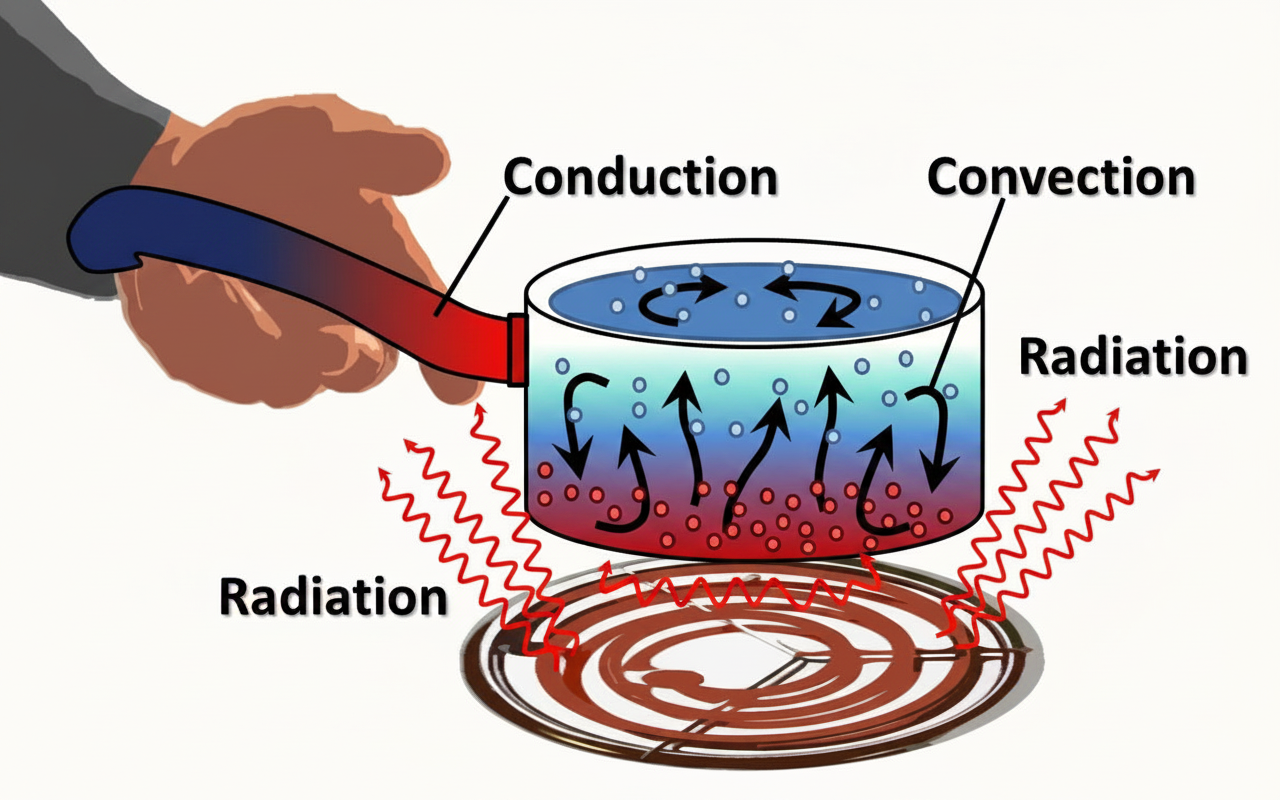
The three modes are:
- Conduction — heat transferred through a solid material, or between two solids in contact
- Convection — heat transferred through a fluid (liquid or gas) by the fluid itself moving
- Radiation — heat transferred through space as infrared electromagnetic waves, with no medium needed
Every plumbing system uses at least two of these, and most use all three.
Conduction: heat through solids
Conduction happens when fast-moving (hot) molecules in a solid bump into their slower-moving (cold) neighbours, passing their energy along. The hotter end of a copper pipe passes heat to the cooler end; the hotter side of a heat exchanger wall passes heat to the cooler side.
Not all materials conduct equally well. Thermal conductivity is the property that tells you how readily a material carries heat:
- Copper: very high — which is why it's used for heat exchangers and pipework that needs to transfer heat efficiently.
- Low carbon steel: moderately high — good enough for radiators.
- Plastic: low — which is why plastic pipe is fine for cold water but less efficient for heat distribution than copper.
- Foam lagging, mineral wool, vacuum: very low — the reason we use them as insulation.
Good conductors let heat pass through easily. Good insulators resist it. There's nothing magical about insulation — it just happens to be a very poor conductor.
Convection: heat through fluids
When a fluid is heated from below, it expands, becomes less dense, and rises. Cooler fluid flows in to replace it. The result is a continuous convection current that carries heat around the fluid.
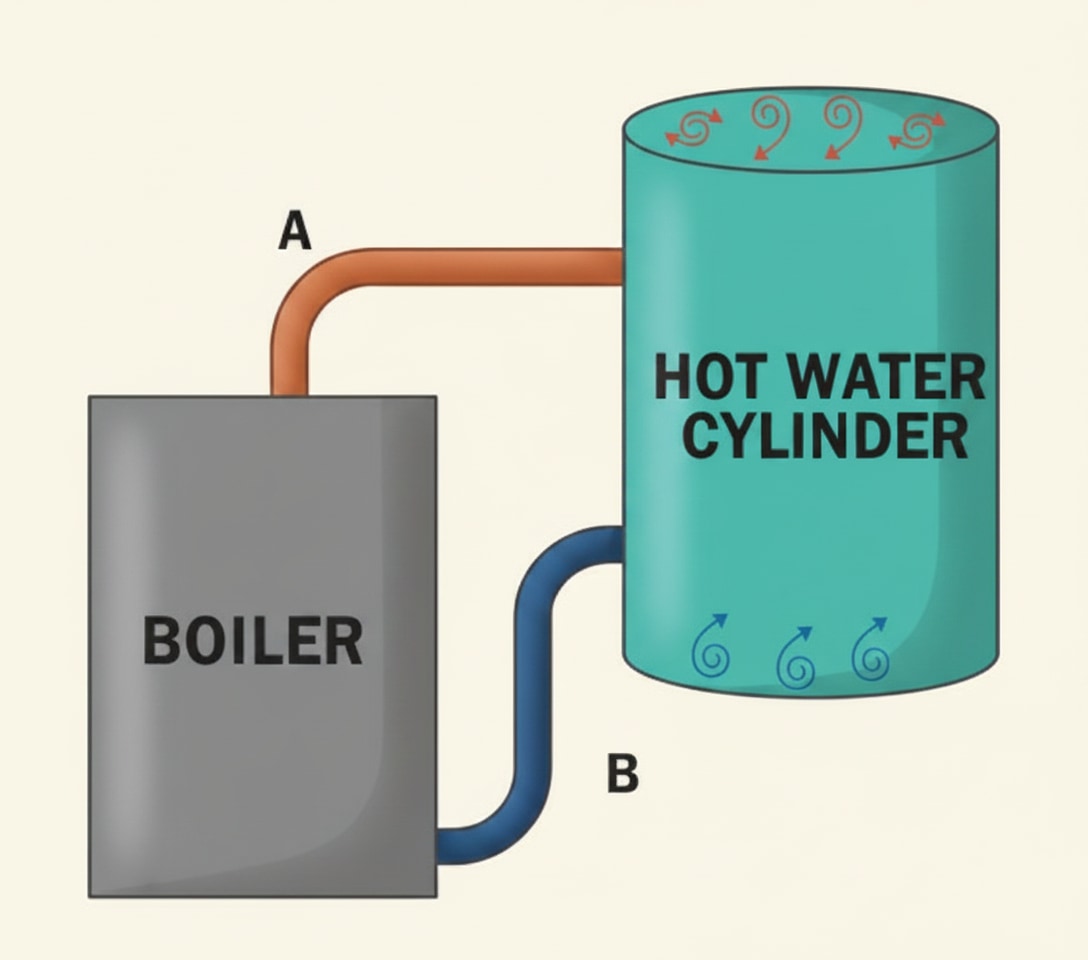
Convection is everywhere in plumbing:
- Hot water cylinders — heated water rises to the top, cooler water sinks to the bottom. This is why the draw-off pipe is at the top (hot) and the cold feed enters at the bottom (cold).
- Natural-circulation primary circuits (now mostly historic) — relied entirely on convection to move hot water from the boiler to the cylinder coil without a pump.
- Hot water rising in vertical pipework even without a pump.
Radiation: heat through space
Radiation is infrared electromagnetic waves carrying heat across space. It needs no medium — it works through a vacuum, which is why vacuum flasks stop heat loss so well.
Every warm object radiates some heat. A hot pipe radiates heat into the room around it. A warm human body radiates heat too. How much radiation depends on the object's temperature and its surface — shiny, polished surfaces radiate and absorb less; dark, matt surfaces radiate and absorb more.
The "radiator" paradox
Here's a Level 2 exam staple: despite the name, most of a radiator's heat output isn't actually radiation.
A panel radiator emits around 15% of its heat by radiation and the other 85% by convection — warming the air in contact with it, which rises and circulates around the room. The heated air is what actually warms the room; the name "radiator" is genuinely misleading. This is why convector fins are added to many radiators to maximise surface area, and why radiators are usually fitted around 150mm off the floor with space above them — both features are about letting the convection current flow properly.
Why does this matter for the exam? Because examiners like testing whether you understand the mechanism rather than just the name. A question asking "by which method does a radiator give out most of its heat?" is designed to catch out students who assumed the answer was radiation.
Why heat pumps need bigger radiators
Modern heating design is all about low-temperature systems. A gas boiler might send water to a radiator at 70°C; a heat pump typically runs at 35–45°C. Lower temperatures change the heat transfer balance:
- Radiation depends strongly on temperature — lower temperatures mean much less radiant output.
- Convection still works but with a smaller temperature difference driving the air movement.
The net effect: a heat pump radiator has to be physically larger to deliver the same total heat output at a lower operating temperature. This is a 2026 exam favourite because the UK is deep into the heat pump rollout.
Insulation and heat loss
The reverse problem: keeping heat in.
- Cylinder jackets and factory-fitted foam — slow conduction out through the cylinder wall.
- Pipe lagging — slows conduction out through the pipe wall; also prevents freezing in cold spaces.
- Loft and cavity wall insulation — slows conduction out through the building fabric.
A vacuum flask is the extreme case — silvered walls reduce radiation, a vacuum between the walls eliminates both conduction and convection. Not practical for hot water cylinders, but a useful extreme example to understand the principle.
Common exam traps
Trap 1: Assuming "radiator" means radiation. Most of a radiator's heat output is convection. If you see "radiator" in the question, don't assume the answer is radiation.
Trap 2: Mixing up conduction and convection. Conduction is through solids. Convection is through fluids moving. A pipe wall is conduction; the water inside is convection.
Trap 3: Thinking cold can move into a room. Heat moves from hot to cold, never the other way. A "cold draught" is warm air leaving, not cold air attacking.
Quick revision summary
Before the mock test, five things you need to be able to produce from memory:
- The three modes: conduction (solids), convection (fluids), radiation (space/vacuum)
- Heat always moves from hot to cold — there is no "cold transfer"
- Copper is a very good conductor; plastic is a poor one; vacuum eliminates all three modes
- A "radiator" is mostly a convector — about 15% radiation, 85% convection
- Heat pumps run at lower flow temperatures, so they need larger emitters
📝 10-Question Mock Test
Click an option to see whether you got it right. Explanations appear instantly — no submitting at the end.
Only radiation can travel through a vacuum — it's electromagnetic waves, not a flow of matter. Conduction needs a solid, convection needs a fluid. This is a gift question if you've learned the three modes.
The pipe wall is a solid material. Heat moves through it by conduction — molecules on the hot side vibrating and passing that energy through. The water on either side is convection; the wall itself is conduction.
Heated water is less dense than cooler water, so it rises. The hottest water in a cylinder sits at the top — which is exactly where the draw-off pipe is placed. This is a direct application of understanding convection.
The classic radiator trap. Despite the name, only about 15% of a "radiator's" heat output is actually by radiation — the other 85% is transferred to the air and carried around the room by convection. Option D (85%) is the common wrong answer from students who've reversed the figures. Memorise which way round it goes: the smaller number is radiation, the larger is convection.
Very high thermal conductivity is exactly why copper is used in heat exchangers and cylinder coils. Steel conducts reasonably well, plastic poorly, and insulation barely at all.
Heat transfer from a radiator to a room depends on the temperature difference between the radiator and the air. A heat pump running at 40°C has a smaller temperature difference than a gas boiler running at 70°C, so the emitter needs more surface area to deliver the same heat.
Heat always moves from hotter areas to colder ones, by any of the three modes. Option B is the classic "cold" misconception — there's no such thing as "cold transfer," only "warm leaving."
Lagging is a poor conductor. It doesn't absorb or convert heat — it just makes heat take much longer to travel outward through the pipe wall and into the surrounding air.
No medium, no conduction or convection. The silvering on the glass additionally reflects radiation back, making the flask extremely efficient at keeping its contents at their original temperature.
The water inside the pipe is warmer than the sub-zero air outside. Heat flows outward (hot to cold) by conduction through the pipe wall, then away from the pipe surface. If enough heat escapes, the water temperature drops to freezing. This is why lagging matters — it slows the conduction rate and keeps the water above freezing for longer.
How PlumbMate puts this into practice
Questions like these are exactly what PlumbMate drills you on — but with the spaced repetition engine doing the scheduling so you're not retesting yourself on the stuff you already know.
- Flashcards, not essays. One prompt, one answer — the format that research has consistently shown works best for active recall.
- Wrong answers are logged. Every question you get wrong goes into a dedicated collection that resurfaces more frequently in future sessions.
- The 3× rule. You need to get a question right three times before it clears — one lucky guess isn't enough.
- Explanations on every question. Like the ones above, but on every single question in the app.