Pressure is the single topic that causes more lost marks in the Level 2 scientific principles exam than any other. Not because it's genuinely difficult — but because the maths looks intimidating, the units are easy to mix up, and examiners know exactly which mistakes to build their distractors around.
This post walks through everything you need to know for the Level 2 exam: head pressure, units, the pressure formula, the force formula, and the traps examiners reliably set. At the end there's a 10-question mock test with full explanations — treat it as a diagnostic for where you stand right now.
If you want the wider revision strategy rather than just the science, pair this with the spaced repetition guide and the common exam mistakes post.
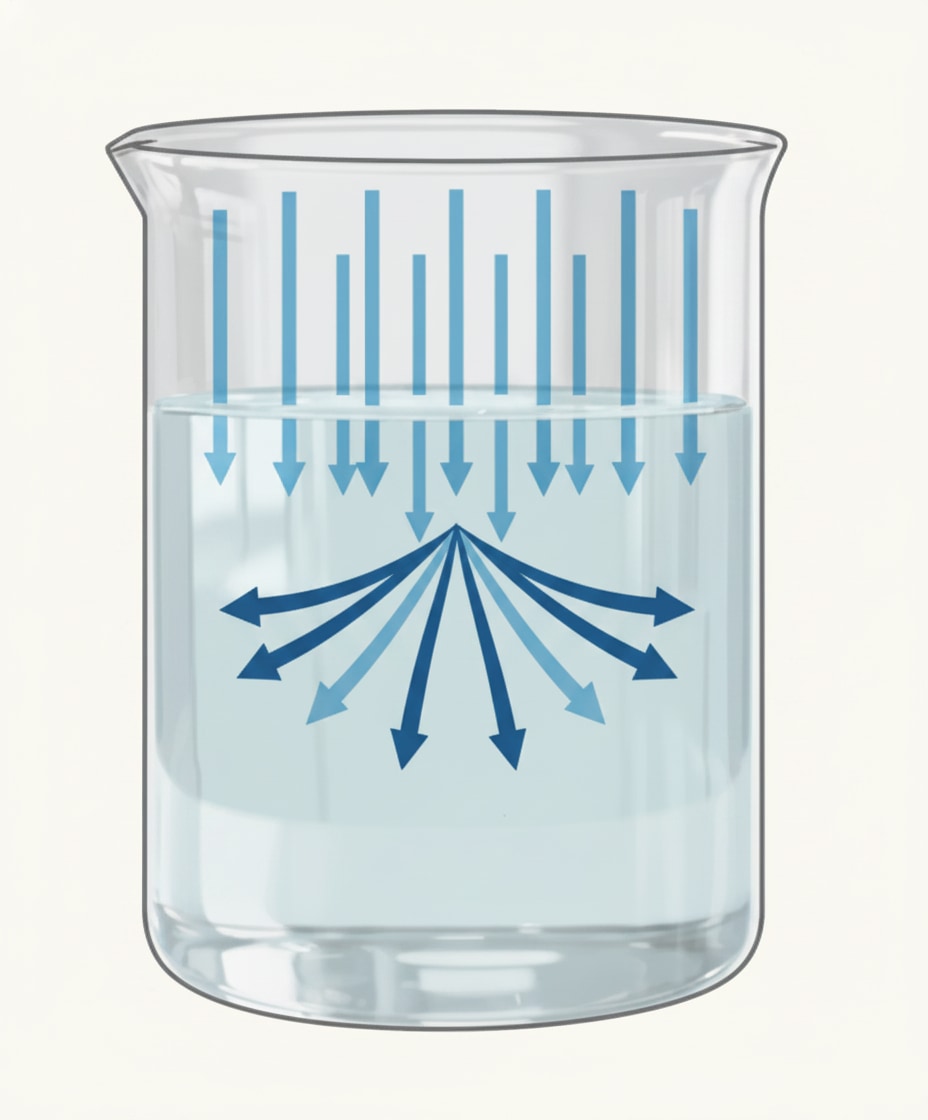
What pressure actually is
Pressure is force spread over an area. The formal definition is:
Pressure = Force ÷ Area
The SI unit is the pascal (Pa), where 1 pascal equals 1 newton per square metre. That's a tiny amount of pressure, so plumbing uses larger units in practice:
- Pa (pascal) — the base unit. Very small — about the pressure of a sheet of paper resting on a table.
- kPa (kilopascal) — one thousand pascals. Sometimes used in exam calculations.
- MPa (megapascal) — one million pascals. You'll see this printed on pipe fittings and components to show their maximum working pressure.
- bar — the unit most plumbers actually use day-to-day on site and on pressure gauges.
The conversions you need to know cold:
- 1 bar = 100,000 Pa = 100 kPa = 0.1 MPa
- 1 MPa = 10 bar
- 1 atmosphere (at sea level) ≈ 1.013 bar
To convert any of these into bar:
- From Pa: divide by 100,000
- From kPa: divide by 100
- From MPa: multiply by 10
Exam questions routinely switch units between the question stem and the answer options — a calculation given in kPa with answers offered in bar, for example. This is one of the most reliable places students lose marks: the arithmetic is right, the answer is correct in one unit, but the selected option is in the wrong one.
Head pressure: the plumbing shortcut
In plumbing, we're almost always calculating pressure produced by a column of water. There's a shortcut that saves you from doing the full formula every time:
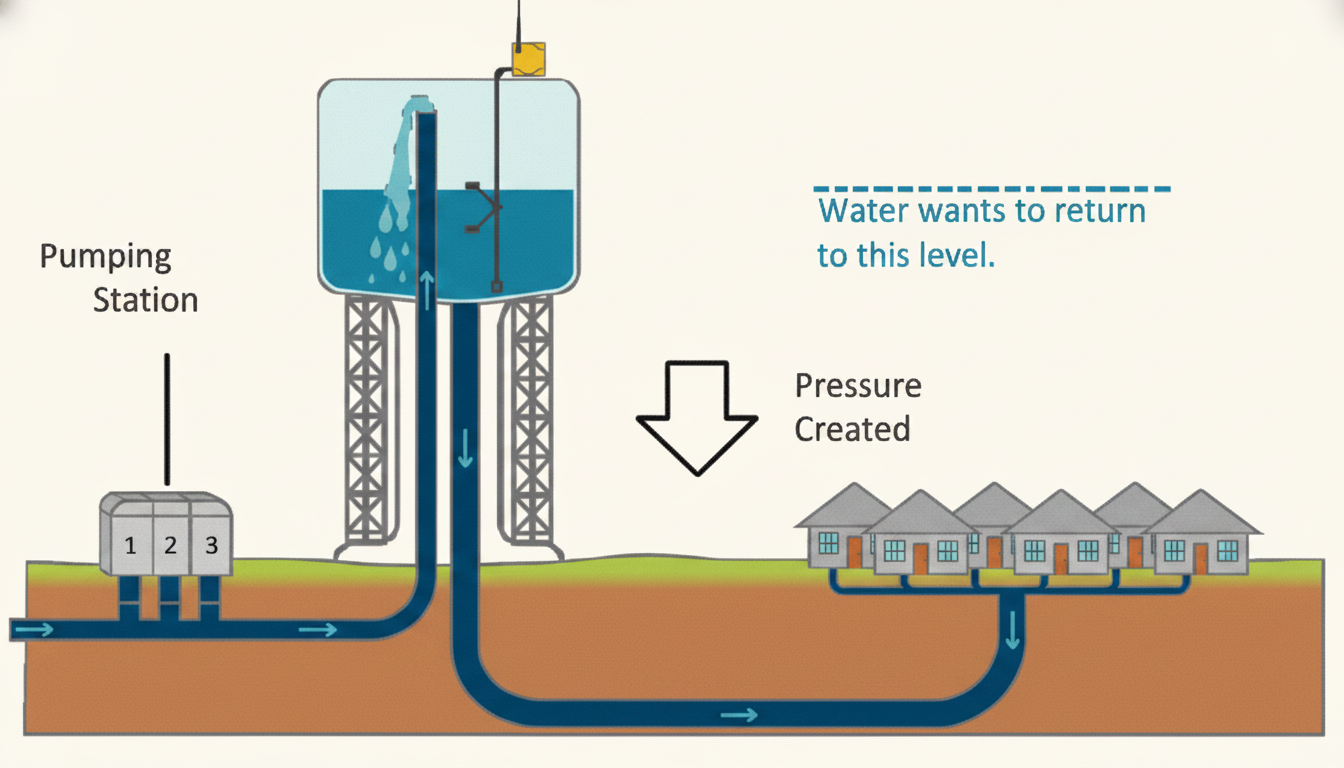
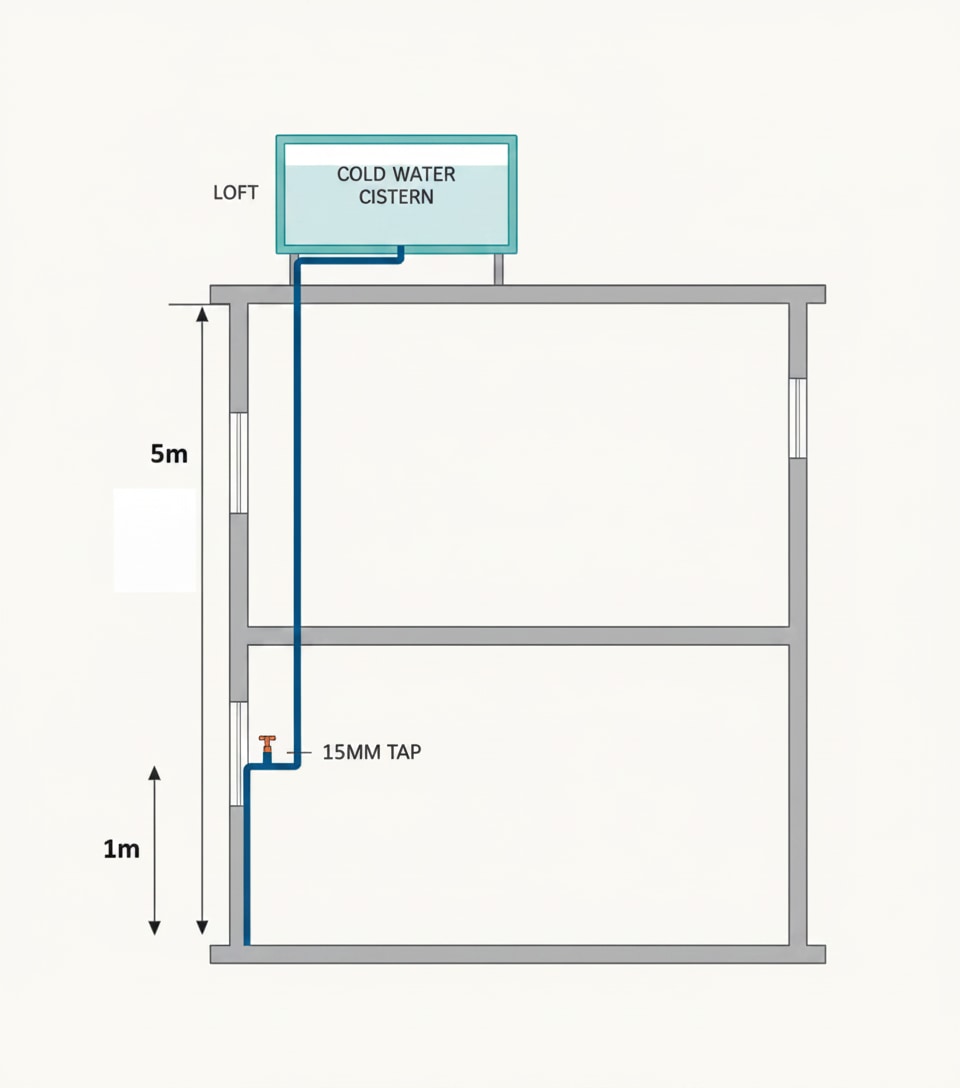
For every 1 metre of vertical height (head), water produces approximately 0.1 bar of pressure.
So a cold water storage cistern 5 metres above a bathroom basin produces roughly 0.5 bar at the basin tap. A header tank 10 metres up produces about 1 bar.
Technically this is an approximation — the exact figure is closer to 0.0981 bar per metre — but 0.1 bar per metre is the working rule of thumb used throughout the trade. Memorise this one. It turns up directly in exam questions as a fast shortcut, and it's genuinely useful on site — when a customer is complaining about slow flow to their bathroom and you need to estimate the head from their loft cistern in your head, the 0.1-bar-per-metre rule is how you do it. This is one of the rare bits of Level 2 theory that earns its keep every day of your career.
The pressure formula: P = ρgh
For precise calculations, use the full formula:
P = ρ × g × h
Where:
- P = pressure in pascals (Pa)
- ρ (rho) = density of the fluid in kilograms per cubic metre (kg/m³). For water, this is 1,000 kg/m³.
- g = acceleration due to gravity, 9.81 metres per second squared (m/s²)
- h = height of the water column in metres (m)
So the pressure at the base of a 6-metre column of water is:
P = 1,000 × 9.81 × 6 = 58,860 Pa (about 0.59 bar)
The units matter. Density in kg/m³, gravity in m/s², height in metres — anything else and your answer comes out in the wrong units.
Force vs pressure: don't confuse them
Pressure and force are related but not the same thing. Pressure is force per unit of area; force is what that pressure exerts on a given surface.
Force = Pressure × Area (F = P × A)
Where force is in newtons (N), pressure in pascals (Pa), and area in square metres (m²).
A classic exam question: "A pressure of 500 Pa is applied to an area of 2 m². What is the force?"
F = 500 × 2 = 1,000 N
This is where unit discipline really matters. If the question gives you pressure in kPa or bar, convert to pascals before multiplying. If the area is in cm² or mm², convert to square metres.
Tensile, compressive and shear force
Force can act on a body in three different ways. Plumbers see all three: in pipework supports, in fixings, and in the materials that pipes and fittings are made from. Each one is named after the way the force is applied.
Compressive force
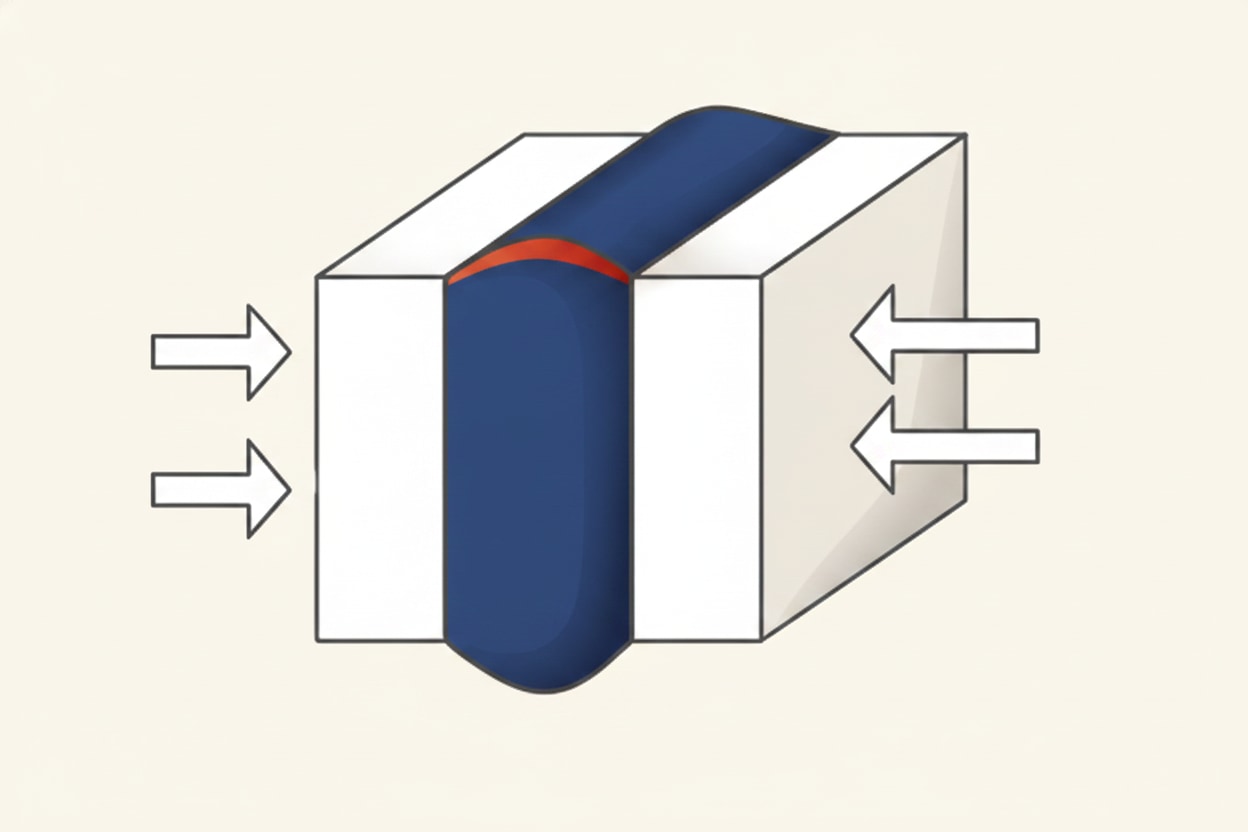
Compressive force acts inwards, squeezing the body. Examples: the weight of stored water pressing down on the base of a cistern; the load on a vertical post supporting a tank in the loft; the clamping force on an olive in a compression fitting. Materials that resist compression well include cast iron, concrete and dense masonry — they can carry heavy weight without crushing.
Tensile force
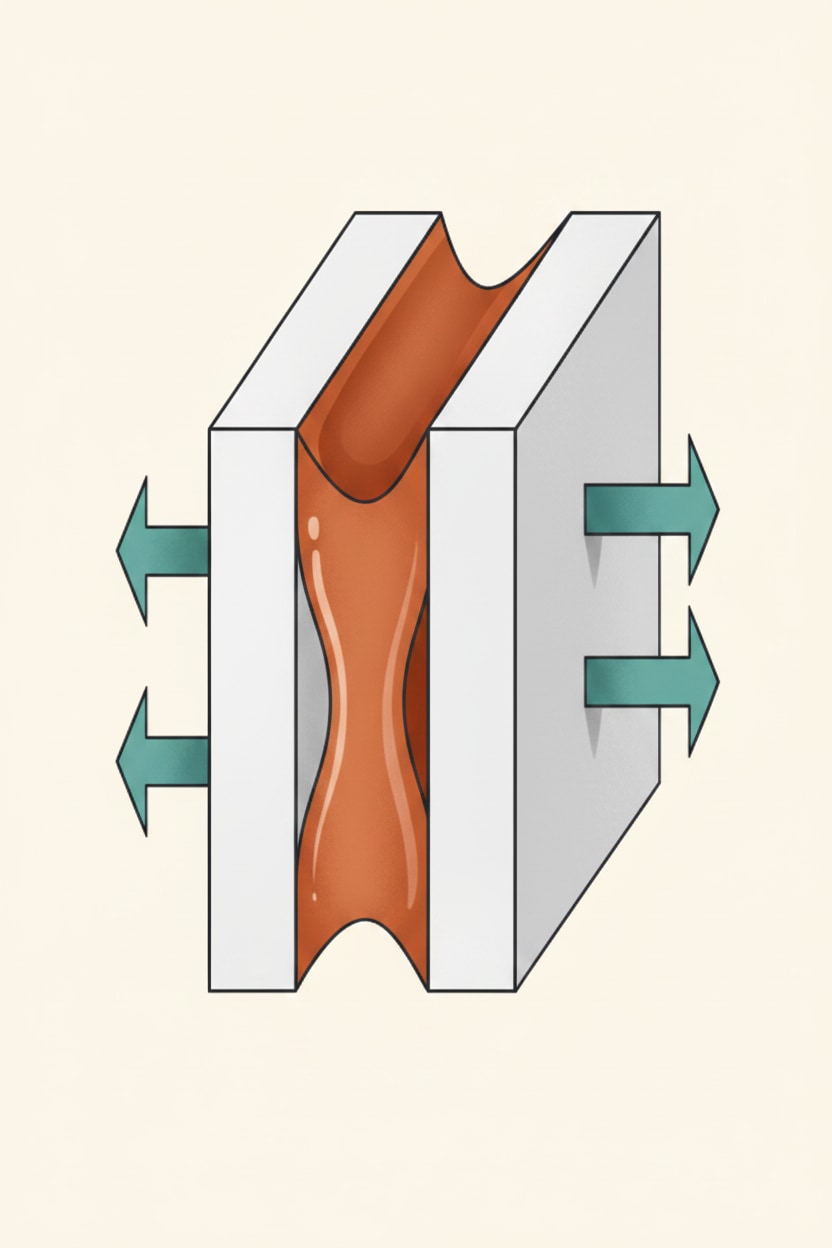
Tensile force acts outwards, pulling a body apart. Example: a hanging bracket holding a length of pipe — gravity is pulling the pipe downwards and the bracket and its fixing are in tension, resisting that pull. Steel cables, threaded rod, and most ductile metals carry tensile loads well. Cast iron is poor in tension — it will snap rather than stretch.
Shear force
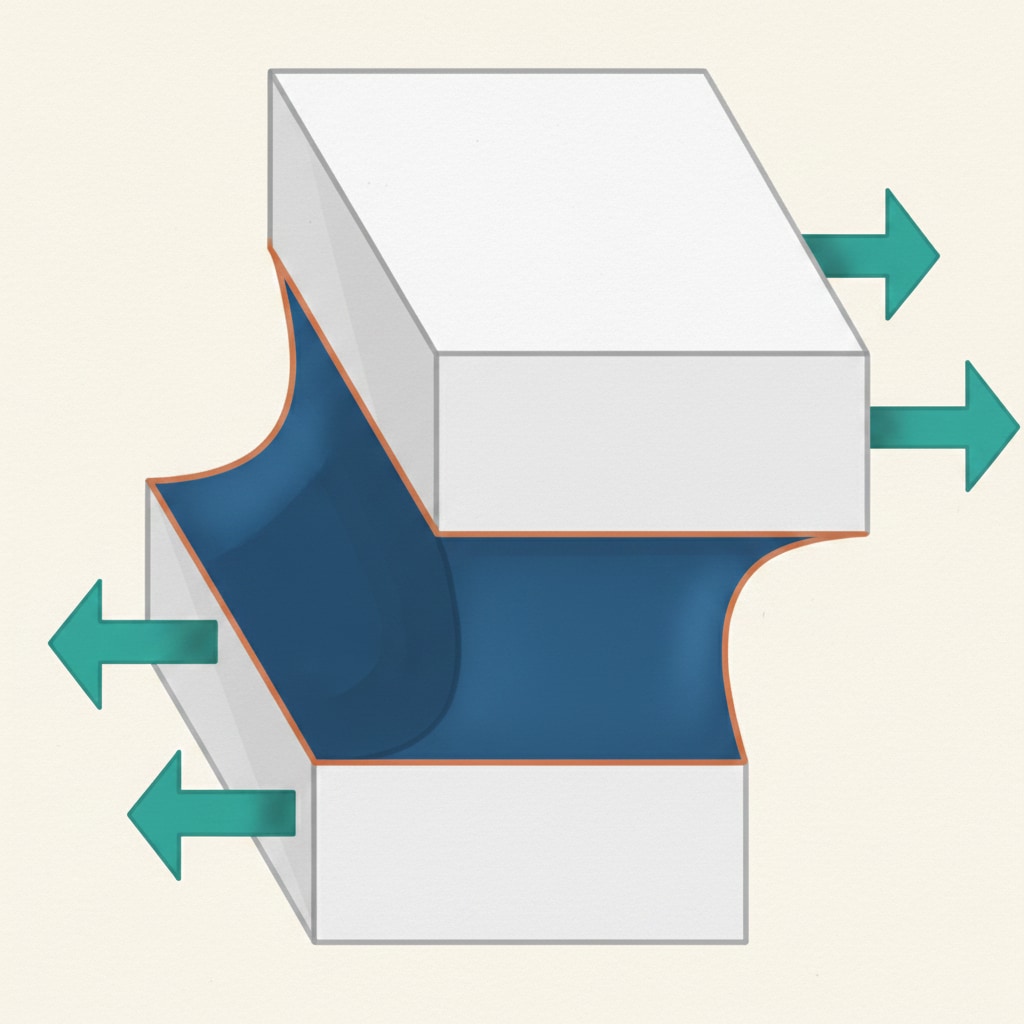
Shear force acts parallel to a surface, with two opposite forces sliding across each other. Example: a screw fixing a pipe clip to a joist — if the pipe tries to drop, it puts a shear load on the screw across the joist face. Bolts, pins and rivets are the components that typically resist shear loading.
The three most common exam traps
Trap 1: Unit swapping. The commonest distractor is a correct number in the wrong unit. If the question asks for pascals and you've calculated in bar, your arithmetic is right but your answer is wrong.
Trap 2: Forgetting the density. In a P = ρgh question, students often drop the density from the formula and write P = gh. Check every formula before you hit the calculator.
Trap 3: Mixing up pressure and force. If a question gives you an area, stop and ask: is it asking for pressure (divide) or force (multiply)? This alone catches a surprising number of students.
Quick revision summary
Before the mock test, five things you need to be able to produce from memory:
- Pressure = Force ÷ Area (units: pascals = newtons per square metre)
- 1 bar = 100,000 Pa = 100 kPa = 0.1 MPa (and therefore 1 MPa = 10 bar)
- Approximately 0.1 bar of pressure per metre of head
- P = ρ × g × h (with ρ = 1,000 kg/m³ for water, g = 9.81 m/s²)
- F = P × A (with pressure in Pa and area in m²)
📝 10-Question Mock Test
Click an option to see whether you got it right. Explanations appear instantly — no submitting at the end.
Using the 0.1 bar per metre rule: 10m × 0.1 bar/m = 1 bar. This is the most common "head pressure" question — learn the shortcut.
1 bar = 100,000 Pa = 100 kPa. One of the most testable conversions in the syllabus. The distractors are all powers of 10, so a student who's half-remembered the number can still get it wrong.
ρ (rho, the Greek letter) is the standard symbol for density. The formula reads "pressure equals density times acceleration due to gravity times height." If you don't know which letter means which, you can't use the formula — which is why examiners test the symbol directly.
Head pressure shortcut again: 5m × 0.1 bar/m = 0.5 bar. The distractors play on decimal-point errors, so double-check your calculation.
Standard atmospheric pressure at sea level. The number you need to commit to memory. This also often appears as 101.3 kPa or 101,300 Pa — all the same thing in different units.
F = P × A = 500 × 2 = 1,000 N. Straightforward calculation, but notice that if you'd mixed up the formula and divided instead of multiplied, you'd get 250 N — which is option A. That's the distractor doing its job.
P = ρgh = 1,000 × 9.81 × 4 = 39,240 Pa. The distractors are all off by powers of ten, testing whether you've tracked the decimal places. You can also sense-check this: 4m head ≈ 0.4 bar ≈ 40,000 Pa — so B is the only answer in the right order of magnitude.
P = F ÷ A = 2,000 ÷ 0.5 = 4,000 Pa. Here the trap is doing the calculation the wrong way round. If you multiplied (2,000 × 0.5), you'd get 1,000 — which is option A.
In an indirect cold water system, only the kitchen tap is fed direct from the rising main (for drinking water). All other cold outlets — including bathroom basin taps — are fed from the cold water storage cistern. The cistern only provides head pressure, while the main supplies full mains pressure (typically several bar).
Pressure at the base of a water column depends on the height of water above it. The tap 4m below the cistern has 4m of head, so roughly 0.4 bar. The tap 2m below has only 0.2 bar.
How PlumbMate puts this into practice
Questions like these are exactly what PlumbMate drills you on — but with the spaced repetition engine doing the scheduling so you're not retesting yourself on the stuff you already know.
- Flashcards, not essays. One prompt, one answer — the format that research has consistently shown works best for active recall.
- Wrong answers are logged. Every question you get wrong goes into a dedicated collection that resurfaces more frequently in future sessions.
- The 3× rule. You need to get a question right three times before it clears — one lucky guess isn't enough.
- Explanations on every question. Like the ones above, but on every single question in the app.