Everything expands when it's heated. On a Level 2 exam paper that fact becomes a calculation question; on site it becomes the ticking sound under a customer's floorboards, a leaking compression fitting above a freshly decorated ceiling, or a discharging boiler or unvented cylinder because an expansion vessel was missed. This post covers the theory, the numbers, and the consequences.
If you want the wider revision framework, pair this with the spaced repetition guide. For the companion science deep-dive, see the pressure and force post.
What thermal expansion actually is
When any material heats up, its atoms vibrate more energetically and need more space. The result is that the material gets slightly larger in every direction — longer, wider, thicker.
In plumbing we need to calculate linear expansion — how much longer a pipe gets when heated. The formula is:
Change in length = coefficient × original length × temperature change
Or using symbols:
ΔL = α × L × ΔT
Where:
- ΔL is the change in length in metres (m)
- α (alpha) is the coefficient of linear expansion — a property of the material, in /°C
- L is the original length in metres (m)
- ΔT is the temperature change in degrees Celsius (°C)
The coefficient tells you how much the material expands per metre, per degree of temperature rise. Different materials expand at very different rates, which is why knowing the coefficient for the material you're working with matters.
The coefficients you need to know
These values are taken from the Level 2 Scientific Principles course material.
| Material | Coefficient of linear expansion (m/°C) |
|---|---|
| Plastic | 0.00018 |
| Copper | 0.000016 |
| Mild steel | 0.000011 |
| Cast iron | 0.000011 |
The key comparison to keep in your head: plastic expands roughly 11 times more than copper, and about 16 times more than mild steel. This is why plastic hot water pipework needs far more allowance for movement than copper does.
Working the formula: a typical exam calculation
A standard question: "A 10-metre length of copper pipe is heated from 10°C to 70°C. How much does it expand?"
Step through it:
- Coefficient for copper: 0.000016 m/°C
- Original length: 10 metres
- Temperature change: 70 − 10 = 60°C
- ΔL = 0.000016 × 10 × 60 = 0.0096 metres = 9.6 mm
That's nearly a centimetre of movement in a single 10-metre run. If the pipe is rigidly clipped at both ends with no allowance for expansion, that movement has to go somewhere — which is exactly the problem thermal expansion creates.
Water itself expands
It's not just the pipework. Water is unusual because it expands both when heated and when it freezes:
- Heated water: expands by about 4% in volume from cold (4°C) to just below boiling.
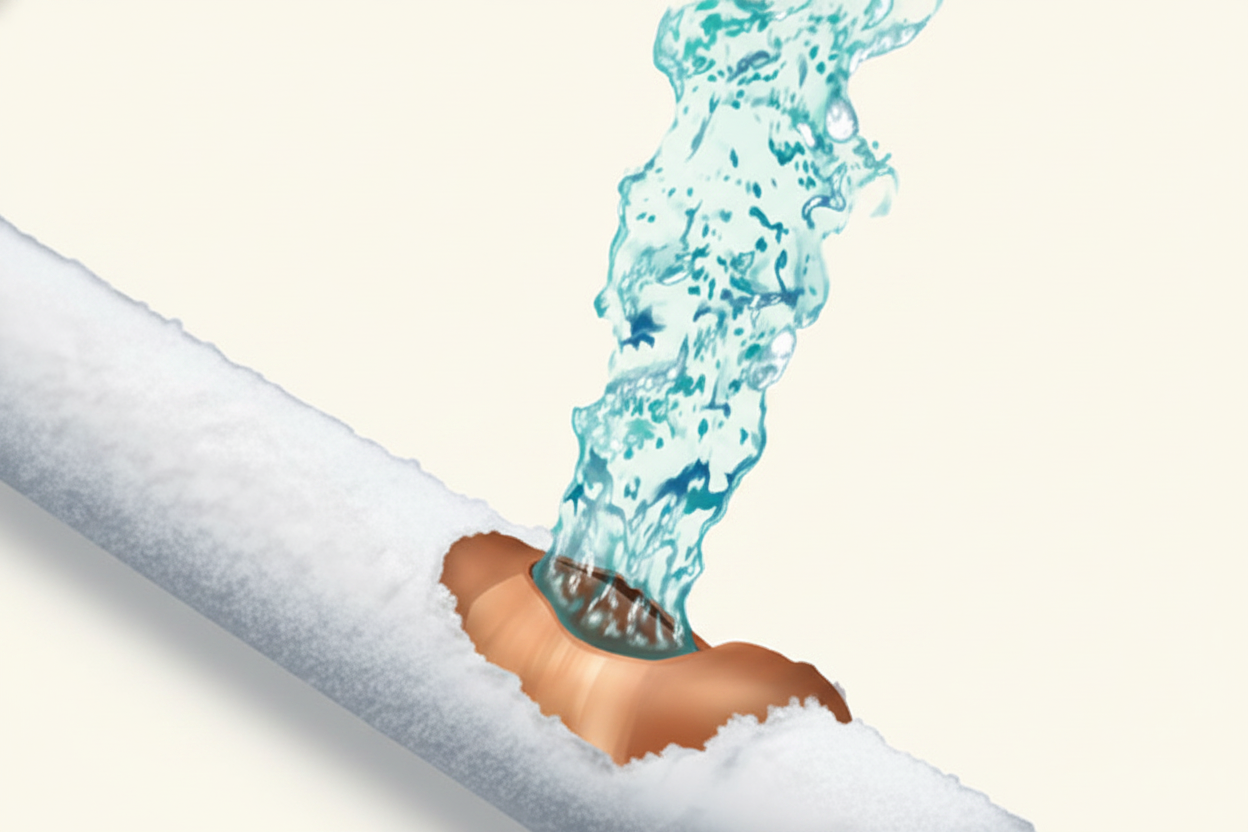
- Freezing water: expands by about 10% when it turns to ice — which is why unlagged pipes in cold spaces burst.
- Water turning to steam: expands by about 1600 times. This is why uncontrolled steam in a hot water or heating system is an explosion risk.
In an unvented hot water system, a 200-litre cylinder heating from 10°C to 60°C gains roughly 4 litres of volume. That water has to go somewhere. If the system doesn't have an expansion vessel or an expansion valve, the pressure inside climbs sharply — which is why unvented hot water systems have both an expansion vessel to absorb the volume and a pressure relief valve as a fallback.
The real-world consequences
This is where theory meets the job. The consequences of ignoring thermal expansion include:
- Ticking and creaking noises in floors as pipes slide through clips as they heat and cool.
- Pipework deformation in long straight runs with no expansion allowance.
- Stressed joints and leaks, particularly at compression fittings where the pipe is being pulled or pushed against a rigid connection.
- Distorted radiators on heating systems with undersized or missing expansion vessels.
- Over-pressurised unvented cylinders with no or insufficient expansion volume.
How plumbers compensate
Experienced plumbers build allowances for expansion into the installation itself:
- Expansion loops and bends — a U-shape or offset in long pipe runs that lets the pipe flex as it expands.
- Pipe sleeves through walls and floors — so the pipe can move freely through the structure rather than being gripped by it.
- Sliding clips — which allow the pipe to move axially rather than holding it rigid.
- Expansion vessels — sealed vessels with a diaphragm and air cushion that absorb water volume changes in sealed heating and unvented hot water systems.
- Plastic pipe support at frequent intervals — because plastic sags as well as expanding, it needs closer clip spacing than copper.
Common exam traps
Trap 1: Unit confusion. The formula gives you an answer in metres. If the question asks for millimetres, multiply by 1,000. The distractors are almost always the same number in a different unit.
Trap 2: Using the wrong coefficient. If the question is about plastic pipework, using copper's coefficient gives you an answer that's 11× too small. Check the material before you plug in numbers.
Trap 3: Forgetting the temperature change is a difference. If the pipe starts at 10°C and heats to 70°C, ΔT is 60°C, not 70°C. A classic source of lost marks.
Quick revision summary
Before the mock test, five things you need to be able to produce from memory:
- ΔL = α × L × ΔT — the linear expansion formula
- Copper coefficient = 0.000016 m/°C; mild steel and cast iron = 0.000011 m/°C; plastic = 0.00018 m/°C
- Water expands 4% when heated from 4°C to just below boiling, 10% when it freezes, and 1600× when it turns to steam
- Consequences of ignoring expansion: ticking pipework, leaking joints, discharging boilers or unvented cylinders
- Compensation methods: expansion loops, sleeves, sliding clips, expansion vessels
📝 10-Question Mock Test
Click an option to see whether you got it right. Explanations appear instantly — no submitting at the end.
The definition. Option A describes thermal conductivity, option D describes specific heat capacity — both are legitimate Level 2 concepts but they're different things. This is exactly the kind of question that separates students who can recite definitions from those who've confused the concepts.
Plastic has a coefficient of 0.00018 m/°C — roughly 11× copper (0.000016) and about 16× mild steel and cast iron (both 0.000011). This is why plastic hot water pipework needs much more allowance for movement. Mild steel and cast iron share the same coefficient in the course material, which is itself worth knowing — examiners sometimes pair them to test whether you've noticed.
ΔL = 0.000016 × 5 × 60 = 0.0048 m = 4.8 mm. Step through it: coefficient × length × temperature change. The distractors are the same digits in the wrong units. Option A (0.48 mm) drops a decimal place in the conversion from metres to millimetres. Option C (48 mm) is 10× too big — a good reminder to sense-check: a 5-metre pipe warming by 60°C producing nearly 5cm of movement would be physically huge.
The Greek letter delta (Δ) always means "change in." If a pipe goes from 10°C to 70°C, ΔT = 60°C, not 70°C. Option B is the most common wrong answer because students use the starting temperature directly.
Water expands by approximately 4% in volume from cold (4°C) to near boiling. This is why expansion vessels are sized based on the system water content — 4% of a large system is a lot of water. Water also expands about 10% when it freezes (which is why unlagged pipes burst in cold lofts) and about 1600× when it turns to steam (which is the explosion risk controlled by the T&P relief valve on an unvented cylinder). All three are worth committing to memory for the exam.
Expansion vessels have an internal diaphragm separating water from an air cushion. As water volume increases, the diaphragm compresses the air, absorbing the expansion without raising pressure dangerously.
Two reasons in one answer — which is how examiners often write it. Plastic expands more, and it also has less structural stiffness than copper, so it needs more frequent support.
The classic symptom. The pipe doesn't rattle — it slides through its clips as it heats, producing a characteristic ticking sound. A pump fault would sound different; a loose valve would usually leak rather than tick.
A sleeve lets the pipe move freely through a rigid structure. Without it, every heating cycle stresses the pipe against the wall material.
ΔL = 0.00018 × 20 × 60 = 0.216 m = 216 mm. Over 20 centimetres of movement on a 20-metre plastic run — which is exactly why long plastic runs need proper expansion allowance. If you used the copper coefficient by mistake (0.000016), you'd have got 19.2 mm — a perfectly valid-looking answer for the wrong material. Always check which material the question is about.
How PlumbMate puts this into practice
Questions like these are exactly what PlumbMate drills you on — but with the spaced repetition engine doing the scheduling so you're not retesting yourself on the stuff you already know.
- Flashcards, not essays. One prompt, one answer — the format that research has consistently shown works best for active recall.
- Wrong answers are logged. Every question you get wrong goes into a dedicated collection that resurfaces more frequently in future sessions.
- The 3× rule. You need to get a question right three times before it clears — one lucky guess isn't enough.
- Explanations on every question. Like the ones above, but on every single question in the app.