You're training as a plumber, not an electrician — but the Level 2 electrical unit expects you to be able to calculate fuse sizes, current draws, and resistances when given the other two values. Every boiler, immersion heater, shower pump, and central heating control you'll ever wire up is a circuit governed by these two formulas. Get them straight and a whole block of exam questions becomes easy marks.
This post is the first in the Level 2 electrical principles sub-cluster. For the others, see the earthing and bonding, safe isolation, and circuits and cables posts. For wider revision strategy, pair this with the spaced repetition guide.
The four quantities and their units
Every Level 2 electrical calculation works with four quantities. Know what each one is, what it's measured in, and its letter in the formulas:
| Quantity | What it is | Unit | Symbol |
|---|---|---|---|
| Voltage | The "push" — what drives electrons around the circuit | volts (V) | V |
| Current | The flow — how much electricity is moving | amps (A) | I |
| Resistance | What slows the flow down | ohms (Ω) | R |
| Power | How much energy the circuit is carrying | watts (W) | P |
A watt is one joule per second. One watt is a small amount of power, so you'll often see kilowatts (kW) in plumbing calculations — 1 kW = 1,000 W. A 3.2 kW immersion heater is a 3,200 W immersion heater.
The symbol for current is "I" (not "C") because the original scientists named it intensité (French for intensity). Memorise the letter — every Ohm's Law question uses it.
Ohm's Law: V, I, R
Ohm's Law relates voltage, current, and resistance. It's expressed using a triangle:
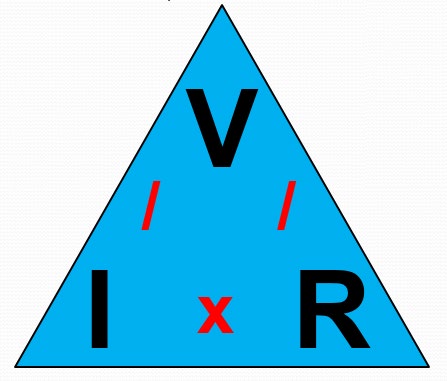
The triangle gives you three formulas at once:
- V = I × R (voltage = current × resistance)
- I = V ÷ R (current = voltage ÷ resistance)
- R = V ÷ I (resistance = voltage ÷ current)
To use the triangle, cover the quantity you're trying to find. Whatever's left is the formula. Cover V → I × R is left → multiply. Cover I → V is on top of R → divide. Same for R.
Worked example from the course material:
A circuit has a resistance of 24 Ω and a current of 10 amps. What's the voltage?
- Cover V in the triangle.
- Left with I × R.
- V = 10 × 24 = 240 volts.
Another:
A circuit has a voltage of 230 V and a resistance of 23 Ω. What's the current?
- Cover I in the triangle.
- Left with V over R.
- I = 230 ÷ 23 = 10 amps.
Power Law: P, I, V
Power Law relates power, current, and voltage. It's a second triangle:
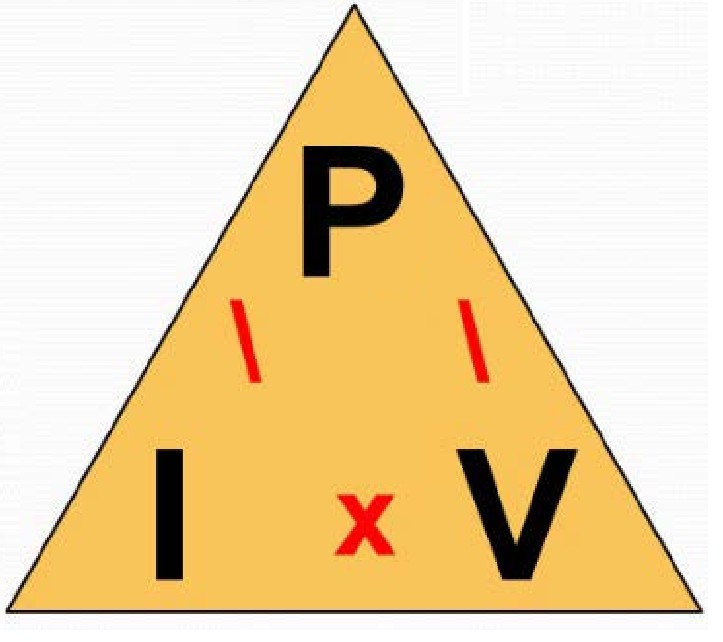
Three formulas:
- P = I × V (power = current × voltage)
- I = P ÷ V (current = power ÷ voltage)
- V = P ÷ I (voltage = power ÷ current)
Same triangle logic — cover what you want to find.
The calculation plumbers need most often is "what fuse size does this appliance need?" — which is really "what current does it draw?" Given a power rating and the supply voltage (usually 230 V in the UK), use I = P ÷ V.
Worked example: what fuse size is required for a 3.2 kW immersion heater running on 230 V?
- Convert kW to W: 3.2 kW = 3,200 W.
- I = P ÷ V = 3,200 ÷ 230 = 13.9 amps.
- Round up to the next standard fuse size. A 13 A fuse would blow under sustained load, so you'd fit a 16 A MCB with a 13 A fuse in the fused switched spur (the standard immersion heater arrangement).
The voltages you need to know
Three voltage figures come up reliably:
- 230 V AC — standard UK domestic supply (what almost every calculation assumes)
- 110 V AC — maximum voltage permitted on a construction site for safety reasons
- 400,000 V — transmission voltage from power stations, reduced through transformers on the way to your house
AC stands for alternating current — the direction of current flow changes 50 times a second in the UK. DC stands for direct current — flow in one direction only, as from a battery or a solar panel. UK mains is AC; most boilers, pumps and immersion heaters you'll wire up run on 230 V AC.
Common exam traps
Trap 1: Mixing up the two triangles. Ohm's Law is V, I, R. Power Law is P, I, V. The two share current (I), which is what links them. If a question gives you voltage and power, use Power Law. If it gives you voltage and resistance, use Ohm's Law.
Trap 2: Forgetting to convert kW to W. If the appliance rating is in kilowatts and you plug it straight into P = I × V, your answer will be 1,000× too small. Always convert to watts first.
Trap 3: Choosing the wrong fuse size. Calculate the current the appliance actually draws, then round up to the next standard fuse size (3 A, 5 A, 13 A for plug fuses; 6 A, 10 A, 16 A, 20 A, 32 A for MCBs). Never round down — a fuse smaller than the actual current will blow under normal use.
Trap 4: Unit symbol confusion. Voltage = V. Current = I (not A, even though amps is the unit). Resistance = R. Power = P. If you see a formula with A in it, the question is using A as the unit, not the symbol for current.
Quick revision summary
Before the mock test, five things you need to be able to produce from memory:
- Voltage (V, volts), current (I, amps), resistance (R, ohms), power (P, watts)
- 1 kW = 1,000 W (always convert before calculating)
- Ohm's Law: V = I × R
- Power Law: P = I × V
- UK domestic supply is 230 V AC; construction site maximum is 110 V
📝 10-Question Mock Test
Click an option to see whether you got it right. Explanations appear instantly — no submitting at the end.
Amps (sometimes written as amperes, symbol A) measure current — the flow of electrons through a circuit. Ohms measure resistance, volts measure voltage, watts measure power. A standard distractor-spotting question: each option is a real electrical unit, so knowing which is which matters.
The symbol comes from the French intensité — intensity. Option A (A) is a common wrong answer because "amps" starts with A, but A is the unit, not the symbol in formulas. Option C is the symbol used in both Ohm's Law (V = I × R) and Power Law (P = I × V).
V = I × R. This is the most-tested single relationship in Level 2 electrical calculations. You need it instantly — if you had to stop and think about it in the exam, you need more drill.
Using I = V ÷ R: 230 ÷ 115 = 2 A. The distractors are all simple divisions of the voltage by various numbers that might look like the resistance. Cover I in the Ohm's Law triangle and the calculation is V over R — a straight division.
Using P = I × V: 10 × 230 = 2,300 W (or 2.3 kW). The distractors test whether you've tracked the decimal places and the magnitude. Sense-check: 10 amps at mains voltage is a decent-sized appliance (similar to a small electric shower), so the answer should be in the low thousands of watts.
Convert 3.2 kW to 3,200 W first. Then I = P ÷ V = 3,200 ÷ 230 = 13.9 A. Option A (1.39 A) is the classic "forgot to convert kW to W" trap — it's 10× too small. Option C (139 A) is 10× too big. The correct order of magnitude for an immersion heater is always around 13–14 amps on 230 V — worth memorising as a sense-check.
Using R = V ÷ I: 240 ÷ 2 = 120 Ω. Straight division. Option A (12 Ω) drops a decimal place; option C (480) multiplies instead of dividing.
The drill draws I = P ÷ V = 1,500 ÷ 230 = 6.5 A. The next standard plug fuse size above 6.5 A is 13 A. Option B (5 A) would blow under normal use because it's smaller than the actual current — a classic "round down" error. Standard UK plug fuses are 3 A, 5 A and 13 A; for a drill drawing 6.5 A, 13 A is the only safe option.
The maximum permitted voltage for power tools on UK construction sites is 110 V (centre-tapped, so 55 V to earth) — this significantly reduces the risk of serious electric shock compared to full domestic 230 V. You may have seen the yellow transformer boxes on building sites that step 230 V down to 110 V — that's why they're there. Option D (230 V) is domestic supply, which isn't permitted for site tools.
UK mains alternates at 50 Hz — 50 times per second. DC (option A) flows in one direction only, as from a battery or solar panel. Option B (static) and D (resistive) aren't standard types of current at all.
How PlumbMate puts this into practice
Calculation questions like these are exactly what PlumbMate drills you on — with the spaced repetition engine making sure the formulas stay sharp.
- Flashcards, not essays. One prompt, one answer — the format that research has consistently shown works best for active recall.
- Wrong answers are logged. Every question you get wrong goes into a dedicated collection that resurfaces more frequently in future sessions.
- The 3× rule. You need to get a question right three times before it clears — one lucky guess isn't enough.
- Explanations on every question. Like the ones above, but on every single question in the app.