Electrical principles is the unit most plumbing students dread. You didn't sign up to be an electrician — but every boiler, pump, immersion heater, shower, and heating control you'll ever work on connects to an electrical supply, and the exam expects you to understand what you're working with. The good news is the scope is tightly defined. You don't need to know BS 7671. You need to know the specific material the course material covers, and that's a lot more learnable than it first looks.
This guide is the single-page overview: what the syllabus covers, which concepts matter most, where students reliably lose marks, and how to build a revision routine that makes the material stick. Each of the four main topics has its own deep-dive post with a full 10-question mock test and explanations — this page links out to all of them.
Why electrical feels harder than it is
There are three reasons students over-estimate how hard this unit is.
First, it's not your subject. You're training as a plumber. The electrical content feels like someone else's material — something you're being forced to learn that doesn't fit. It does fit, though. Everything in the syllabus is there because plumbers work around electrical systems every day: every appliance you connect, every pipe you bond, every circuit you isolate before touching. The material is plumber-specific, not generic electrician content.
Second, safety anxiety stacks on top of exam anxiety. Electrical faults can kill you. That's true, and the unit teaches it for exactly that reason — but the safety anxiety that comes with the subject can make the material feel higher-stakes than it needs to be for revision purposes. Separate the two: learning the procedure properly is the safety; the exam is just testing whether you've learned it.
Third, there's a lot of specific numbers to remember. Cable sizes, fuse sizes, distances, floor areas, arrangement codes. Students try to "understand" these facts as if they were reasoning questions, when in reality they just need drilling. Spaced repetition clears these kinds of facts faster than any other revision technique — which is good news, because there's a lot of them.
The five areas you need to master
Level 2 electrical principles breaks down into five main blocks. Each one has its own deep-dive post; the summaries below give you enough to decide where your gaps are.
1. Ohm's Law and Power Law
The calculations block. Four quantities, two triangles, and a lot of exam questions that test whether you can use them.
The core facts:
- V, I, R, P — voltage (volts), current (amps, symbol I), resistance (ohms), power (watts)
- 1 kW = 1,000 W — always convert before calculating
- Ohm's Law: V = I × R
- Power Law: P = I × V
- UK domestic supply: 230 V AC; construction site maximum: 110 V
Most exam questions on this block are calculation-based. You're given two of the four quantities and asked for a third. The single most common question is "what fuse size does this appliance need?" — which is really "what current does it draw?" — answered with I = P ÷ V. For the full treatment plus a 10-question mock test, see the Ohm's Law and Power Law deep-dive.
2. Earthing and bonding
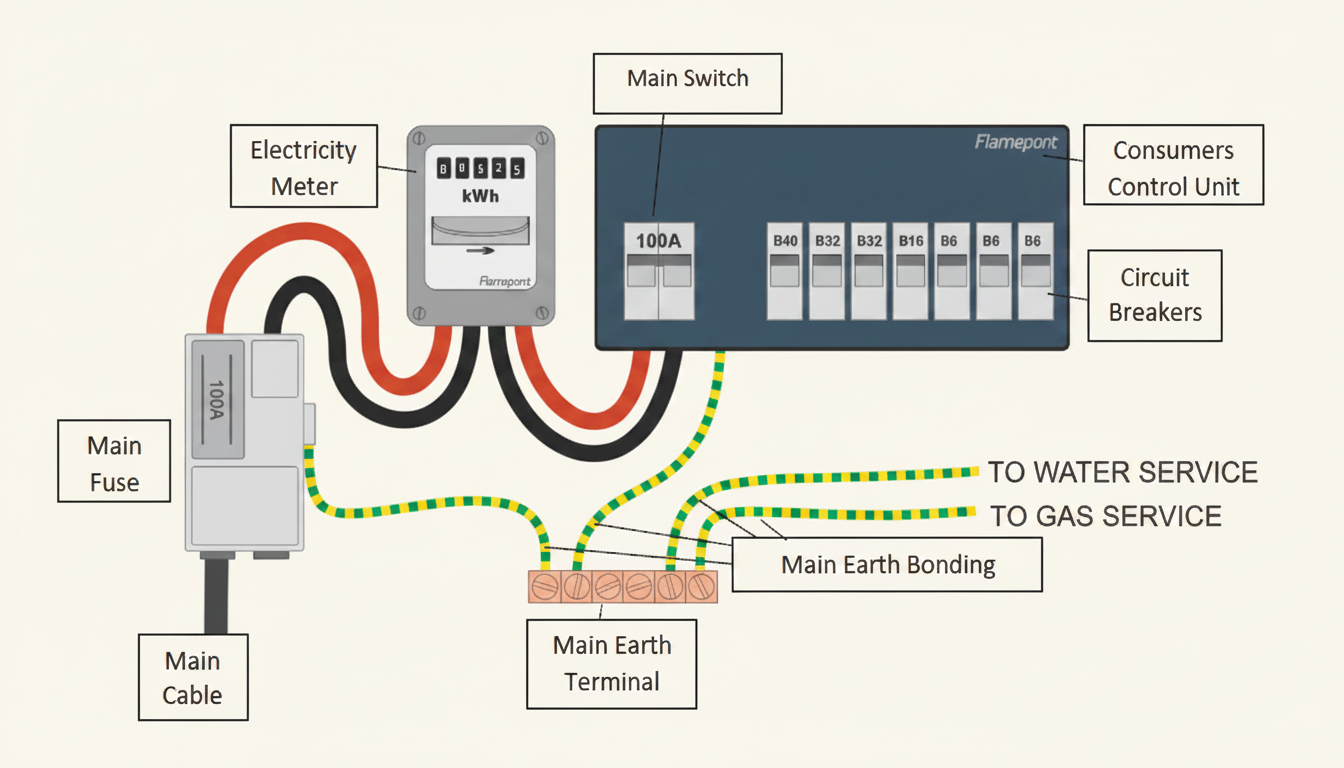
This is where electrical theory meets the pipework you actually work on. If a fault electrifies a metal pipe and someone touches it, proper earthing is what sends the fault current to earth and trips the breaker before anyone gets hurt.
The numbers to commit to memory:
- Main protective bonds (water and gas mains) = 10 mm²
- Main earthing conductor (from consumer unit to main earthing terminal) = 16 mm²
- Supplementary bonds (bridging plastic sections; bathrooms and other wet areas) = 4 mm²
- Temporary continuity bonds (fitted before cutting into pipework) = 10 mm² multi-strand
- Gas meter bond: within 600 mm of the meter outlet
- Three earthing arrangements: TN-S (separate supply earth), TN-C-S (combined then split; also called PME), TT (earth rod on site)
This block is fact-heavy rather than calculation-heavy. Understand the reason for bonding (fault current to earth), then drill the specific numbers. For the deep-dive plus 10-question mock test, see the earthing and bonding post.
3. Safe isolation
The procedure that keeps you alive every time you work on anything electrical. The course material is emphatic that this matters — and examiners reliably test whether you know the full 6-step sequence in the correct order.
The non-negotiables:
- Use an approved voltage indicator conforming to GS38 — never a neon screwdriver
- Test the indicator on a proving unit (or known live supply) before and after the isolation test
- Test between three combinations: line-to-neutral, line-to-earth, and neutral-to-earth
- Lock off with a locking device and a unique key — which stays with you
- If removing a fuse, keep it in your pocket (not nearby, not on a shelf)
The full 6-step sequence: (1) check indicator on known supply → (2) isolate → (3) lock off → (4) post notice → (5) test dead at all three combinations → (6) recheck indicator on known supply. Every step matters, and they come in that order. For the full deep-dive and mock test, see the safe isolation post.
4. Circuits and cables
The practical "how appliances connect to the electrical system" block. Every boiler, immersion heater, shower or pump you wire up fits into one of the standard arrangements this section covers.
The numbers to know:
- Ring main: 32 A, 7,200 W, 100 m² maximum floor area, 2.5 mm² twin and earth
- Immersion heater arrangement: 16 A MCB → 2.5 mm² T&E to fused switched spur → 13 A fuse in spur → 1.5 mm² heat-resistant flex to heater
- Gas boiler: fused switched spur with 3 A fuse, 230 V AC
- Electric shower: own dedicated radial circuit, RCD-protected, double-pole pull cord switch
- Colour codes: line brown, neutral blue, earth green and yellow
- Cable protection: run at least 50 mm from any surface or protect with conduit/trunking
If you can reproduce the immersion heater arrangement from memory — the whole chain from MCB to flex — you've got most of this block under control. For the deep-dive plus mock test, see the circuits and cables post.
5. Circuit protective devices
The block that ties the rest of the unit together. Every circuit has to be protected — against overload, short circuit, and earth fault — and the devices that do this protection have specific ratings, mechanisms, and applications you need to recognise on the exam.
The essentials:
- Fuses and MCBs protect against overcurrent (overload + short circuit)
- RCDs protect against earth faults by detecting current imbalance — typically 30 mA, 40 ms
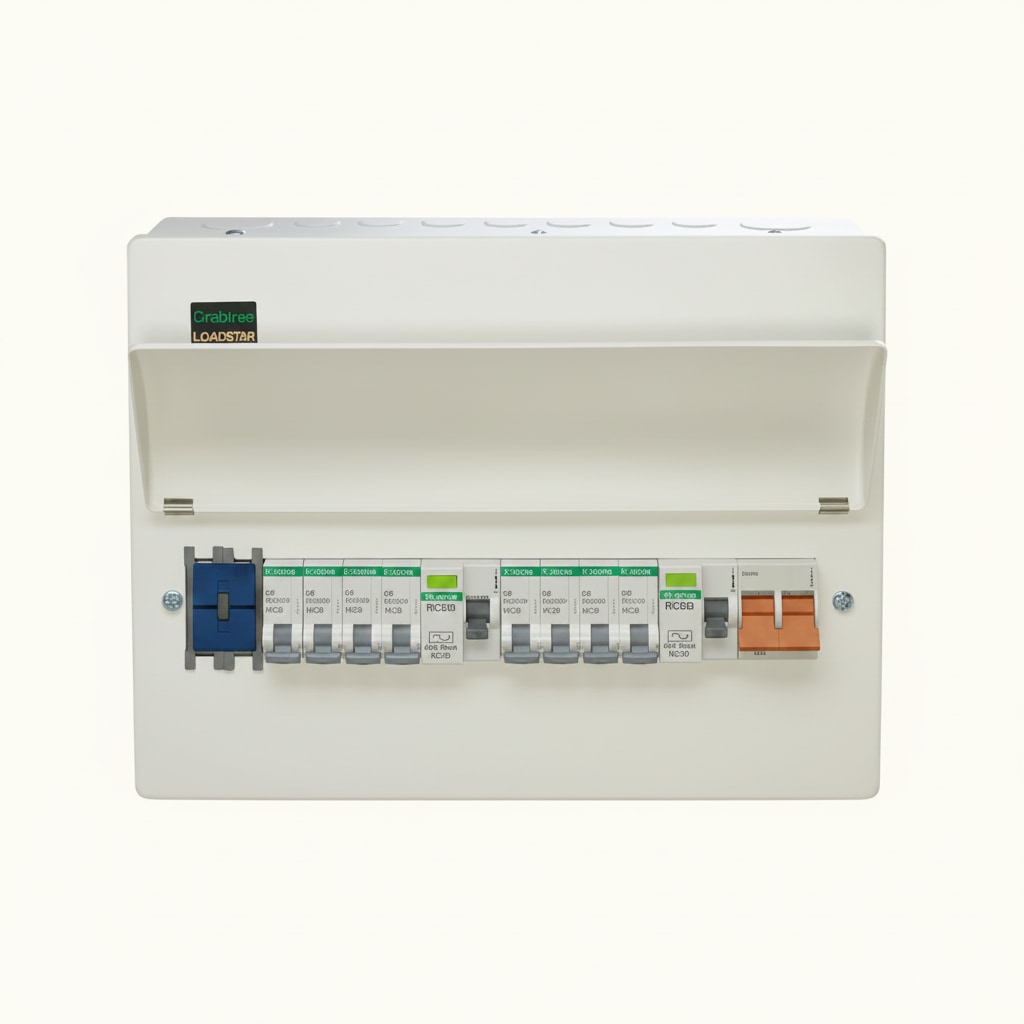
- RCBOs combine MCB and RCD in a single device — standard in modern consumer units
- Common MCB ratings: 6 A lighting, 16 A immersion, 32 A ring main, 40–50 A shower
- Discrimination: ratings step up from the appliance back to the supplier so only the device nearest the fault operates
This block isn't calculation-heavy, but it tests the difference between mechanisms (does it sense current or does it sense imbalance?) and the difference between ratings. For the deep-dive plus mock test, see the circuit protective devices post.
Four exam-technique habits that apply across all five blocks
Before you dive into the revision itself, four habits worth building now. These apply across the whole electrical unit and they're the difference between students who know the material and students who can show they know it in a 40-question multiple-choice exam.
Know both triangles cold. Ohm's Law (V, I, R) and Power Law (P, I, V). You should be able to draw them from memory and reproduce any of the six formulas they contain. Everything else in the calculations block flows from there.
Memorise the numbers, don't try to reason them out. Cable sizes (10, 16, 4, 10 mm²), fuse sizes (3, 13, 16, 32 A), floor areas (100 m²), distances (600 mm), ring main specs (32 A, 7,200 W). These are facts, not reasoning questions. Drilling them with flashcards is far faster than trying to "understand" why each number is what it is.
Check the units before you check the numbers. A calculation answer in the wrong unit is still wrong. If the question asks for amps and you've calculated in milliamps, you've lost the mark. Circle the required unit in the question stem before you start working.
Learn the safe isolation sequence in the exact course material order. The six steps appear in a specific order, and examiners test whether you know it. Questions often give you four options with the same steps in different orders — only one is right. Memorise the sequence so it flows without thinking.
Building a revision routine that actually works
The research on revision is overwhelming and consistent: spaced repetition beats cramming, active recall beats re-reading, and little-and-often beats long weekend sessions. Every credible study on student learning over the last fifty years points to the same conclusions.
In practical terms:
- Use flashcards, not re-reading. Passive reading feels productive and is nearly useless for exam recall. Active recall — forcing your brain to produce the answer before checking it — is what builds long-term memory.
- Little and often. Three ten-minute sessions across the day beat one thirty-minute block, and both beat a three-hour cram the night before.
- Revisit at increasing intervals. If you get a fact right today, don't retest it tomorrow — test it in three days. If you get it right again, test it in a week. This is the spacing that beats the forgetting curve.
- Focus on what you don't know. There's no point drilling yourself on the stuff you already know cold. Spend your time on the material you keep getting wrong.
For the full treatment of this method, see the spaced repetition guide — which also covers how PlumbMate operationalises it.
A recommended revision order
If you've got four weeks to the exam and you're starting from scratch, here's a sensible sequence:
Week 1: Ohm's Law and Power Law. This is the foundation — the calculations unlock a big chunk of the exam questions directly, and understanding the relationships between voltage, current, resistance and power makes the rest of the unit make sense.
Week 2: Earthing and bonding. Fact-heavy. Spaced repetition is particularly effective here because you're drilling specific numbers (cable sizes, distances) rather than working through reasoning. Build twenty or thirty flashcards and review them daily.
Week 3: Safe isolation. The procedure needs to be cold. Drill the 6-step sequence in order, the three test combinations, and the GS38 / approved voltage indicator requirements. Half the questions in this section test whether you know the exact order.
Week 4: Circuits and cables. This block pulls together everything you've learned — the calculations tell you what fuse an appliance needs, the earthing tells you why bonding matters, the safe isolation tells you how to work on circuits safely, and this block shows you how the standard arrangements fit together.
Mock tests and weakness-targeting. Do the 10-question mock tests in all four deep-dives. Anything you get wrong, mark and re-drill. The last week isn't for learning new material — it's for turning wobbly knowledge into exam-ready knowledge.
If you've got less than four weeks, compress the schedule but keep the order. If you've got more, spend the extra time on mock questions rather than re-reading notes.
Don't overthink it
Electrical principles feels harder than it is because it's not your natural subject, because the safety aspect raises the emotional stakes, and because there are a lot of specific numbers to remember. None of those three things make the material harder to learn — they just make it feel harder.
The students who pass first time aren't the ones who've magically become electricians. They're the ones who accepted early that this unit is mostly memorisation plus two formulas, drilled the numbers consistently, and used active recall instead of re-reading.
How PlumbMate puts this into practice
PlumbMate covers the full Level 2 electrical principles syllabus with spaced repetition built in — exactly the method described in the revision section above.
- Flashcards, not essays. One prompt, one answer — the format that research has consistently shown works best for active recall.
- Wrong answers are logged. Every question you get wrong goes into a dedicated collection that resurfaces more frequently in future sessions.
- The 3× rule. You need to get a question right three times before it clears — one lucky guess isn't enough.
- Explanations on every question. So you learn the logic rather than memorising answers.