Here's something you've probably never thought about: every metal pipe in a house is a potential electrical conductor. If a fault in the wiring electrifies a radiator, a copper pipe, or a metal cold water main, anyone who touches it can be seriously injured — unless the pipework is properly bonded to earth. This is why plumbers need to understand earthing. Not because we install it, but because we work on the pipes that depend on it.
This is the second post in the Level 2 electrical principles sub-cluster. For the others, see the Ohm's Law and Power Law post, the safe isolation post, and the circuits and cables post.
The core idea: giving electricity somewhere to go
When everything's working normally, electricity flows through the live and neutral wires and nothing else. When something goes wrong — a frayed cable, a failed appliance, a nail through a wire — the fault can electrify a metal object it shouldn't, like a pipe.
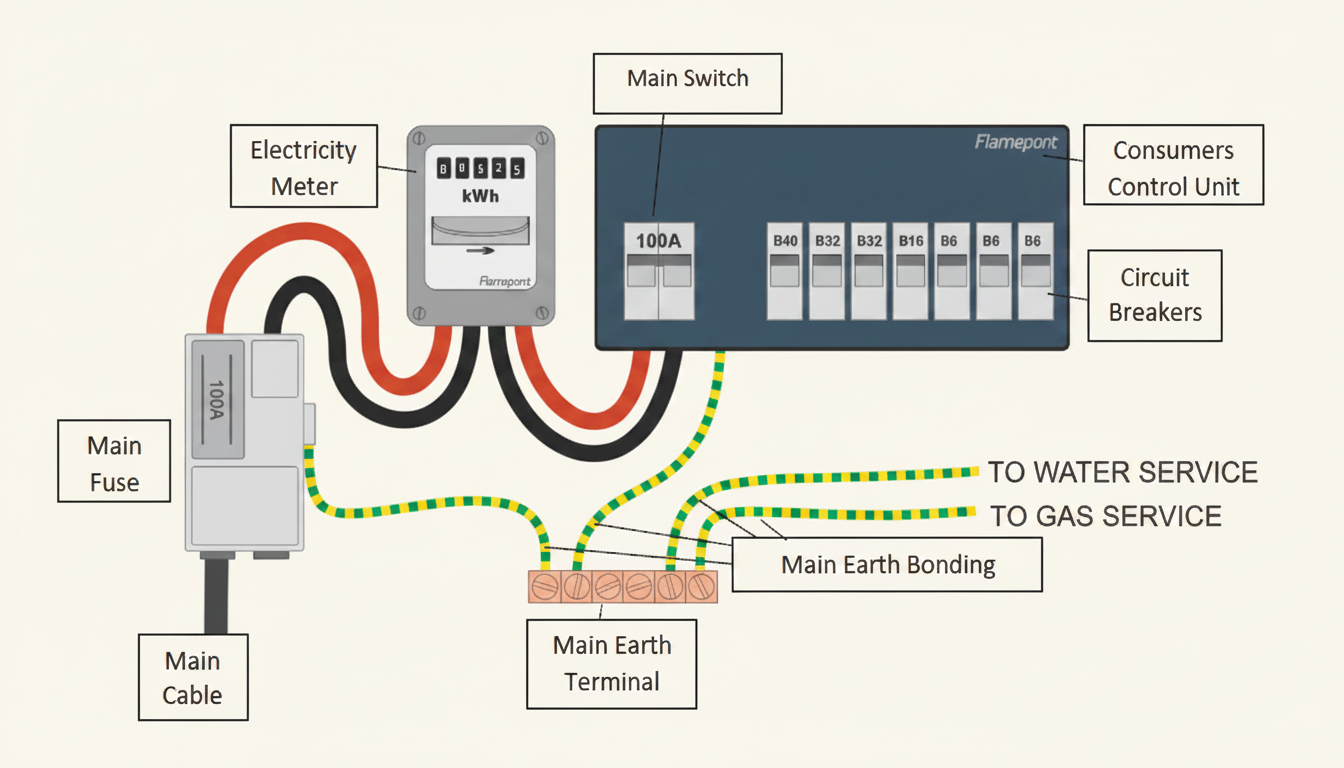
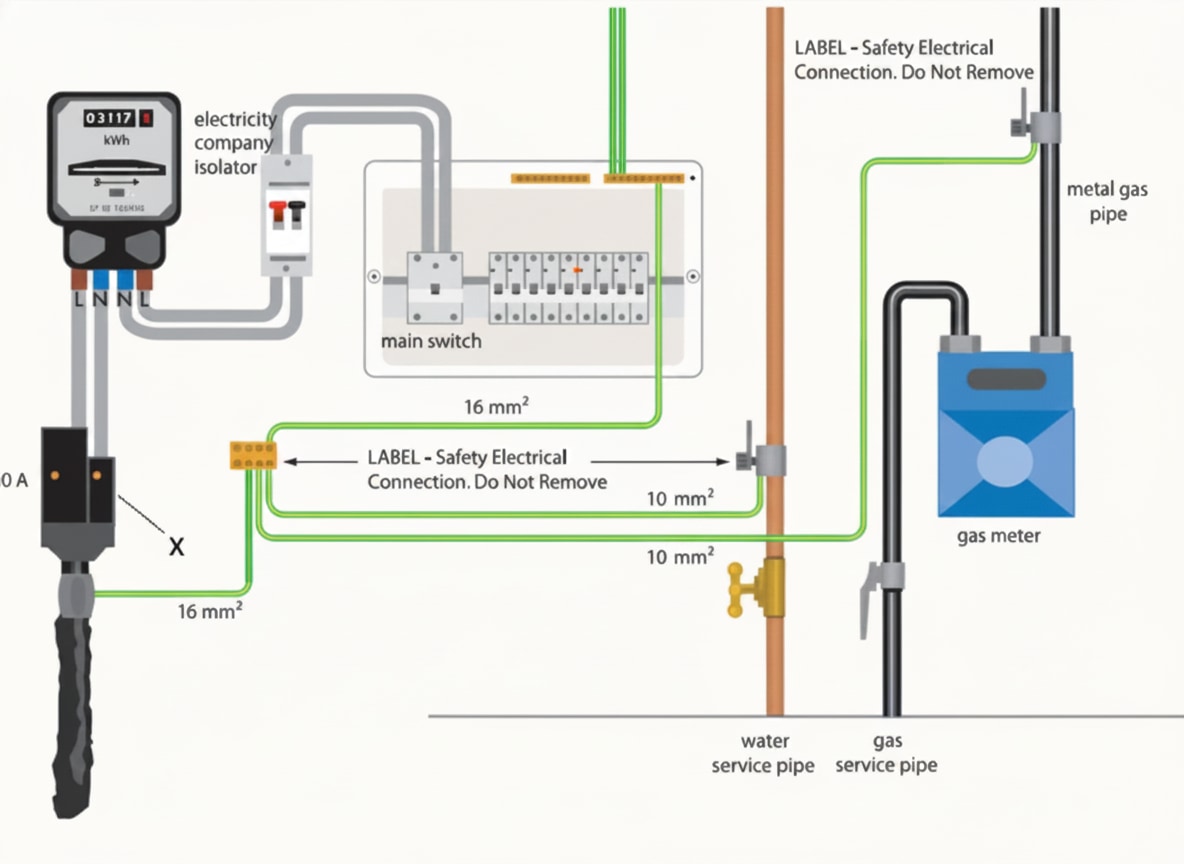
Earth wires (sometimes called circuit protective conductors, or CPCs) give that fault current a safe path back to earth. The current flows down the earth wire, trips the circuit breaker, and the power cuts off — before anyone touches the electrified pipe.
This is the job of earthing: keeping us from becoming the path the electricity takes.
Main protective bonding
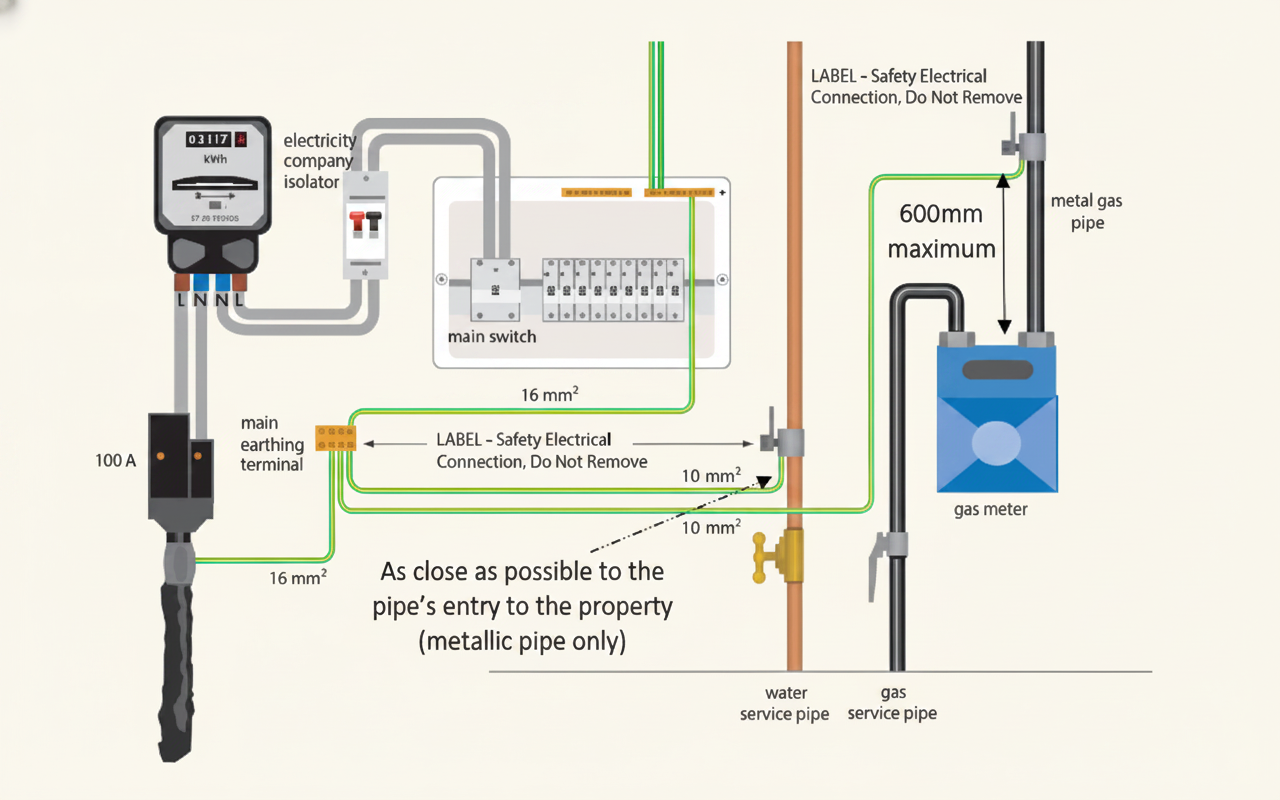
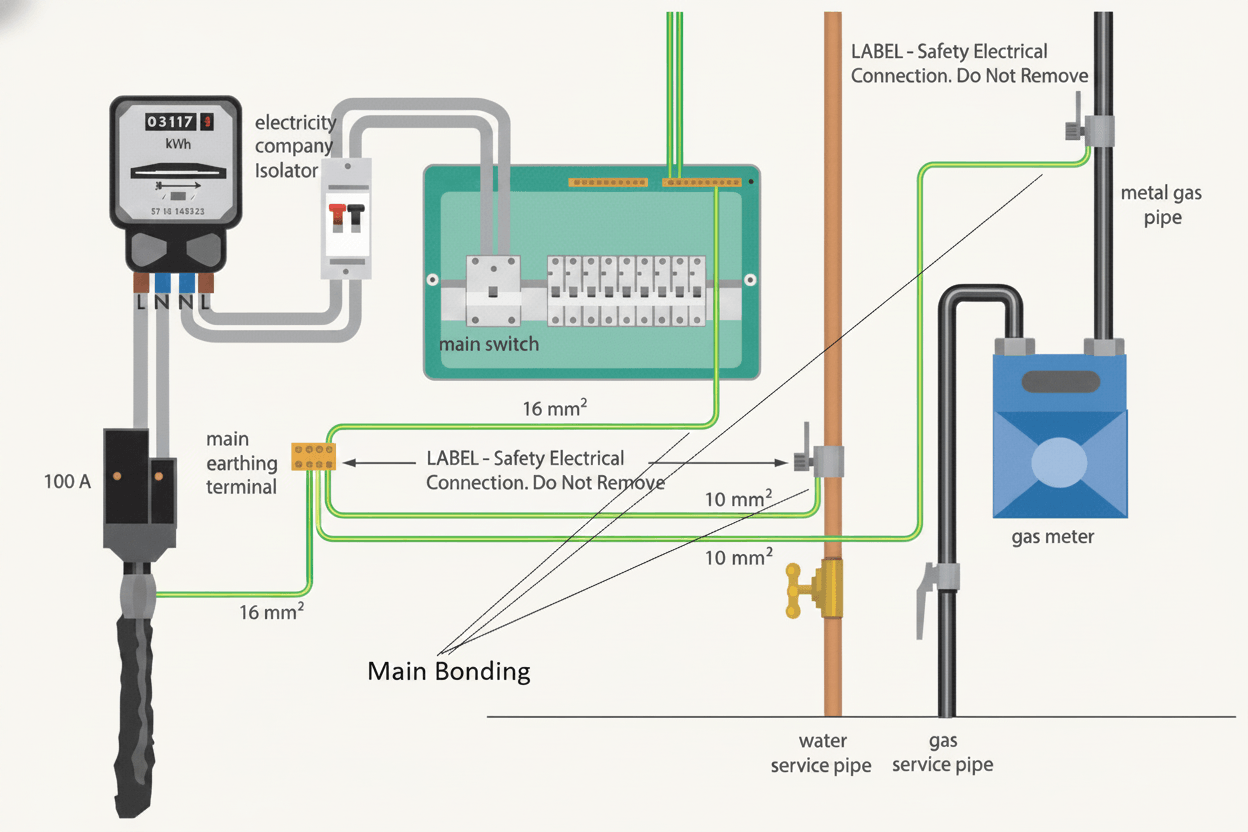
The metallic services entering the house — the incoming water main and gas main — get connected to the main earthing terminal at the consumer unit. These are called main protective bonds (or main equipotential bonds).
The sizes and distances below come from BS 7671:2018 — the 18th Edition of the IET Wiring Regulations, which is the wiring standard an electrician works to and the source these figures come from.
Key facts for the exam:
- Main protective bonds connecting the water and gas mains to the main earthing terminal are run in 10 mm² cable.
- The main earthing conductor running from the consumer unit to the main earthing terminal (and the supply cable earth) is at least 16 mm².
- Bonds are connected to the pipes using an earth bonding clamp — a metal clamp that grips the pipe and terminates the earth wire.
- Each clamp carries a label reading "Safety Electrical Connection — Do Not Remove".
- The clamp must be fitted as close as possible to the pipe's entry into the property (for metallic pipes) and within 600mm maximum of the gas meter outlet.
These numbers — 10 mm², 16 mm², 600 mm — are the ones examiners test. Memorise them.
Supplementary bonding
Supplementary bonds are used in two situations:
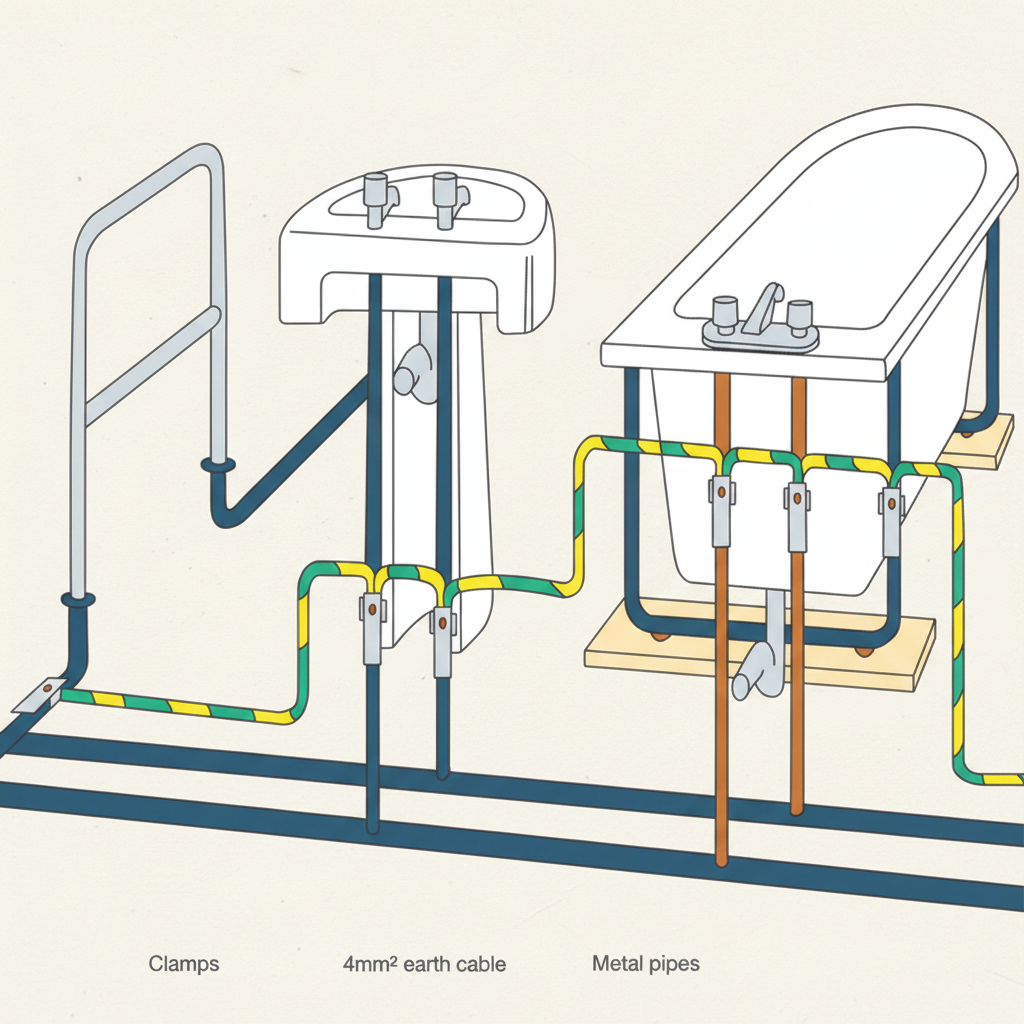
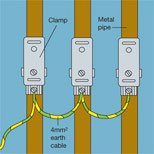
- To bridge breaks in the pipework — for example, if there's a short section of plastic pipe or a plastic push-fit fitting interrupting an otherwise metallic run.
- In high-risk areas where there's running or stored water — under boilers, around cold water storage cisterns, airing cupboards, and bathrooms.
Supplementary bonds are run in a minimum of 4 mm² cable where the cable is in free air — which is the figure to give if you are asked. The qualifier matters: 4 mm² is the minimum for a bond running unprotected. Where the conductor is mechanically protected (run in conduit, or sheathed), BS 7671 permits a smaller size, down to 2.5 mm². Supplementary bonding is also called cross-bonding. Bonds are fixed to the pipework using earth bonding clamps in the same way as main bonds.
The logic in high-risk areas is straightforward: if any metalwork in a bathroom became live due to a fault, you'd be at serious risk touching it while wet. Bonding all the metalwork together and to earth ensures that if one part becomes live, the fault current flows to earth and trips the breaker before anyone gets hurt.
For the four bathroom zone classifications and what each one requires, see the bathroom zones section of the protective devices post.
Temporary continuity bonds
This is the one that directly affects your day-to-day work as a plumber.
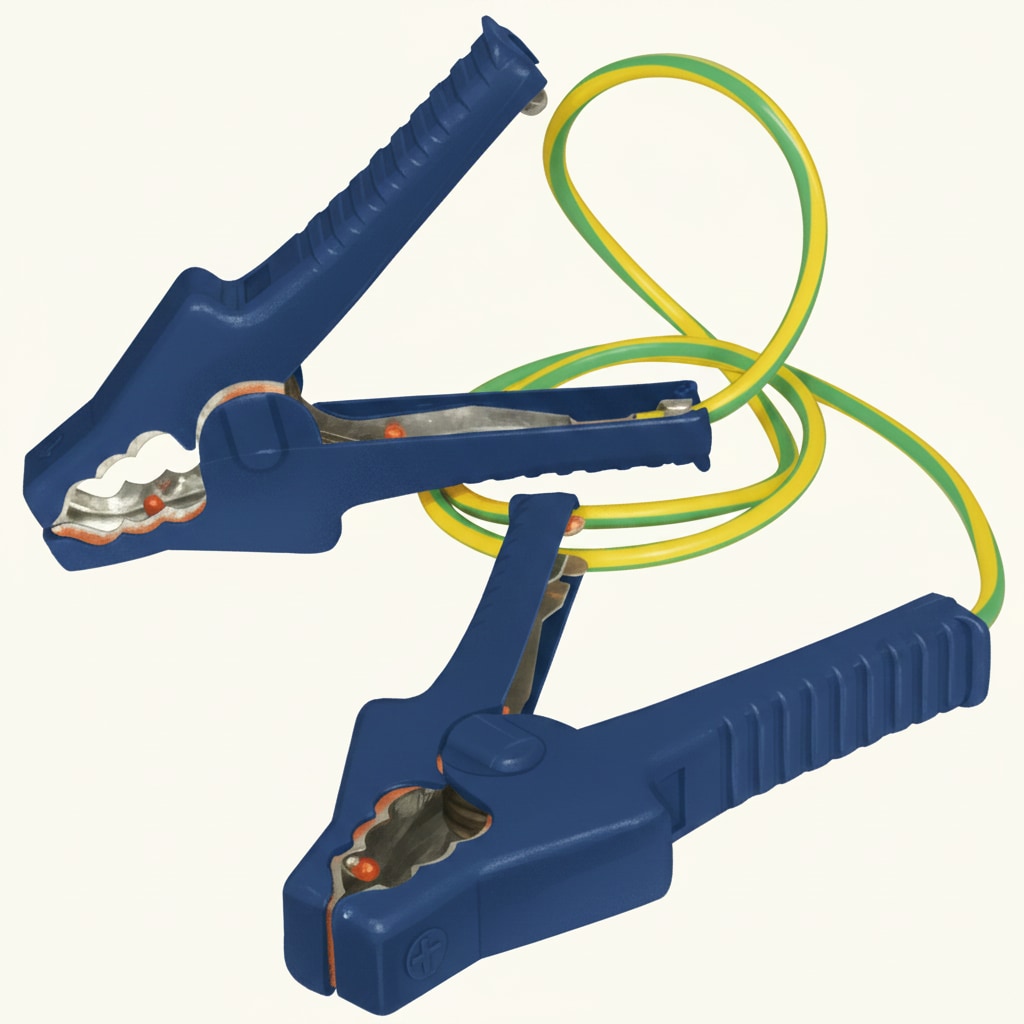
Existing metal pipework might already be part of an earth path — either deliberately (as a main bond) or accidentally (via stray fault currents). If you cut into a pipe without taking precautions, you could:
- Break the earth path for the property, leaving other metalwork dangerously unearthed.
- Create a spark as the potential difference between the two pipe ends discharges — particularly dangerous if you're working on gas pipework.
A temporary continuity bond is a piece of multi-strand cable with an earth clamp at each end, fitted across the pipe before you cut it. It maintains the electrical continuity while the pipe is physically broken.
Key facts:
- Minimum 10 mm² multi-strand cable.
- Fitted across the intended cut before cutting.
- Critical on gas pipework — prevents sparks caused by potential differences between the two sides.
The three earthing arrangements
Every domestic electrical installation is classified by the type of earthing arrangement the supply uses. Level 2 expects you to recognise the three common UK types:
TN-S (Terra Neutral-Separate). The supplier provides a separate earth conductor — usually the steel armour of the supply cable. The neutral and the earth are separate all the way from the transformer. This is the classic arrangement in many older UK properties.
TN-C-S (Terra Neutral-Combined-Separate). The supplier uses the same conductor for neutral and earth (combined) for part of the run, then splits them at the property (separate). Often called PME — Protective Multiple Earthing. Common in newer installations.
TT (Terra Terra). The supplier does not provide an earth. The property has its own earth electrode — typically a rod driven into the ground — as part of the earth fault path. Common in rural properties with overhead supplies.
For the exam, you need to be able to identify each one from a diagram or a description. The distinguishing features to look for:
- TN-S: separate earth from supply, usually armoured cable
- TN-C-S: combined neutral/earth from supplier, split at the property
- TT: earth rod on site
Who's responsible for what
Everything before the main switch is the electricity supplier's responsibility — the main cable, the main fuse, the meter, and the supply earth. Everything after the main switch — the consumer unit, circuit breakers, the main earthing terminal, all the bonding, every final circuit — is the homeowner's responsibility.
This matters because if you're fitting a new main bond to a gas pipe, you're working on the homeowner's side. If the installation isn't already properly bonded — and plenty of older installations aren't — that's something to flag, not ignore.
Common exam traps
Trap 1: Confusing main and supplementary bond cable sizes. Main bonds = 10 mm² (to water/gas). Main earthing conductor = 16 mm² (to consumer unit). Supplementary bonds = 4 mm². Temporary continuity bonds = 10 mm² multi-strand. Keep the four separate — they all come up in questions.
Trap 2: Clamp location on the gas meter. Within 600 mm maximum of the gas meter outlet. Questions like to test specific distances.
Trap 3: Plastic pipework. Bonding is only required on metallic services entering the property. If the incoming water main is plastic, no main water bond is needed. If a previously metallic run has been partly replaced with plastic, supplementary bonds bridge the gap.
Trap 4: Mixing up the earthing arrangements. TN-S separate supply earth, TN-C-S combined then split, TT local earth rod. Memorise the distinguishing feature of each.
Quick revision summary
Before the mock test, six things you need to be able to produce from memory:
- Main protective bonds (water/gas) = 10 mm²
- Main earthing conductor (consumer unit) = 16 mm²
- Supplementary bonds = 4 mm²
- Temporary continuity bonds = 10 mm² multi-strand
- Gas meter clamp location = within 600 mm of meter outlet; water bond = close to pipe's entry into the property
- Three earthing arrangements: TN-S (separate), TN-C-S (combined then split), TT (local earth rod)
📝 10-Question Mock Test
Click an option to see whether you got it right. Explanations appear instantly — no submitting at the end.
Main protective bonds on the incoming water and gas mains are run in 10 mm² cable. This is one of the most reliably tested single facts in the Level 2 electrical unit. Option D (16 mm²) is the classic trap — 16 mm² is the main earthing conductor from the consumer unit, not the bonding cable to the water/gas mains.
Supplementary bonds — used to bridge breaks in pipework and in high-risk wet areas like bathrooms — are a minimum of 4 mm² where the cable runs in free air, which is the answer wanted here. Option A (1.5 mm²) is a lighting circuit cable, not a bonding conductor, and option D is over-specified. Option B (2.5 mm²) is the near-miss: BS 7671 does allow 2.5 mm² for a supplementary bond, but only where the conductor is mechanically protected in conduit or sheathing. Unprotected — the normal case on pipework — it is 4 mm².
The course material specifies the earth bonding clamp must be fitted within 600 mm of the gas meter outlet. Option A (200 mm) is a common wrong answer from students who've confused this with other plumbing minimum distances. Memorise: gas meter bond = 600 mm maximum.
Every earth conductor where the insulation is exposed or needs sleeving is covered in green and yellow striped sleeving. This is a universal UK electrical colour standard. Option A (green and blue) is a common distractor because both colours turn up separately in electrical work (green historically meant earth on its own, blue now means neutral).
TN-S — "Terra Neutral-Separate" — uses the steel armour of the supplier's armoured cable as the earth conductor. The neutral and the earth are separate all the way from the transformer. The "S" in TN-S stands for Separate.
TN-C-S combines neutral and earth in the supplier's cable (the "C" — Combined), then separates them at the property (the "S" at the end — Separate). Also commonly called PME (Protective Multiple Earthing). The structure of the name tells you exactly what's happening.
TT — "Terra Terra" — means both the supply and the installation rely on a connection to earth at the property. The supplier doesn't provide an earth; instead, an earth rod driven into the ground provides the earth fault path. Common in rural areas with overhead supplies.
Temporary continuity bonds are 10 mm² multi-strand cable — multi-strand because the cable needs to be flexible enough to work around pipework during a cut. Options A and B would be under-specified for the fault currents a continuity bond might need to carry.
This is the critical safety reason. If one side of the gas pipe is at a different electrical potential from the other, cutting the pipe could produce a spark — which near a gas supply is a genuine ignition risk. The temporary continuity bond maintains electrical continuity across the cut, so there's no potential difference and no spark. Option A describes the purpose of main bonding, not a temporary continuity bond.
Two water pipes in a bathroom (one hot, one cold, both metallic, or in a system with some plastic sections) are connected by a supplementary bond — because the bathroom is a high-risk wet area, and all metalwork needs to be at the same potential. Options A (circuit protective conductor) and B (high integrity protective conductor) are types of CPC used for specific final circuits, not for bonding pipes together.
How PlumbMate puts this into practice
Earthing and bonding is exactly the kind of topic spaced repetition is built for: lots of specific facts (cable sizes, clamp distances, earthing arrangements) that have to be at your fingertips in the exam.
- Flashcards, not essays. One prompt, one answer — the format that research has consistently shown works best for active recall.
- Wrong answers are logged. Every question you get wrong goes into a dedicated collection that resurfaces more frequently in future sessions.
- The 3× rule. You need to get a question right three times before it clears — one lucky guess isn't enough.
- Explanations on every question. Like the ones above, but on every single question in the app.