Copper, LCS, stainless steel, polybutylene, MDPE, PVCu, ABS. Different materials for different jobs — some suit hot water, some cold, some drainage, some underground, some where appearance matters. Level 2 expects you to know the grades within each material, where each is used, and the physical properties that make them suitable (or unsuitable) for specific applications.
This post is the third in the Level 2 Plumbing Processes sub-cluster. For the others, see the hand tools, power tools, jointing, bending and installation posts.
Three material principles that underpin everything
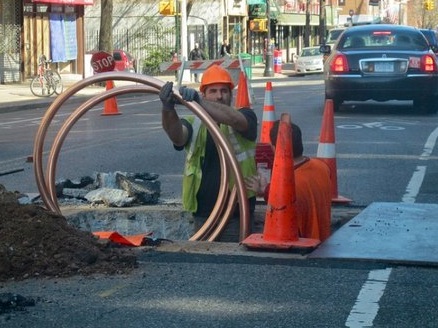
Before the specific materials, three principles that explain why we use what we use:
1. Ferrous vs non-ferrous. Ferrous metals contain iron, are magnetic, and rust when exposed to air and water (atmospheric corrosion). Non-ferrous metals don't contain iron and generally don't rust.
- Ferrous: cast iron, low carbon steel (LCS), malleable iron
- Non-ferrous: copper, brass, bronze, gunmetal, stainless steel (technically an alloy)
Why it matters: ferrous pipes rust, which means the rust contaminates water supplies. That's why iron and steel pipes are only used for heating (where rust is controlled with inhibitor) or drainage (where water contamination doesn't matter). You can't use iron or steel pipes for water supply. Stainless steel is the exception because the alloy makes it rust-resistant.
2. Corrosion resistance. The ability of a material to resist chemical breakdown. Copper is very corrosion-resistant, which is why it's been the dominant plumbing material for decades. But even copper can be damaged by residual flux after soldering (wipe it off) or by contact with cement and plaster (protect the pipe where it passes through these materials).
3. Alloying changes properties. An alloy is a mixture of metals designed to get properties neither metal has alone. Common plumbing alloys:
- Copper + zinc = brass
- Copper + tin = bronze
- Copper + tin + zinc = gunmetal
All three retain copper's corrosion resistance but gain strength. Brass and gunmetal appear in fittings, valves, and pump bodies throughout plumbing.
Copper — three grades
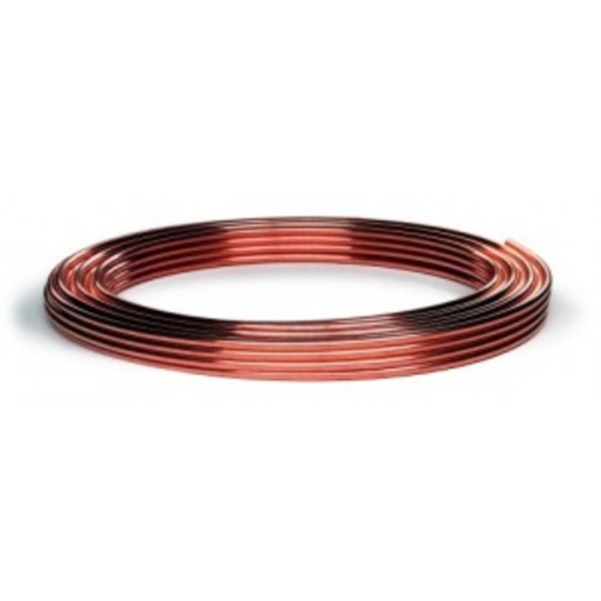
Copper is the most common plumbing material in the UK. Three grades exist, each with specific uses:
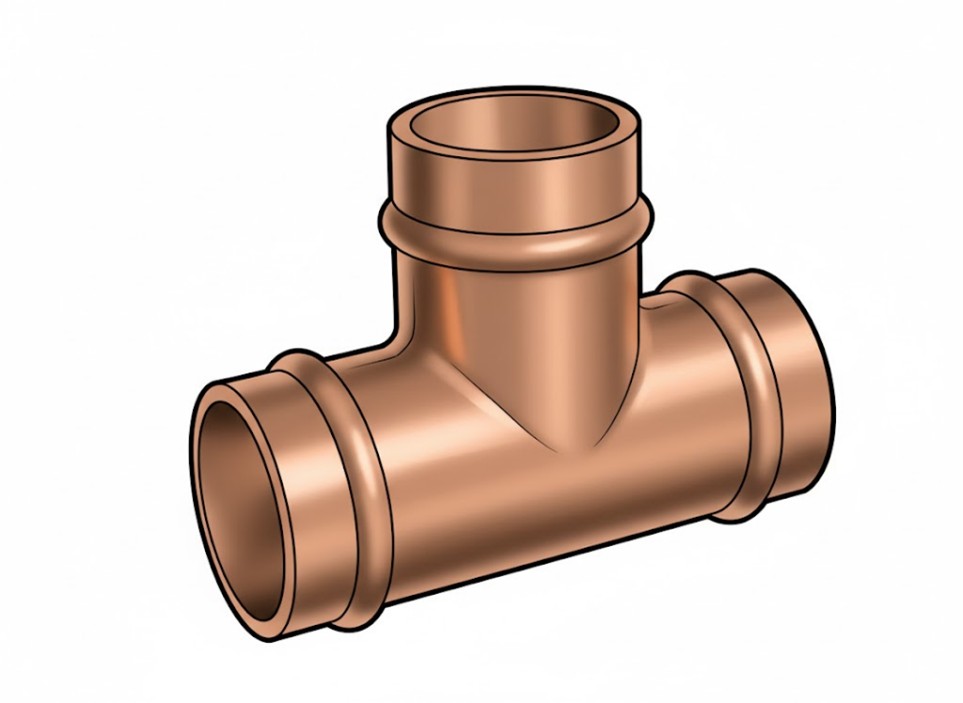
R220 — soft copper. The softest grade, supplied in coils. Pre-annealed (heat-treated to soften). Can be easily bent by hand without a machine.
Uses:
- Microbore heating (small-bore pipework to radiators)
- Underground water supply (coils for long runs)
R250 — half-hard copper. The most common domestic grade. Supplied in straight lengths. Stiffer than R220 but still bendable with a machine.
Uses:
- Hot and cold water pipework inside domestic properties (the standard answer)
- Above-ground plumbing generally
R290 — hard copper. The stiffest grade. Cannot be bent — any changes of direction must be made with fittings.
Uses:
- Specialist applications where rigidity is preferred
- Limited domestic use
Pipe size crossover: copper, stainless steel, and polybutylene all use the same pipe diameters: 15mm, 22mm, and 28mm. This is a real convenience on site because fittings often work across materials.
Low Carbon Steel (LCS)
LCS = Low Carbon Steel. Steel with low carbon content, making it strong but still workable. Ferrous (rusts), so used only for heating and gas (not water supply).
Three grades, each carrying a coloured band:
- Light grade LCS — colour-coded brown
- Medium grade LCS — colour-coded blue
- Heavy grade LCS — colour-coded red
The band follows the wall thickness: light is the thinnest, heavy the thickest. Heavy grade suits higher-pressure applications (industrial/commercial); medium grade covers domestic heating.
Jointing: LCS uses threaded joints primarily (cut with stocks and dies) or compression fittings. Threaded is cheaper and more common; compression is quicker but more expensive.
Thread sealant: PTFE tape for water; Boss White (or Hawk White) for heating systems.
LCS sizing: LCS sizes are given by internal bore diameter, expressed in inches or millimetres:
- ½" (15mm internal bore)
- ¾" (20mm internal bore)
- 1" (28mm internal bore)
Note LCS sizes don't match copper sizes directly — a "22mm copper" pipe is 22mm outside diameter, while "20mm LCS" (the equivalent in practice) is 20mm internal bore.
Stainless steel
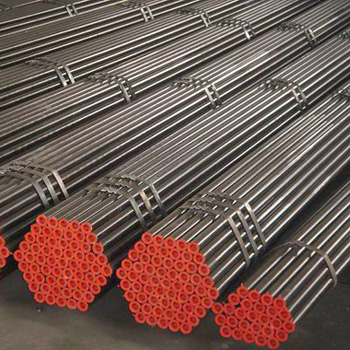
Stainless steel is an alloy of iron, chromium, and sometimes nickel. The chromium forms a passive oxide layer on the surface that prevents further corrosion — which is why stainless doesn't rust even though iron is its main ingredient.
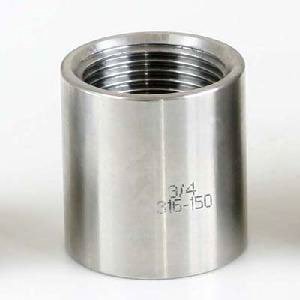
Because stainless steel has little magnetism and does not rust, it is NOT considered ferrous (despite containing iron).
Uses in plumbing:
- Unvented hot water cylinders (strength + corrosion resistance for mains pressure)
- Water supply pipework in some applications
- Sinks and splashbacks
Stainless steel uses the same sizes as copper and polybutylene (15/22/28mm).
Copper and ferrous metals — the corrosion story
A few related corrosion points worth understanding:
Copper + cement/plaster = damage. The chemicals in wet cement and plaster attack copper. Where copper passes through a concrete floor or plastered wall, it needs protection (lagging, conduit, or a sleeve).
Residual flux on soldered joints. Flux is acidic. After soldering, wipe off excess flux with a damp cloth — left on, it will corrode the pipe and leave unsightly green staining.
Corrosion inhibitor for heating systems. A chemical additive added to central heating water. Reduces rust formation inside steel radiators, which would otherwise slowly destroy them and circulate iron oxide (sludge) through the system.
Pipe size summary
The most common standard sizes Level 2 tests:
| Material | Standard sizes |
|---|---|
| Copper | 15mm, 22mm, 28mm (and larger for commercial) |
| Stainless steel | 15mm, 22mm, 28mm |
| Polybutylene | 15mm, 22mm, 28mm |
| LCS | ½" (15mm IB), ¾" (20mm IB), 1" (28mm IB) |
| MDPE (cold water) | 25mm typical (for domestic supply) |
The sanitary plastic sizes (drainage) are different: 32mm, 40mm, 50mm, 82mm, 110mm.
Plastics for water supply
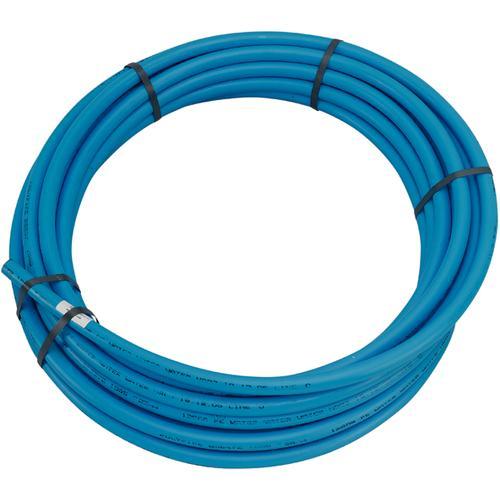
Polybutylene (PB). Flexible, general-purpose plastic for cold water, hot water, and heating systems. Can be bent by hand or cold-formed. Requires pipe inserts to support the soft inner wall so compression fittings don't crush it. Same 15/22/28mm sizing as copper.
Polyethylene (MDPE — Medium Density Polyethylene). The underground water supply pipe you meet as the communication and external service pipe.
- Blue = mains water (as covered in the cold water cluster)
- Yellow = gas
- Black = old alkathene (predecessor to MDPE, still found on older installations)
- Typical domestic size: 25mm
- Flexible — can be bent easily; cabling technique used for long runs
Plastics for sanitary (drainage) pipework
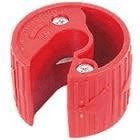
PVCu (or uPVC). Rigid plastic for above and below-ground drainage, discharge stacks, branch pipes. Jointed with pushfit, compression, or solvent weld. Standard drainage material.
MuPVC. Like PVCu, slightly more resistant to UV degradation. Used above and below ground.
ABS. Used mainly for branch discharge pipes. The sanitary plastic most susceptible to UV damage — avoid extended outdoor exposure unless protected. Jointed with pushfit, compression, or solvent weld.
Polypropylene (PP). Used mainly for branch discharge pipes. Only jointed with pushfit or compression — cannot be solvent welded. Tests sometimes ask which plastic can't be solvent welded: PP is the answer.
All plastic sanitary pipework becomes brittle in low temperatures. Extra care installing in winter.
Mechanical properties of pipe materials
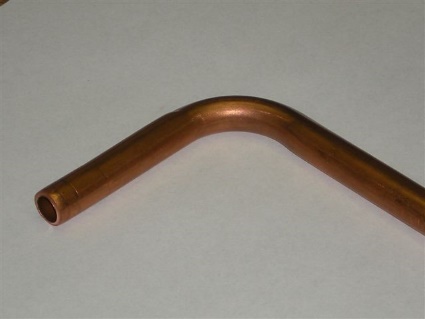
Hardness. Resistance to scratching. Measured on two scales: Mohs Scale and the Absolute Scale of Hardness. Diamond is the hardest naturally-occurring substance known.
Ductility. Ability to be drawn into a wire under tensile (pulling) stress. Copper is very ductile — this is why most electrical wires are made of copper, and why copper pipes can be bent without breaking.
What mechanical property makes bending pipe possible? Ductility. A brittle material would crack when bent; a ductile one deforms smoothly.
Malleability. Ability to deform under compressive force (hammering). Lead is the most malleable material plumbers encounter — used for roofing flashing because it can be worked by hand into complex shapes.
Strength — three types
Compressive strength. Resistance to compressive force (two forces pushing directly towards each other — squashing). Foundations, pipe supports, load-bearing walls all need compressive strength.
Tensile strength. Resistance to tensile force (two forces pulling directly apart — stretching). Hoisting cables, guy wires, and any material being pulled need tensile strength.
Shear strength. Resistance to shear force (forces not directly opposite — like cutting with scissors). Bolts, fasteners, and structural connections need shear strength.
Compressive force = squashing. Tensile force = pulling. Shear force = sideways/opposing. Exam questions test these definitions directly: "Tensile force describes..." → pulling.
Thermal and electrical properties
Thermal conductivity. How well a material transmits heat. Silver, copper and gold are the top three metal conductors of heat — which is why copper is also excellent for heat exchangers and radiators.
Thermal expansion. How much a material expands when heated. Plastics expand considerably more than metals when heated — which is why sanitary pushfit fittings need a 10mm expansion gap.
Electrical conductivity. How well a material conducts electricity. Silver, copper, and gold are the top three electrical conductors too — which is why electrical wires are mostly copper (silver is too expensive; gold is used for specialist applications like connectors).
Copper vs ceramic, lead, plastic for heat conductivity: Copper is best (fastest heat transfer). Plastics are essentially insulators. This is why we use copper for central heating and hot water cylinders, and plastic for cold water where heat transfer is unwanted.
Material selection — matching material to job
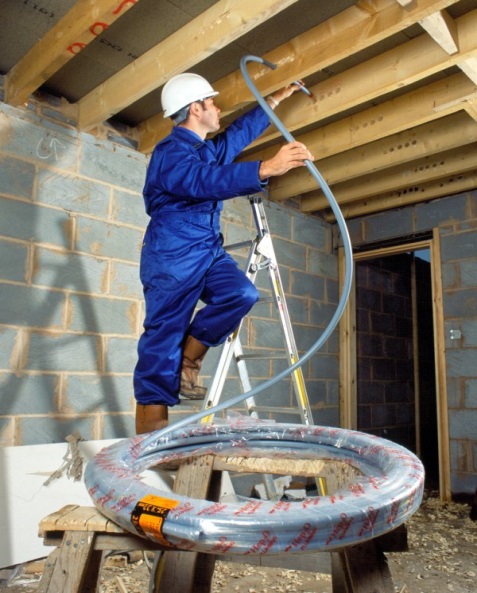
A reasonable summary table of material-to-application matching:
| Application | Typical material |
|---|---|
| Hot and cold water (domestic, above ground) | Copper R250 |
| Underground cold water supply (communication/external service) | MDPE (blue) |
| Underground cold water supply (replacement/retrofit) | R220 copper or MDPE |
| Central heating (above ground) | Copper R250 or LCS |
| Central heating (microbore) | R220 copper |
| Gas supply underground | MDPE (yellow) |
| Drainage above ground | PVCu, ABS, MuPVC, PP |
| Drainage below ground | PVCu, cast iron (some applications) |
| Hot water cylinder (unvented) | Stainless steel |
| Radiators | Pressed steel |
| Sheet lead work (flashing) | Lead |
| Heating system additive | Corrosion inhibitor |
Common exam traps
Trap 1: Copper R250 = standard domestic hot/cold water pipework. Not R220 (microbore only), not R290 (can't be bent).
Trap 2: R290 cannot be bent. Change direction with fittings only.
Trap 3: LCS bands are light grade (brown), medium grade (blue), heavy grade (red). Swapping medium and heavy is the single most likely colour-coding error. Don't confuse the bands with MDPE either (blue = water, yellow = gas).
Trap 4: MDPE colours. Blue = water, yellow = gas, black = old alkathene. (Covered also in the cold water cluster — a reliably-tested piece of knowledge.)
Trap 5: ABS is most UV-susceptible sanitary plastic. Keep out of prolonged sun or protect.
Trap 6: Polypropylene (PP) cannot be solvent welded. Pushfit or compression only.
Trap 7: Ductility makes bending pipe possible. Not strength, not hardness.
Trap 8: Lead is the most malleable material plumbers use. Can be hammered into complex shapes.
Trap 9: Copper is one of the top three heat conductors (silver, copper, gold). Plastics are essentially insulators.
Trap 10: Stainless steel is NOT considered ferrous despite containing iron, because it doesn't rust.
Quick revision summary
Before the mock test, eight things you need to be able to produce from memory:
- Copper grades: R220 (soft, bend by hand), R250 (half-hard, standard domestic), R290 (hard, cannot be bent)
- LCS grades: light (brown), medium (blue), heavy (red); ferrous so only for heating/gas, not water
- Stainless steel = alloy; non-ferrous (for plumbing purposes)
- Pipe sizing crossover: copper/stainless/PB all 15/22/28mm; LCS in inches/internal bore
- MDPE colours: blue = water, yellow = gas, black = old alkathene
- Sanitary plastics: PVCu, MuPVC, ABS (UV-susceptible), PP (no solvent weld); sizes 32/40/50/82/110mm
- Mechanical properties: ductility (bending), malleability (hammering), tensile strength (pulling), compressive strength (squashing), shear strength (sideways)
- Heat/electrical conductivity: silver, copper, gold top three
📝 10-Question Mock Test
Click an option to see whether you got it right. Explanations appear instantly — no submitting at the end.
The standard half-hard grade used for above-ground domestic water pipework. R220 (A) is softer, used for microbore heating and underground. R290 (C) is too rigid to bend. R310 (D) isn't a standard grade designation.
Hard copper cannot be bent — any direction changes require fittings. R220 (A) is annealed and bends by hand. R250 (B) bends with a machine. R300 (D) isn't a standard grade.
Steel with low carbon content, strong but still workable. Ferrous, so used only for heating and gas. Options A, C and D are plausible-sounding distractors.
"Medium grade" specifically refers to LCS — blue colour coded. Copper (A) has different grade names (R220/R250/R290). Lead (B) and brass (C) don't use "medium grade" terminology.
Blue is the mandatory colour for underground MDPE carrying mains water (covered in detail in the cold water cluster). Gas MDPE is yellow; old alkathene is black. Options A, B, C are other colours but not the water code.
Heavy grade LCS is colour-coded red — the thickest wall, highest strength. Blue (B) is medium grade and brown (D) is light grade, so both are real LCS bands but the wrong ones. Yellow (A) would suggest gas MDPE.
Most UV-susceptible of the sanitary plastics — prolonged sunlight causes it to become brittle. PVCu (A) and MuPVC (B) are more UV-resistant. Polybutylene (D) is a water supply material, not sanitary.
PP can only be jointed with pushfit or compression fittings — not solvent weld. PVCu (A), ABS (C) and MuPVC (D) all accept solvent weld.
The ability to deform under tensile stress without breaking. Ductile materials bend; brittle ones crack. Hardness (A) is scratch resistance. Brittleness (C) is the opposite — brittle materials break when bent. Conductivity (D) is about heat/electricity.
Copper is one of the top three metal conductors of heat (silver, copper, gold). Ceramic (A), lead (C) and plastic (D) are all much lower in thermal conductivity — plastic is essentially an insulator.
How PlumbMate puts this into practice
Pipe material content is heavy on specific grades, colour codes, and property-to-material matching — ideal spaced-repetition material.
- Flashcards, not essays. One prompt, one answer — the format that research has consistently shown works best for active recall.
- Wrong answers are logged. Every question you get wrong goes into a dedicated collection that resurfaces more frequently in future sessions.
- The 3× rule. You need to get a question right three times before it clears — one lucky guess isn't enough.
- Explanations on every question. Like the ones above, but on every single question in the app.