Components are worth 7 questions, 17.5% of the 505 paper, and most of those marks come down to three things: which valve isolates what, how a float operated valve actually shuts itself off, and what is going on inside a tap.
None of it is difficult. All of it is detail, and detail is exactly what a multiple-choice paper is good at testing.
For the rest of the unit see the cold water revision guide, and for cisterns themselves the storage cistern post.
Isolation valves — which one, and where
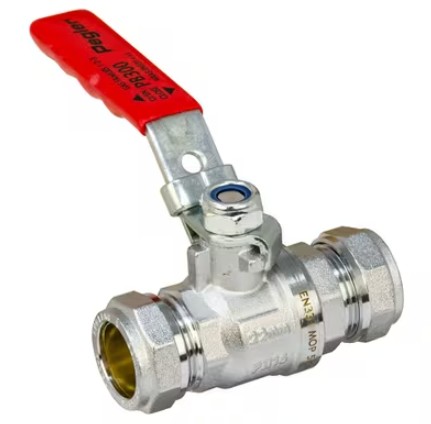
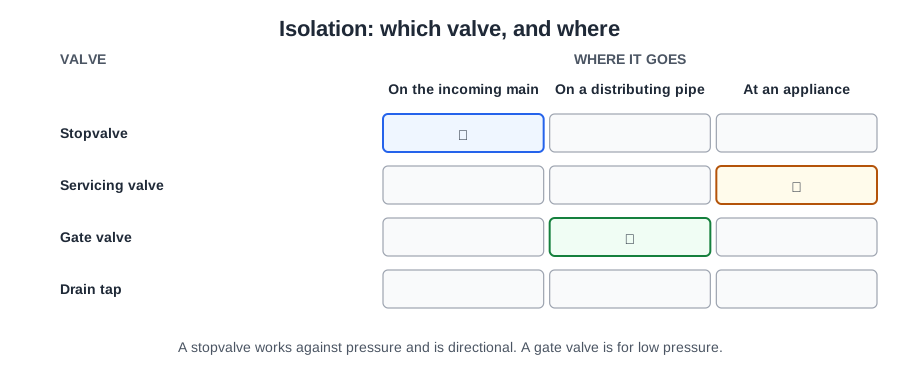
The specification names a long list. What makes it manageable is that each valve answers a different question: how much do I need to shut off, and at what pressure?
| Valve | Where it goes |
|---|---|
| Supply stop valve | The water company's valve at the property boundary, in the external chamber |
| Screw down stop valve | The internal stop valve where the supply enters. Shuts the whole property off. Marked with an arrow — it must be fitted the right way round |
| Service valve (high pressure) | A small screwdriver-operated valve on mains-pressure pipework, typically a spherical plug valve. Quarter turn |
| Service valve (low pressure) | A gate valve on gravity-fed distribution from a cistern. Low resistance to flow, which matters when you have very little head |
| Drain valve | At the lowest point of whatever it drains, downstream of the isolating valve |
| Full-bore valve | A lever-operated valve whose bore matches the pipe, so it causes almost no restriction when open |
| Water fuse (Surestop) | A switched stop valve that can be operated remotely from a convenient position, rather than reaching into a cupboard under the sink |
The pairing that gets tested is gate valve versus stop valve. A gate valve slides a gate across the bore, offering very little resistance but sealing poorly against high pressure — so it belongs on the low pressure side, downstream of a cistern. A screw down stop valve seals firmly against mains pressure but restricts flow, which is fine when you have 2–3 bar behind it and useless on a gravity system with a metre of head.
Put a gate valve on the mains and it will pass; put a stop valve on a gravity outlet and the shower will disappoint.
Float operated valves
A float operated valve does one job: let water into a cistern and shut off cleanly when it reaches the right level. Every type is classified under BS 1212, in four parts, and the parts are the answer to most questions on this topic.
BS 1212 Part 1 — the Portsmouth valve
The traditional design. A piston slides horizontally inside the valve body, carrying a washer on its end. The lever arm and float push the piston against the orifice as the water rises, and the washer seals against it.
Its defining problem is where the water comes out. A Part 1 valve discharges below the water line, which means that if the overflow ever runs and the level rises, the outlet is submerged — a direct backflow and contamination risk.
That is why a Portsmouth valve may only be fitted to a new installation if a backflow prevention device is installed before it, normally a double check valve. An existing one may be repaired in place; that is permitted. You just cannot install one afresh without protection.
BS 1212 Parts 2 and 3 — diaphragm valves
These replace the piston and washer with a diaphragm, and they discharge over the top of the valve rather than below the water line. That single change removes the submersion risk that dogs the Part 1.
They also have fewer moving parts, which makes them quieter and much less likely to cause water hammer.
The only real difference between the two parts is the material:
- Part 2 — brass
- Part 3 — plastic
They are otherwise almost identical. One restriction worth knowing: plastic (Part 3) valves are not recommended for cisterns other than WC cisterns, because of the risk of the plastic freezing and splitting in a loft.
BS 1212 Part 4 — the equilibrium valve
A diaphragm valve that works on a cleverer principle: equal pressure in front of and behind the diaphragm while the valve is open. Because the pressures balance, the float has almost no work to do, and no moving parts touch the diaphragm at all.
It closes when pressure builds up in front of the diaphragm, which happens when the float arm closes a pressure relief orifice on the front of the valve.
Two consequences:
- It is quieter than the other types in normal operation.
- But it has a positive "snap" closing action, which on some systems produces banging and reverberation of its own.
An equilibrium valve can work on either high or low pressure, by fitting the appropriate flow restrictor in the valve stem. Many also carry a filter to catch fine solids that would otherwise foul the mechanism. The most common type, the Torbeck, can only be used on WC cisterns.
Water hammer, and where it comes from
The classic float valve fault, and worth understanding rather than memorising.
As the water level nears its final position, the valve is almost closed. If the float can move freely, it starts to bounce rapidly up and down and side to side, opening and closing the valve many times a second. Each closure sends a pressure wave down the pipework, and the result is the banging, reverberation or whining note a customer will describe as knocking pipes.
The same effect comes from a faulty washer or diaphragm, which lets the valve flutter instead of sealing. And it is made far worse by poorly supported pipework, which has nothing to damp the wave.
An approved valve may be fitted with a flexible silencer tube to reduce the noise as the cistern fills. It must be flexible and approved — a rigid tube reaching below the water line would recreate exactly the backflow problem the diaphragm valve was designed to remove.
Taps
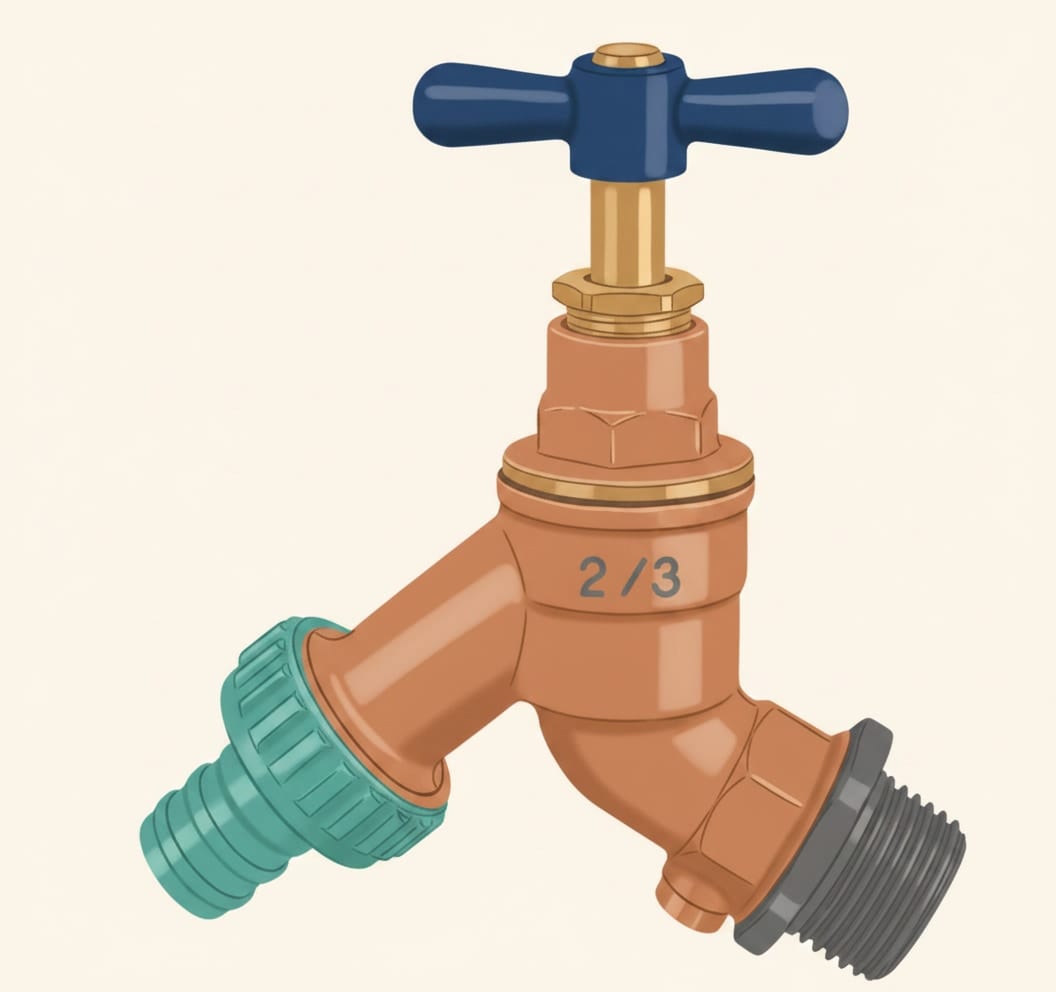
Five types are named, and they divide neatly by what happens when you turn the head.
Rising spindle taps — bib and pillar
The traditional design. Turning the head screws a spindle upwards or downwards, and the spindle carries a jumper and washer that lifts off or presses onto the seating. You can see the spindle rise as the tap opens, which is where the name comes from.
- A bib tap is wall-mounted with a horizontal inlet — an outside tap, or over a Belfast sink.
- A pillar tap mounts vertically through the appliance — the standard basin or bath tap.
Both are repairable, and both fail the same way: the washer wears, and the tap drips.
Non-rising spindle taps
Mechanically similar, but the spindle turns without rising — the head stays at a constant height as the tap opens. The advantage is a cleaner appearance and no exposed thread to collect dirt and limescale.
Ceramic disc taps
A different mechanism entirely. Two very thin ceramic discs sit face to face; turning the head rotates one against the other so their openings line up and water passes. A quarter turn takes it from fully off to fully on.
There is no washer to replace. That is the point of the design, and it is the exam answer. Most ceramic disc taps are not repairable — the head workings are replaced as a like-for-like unit.
One detail worth carrying to the merchant: hot and cold head workings open in opposite directions, so you have to state which one you need when ordering.
Mixer taps
Two arrangements, and the difference matters for backflow rather than for plumbing.
- Mixing in the valve body (single flow). Hot and cold meet inside the tap and leave through one waterway. Because the two supplies can meet, a single check valve is needed on each to prevent one pushing back into the other.
- Twin flow. Hot and cold stay in separate waterways the whole length of the tap and only meet in the air below the spout. Nothing can cross, so no check valves are needed.
The reason the distinction exists is that a mixer fed from a cistern on one side and the mains on the other is a cross connection in miniature. Twin flow solves it by never letting the two touch inside the fitting.
Common exam traps
Trap 1: BS 1212 part numbers. Part 1 Portsmouth, Part 2 brass diaphragm, Part 3 plastic diaphragm, Part 4 equilibrium. The one that catches people is that 2 and 3 differ only by material.
Trap 2: why the Portsmouth is restricted. Not because it is old — because it discharges below the water line and can be submerged if the overflow runs. An existing one may still be repaired.
Trap 3: gate valve versus stop valve. Gate valve on low pressure from a cistern; screw down stop valve on the mains.
Trap 4: ceramic disc taps have no washer. Any answer about re-washering one is wrong.
Trap 5: check valves on mixers. Needed where the water mixes in the valve body. Not needed on twin flow, because the supplies never meet inside the tap.
Trap 6: plastic float valves in a loft. Part 3 is not recommended for anything other than a WC cistern, because plastic can freeze and split.
Quick revision summary
Before the mock test, eight things you need to be able to produce from memory:
- BS 1212: Part 1 Portsmouth (piston and washer), Part 2 brass diaphragm, Part 3 plastic diaphragm, Part 4 equilibrium
- Part 1 discharges below the water line — a contamination risk, so new installations need backflow protection before it
- Parts 2 and 3 discharge over the top, have fewer moving parts, and are quieter
- Equilibrium valves balance pressure across the diaphragm; quiet, but the snap closure can cause banging. Torbeck is WC cisterns only
- Water hammer comes from the float bouncing as the valve nears closure, from a faulty washer or diaphragm, and from poorly supported pipework
- Gate valve = low pressure from a cistern; screw down stop valve = mains pressure
- Ceramic disc taps have no washer — replace the head workings, and state hot or cold when ordering
- Mixing in the valve body needs single check valves; twin flow does not
📝 16-Question Mock Test
Click an option to see whether you got it right. Explanations appear instantly — no submitting at the end.
Part 1. It uses a piston carrying a washer, pushed against the orifice by the lever arm. Parts 2 and 3 are diaphragm valves in brass and plastic; Part 4 is the equilibrium valve.
Material. Part 2 is brass, Part 3 is plastic, and they are almost identical in every other respect. Both are diaphragm valves discharging over the top of the valve body.
It discharges below the water line. If the overflow ever runs and the level rises, the outlet is submerged — a backflow and contamination risk. It may be fitted new only if a backflow prevention device is installed before it, and an existing one may still be repaired.
Equal pressure across the diaphragm, which is where the name comes from. Because the pressures balance, the float has almost no work to do. It closes when the float arm shuts the pressure relief orifice and pressure builds in front of the diaphragm.
Freezing. A cold water storage cistern usually sits in a loft, and plastic that freezes can split. A WC cistern is inside the heated envelope, so the risk does not arise.
As the level nears its final position the valve is almost shut, and a free-moving float begins to bounce up and down and side to side, opening and closing the valve many times a second. Each closure sends a pressure wave down the pipework.
Poorly supported pipework has nothing to damp the pressure wave, so the noise travels and the pipes move. A faulty washer or diaphragm is the other common contributor, because it lets the valve flutter rather than seal.
To reduce the noise of water falling into the cistern as it fills. It must be flexible and approved — a rigid tube reaching below the water line would recreate the very backflow risk that discharging over the top of the valve was designed to remove.
A gate valve. The gate slides clear of the bore, giving very little resistance to flow — which matters when you only have a metre or two of head. A screw down stop valve seals well against mains pressure but restricts flow far too much for a gravity outlet.
A switched stop valve operated remotely, so the supply can be shut off from a sensible position rather than by reaching into the back of a cupboard. It is about accessibility, not automatic detection.
The bore matches the pipe, so with the lever open the waterway is effectively uninterrupted. That makes it the choice where any restriction would matter.
Turning the head screws the spindle up or down, lifting a jumper and washer off the seating or pressing it onto it. You can see the spindle rise as the tap opens, which is where the name comes from.
It is about how they mount. A bib tap is wall-mounted with a horizontal inlet — an outside tap or one over a Belfast sink. A pillar tap comes vertically up through the appliance, the standard basin or bath tap.
Ceramic disc taps have no washer, and most are not repairable. The head workings are replaced complete. When ordering, state whether it is the hot or the cold, because they open in opposite directions.
Because the two supplies actually meet inside the fitting. Without check valves, the one at higher pressure can push back into the other — and where one side is mains and the other is cistern-fed, that is a cross connection in miniature.
Hot and cold run in separate waterways the whole length of the tap and only combine after leaving it. Because the two can never meet inside the fitting, no check valves are needed.
How PlumbMate puts this into practice
This is recognition-and-detail territory, which is exactly what spaced retrieval is for — and the app has interactive boards for every valve and tap on this page.
- Label the components. Drag-and-drop boards for the Portsmouth, equilibrium, brass and plastic diaphragm valves, the ceramic disc tap, the non-rising spindle tap, and both mixer types.
- Wrong answers are logged and resurface more frequently in later sessions.
- The 3× rule. Three correct answers before a question clears — one lucky guess isn't enough.
- Explanations on every question, like the ones above.