Cold water is the foundational unit of Level 2 plumbing — every other unit builds on the terminology, the systems, and the principles introduced here. That's both a challenge (get cold water wrong and everything else becomes harder) and an asset (learn it properly and you've laid the groundwork for hot water, heating, and drainage at the same time). This guide covers the whole unit at single-page summary depth, with links out to the six deep-dive posts that handle each topic in full.
Why cold water feels harder than it is
Three reasons students underestimate this unit — and one key insight that makes the whole subject much easier.
First, the terminology overlaps with other units. Supply pipe, distribution pipe, cold feed, stop valve, gate valve, service valve — these terms come up in cold water, hot water, and heating. Students learning cold water first sometimes blur the distinctions; students learning it alongside hot water or heating sometimes carry incorrect cross-unit assumptions back into cold water.
Second, the Water Regulations feel like a pile of arbitrary numbers. 750mm, 1350mm, 230 litres, 350mm, 25mm, 75mm. Each rule exists for a specific reason, but presented as a flat list, they feel like things to memorise rather than understand.
Third, the fluid category system is new and unfamiliar. Five categories, three types of air gap, three mechanical devices, and specific matchings between them. Students reliably drop marks here in the first weeks of revision.
The key insight that unlocks the whole unit: every rule in cold water comes back to one of three principles:
- Get clean water to the outlet safely — depths, insulation, approved materials, supply vs distribution
- Keep the water clean after it arrives — cisterns, temperature control, stagnation prevention
- Stop contaminated water getting back into the mains — fluid categories, backflow prevention
If you can classify a rule by which principle it serves, the rule itself becomes far easier to remember.
The six areas you need to master
Level 2 cold water breaks into six main blocks. Each one has its own deep-dive post; the summaries below give you enough to locate your gaps.
1. Water sources and supply to the property
The journey from source to tap — and the terminology for every section along the way.
Core facts:
- Above-ground sources: lake, river, stream, upland surface, reservoir
- Below-ground sources: borehole, deep/shallow well, spring, aquifer
- Treatment: screening → settlement → sand/charcoal filter → chlorination → storage
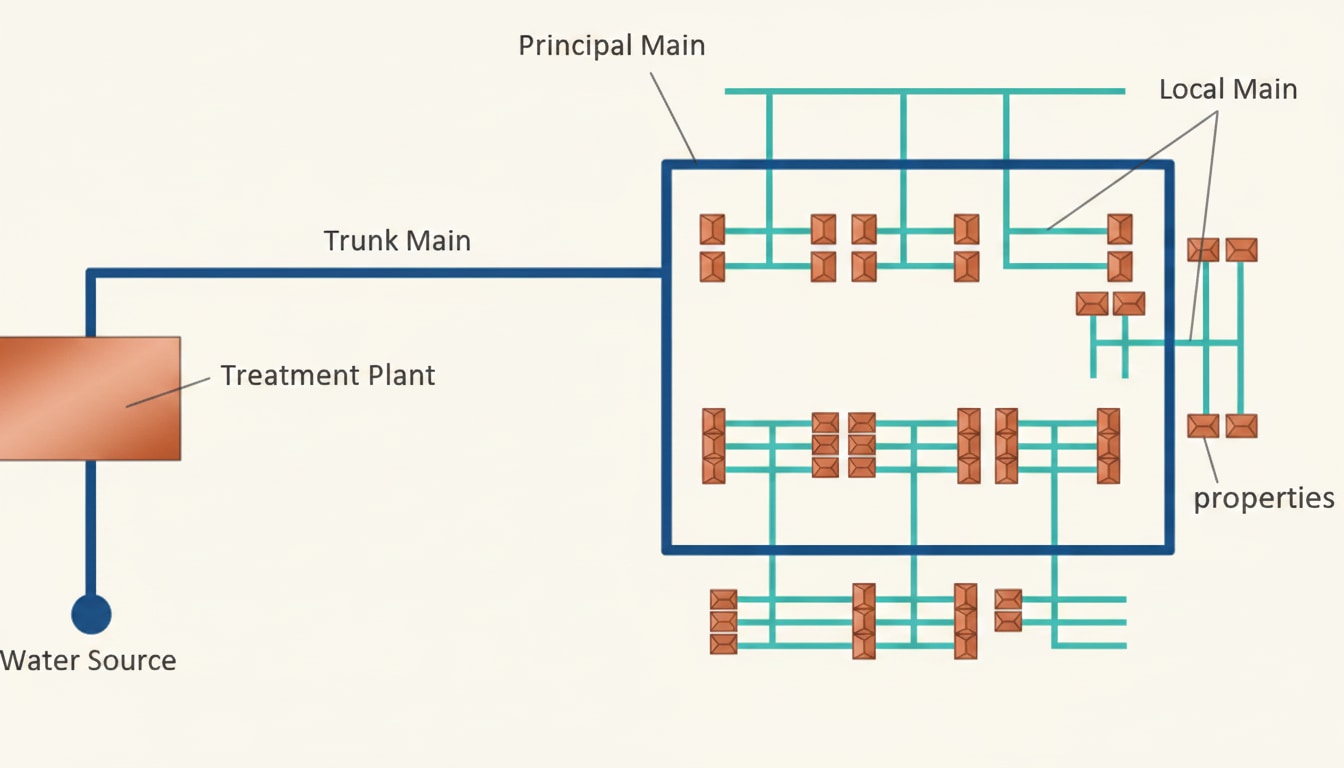
- Mains network: trunk main → principal main → local main → communication pipe → external supply pipe → internal supply pipe
- Communication pipe = supplier's responsibility; external supply pipe = homeowner's responsibility
- Blue MDPE 25mm for underground pipework
- Depths: 750mm minimum, 1350mm maximum — if shallower, insulate
- Internal entry: stop valve first, drain valve immediately after
- Assessment of supply: pressure and flow rate
For the full deep-dive and mock test, see the water sources and supply to the property post.
2. Direct vs indirect cold water systems
The two fundamental domestic designs.
Core facts:
- Direct: all outlets fed from mains at high pressure; drinking water at every tap; if gravity hot water is fitted alongside, cistern minimum 110 litres and never smaller than the cylinder
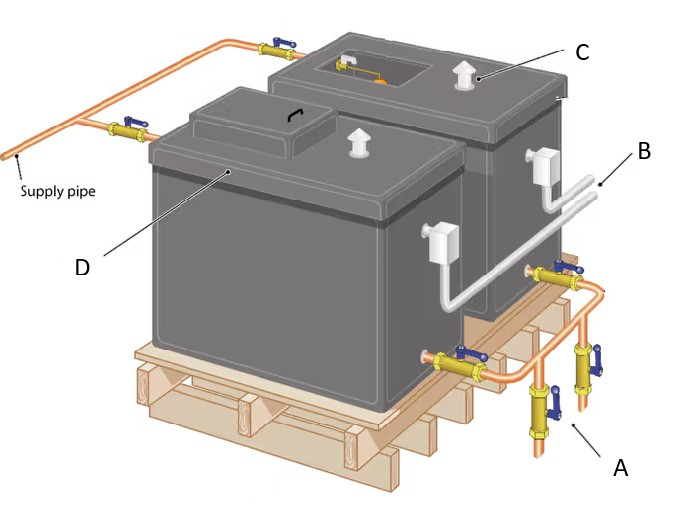
- Indirect: kitchen sink from mains; all other cold outlets from cistern; cistern feeding hot + cold minimum 230 litres
- Kitchen sink always direct from mains in both systems (drinking water, food prep area)
- Supply pipe = mains (high pressure); distribution pipe = cistern (low pressure); cold feed = specific pipe from cistern to cylinder (min 22mm)
- Stop valves on supply pipework; gate valves on distribution pipework
- Direct = simpler/cheaper; indirect = backup reserve and limited backflow risk
For the deep-dive plus mock test, see the direct vs indirect cold water systems post.
3. Cold water storage cisterns
The most regulated component in domestic cold water.
The numbers to know:
- Lid excludes light, tightly fitting; 350mm clearance above the cistern to any ceiling or roof (225mm only if no dimension exceeds 450mm)
- Float valve: service valve before it; 25mm above overflow; 350mm clearance above; stiffener plate in plastic cisterns
- Overflow: 25mm above water level; screened; 19mm internal diameter min (22mm typical)
- Outlets from the base where practical; opposite ends if multiple
- Cold feed above cold distribution (prevents scalding if mains fails)
- Service valves on inlet AND outlet
- Water temperature max 25°C — frost AND heat insulation
- Plastic cistern support: firm, level board 150mm longer and wider than the base
For the deep-dive plus mock test, see the cold water storage cisterns post.
4. Fluid categories and backflow prevention
The Water Regulations' framework for preventing contamination.
Core facts:
- Five categories: 1 wholesome, 2 aesthetic change, 3 slight hazard, 4 significant hazard, 5 serious hazard
- Category-to-device table: Cat 1 = none; Cat 2 = single check; Cat 3 = double check; Cat 4 = RPZ; Cat 5 = air gap
- Kitchen sinks and WCs/bidets are Cat 5 (surprising but the bowl contents, not the supply, are the risk)
- AUK1 (WC cistern to pan, Cat 5 protection)
- AUK2 (basins/baths/showers, Cat 3, 20mm gap for 15mm pipe, 25mm gap for 22mm pipe)
- AUK3 (over-rim bidets, kitchen sinks, Cat 5, min 20mm OR 2× inlet diameter)
- Two causes of backflow: back pressure and back siphonage
- Outside taps = double check valve + service valve inside
- Mixer taps mixing in body = single checks on hot and cold
- Biflow taps = no internal backflow protection required (design prevents cross-contamination)
- Dead legs = bacterial growth risk; cut back to the branch when decommissioning
For the deep-dive plus mock test, see the fluid categories and backflow prevention post.
5. Hard and soft water; frost protection
How water chemistry and weather affect the pipework.
Core facts:
- Soft water = acidic (dissolved CO₂); causes pinhole corrosion in copper pipes over decades
- Hard water = alkaline (dissolved limestone/chalk); reacts poorly with soap
- Temporary hard = calcium carbonate; forms limescale above 65°C
- Permanent hard = calcium sulphate; doesn't form limescale
- Base exchange water softener = exchanges calcium ions for sodium ions; regenerated with salt
- Kitchen sink should NOT be fed with softened water (high sodium)
- Frost protection: bury below 750mm (frost line); insulate; trace heating for exposed pipework
- Roof spaces: frost AND heat protection on cold water supplies
For the deep-dive plus mock test, see the hard and soft water and frost protection post.
6. Commissioning, testing and maintenance
The end of the job and the ongoing maintenance cycle.
Core facts:
- Five commissioning stages: Visual → Soundness → Flushing → Performance → Handover
- Rigid pipe soundness test: wholesome water, 30 min stabilise, 1.5× working pressure, 1 hour
- Plastic pipe Test A: 1 bar/45 min → 1.5× working pressure/15 min → 1/3 working pressure/45 min
- Plastic pipe Test B: 1.5× working pressure/30 min top-up → 30 min obs (0.6 bar tolerance) → 120 min obs (0.2 bar tolerance)
- Flushing: domestic = wholesome water; commercial = chlorine (COSHH, inform water undertaker)
- Performance tools: pressure gauge + Weir cup
- Decommissioning: cap as far back as possible; stop ends on open pipework
For the deep-dive plus mock test, see the commissioning, testing and maintenance post.
Four exam-technique habits that apply across the whole unit
Draw the cold water system you're being asked about. Direct or indirect, every question about pipework or valves is easier if you sketch the system first. Mains, stopcock, cistern (if indirect), supply pipes, distribution pipes, cold feed — put them on paper and the question often answers itself.
Classify each rule by which principle it protects. Every number in cold water serves one of three purposes: get clean water in, keep it clean in storage, stop backflow. Knowing why a rule exists makes it easier to remember what the rule is.
Match the air gap or valve to the fluid category. The category-to-device table is the central piece of backflow content. If you know Cat 3 needs double check, Cat 5 needs air gap, and which appliances are which category, you'll pick up all the backflow questions on the paper.
Memorise the specific numbers; don't try to derive them. Pipe depths (750mm/1350mm), cistern capacities (100L/200L), clearance (one figure: 350mm above the cistern, covering cleaning and float valve access alike, or 225mm for a small cistern), overflow (25mm above water level, 19mm internal diameter min), temperatures (25°C cistern max, 65°C limescale threshold). Flashcards clear them faster than any other method.
Building a revision routine that actually works
The research on revision is overwhelming and consistent: spaced repetition beats cramming, active recall beats re-reading, and little-and-often beats long weekend sessions. Every credible study on student learning over the last fifty years points to the same conclusions.
In practical terms:
- Use flashcards, not re-reading. Passive reading feels productive and is nearly useless for exam recall. Active recall — forcing your brain to produce the answer before checking it — is what builds long-term memory.
- Little and often. Three ten-minute sessions across the day beat one thirty-minute block, and both beat a three-hour cram the night before.
- Revisit at increasing intervals. If you get a fact right today, don't retest it tomorrow — test it in three days. If you get it right again, test it in a week. This is the spacing that beats the forgetting curve.
- Focus on what you don't know. There's no point drilling yourself on the stuff you already know cold. Spend your time on the material you keep getting wrong.
For the full treatment of this method, see the spaced repetition guide — which also covers how PlumbMate operationalises it.
A recommended revision order
Cold water is roughly the same size as the science and electrical units — smaller than heating or drainage. If you've got four weeks to the exam and you're starting from scratch, here's a sensible sequence:
Week 1: Supply, systems, cisterns (posts 1–3). The foundational content. Get the pipework terminology, the two system types, and the cistern regulations locked in before moving on.
Week 2: Backflow prevention (post 4). The most testable topic in the whole unit. The category-to-device table should be memorised by the end of the week.
Week 3: Water properties and frost, commissioning (posts 5–6). The applied content — how water chemistry and weather affect the system, and how you verify and maintain it.
Week 4: Mock tests and weakness-targeting. Do the 10-question mock tests in all six deep-dives. Anything you get wrong, mark and re-drill. This is the week that turns wobbly knowledge into exam-ready knowledge.
If you've got less than four weeks, compress the schedule but keep the order. If you've got more, spend the extra time on mock questions rather than re-reading notes.
Don't overthink it
Cold water has a lot of moving parts but a small number of genuinely important ideas: get clean water in safely, keep it clean in storage, stop contaminated water from getting back into the mains. Every rule in the course material serves one of those three purposes.
The students who pass first time aren't the ones who've memorised a long list of unconnected facts. They're the ones who understood the three underlying principles, drilled the specific numbers consistently, and used active recall instead of re-reading.
How PlumbMate puts this into practice
PlumbMate covers the full Level 2 cold water syllabus with spaced repetition built in — exactly the method described in the revision section above.
- Flashcards, not essays. One prompt, one answer — the format that research has consistently shown works best for active recall.
- Wrong answers are logged. Every question you get wrong goes into a dedicated collection that resurfaces more frequently in future sessions.
- The 3× rule. You need to get a question right three times before it clears — one lucky guess isn't enough.
- Explanations on every question. So you learn the logic rather than memorising answers.