Everything in this post comes from the Water Supply (Water Fittings) Regulations 1999 — the Water Regulations — with sizing guidance from BS 8558 and BS EN 806. A cold water storage cistern (CWSC) looks like the simplest component in a plumbing system — it's just a plastic tank with a float valve and a pipe going out. In reality it's the most regulated component in a domestic cold water system. The Water Regulations specify materials, lid design, clearances, overflow sizing, float valve position, insulation, support, and temperature control. Get any of those wrong and you've built in a contamination risk that could make people ill — which is why Level 2 tests this topic extensively.
This is the third post in the Level 2 cold water sub-cluster. For the others, see the water sources and supply, direct vs indirect systems, fluid categories, hard and soft water, and commissioning posts.
Why cisterns are heavily regulated
A cold water storage cistern holds water — often hundreds of litres — for hours or days before it's drawn off. That creates three risks that the Water Regulations are designed to control:
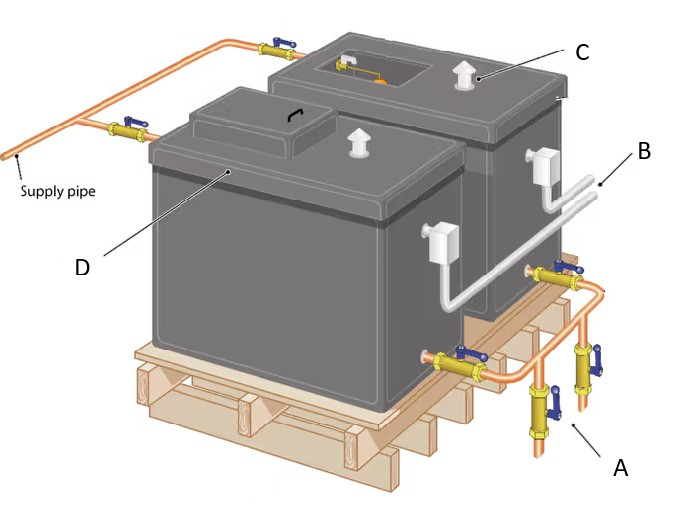
- Contamination from above — dust, insects, rodents, birds, debris falling in if the lid is inadequate
- Stagnation and bacterial growth — water sitting still, warming up, providing ideal conditions for Legionella and other bacteria
- Backflow into the mains — if mains pressure drops, water from a contaminated cistern could potentially be sucked back into the supply
Every rule about cistern installation addresses one of these three risks. If you can't remember why a specific rule exists, ask yourself which of these three it's preventing.
WRAS approval
Every material used in a cistern must be WRAS approved — listed in the Water Fittings and Materials Directory published by WRAS. In practice this means:
- Modern cisterns are almost always plastic (polypropylene or polyethylene)
- Galvanised steel was used historically but is rare in new installations
- Fittings (float valves, tank connectors, washers) must be WRAS approved too
Lid requirements
The lid has three jobs:
- Excludes light — prevents algae growth in stored water
- Tightly fitting and securely fastened — so birds, vermin, and dust cannot get into the water
- Allows maintenance access — lid is removable for cleaning and float valve maintenance
Minimum clearance above the cistern: 350mm. BS 8558 clause 4.3.41.1 asks for a clear space of not less than 350mm between the top of the cistern and any ceiling or other obstruction above it — enough room to lift the lid, get inside to clean it, and service the float-operated valve. That is one figure covering both jobs, not two separate rules. It may drop to 225mm, but only where no dimension of the cistern exceeds 450mm in any plane, which rules out most domestic storage cisterns. Under a standard loft the 350mm is usually available; in tight spaces it's worth checking at the design stage.
Float valve position and clearance
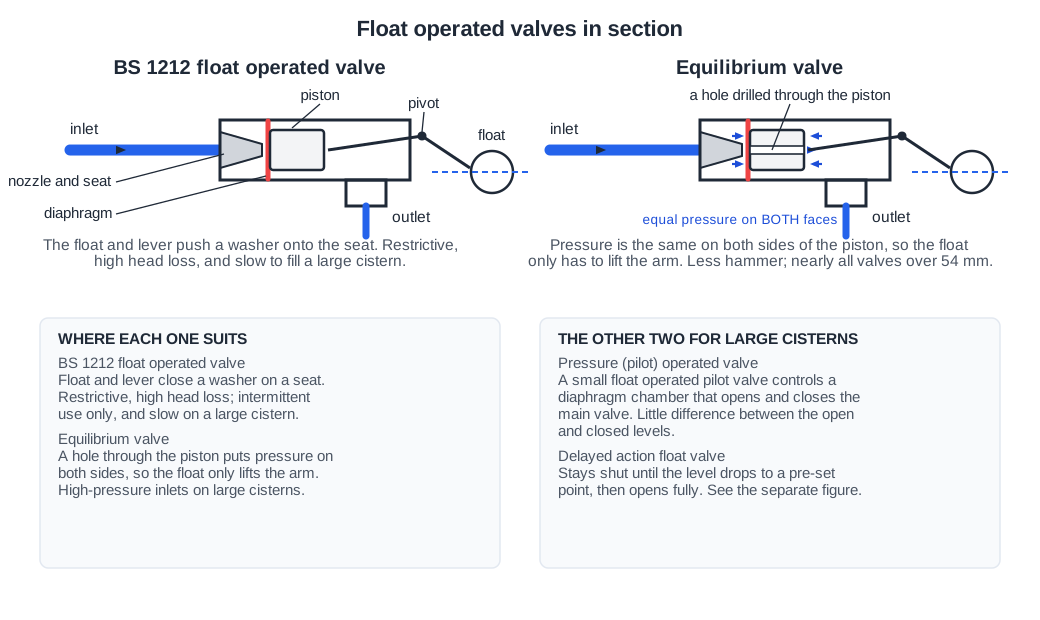
The float valve controls water entry from the mains. Three rules:
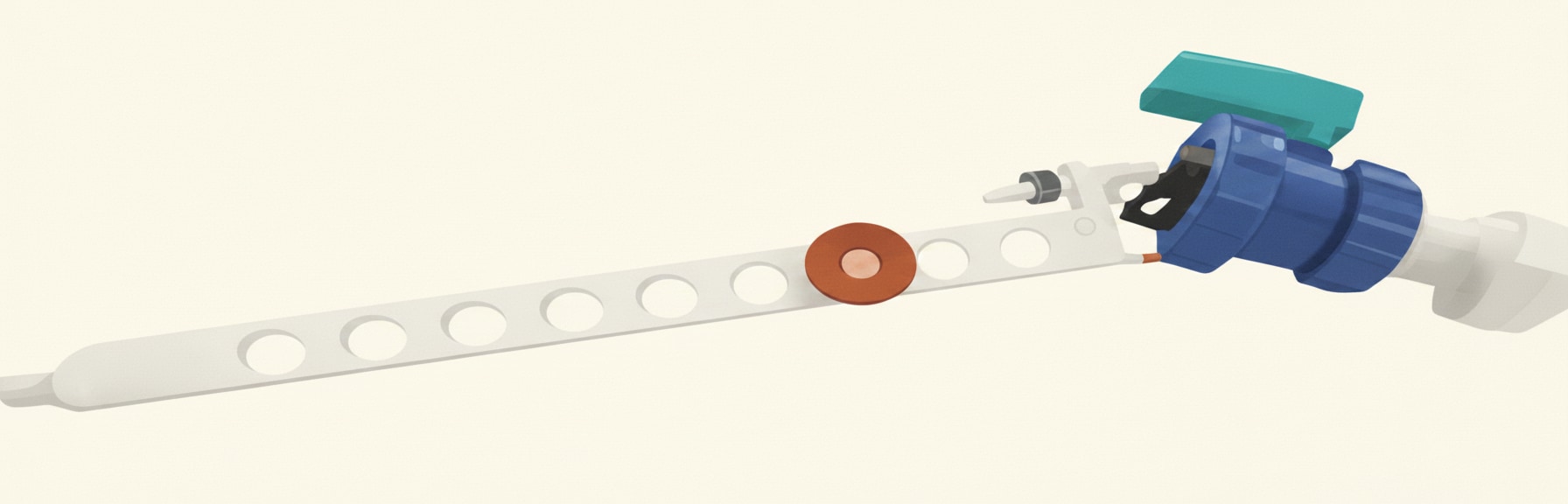
- Service valve before the float valve — so you can isolate the water to work on the float valve without draining the cistern
- Float valve connected at least 25mm above the overflow — prevents the float valve itself being submerged and potentially becoming a contamination route
- Minimum 350mm clearance above the float valve — for maintenance access (replacing washers, adjusting the arm)
In plastic cisterns, the float valve must be supported with a stiffener plate. Plastic flexes as the float valve opens and closes repeatedly — without a stiffener plate, the cistern wall will eventually crack from the fatigue. A stiffener plate spreads the load across a larger area of the plastic.
Overflow (warning pipe)
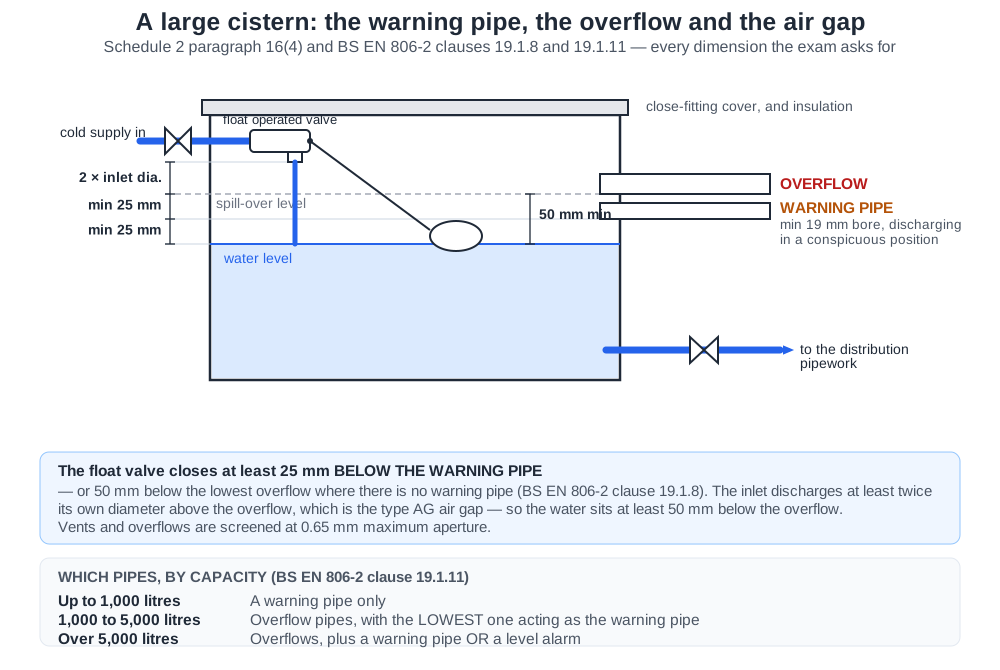
The overflow — sometimes called the warning pipe — takes water out of the cistern if the float valve fails and the water level keeps rising. Four rules:
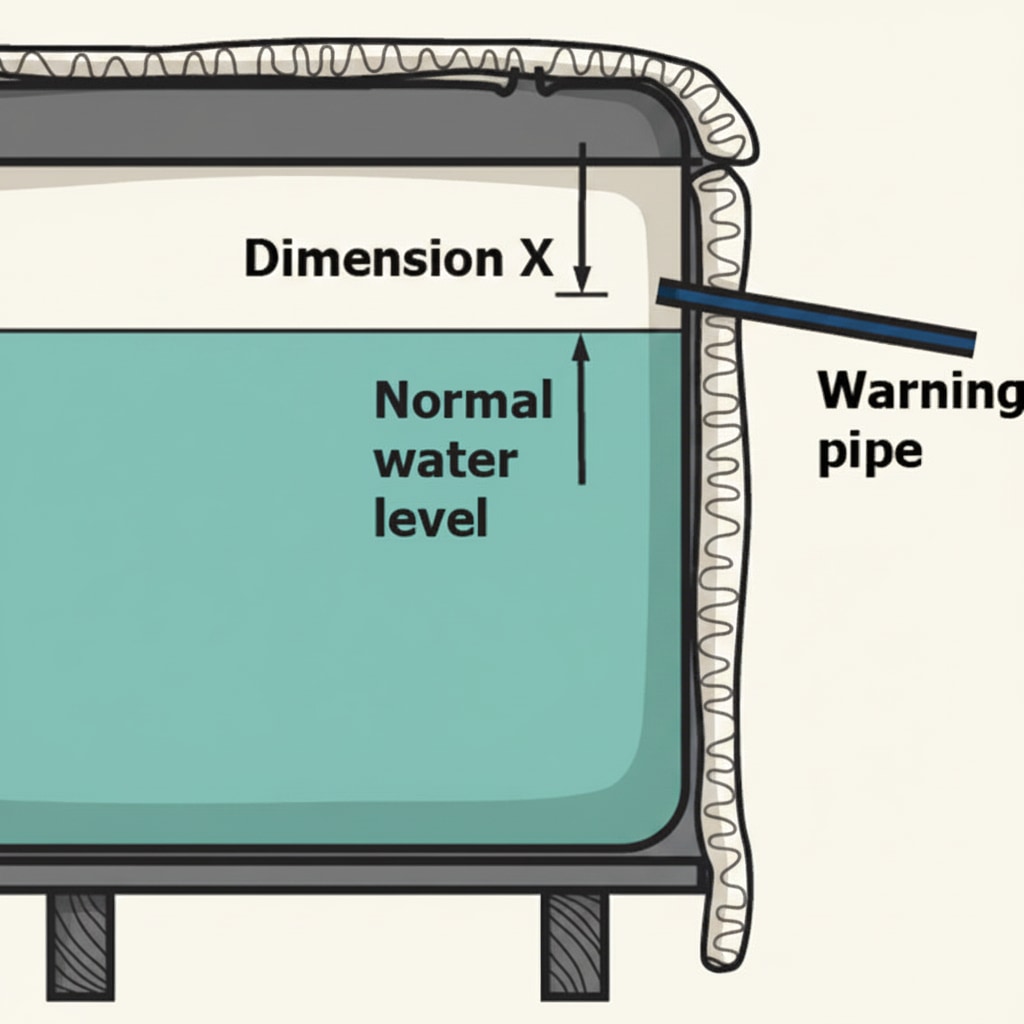
- Positioned at least 25mm above the final water level (with thermal expansion considered if the cistern feeds a hot water cylinder — heated water will expand back up the cold feed and raise the cistern level)
- Screened at the outlet against ingress of insects and particles
- Sized to cope with the flow of water should the inlet control device fail — minimum 19mm internal diameter
- Kept separate from other overflows — never common-manifold two cistern overflows together
Typical overflow pipe size: 22mm. That's the standard domestic size — the 19mm internal diameter minimum is met by 22mm copper or plastic pipework comfortably.
The overflow must discharge to a visible external location. The reason it's called a "warning pipe" is the clue: if water comes out of it, the householder can see it and knows something is wrong with the float valve.
Outlet positions and pipe connections
Where the cold feed and distribution pipes leave the cistern matters for preventing stagnation:
- Ideally, outlets taken from the base of the cistern — this prevents sludge build-up because any debris that settles gets drawn out with the water
- Where taking from the base isn't practical, take from the side
- If multiple connections are needed, make them at opposite ends of the cistern — this ensures water moves through the whole cistern rather than just the end nearest the float valve, reducing stagnation
A specific best-practice rule: if the cistern feeds both hot and cold water, the cold feed to the cylinder should connect above the cold distribution pipe. Why? Because if the mains supply fails, the hot water supply runs out first (through the cold feed at a higher level), leaving cold water for the rest of the property. This prevents scalding risk from an emptying cylinder.
Service valves on inlet and outlet
Service valves must be fitted on both the inlet and outlet of the cistern. Two reasons:
- Inlet service valve — lets you isolate the mains to service the float valve without draining the cistern
- Outlet service valve(s) — let you work on the distribution pipework or cylinder without draining the cistern
Without these valves, any maintenance job means draining the cistern — which wastes water, empties the hot water cylinder, and takes far longer than necessary.
On the distribution (outlet) side, fit a gate valve (low-pressure pipework). On the inlet side (supply pipework, high pressure), fit a stop valve or ballofix valve.
Insulation and temperature control
Bacteria — particularly Legionella — multiply between 20°C and 45°C. The Water Regulations require cisterns to be installed so that stored water temperature does not exceed 25°C.
Two practical consequences:
- Cisterns must be insulated — to prevent heat from the surrounding space (often a warm loft in summer) raising the water temperature
- Cisterns must be in a cool place — a well-insulated loft can get very hot in summer; if temperatures rise above 25°C despite insulation, the cistern may need to be relocated
The other reason cisterns need insulation: frost protection in winter. Water in an uninsulated cistern can freeze in cold conditions, splitting the cistern and causing serious water damage. In a loft, cisterns and their associated pipework need both frost and heat protection — protection in both directions.
Support requirements
A full cold water storage cistern is heavy. A 200-litre cistern holds 200kg of water — a substantial load that needs proper support.
Plastic cisterns must sit on a firm, level board that is at least 150mm longer and wider than the base of the cistern. Reasons:
- Firm and level — an uneven or flexing base would distort the plastic over time, eventually causing leaks
- Larger than the base — spreads the load safely onto the supporting joists, rather than concentrating it on the specific joists directly under the cistern
The cistern must NOT sit directly on two or three ceiling joists — the plastic would flex between unsupported sections. The board is essential.
Connections — how to make them
Holes in plastic cisterns are made with a holesaw of the correct diameter for the pipe being connected. Pipes are secured through the cistern wall using tank connectors with appropriate rubber or plastic washers to create a watertight seal.
Tank connector = the specific fitting that passes through a cistern wall and creates a watertight seal on both sides. It's not a compression fitting, not a pushfit fitting — it's its own fitting type designed for this specific job.
Open vent pipe (if feeding a gravity hot water cylinder)
If the cistern feeds a gravity hot water cylinder, there'll be a primary open vent pipe from the top of the cylinder back up over the cistern. Two rules:
- Sealed with a rubber grommet where it passes through the cistern lid (to prevent contamination ingress around the vent)
- The pipe projects no lower than the inlet — so it doesn't discharge into stored water (which would defeat the whole point of having a vent)
This is only relevant for properties with gravity hot water systems. Modern combi or unvented cylinders don't have an open vent pipe at all.
Minimum distance from the roof
Minimum 350mm between the top of the cistern and the roof — for maintenance access. This is the same 350mm rule as above rather than a second one: the clearance is measured to whatever sits above the cistern, and in a loft that is usually the underside of the roof.
The F&E cistern (briefly)
A feed and expansion (F&E) cistern is a smaller cistern used alongside an open-vented heating system — not for cold water supply, but to fill the heating system and accept expansion water from the heating circuit.
Key differences from a CWSC:
- Minimum 18 litres (much smaller than a CWSC's 100–200L minimum)
- Cold feed from it is minimum 15mm and must not have any valves fitted (because heating water needs to expand freely back into the cistern)
- Covered in detail in the heating cluster (see the open-vented vs sealed heating post)
All the other cistern rules — lid, overflow, float valve position, service valves, insulation, support board — apply to F&E cisterns too.
Common exam traps
Trap 1: Plastic cistern support. Firm level board 150mm longer and wider than the base. Not on ceiling joists directly. Not on battens. Not on polystyrene. A board.
Trap 2: Clearances. There is one overhead figure, not three: 350mm between the top of the cistern and any ceiling, roof or other obstruction above it, covering cleaning the interior and maintaining the float valve. It reduces to 225mm only for a cistern with no dimension over 450mm. If an answer sheet offers you 500mm, it has borrowed from the unvented hot water rules — where Approved Document G3 paragraph 3.54 allows no more than 600mm of pipe between the safety valve outlet and the tundish, and the older standards said 500mm. A real number from a different part of the syllabus, attached to a different fitting.
Trap 3: Overflow height above water level. 25mm minimum. With thermal expansion considered if feeding a cylinder — the water level rises as the cylinder heats, so set the overflow higher than the heated level.
Trap 4: Overflow pipe size. Minimum 19mm internal diameter. In practice, typical domestic overflow is 22mm.
Trap 5: Stiffener plate for float valves. Specifically in plastic cisterns. The plate stops the cistern wall flexing and cracking under repeated float valve operation.
Trap 6: Service valve before the float valve. Mandatory. Without it, maintaining the float valve means draining the cistern.
Trap 7: 25°C maximum water temperature. Above 25°C, bacteria multiply rapidly. Exam questions sometimes express this as "stored water should not exceed" — the answer is 25°C.
Trap 8: Both frost and heat protection. Loft cisterns need insulation in both directions — frost in winter, heat in summer. Not "just frost protection". Not "just heat protection". Both.
Quick revision summary
Before the mock test, eight things you need to be able to produce from memory:
- Approved materials (WRAS / Water Fittings and Materials Directory); plastic usual
- Lid excludes light, tightly fitting; 350mm clearance above the cistern to any ceiling or roof (225mm only if no dimension exceeds 450mm)
- Float valve: service valve before it; 25mm above overflow; 350mm clearance above; stiffener plate in plastic cisterns
- Overflow: 25mm above water level; screened; 19mm internal diameter min (22mm typical); separate from other overflows
- Outlets from base where practical; opposite ends if multiple; cold feed above cold distribution to prevent scalding
- Service valves on inlet AND outlet
- Water temperature max 25°C — frost AND heat insulation
- Plastic cistern support: firm, level board 150mm longer and wider than the base
📝 10-Question Mock Test
Click an option to see whether you got it right. Explanations appear instantly — no submitting at the end.
Plastic cisterns need continuous, level support — placing them directly on joists or timbers (A, B, D) would flex the plastic and eventually cause leaks. The board provides even support across the whole base and spreads the load safely onto the supporting structure below.
Minimum 350mm from the top of the cistern to the roof. BS 8558 clause 4.3.41.1 gives that single figure for the whole job — lifting the lid, cleaning the interior and maintaining the float valve — measured to any ceiling or other obstruction above the cistern. It reduces to 225mm only where no dimension of the cistern exceeds 450mm in any plane.
Connecting the outlet at the opposite end to the float valve (inlet) ensures water flows through the whole length of the cistern, so stored water doesn't sit stagnant in one area. Stagnation (A) is what we want to avoid — stagnant water is where bacteria grow. The pressure head (B) is set by cistern height, not outlet position. Draining (C) isn't the primary purpose.
A service valve before the float valve lets you isolate the supply for maintenance without draining the cistern. Check valves (A, B) protect against backflow but don't isolate. A drain valve (D) would drain the cistern, which is exactly what you're trying to avoid needing to do.
Loft spaces get very cold in winter (frost risk to pipework) and very hot in summer (temperature risk that would grow bacteria in the cistern). Insulation provides protection in both directions. Options A and B only cover one half of the problem.
Ideally from the base, so any debris that settles gets drawn out with the water rather than accumulating. Where taking from the base isn't practical, from the side is acceptable. High on the side (A) would leave sludge building up below the outlet. The top (D) wouldn't be fed by gravity at all.
Above 25°C, bacterial growth (particularly Legionella) accelerates. The Water Regulations require cisterns to be installed to keep stored water below this temperature. 10°C (A) is unnecessarily cold; 40°C (C) is in the active bacterial growth range; 60°C (D) is the storage temperature for hot water, not cold.
Minimum internal diameter of the overflow is 19mm — sized to cope with the full flow of water should the float valve fail to close. In practice, most domestic overflow pipes are 22mm (which easily exceeds 19mm internal). Smaller (15mm) wouldn't cope with the failure flow; 28mm or 35mm would be over-specified.
Every time the float valve opens and closes, it pulls slightly on the cistern wall. Without a stiffener plate spreading the load, the plastic will eventually crack from fatigue. Options A, C and D don't describe the actual failure mode.
Minimum 230 litres when the cistern is feeding both the cold water outlets and the hot water cylinder. BS EN 806 no longer states a minimum capacity for cisterns, but 230 litres is the accepted figure for this duty. Where a cistern feeds only a hot water cylinder the rule is different — 110 litres minimum, and at least the size of that cylinder — its capacity should be at least equal to the cylinder it serves. 150L and 300L are not standard minimum figures.
How PlumbMate puts this into practice
Cistern regulations are heavy on specific figures and specific components. Exactly what spaced repetition was designed for.
- Flashcards, not essays. One prompt, one answer — the format that research has consistently shown works best for active recall.
- Wrong answers are logged. Every question you get wrong goes into a dedicated collection that resurfaces more frequently in future sessions.
- The 3× rule. You need to get a question right three times before it clears — one lucky guess isn't enough.
- Explanations on every question. Like the ones above, but on every single question in the app.