The pipe names, ownership boundaries and burial depths in this post are set by the Water Supply (Water Fittings) Regulations 1999 — the Water Regulations. Every plumbing job starts with water arriving at the property — and every Level 2 cold water exam question about "pipe names and depths" assumes you know the journey that water has taken. Trunk main, principal main, local main, communication pipe, external supply pipe, internal stop valve. If you can't name each section and say who's responsible for it, you'll lose marks on a whole family of questions.
This post is the first in the Level 2 cold water sub-cluster. For the others, see the direct vs indirect systems, cold water storage cisterns, fluid categories and backflow prevention, hard and soft water and frost protection, and commissioning and maintenance posts.
Where our water comes from
Two categories of source for public water supply:
Above-ground sources
- Lake
- River
- Stream
- Upland surface (runoff from hills)
- Reservoir (man-made storage lake)
Below-ground sources
- Borehole — a narrow vertical shaft drilled into an aquifer
- Deep well and shallow well
- Spring — where groundwater naturally emerges at the surface
- Aquifer — a rock layer that holds water
Exam questions test the distinction between the two groups directly. The mnemonic most students find useful: wells, boreholes, springs, and aquifers are all underground (the clue is in the word "ground"); lakes, rivers, streams, and reservoirs are all above ground.
The water cycle in brief
Water evaporates from lakes, rivers, and seas. In the atmosphere, it cools and condenses into clouds. Eventually it falls as rain or snow — precipitation. Some of that water runs off the surface back to rivers and the sea; some soaks into the ground and becomes groundwater. The cycle repeats.
Key terms reliably tested:
- Evaporation — liquid water becoming vapour
- Condensation — water vapour becoming clouds
- Precipitation — water falling from clouds as rain or snow
- Runoff — water flowing over the land surface
Water treatment
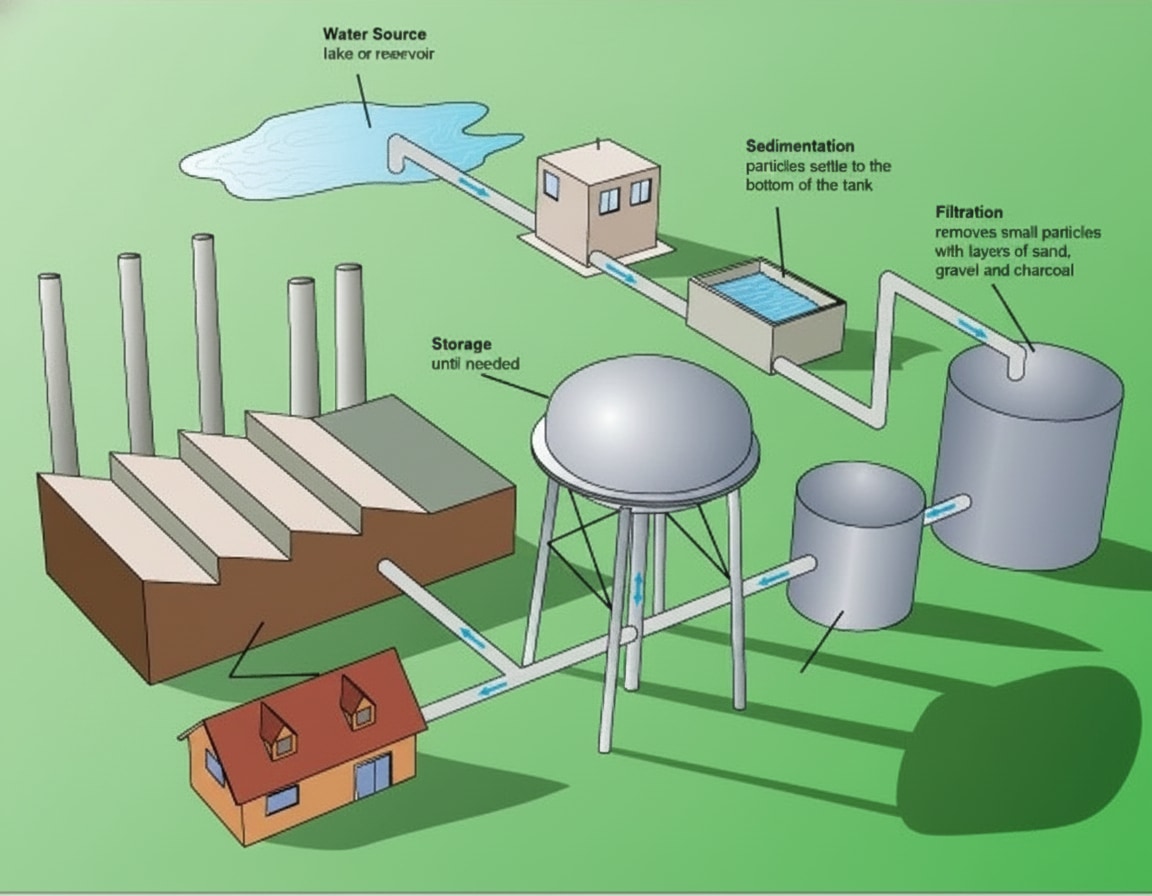
Water from any natural source has to be treated before it's safe to drink. The standard UK treatment process, in order:
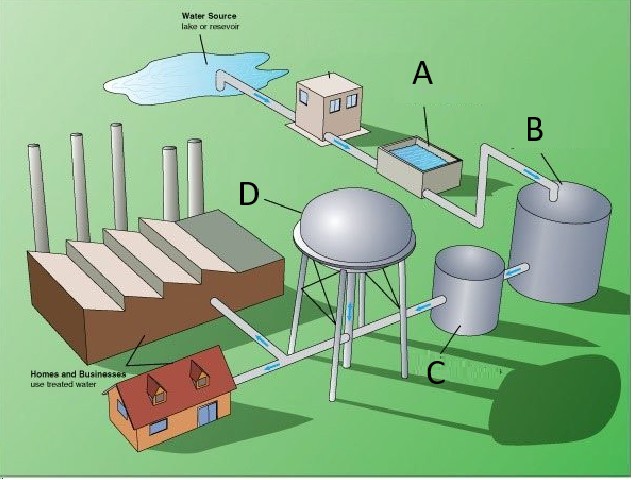
- Screening — water from the source passes through a screen (like a large sieve) that removes sticks, leaves, litter, and other large debris. Often combined with a pumping station that lifts the water to the next stage.
- Settlement tank — water sits in a large tank so small particles settle to the bottom.
- Filtration — water passes through sand and charcoal filters that remove the smallest particles.
- Chlorination — chlorine is added to sterilise the water, killing any remaining bacteria.
- Service reservoir (water tower) — the treated water is stored here before distribution.
Treated water leaving the water tower is called wholesome water — fit for drinking, cooking, and all domestic uses. The Water Regulations use this term throughout, so it's worth committing to memory.
Public vs private supply
Public supply. Water from a licensed water undertaker (the water company). This is what serves the vast majority of UK homes.
Private supply. Any water supply not provided by a water company. About 1% of the population of England and Wales uses a private supply — typically in remote rural areas. Sources include:
- Boreholes
- Natural springs
- Watercourses (streams, rivers)
Private supplies are usually filtered and treated on site, with the level of treatment depending on the source and risk. A deep borehole through impermeable rock is lower-risk than a surface stream.
Reclaimed water (rainwater harvesting and grey water recycling) is increasingly common. Treated appropriately, recycled water can be used for many domestic purposes — but untreated rainwater and grey water are Category 5 water (the highest risk) and must never be used for anything that contacts food, skin, or drinking supplies. This is covered in more detail in the fluid categories post.
From the treatment works to the neighbourhood
Once treated water leaves the service reservoir, it's distributed through a series of progressively smaller pipes:
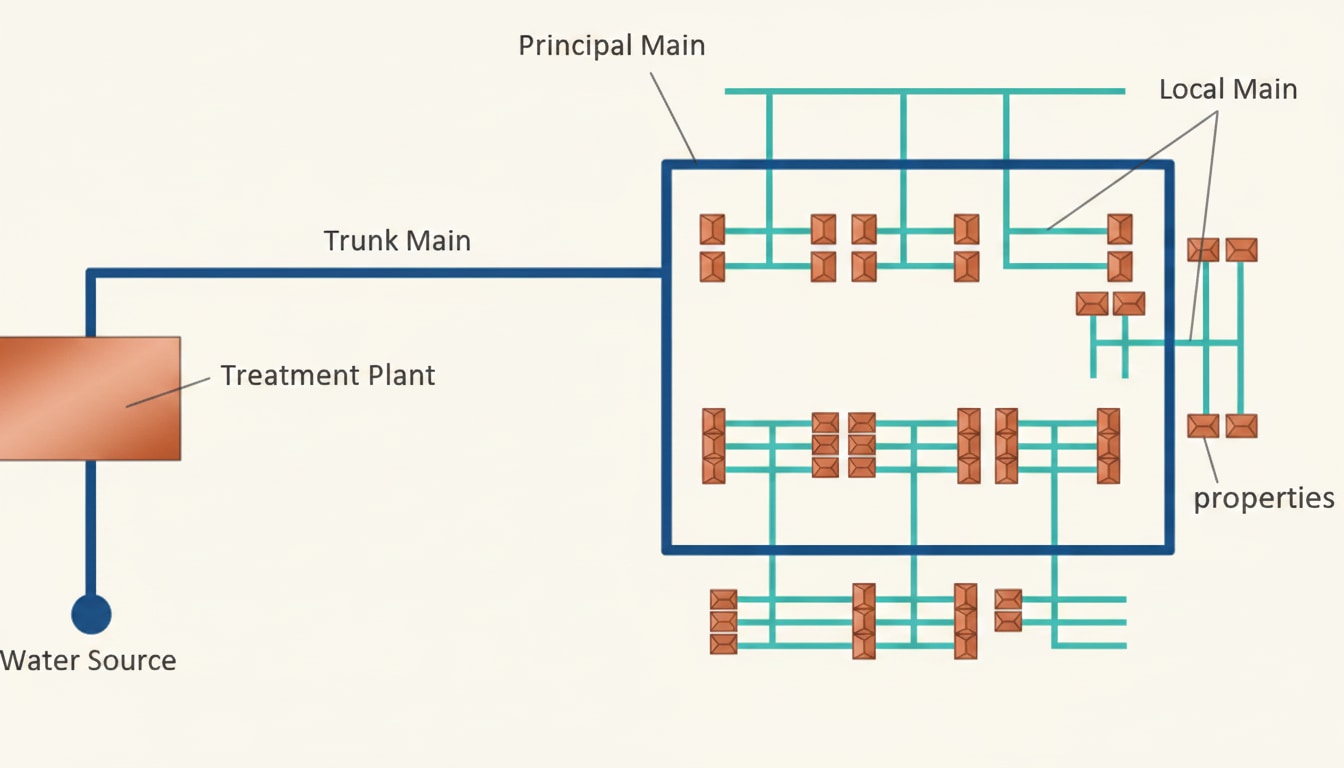
- Trunk main — the largest pipe, running from the treatment works to the neighbourhood. Often several hundred millimetres in diameter.
- Principal main — splits off the trunk main, carrying water to specific areas.
- Local main (also called "supplier's local main" or just the "water main") — the final distribution pipe that runs along a street with individual property connections branching off it. Often over 100mm diameter.
- Communication pipe — the short section from the local main to the boundary of the individual property. This is the water supplier's responsibility. Made from blue 25mm MDPE (medium-density polyethylene) — the blue colour is a regulation requirement for mains water pipework.
The water supplier is responsible for everything up to and including the boundary. Past the boundary, responsibility transfers to the homeowner.
External stop valve and water meter
At the property boundary, in a meter chamber (a small below-ground chamber accessible from a surface cover):
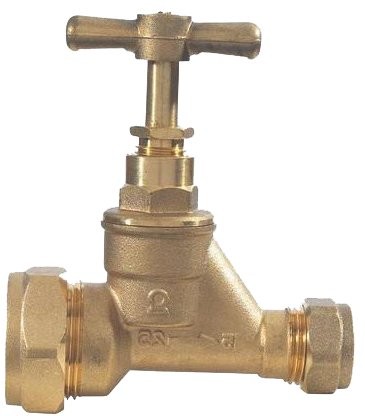
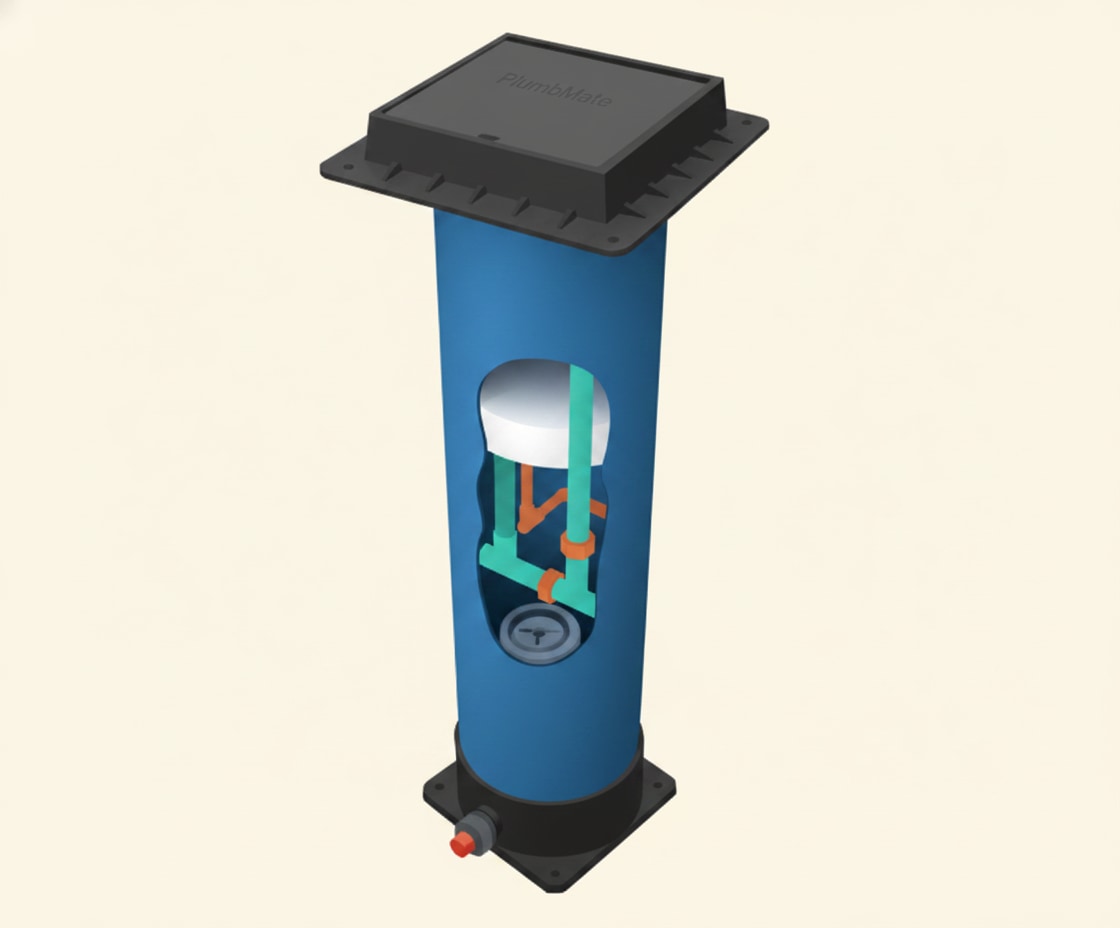
- External stopcock — the main stop valve for the property, where the communication pipe becomes the supply pipe. Marks the transfer of responsibility from supplier to homeowner.
- Water meter — measures the volume of water used in the property. Fitted outside every new UK property. Three types: internal, external, and groundbreaker.
The water meter measures volume — not flow rate, not pressure, not temperature. Exam questions reliably test this.
External supply pipe
From the boundary into the property, the pipe becomes the external supply pipe — still usually blue 25mm MDPE, still the homeowner's responsibility.
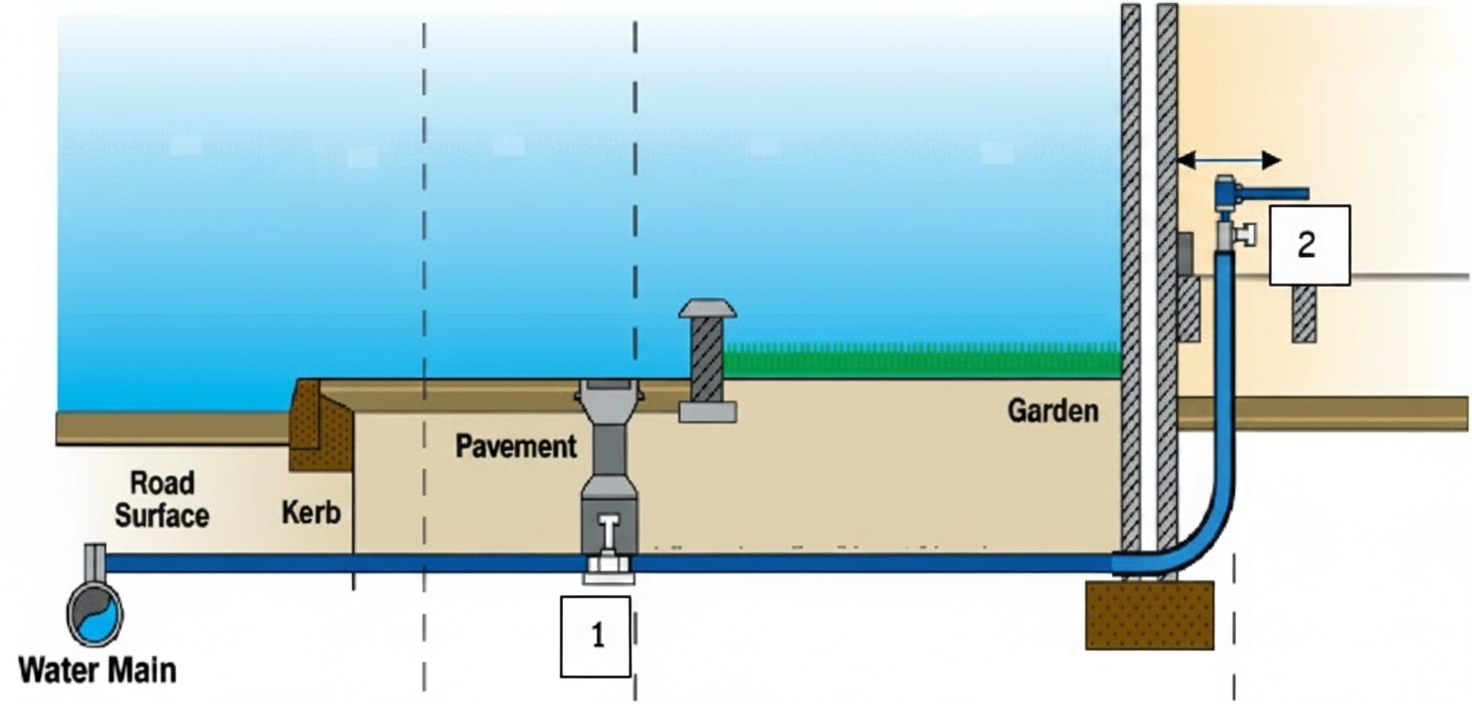
Critical figures on pipe depth:
- Minimum depth: 750mm below ground level
- Maximum depth: 1350mm below ground level
Why 750mm minimum? Below that depth the pipe is below the frost line for most of the UK — the water inside won't freeze in typical winters. Above that depth, frost protection becomes unreliable.
Why 1350mm maximum? Deeper than that and repairs become much harder and more expensive to carry out.
If the pipe can't be buried to 750mm minimum, it must be insulated (standard exam answer). Not "buried deeper where possible", not "moved to a different location" — the specific remedy is insulation.
If the supply pipe isn't insulated, minimum distance from the external wall = 750mm. This comes up as a separate exam question about horizontal clearance rather than vertical depth.
Passing through the foundations
Where the external supply pipe passes through the property's foundations on its way inside, it must be protected by a protective sleeve. Two reasons:
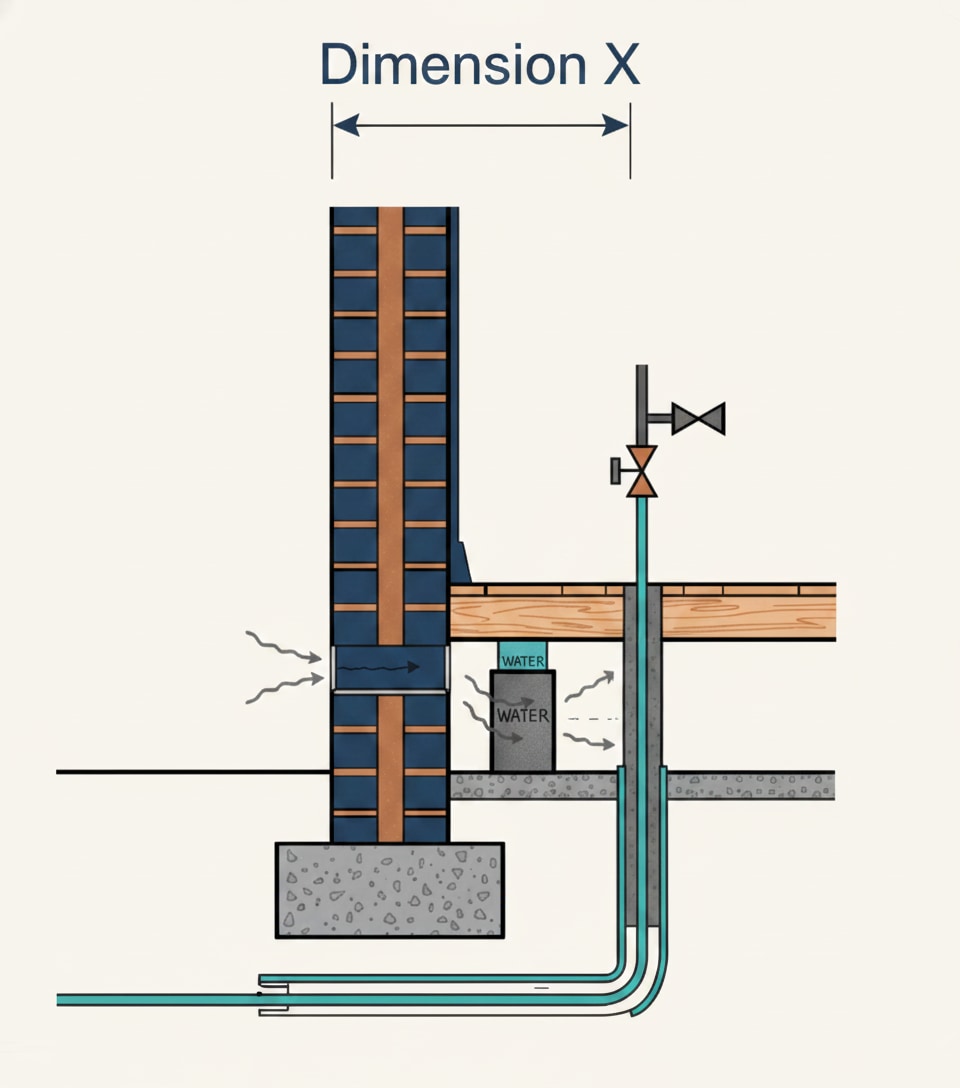
- The pipe may need to move slightly as the building settles, and a rigid connection through the foundations would crack the pipe
- Allows for future replacement without digging up the foundations
Inside the property
Once inside the building, the pipe becomes the internal supply pipe (also sometimes called the "rising main"). The key components fitted at the point of entry:
Internal stopcock (stop valve). Must be fitted as soon as the pipe enters the property. The first means of isolating the water supply inside the building. On high-pressure (mains) pipework, a stop valve is the right choice — not a gate valve.
Drain valve. Fitted immediately after the internal stopcock, at a low point in the pipework. Lets you drain down the supply pipework after isolation. Also fit drain valves at any other low points in the supply system.
Stop valves should be used on high/mains pressure pipework only. Gate valves go on low-pressure distribution pipework from cisterns. Putting a gate valve on a high-pressure supply pipe would cause the gate to knock about and eventually fail.
What "suitability of incoming supply" means
When assessing whether an incoming supply can handle what you want to connect to it, the two key considerations are pressure and flow rate.
- Pressure — static pressure when outlets are closed; working pressure when outlets are running
- Flow rate — how many litres per minute can actually come out of the pipe
Not chlorine level (that's the water company's job). Not hardness (that doesn't affect supply capacity). Not acidity. Pressure and flow rate. This is a reliably-tested combination.
Approved fittings (WRAS)
Every fitting used on mains water must be WRAS approved (Water Regulations Advisory Scheme). Approved fittings are listed in the Water Fittings and Materials Directory.
Why WRAS approval matters:
- Legal requirement — using unapproved fittings is a breach of the Water Regulations
- Corrosion resistance — approved fittings are tested to not deteriorate in water
- Avoidance of contamination — approved fittings don't leach harmful substances into the water
The three reasons for using approved fittings — legal requirement, corrosion resistance, avoidance of contamination — are a reliably-tested combination.
Fittings NOT approved for mains water include anything with leaded solder (capillary fittings soldered with a lead/tin mix) or untreated steel. Any soldered fittings on hot or cold water must use lead-free solder only.
Common exam traps
Trap 1: Depth figures. 750mm minimum, 1350mm maximum. Questions reliably test both figures — and also the 750mm minimum distance from an external wall if the pipe isn't insulated.
Trap 2: "If the pipe can't be buried to 750mm minimum…" The answer is insulate the incoming pipe — not notify building control, not bury deeper, not abandon the job.
Trap 3: Colour of underground MDPE. Blue. Not black (gas), not brown or grey or white. Blue = mains water.
Trap 4: External supply pipe responsibility. Homeowner (from the boundary inwards), not the water supplier. The communication pipe, which is before the boundary, is the supplier's responsibility.
Trap 5: What a water meter measures. Volume of water used. Not flow rate (a Weir cup measures that), not pressure (a pressure gauge), not temperature.
Trap 6: Pressure AND flow rate. The two key considerations when assessing incoming supply suitability. Distractor answers combine one of these with an irrelevant factor like chlorine, calcium, or oxygen levels.
Trap 7: Stop valve vs gate valve. Stop valves on mains pressure supply pipework; gate valves on distribution pipework. A stop valve on the internal supply pipe immediately after entry; gate valves only on the low-pressure side of cisterns.
Quick revision summary
Before the mock test, seven things you need to be able to produce from memory:
- Above-ground sources: lake, river, stream, upland surface, reservoir
- Below-ground sources: borehole, deep/shallow well, spring, aquifer
- Water treatment process: screening → settlement → filtration (sand/charcoal) → chlorination → storage
- Mains network: trunk main → principal main → local main → communication pipe (supplier) → external supply pipe (homeowner)
- MDPE: blue, 25mm typical, used for underground supply
- Depths: 750mm minimum, 1350mm maximum; if shallower, insulate
- Internal entry: stop valve first, drain valve immediately after
📝 10-Question Mock Test
Click an option to see whether you got it right. Explanations appear instantly — no submitting at the end.
A borehole is a vertical shaft drilled down into an aquifer — underground by definition. Lakes, rivers and reservoirs are all surface-level above-ground sources. The word "ground" in "borehole" is the clue.
Rain falling from clouds is precipitation. Evaporation (B) is liquid turning to vapour. Condensation (C) is vapour becoming clouds. Dissolution (D) is a chemical dissolving in water — not part of the cycle.
Chlorine is added to kill residual bacteria. Boiling (A) isn't used in bulk treatment because it's far too energy-expensive. Flushing (B) isn't a treatment method. Desalination (C) is used in areas without fresh water sources — not standard UK treatment.
Blue is the mandatory colour for underground MDPE carrying mains water. Gas MDPE is yellow. Black polyethylene pipe you might come across on older installations is usually alkathene — an older plastic that predates modern MDPE colour-coding. Getting the colour right matters on site because mis-identifying a pipe could cause a serious cross-connection.
Maximum 1350mm; minimum 750mm. Shallower than 750mm means the pipe is above the frost line and must be insulated. Deeper than 1350mm and repairs become prohibitively difficult. The other options are distractors with plausible-looking numbers.
If the pipe is above ground on the horizontal approach to the property, it must be at least 750mm from the wall — the same figure as the vertical minimum depth. Same reasoning: keeping the pipe clear of temperature extremes at wall level. Option B (200mm) would be far too close; A and D don't match the rule.
These are the two practical characteristics that determine whether a supply can drive an appliance or system. Chlorine level (A) is the water company's concern; calcium level (B) matters for limescale prevention but isn't about supply capacity; acidity (D) affects pipe materials but isn't the "suitability" question.
Meters measure cubic metres (or litres) of water that have passed through, for billing purposes. Flow rate (A) is measured with a Weir cup; pressure with a gauge; temperature with a thermometer.
The three reasons for WRAS approval. Options A, B and D mix one or two correct items with plausible-sounding wrong ones. Cost, ease of use, and appearance aren't the primary concerns of the Water Regulations — they're about safety and longevity.
Leaded solder is banned on hot and cold water systems because lead leaches into drinking water and is a serious health hazard. Lead-free solder is required. Options A, B and D are all acceptable above-ground fittings.
How PlumbMate puts this into practice
Water sources, pipe depths, and supply terminology are classic fact-heavy topics. Exam-hall recall gets much more reliable with spaced repetition.
- Flashcards, not essays. One prompt, one answer — the format that research has consistently shown works best for active recall.
- Wrong answers are logged. Every question you get wrong goes into a dedicated collection that resurfaces more frequently in future sessions.
- The 3× rule. You need to get a question right three times before it clears — one lucky guess isn't enough.
- Explanations on every question. Like the ones above, but on every single question in the app.