Combustion is the one part of the Level 2 scientific principles unit that most learners assume they can skip, on the grounds that they are not allowed near a gas appliance yet. That reasoning is exactly backwards. You are examined on it at Level 2 precisely because you are not qualified to work on it — the syllabus wants you to understand what is happening inside the appliance long before you are permitted to open one.
It is also a small, self-contained set of facts. There is no formula to learn and the whole topic comes down to one triangle, three fuels and a handful of numbers.
For the rest of the science unit, see the complete science revision guide, and for the companion deep-dives, the heat transfer and thermal expansion posts.
Before anything else: the qualification boundary
Understanding combustion and being allowed to work on it are two different things, and it is worth being blunt about the line.
Until you hold the relevant qualification and registration, you must not install, alter, service or otherwise work on gas or oil pipework and appliances. For gas that means Gas Safe registration; for oil it means OFTEC. Both come after Level 2, not during it. Working on gas without registration is a criminal offence, not a technicality.
What this page gives you is the theory the exam asks for, and the grounding you will need when you do progress to those qualifications.
The fire triangle
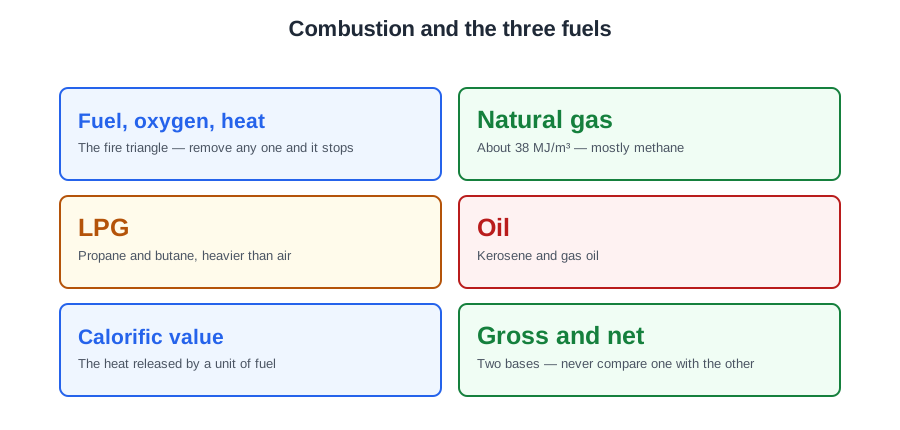
Three things are needed for a fire to start and keep burning, and removing any one of them stops it:
- Fuel — something to burn
- Oxygen — from the air
- Heat — a source of ignition
The same triangle appears in the health and safety unit as the basis for how extinguishers work, which is a useful way to remember it: water removes heat, foam and CO&sub2; remove oxygen, and turning off the gas removes fuel. Same three sides, approached from the fire-fighting end instead.
Combustion, then, is simply a controlled fire — fuel and oxygen brought together deliberately, ignited, and the heat given off used to warm water.
The three fuels
Plumbing systems burn one of three fuels, and the exam expects you to know which is which.
Natural gas
The most common fuel in UK homes, piped to the property from the mains. Natural gas is methane, and that alternative name is examined directly. It arrives ready to burn, needing only to be mixed with air at the burner.
Liquefied petroleum gas (LPG)
Used where there is no gas main — rural properties, park homes, boats — and stored in bottles or a bulk tank. LPG is a family rather than a single gas, made up of propane, butane and MAPP.
You already use it: propane is the gas in a plumber’s blowtorch. Some properties also run boilers on it.
Oil
The fuel for properties off both the gas main and the LPG route. The oil used in domestic boilers is kerosene.
Oil behaves differently from the two gases in one important respect: it does not ignite readily as a liquid. To burn it, an oil burner sprays it through a nozzle to break it into a fine mist — atomising it — so that it vaporises and mixes with air. Only then will it light. That extra step is why oil burners have a nozzle, a pump and an ignition electrode where a gas burner simply has a jet.
Calorific value
Calorific value (CV) is the amount of heat energy released by burning a given quantity of a fuel. It is what tells you how much you get for what you burn, and in the UK it is expressed in megajoules per cubic metre (MJ/m³).
That unit is worth pausing on, because it ties back to the heat transfer post: joules measure energy, so a calorific value is a quantity of energy per quantity of fuel. Nothing more complicated than that.
| Fuel | Calorific value | Combustion temperature |
|---|---|---|
| Natural gas | 38–39 MJ/m³ | 1,920 °C |
| LPG (propane) | 93 MJ/m³ | 1,970 °C |
The headline comparison is the one to carry into the exam: LPG has the higher calorific value and the higher combustion temperature of the two. That is why an LPG appliance needs smaller burner injectors than the equivalent natural gas one — more energy per cubic metre means less gas is needed for the same output, and swapping an appliance between the two fuels means changing the injectors, not just the pipe.
One honest caveat on the numbers, because you will find different figures if you go looking: published calorific values for LPG vary considerably depending on whether they are quoted by volume or by mass, and on whether the figure is gross or net. The table above is by volume, which is the fair comparison against natural gas. Quoted by mass, propane comes out at roughly 50 MJ/kg — a similar-looking number to natural gas but measuring something completely different, and that mix-up is the usual reason two sources appear to disagree. Butane is higher again, around 121 MJ/m³. Use the values taught on your course for exam purposes, and expect manufacturers' data to be expressed differently.
Relative density: which way does a leak go?
This is the single most practically important difference between the two gases, and it comes straight from relative density — the property covered in the materials and density post, where gases are compared against air.
- Natural gas is lighter than air. A leak rises. It collects at high level and disperses reasonably readily through upper ventilation.
- LPG is heavier than air. A leak sinks. It collects at low level — in cellars, under floors, in drainage channels and inspection chambers — and it stays there.
Everything downstream follows from those two lines. It is why LPG cylinders are not stored below ground level or near drains and gullies, why LPG ventilation is provided at low level while natural gas ventilation is at high level, and why a boat or a caravan running on LPG is treated with such caution: any leak pools in the lowest part of the hull or floor pan rather than blowing away.
Complete and incomplete combustion
Burn a fuel with enough oxygen and you get complete combustion. The products are carbon dioxide, water vapour and heat, and the flame burns blue and stable.
Starve that same flame of oxygen and you get incomplete combustion. The fuel does not burn fully, and the products now include carbon monoxide and unburnt carbon in the form of soot. The flame goes yellow, orange and lazy, and sooting appears around the appliance.
Carbon monoxide is colourless, odourless and lethal. Unlike natural gas, which is deliberately given its smell by an added odorant, carbon monoxide gives you no warning at all. This is the reason appliance ventilation and flueing are regulated so tightly, and the reason a yellow flame on an appliance that should be burning blue is treated as an emergency rather than a service item.
The exam version is usually a flame-colour question. Blue is complete; yellow or orange is incomplete. The one exception you should know about is a decorative fuel-effect fire, which is designed to produce a yellow flame deliberately and is flued accordingly.
Condensing boilers: recovering the latent heat
Water vapour is one of the products of complete combustion, and for most of the history of gas heating it went straight up the flue taking its energy with it. A condensing boiler exists to get some of that energy back.
It uses a larger or secondary heat exchanger to cool the flue gases far enough that the water vapour in them condenses back into liquid. Changing state releases the latent heat the vapour was carrying — and as covered in the thermal expansion and latent heat post, the energy tied up in a change of state is far larger than the energy involved in a change of temperature. Recovering it is what lifts a condensing boiler's efficiency above that of the appliances it replaced.
Two consequences you meet on site follow directly. The condensate produced is slightly acidic, which is why condensate pipework is plastic rather than metal. And a condensing boiler only actually condenses when the return water is cool enough — run it at too high a flow temperature and it behaves like a conventional boiler, which is one reason low-temperature system design matters.
Common exam traps
Trap 1: Assuming all gas behaves the same way in a leak. Natural gas rises, LPG sinks. Almost every LPG-specific rule about storage and ventilation exists because of that one difference.
Trap 2: Mixing up the fuels and their uses. Kerosene is oil-boiler fuel. Propane is blowtorch fuel. Methane is another name for natural gas. Butane is an LPG, not a natural gas — a favourite distractor.
Trap 3: Forgetting that oil has to be vaporised. If a question asks why an oil burner has a nozzle, the answer is atomisation — oil will not ignite readily until it has been broken into a mist and turned to vapour.
Trap 4: Reading the calorific value comparison backwards. LPG has the higher figure of the two, and the higher combustion temperature with it.
Trap 5: Thinking a yellow flame just needs adjusting. A yellow flame on an appliance designed to burn blue means incomplete combustion, and incomplete combustion means carbon monoxide.
Quick revision summary
Before the mock test, the things you need to be able to produce from memory:
- Fire triangle: fuel, oxygen and heat — remove any one and combustion stops
- Natural gas is methane, piped from the main, and is lighter than air
- LPG is propane, butane and MAPP, stored in bottles or a tank, and is heavier than air
- Propane is the gas in a blowtorch; kerosene is the oil in a domestic boiler
- Oil must be atomised through a nozzle and vaporised before it will ignite
- Calorific value is measured in MJ/m³: natural gas 38–39, LPG 49
- Combustion temperatures: natural gas 1,920 °C, LPG 1,970 °C
- Complete combustion gives carbon dioxide, water vapour and heat, and a blue flame
- Incomplete combustion gives carbon monoxide and soot, and a yellow or orange flame
- A condensing boiler recovers latent heat by condensing the water vapour in the flue gases
- Gas and oil work requires Gas Safe or OFTEC registration — not available at Level 2
📝 12-Question Mock Test
Click an option to see whether you got it right. Explanations appear instantly — no submitting at the end.
The fire triangle: fuel, oxygen and heat. Remove any one side and burning stops, which is exactly how every extinguisher works. The three distractors are all heat or state processes from elsewhere in this unit, which is what makes them tempting.
Natural gas is methane. Propane and butane are both LPGs and kerosene is an oil, so every distractor is a real plumbing fuel — you cannot eliminate them by recognising the word, only by knowing which is which.
Natural gas sits at 38–39 MJ/m³. LPG is much the higher of the two — propane about 93 MJ/m³ and butane about 121 MJ/m³ — so if you can only remember which is bigger you can still separate them. Calorific value simply means the heat energy released by burning a given quantity of fuel.
Butane is an LPG, alongside propane and MAPP. This is a favourite exam question because “natural” sounds plausible for any gas — but natural gas means methane specifically, and butane is bottled rather than piped.
Propane. You have handled it every time you have soldered a joint, which makes it one of the easier marks on the paper — the distractors are all real hydrocarbons but none of them come in a blowtorch cylinder.
Kerosene. Note that methane and propane are both gases, so they cannot be a fuel oil at all — spotting that eliminates half the options before you have to recall anything.
A condensing boiler burns a fuel, and in most UK properties that fuel is natural gas. Air conditioning and heat pumps run on electricity, and an accumulator is a cold water storage vessel that burns nothing at all.
Around 1,970 °C for LPG, against roughly 1,920 °C for natural gas. Learn them as a pair with the calorific values, because LPG is the higher figure on both counts — get one right and you can reason out the other.
Oil does not burn readily as a liquid. Breaking it into a fine mist turns it to vapour and mixes it with air, and only then will it light. That single requirement is why an oil burner needs a nozzle, a pump and an ignition electrode where a gas burner needs only a jet.
Natural gas is lighter than air, so it rises and collects at high level — which is why ventilation for natural gas appliances is provided high up. LPG does the opposite, and almost every difference in the rules between the two fuels traces back to this one property.
LPG is heavier than air. A leak sinks into cellars, ducts, gullies and inspection chambers and stays there rather than dispersing, which turns a low-level space into a collection point. It is also why LPG ventilation is provided at low level rather than high.
A lazy yellow or orange flame means the fuel is not getting enough oxygen to burn fully. The products then include soot and carbon monoxide — colourless, odourless and lethal, with none of the added smell that warns you about a gas leak. This is treated as an emergency, not a service item.
How PlumbMate puts this into practice
Questions like these are exactly what PlumbMate drills you on — but with the spaced repetition engine doing the scheduling so you're not retesting yourself on the stuff you already know.
- Flashcards, not essays. One prompt, one answer — the format that research has consistently shown works best for active recall.
- Wrong answers are logged. Every question you get wrong goes into a dedicated collection that resurfaces more frequently in future sessions.
- The 3× rule. You need to get a question right three times before it clears — one lucky guess isn't enough.
- Explanations on every question. Like the ones above, but on every single question in the app.