Level 2 expects you to identify six main hot water cylinder types from a diagram, explain what makes each different, and know the situations each is used in. The good news: once you understand three underlying principles (direct vs indirect, vented vs unvented, how the primary and secondary water are kept separate), all six cylinders become identifiable variants rather than six separate things to memorise.
This is the second post in the Level 2 hot water sub-cluster. For the others, see the classifications, open vented systems, unvented systems, heat sources and temperature control posts.
Cylinder vocabulary
Before the six types, a quick tour of the vocabulary you'll see on every cylinder diagram:
Primary water — the water in the boiler and primary pipework. Heated by the boiler, circulates round the primary circuit, and delivers heat to the cylinder via the coil or annulus. Also feeds the radiators on a combined heating/hot water system. On an open vented system, the primary water is fed by the F&E (Feed and Expansion) cistern.
Secondary water — the water that comes out of the hot taps. Stored in the body of the cylinder, heated by the primary water (if indirect) or directly (if direct). On an open vented system, the secondary water is fed by the CWSC (Cold Water Storage Cistern).
Heating coil — a copper or steel pipe coiled inside the cylinder. Primary hot water flows through the coil; secondary stored water surrounds the coil and picks up heat through the coil wall. Keeps the two waters completely separate.
Annulus — an alternative to a coil. A cylinder-shaped heat exchanger (imagine a cylinder with no middle) inside the main cylinder. Works the same way as a coil but uses a different geometry.
Cold feed — the pipe from the CWSC that fills the cylinder and accommodates expansion back up into the cistern.
Vent pipe — the pipe from the top of the cylinder that rises up and over the cistern. Maintains atmospheric pressure on the system and provides a route for water to expand into if anything goes wrong.
The six cylinder types
Six main types you need to recognise on diagrams:
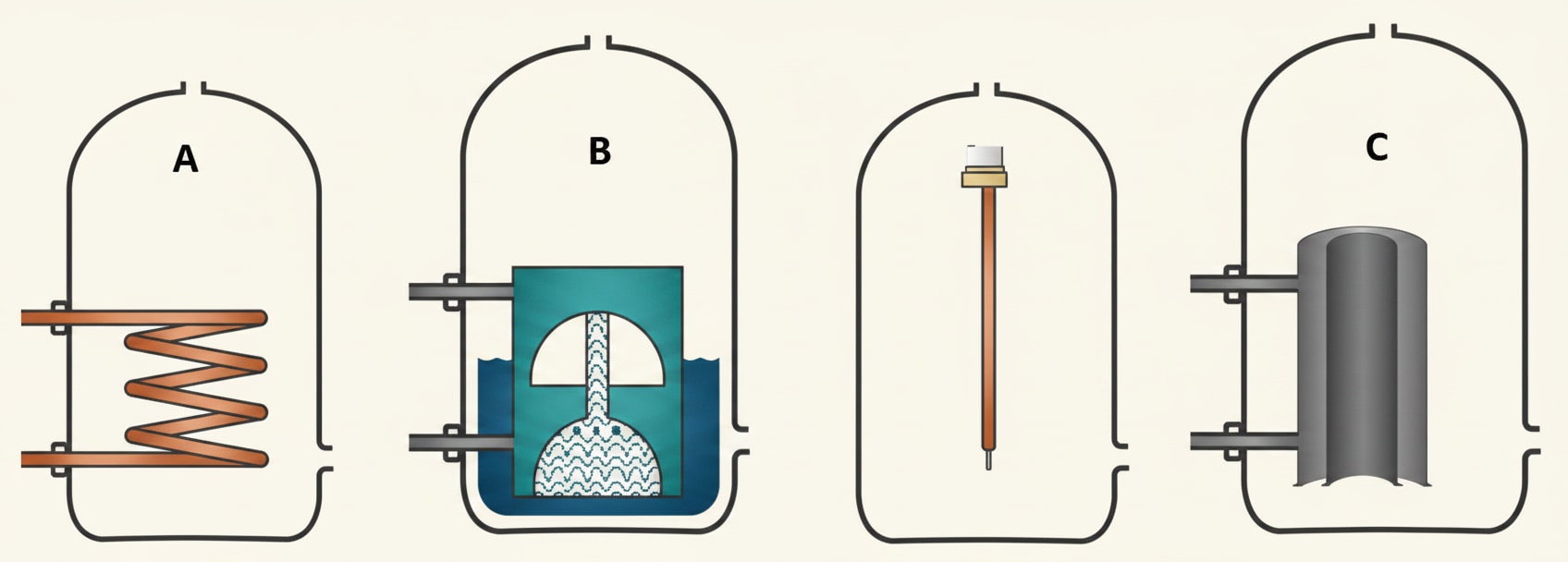
1. Direct cylinder (heated by immersion or direct boiler)
What it looks like: a simple cylinder with no coil visible inside. Heat is added directly to the stored water.
Two sub-types:
- Immersion-heated direct cylinder — an electric element sits in the cylinder. No boiler, no primary circuit. The element heats the stored water directly.
- Direct cylinder heated by boiler — primary pipework from the boiler flows into the cylinder, mixes with the stored water, and circulates back. The primary and secondary waters are the same water.
When used: the immersion-heated variant is common as a backup hot water source (on a cylinder that's normally heated by a boiler, in case of boiler failure) or as the sole heat source in properties without gas. The boiler-fed direct cylinder is now rare — indirect is the modern standard.
Identification clue: no coil visible inside the cylinder on the diagram.
2. Double feed indirect cylinder with coil
What it looks like: a cylinder with a coil visibly inside it. Separate CWSC and F&E cistern shown on the diagram.
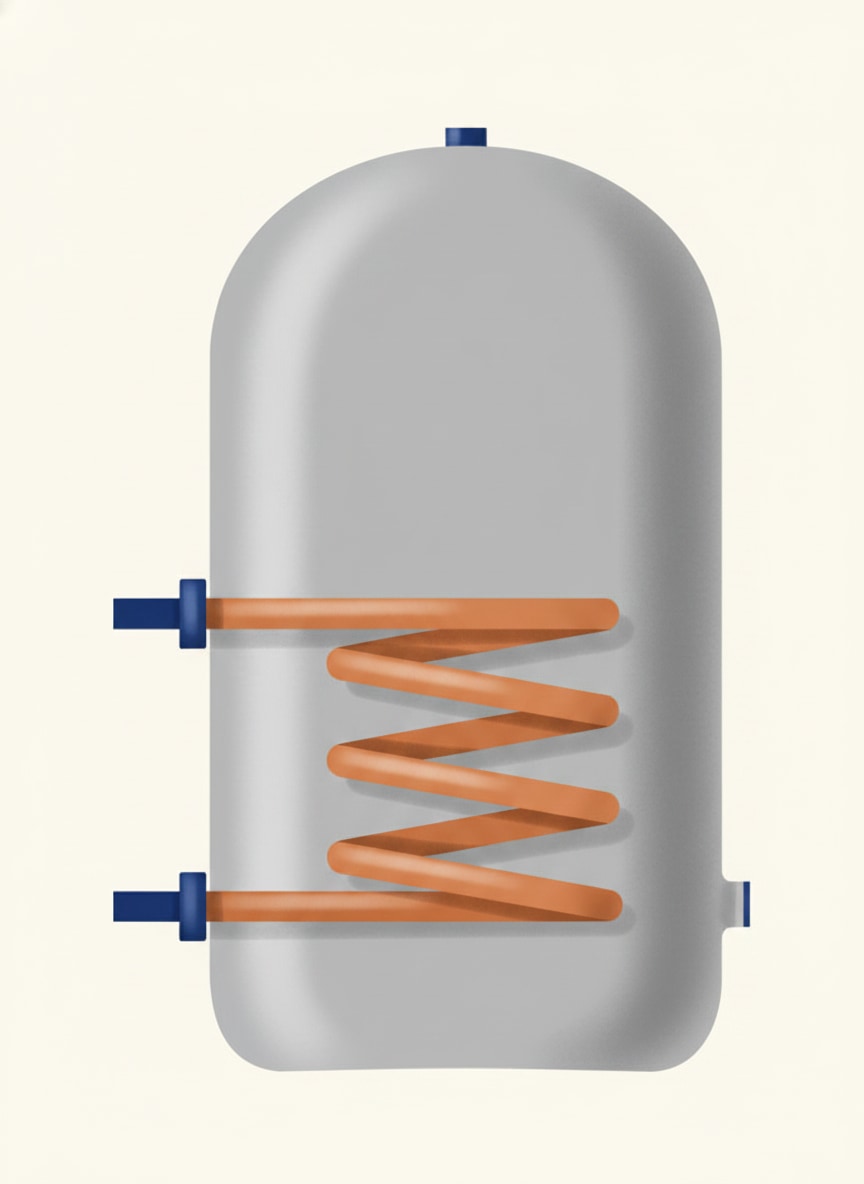
How it works: the primary water (from the boiler) flows through the coil. The secondary water (from the CWSC) surrounds the coil in the body of the cylinder. Heat transfers across the coil wall. The two waters never mix.
"Double feed" because there are two separate cisterns feeding the system: one for the primary side (F&E), one for the secondary side (CWSC).
When used: the standard open vented indirect system for properties with gravity hot water fed from a boiler. Very common in older UK properties.
Identification clue: visible coil inside the cylinder + two cisterns on the diagram (CWSC for secondary, F&E for primary).
3. Double feed indirect cylinder with annulus
What it looks like: similar to the coil version, but the heat exchanger is an annulus rather than a coil. On the diagram it appears as a cylinder-within-a-cylinder rather than a visible coil.
How it works: same principle as the coil — primary water on one side of the annulus wall, secondary water on the other, heat transfers through the wall.
When used: same applications as the coil version. Less common than coil versions but functionally equivalent.
Identification clue: cylindrical heat exchanger visible inside the cylinder (no coiled shape) + two cisterns on the diagram.
4. Single feed indirect cylinder
What it looks like: a cylinder with a specific internal heat exchanger, but only one cistern (the CWSC) feeds the system. No F&E cistern.
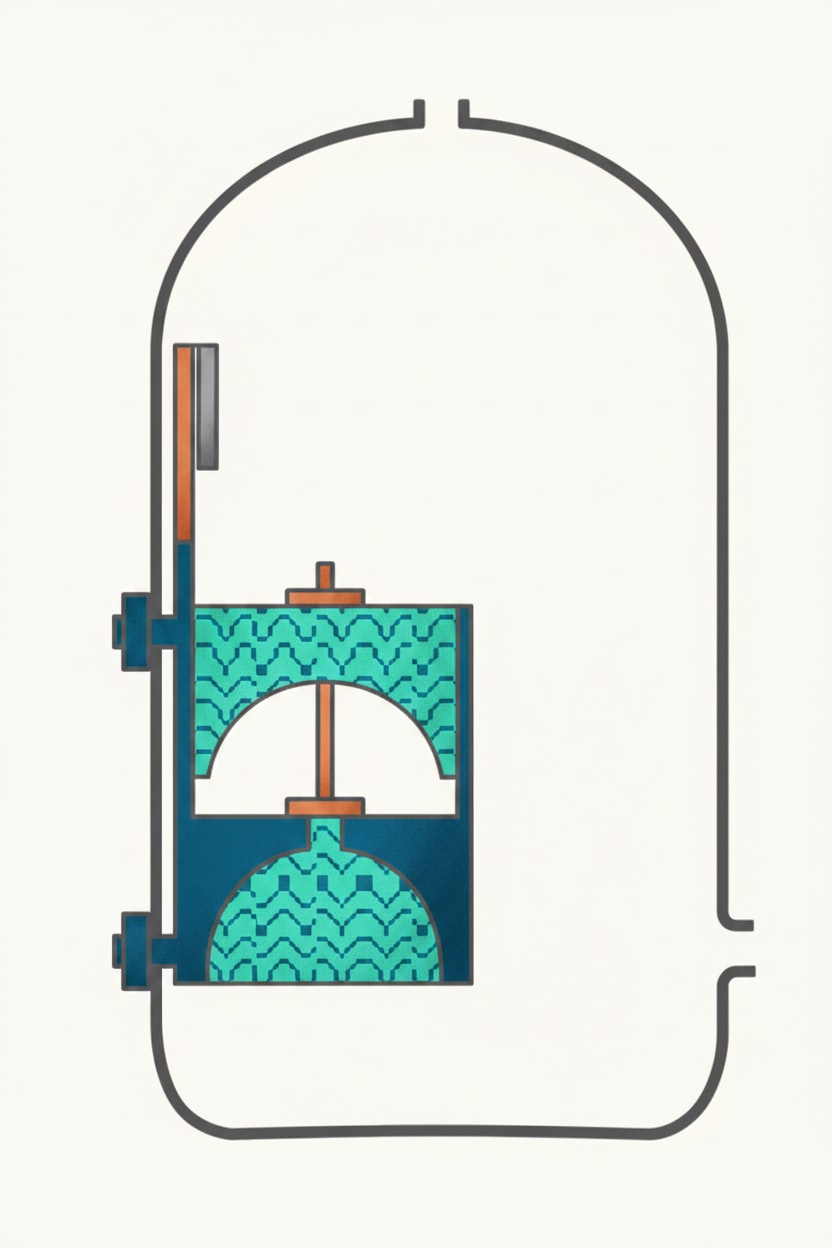
How it works: this is the clever one. The CWSC feeds both the primary and secondary sides of the system through the cylinder itself. When the system is first filled, water flows into both circuits from the same cistern. Then an air bubble forms in the heat exchanger inside the cylinder, keeping the primary and secondary waters separate thereafter.
Advantage: no F&E cistern needed (simpler installation, less loft space).
Disadvantage: the primary side's "vent" is effectively into the cylinder — if there's a fault, primary water can end up in the secondary cylinder water. For this reason, single feed indirect systems can't use any chemicals (like heating inhibitor) on the primary side, because those chemicals could end up in the drinking water.
How to identify a single feed indirect system on an installation: look at whether there's an F&E cistern connected to the primary circuit. If not, it's a single feed indirect.
Identification clue: indirect cylinder (heat exchanger visible) + only one cistern in the diagram.
5. Combination cylinder
What it looks like: a cylinder with the CWSC built into the top of the cylinder itself — no separate cistern in the loft.
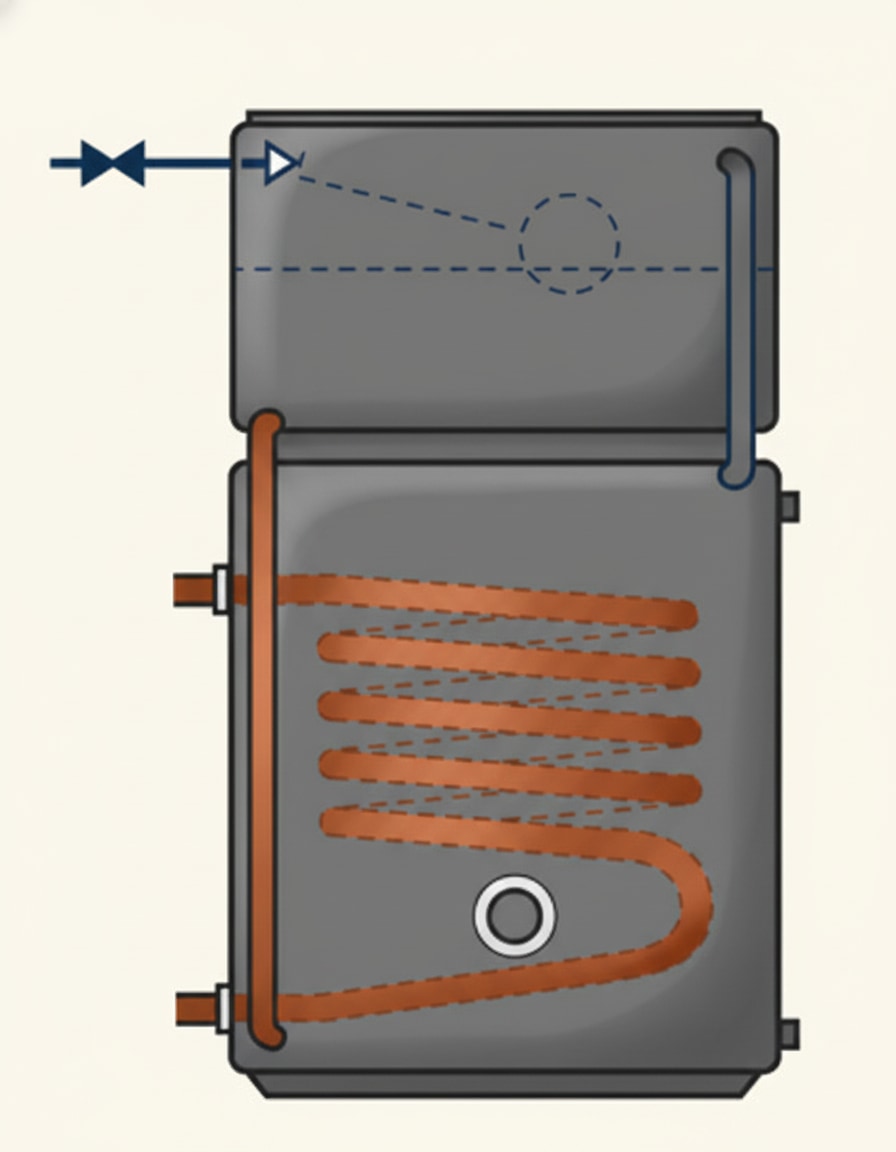
How it works: the "combined" name refers to the cistern and cylinder being combined into one unit. The CWSC sits on top; the cylinder sits below; they're manufactured as one piece.
Where it's used: rarely installed new. Typically seen in flats or small properties where loft space isn't available for a separate cistern.
Critical constraint: a combination cylinder must not be fitted lower than the highest outlet. Why? Because the CWSC is at the top of the cylinder — if the cylinder is below any hot tap, the CWSC would be below that tap too, and no gravity flow would happen.
Notorious for: low pressure at outlets. The CWSC sits on top of the cylinder, which is typically at appliance level (not high in the loft), so the gravity head is very small. On a single-storey property with a combination cylinder, pressure at all outlets will be low.
Identification clue: cistern built into the top of the cylinder body; no separate loft cistern.
6. Unvented cylinder
What it looks like: a stainless steel cylinder (typically) with an expansion vessel, temperature and pressure relief valve, and discharge pipe connected. No cistern feeding it — it's fed directly from the mains.
How it works: covered in detail in the unvented systems post. The key features:
- Fed from mains at high pressure
- Can be heated directly (immersion heater) OR indirectly (via coil)
- Expansion vessel takes up the volume expansion of heated water
- Temperature and pressure relief valve provides safety backup
- No CWSC needed
- Installer requires G3 qualification
When used: increasingly the modern standard, particularly in new builds where loft space is at a premium and high pressure at outlets is expected.
Identification clue: no cistern on the diagram; expansion vessel visible; T&P relief valve visible; discharge pipe visible.
Multi-coil cylinders
A variation worth knowing: cylinders with twin, triple, or quad coils — each coil connects to a different heat source.
Example use cases:
- Twin coil — gas boiler (main heat) + solar thermal (supplementary)
- Triple coil — gas boiler + solar thermal + heat pump
- Quad coil — as above plus an immersion heater for peak demand or backup
Multi-coil cylinders allow a single cylinder to accept heat from multiple sources, which is increasingly important for properties combining traditional and renewable heat sources. More detail on how heat sources combine is in the heat sources post.
Cylinder construction and insulation
Materials:
- Copper — traditional, good heat transfer, corrosion-resistant in most water
- Steel — cheaper, needs corrosion protection (glass-lined, sacrificial anode)
- Stainless steel — typical for unvented cylinders because it can handle mains pressure
Insulation:
- Cylinders can be bought pre-lagged (insulation sprayed-on at manufacture) or unlagged (no insulation, requires a separate jacket)
- All pipework going into and out of any hot water cylinder must be insulated for at least 1m (Part L of the Building Regulations)
Recovery time = time taken to reheat a quantity of used hot water:
- Modern cylinder average: around 30 minutes
- High-recovery cylinders: around 15 minutes (achieved with larger-surface-area coils or multiple coils)
Cylinder unions (connections)
How pipework connects to a cylinder:
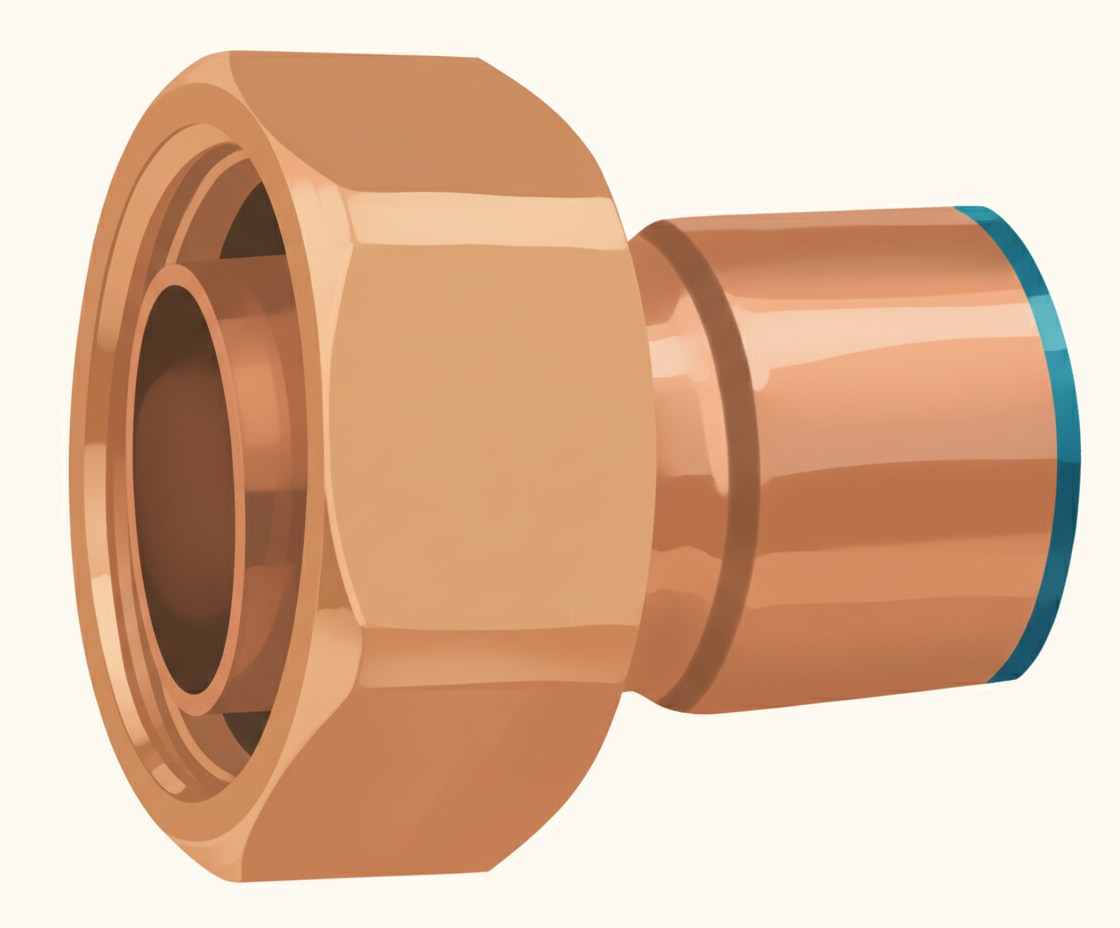
- Flow and return (primary circuit to/from boiler) — can use soldered or female-threaded compression fittings
- Cold feed and open vent (secondary side) — require male-threaded fittings connected to the cylinder's female threaded tappings
Common exam traps
Trap 1: Identifying single feed indirect. The test: does it have an F&E cistern? If yes → double feed indirect. If no (only a CWSC) but the cylinder is indirect → single feed indirect.
Trap 2: Combination cylinder pressure problem. Low pressure is inherent to the design because the CWSC is built into the top of the cylinder (low height = low gravity head). On a single-storey property this is particularly problematic.
Trap 3: Combination cylinder positioning. Must not be fitted lower than the highest outlet. If it's below an outlet, no gravity flow will occur at that outlet.
Trap 4: Direct cylinder heated by immersion = direct heating. Because the element is in the water. Don't overthink this one — an electric element sitting in water is as direct as heating gets.
Trap 5: Coil vs annulus. Same function (heat exchanger), different geometry. Both make a cylinder "indirect". Neither is universally preferred.
Trap 6: Unvented cylinder material. Typically stainless steel for strength under mains pressure. Copper or protected steel is possible but less common.
Trap 7: Pipe insulation 1m before and after cylinder. Building Regulations Part L. Not optional, not "where practical" — a legal requirement.
Quick revision summary
Before the mock test, seven things you need to be able to produce from memory:
- Six cylinder types: Direct (immersion or boiler), Double Feed Indirect with coil, Double Feed Indirect with annulus, Single Feed Indirect, Combination, Unvented
- Direct = no coil; indirect = coil or annulus present
- Single feed indirect has no F&E cistern — primary and secondary both fed from the CWSC, separated by an air bubble in the cylinder
- Combination cylinder has CWSC built into the top — must not be below highest outlet; notorious for low pressure
- Unvented cylinder is fed from mains — no cistern, expansion vessel, T&P relief valve, discharge pipe; typically stainless steel; G3 qualification to install
- Multi-coil cylinders (twin/triple/quad) for combining multiple heat sources
- All cylinder pipework insulated 1m before AND after the cylinder (Part L)
📝 10-Question Mock Test
Click an option to see whether you got it right. Explanations appear instantly — no submitting at the end.
Single feed systems have no F&E cistern — the primary side is fed from the CWSC through the cylinder. Double feed systems have a separate F&E cistern for the primary circuit. Options A (water company), B (soundness test), and C (flow rate) don't reveal the difference.
Combination cylinders have the CWSC built into the top of the cylinder, which is usually at appliance level rather than high in the loft. The gravity head is therefore very small — maybe 1–2 metres. On a single-storey property the outlets are at similar height to the CWSC, giving almost no gravity pressure. Options A, C and D aren't consequences of the combination design.
Coil visible = indirect. Two cisterns (CWSC + F&E) = double feed. So: double feed indirect cylinder with coil. Combination (A) has CWSC in the top. Direct (B) has no coil. Single feed indirect (D) has only one cistern.
The coil (or annulus) is what makes a cylinder "indirect" — it's the heat exchanger between the primary and secondary waters. Sacrificial anodes (A) exist in some cylinders for corrosion protection regardless of type. Vent pipework (B) is about open vs sealed, not direct vs indirect. Expansion vessels (D) are on sealed systems.
Single feed indirect relies on an air bubble to keep primary and secondary waters separate — if the bubble is disturbed, primary water can enter the secondary cylinder water. Because that secondary water will end up at the taps (and possibly be drunk), the primary side can't contain anything harmful like corrosion inhibitor. Options A, C and D don't describe specific single feed disadvantages.
Unvented cylinders operate at mains pressure, which requires significant strength. Stainless steel is the typical modern material — strong enough for the pressure, resistant to corrosion. Copper (A) is used occasionally but less common. Galvanised steel (B) corrodes in hot water. Plastic (D) couldn't handle the pressure or temperature.
Building Regulations Part L requires 1m insulation either side of the cylinder. This is not optional and is a legal minimum. Lower figures would allow too much heat loss through uninsulated pipe runs.
The "combined" name refers to cistern and cylinder being manufactured as one unit. Options A, C and D describe things combination cylinders aren't or don't include.
The CWSC in a combination cylinder is at the top of the cylinder body. If the cylinder is below the highest outlet, the CWSC is also below that outlet — water can't flow upwards from a CWSC below the tap. Gravity requires the cistern to be above the outlet. Options A, C and D don't describe this constraint.
Each coil connects to a different heat source. A cylinder with two coils can be heated by both a gas boiler and a solar thermal system, for example. Triple coils add an immersion heater or another source; quad coils add yet another. Options A, B and D aren't designed for multiple heat sources.
How PlumbMate puts this into practice
Cylinder identification is a classic diagram-recognition skill. Spaced repetition on labelled cylinder images is the fastest way to build fluency.
- Flashcards, not essays. One prompt, one answer — the format that research has consistently shown works best for active recall.
- Wrong answers are logged. Every question you get wrong goes into a dedicated collection that resurfaces more frequently in future sessions.
- The 3× rule. You need to get a question right three times before it clears — one lucky guess isn't enough.
- Explanations on every question. Like the ones above, but on every single question in the app.