Hot water systems have two jobs: deliver hot water where it's needed, and do it safely. Temperature control keeps the water hot enough to be useful and kill bacteria but cool enough not to scald. Secondary circulation keeps hot water available at distant outlets without a long wait. Commissioning confirms the system works before handover, and maintenance keeps it working over its lifetime. This post covers all four areas.
This is the sixth and final deep-dive in the Level 2 hot water sub-cluster. For the others, see the classifications, cylinder types, open vented systems, unvented systems and heat sources posts.
Why temperature control matters
Hot water systems face two competing temperature requirements:
- Hot enough to kill Legionella and other bacteria — 60°C minimum stored water
- Cool enough not to scald people using the outlets — 43°C maximum at bathing appliance outlets (TMV3 standard)
60°C water can cause third-degree burns in seconds. 43°C water is safe for bathing but warm enough to be useful. The gap between them — storage at 60°C+, outlet at 43°C — is bridged by thermostatic mixing valves.
Why 60°C, and not 55
Legionella multiplies between 20°C and 45°C. That is the figure to remember and the one you will be asked for. But the bacteria do not simply stop at 45°C and sit there quietly — above about 50°C they start to die, and how fast they die changes dramatically over the next twenty degrees.
| Water temperature | What happens to Legionella |
|---|---|
| Below 20°C | Dormant — survives, but does not multiply |
| 20–45°C | Multiplies — the danger zone |
| 45–50°C | Survives, but stops multiplying |
| Above 50°C | Begins to die, slowly |
| 55°C | Around 90% killed in 20–30 minutes |
| 60°C | Around 90% killed in about 2 minutes |
| 70°C and above | Effectively instant — the disinfection range |
The times are approximate and are given as ranges in the guidance. What is dependable is the shape of it: slow at 50°C, fast at 60°C, instant at 70°C.
You will also see it written that "at 60°C Legionella is dead within 32 minutes", and both figures are correct. The two-minute figure is a 90% kill — nine out of ten bacteria gone. The 32-minute figure is what it takes to be confident of a complete kill. Same curve, measured at two different points, so do not treat them as a contradiction: at 60°C most of the bacteria die within a couple of minutes and the stragglers are gone well inside half an hour.
Read that table and the three temperatures you have to memorise stop being three unrelated facts and become a single argument:
- Store at 60°C — because that is where the kill time falls from half an hour to a couple of minutes.
- Distribute so outlets reach 50°C within a minute — above the growth band, so the pipework itself never becomes somewhere the bacteria can breed. BS 8558:2015 puts it exactly like that: the temperature at an outlet, and the supply to any TMV, should be at least 50°C within 1 minute of running the water.
- Blend down to 43°C at bathing outlets — because water at storage temperature scalds in seconds.
Where does 55°C come from, then?
You will meet 55°C often enough to wonder, and it is a real figure — it just belongs to healthcare. On a secondary circulation loop, the water leaves the cylinder at least 60°C and comes back at 50°C or more (HSE HSG274 Part 2 and BS 8558:2015 — guidance, not regulation). In healthcare premises both figures rise to 55°C: under HTM 04-01 the return comes back at 55°C and the outlets reach 55°C within a minute rather than 50°C.
You will also see CIBSE quote 55°C at the end of each return leg as a commissioning target, with 50°C as the absolute minimum. None of these is the general domestic figure, which is 50°C within a minute at the outlets and 50°C or more back on a return.
While you are in that clause, BS 8558 sets the cold side too: cold water should not be warmed above 25°C (ideally 20°C), and should be below 20°C after running for up to 2 minutes.
It also explains why 55°C is the wrong answer to "what temperature should stored water be". It is not that 55°C does nothing. It is that 55°C takes half an hour to do what 60°C does in two minutes — and stored water is not guaranteed to sit undisturbed for half an hour.
TMVs (Thermostatic Mixing Valves)
A TMV blends hot water from the cylinder with cold water from the mains or cistern to deliver a controlled outlet temperature.
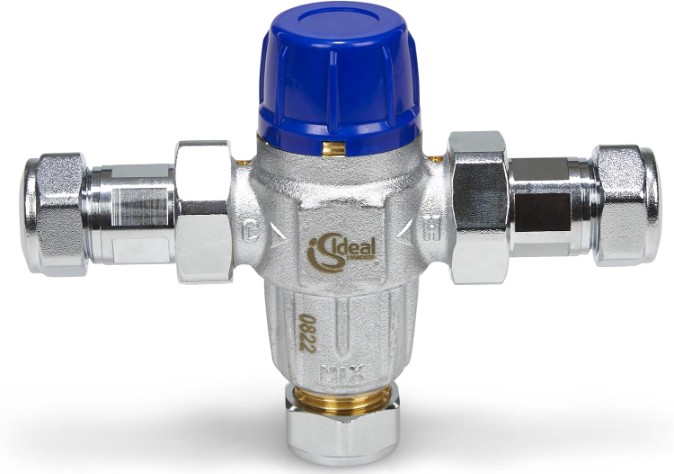
How it works: a thermostatic element inside the valve senses the blended water temperature. If the output temperature is too hot, the element expands and closes off the hot water inlet proportionally. If too cool, it contracts and opens the hot inlet. The result: consistent blended output temperature regardless of variations in the hot and cold supplies.
TMV standards:
- TMV3 — the higher standard, required in healthcare settings and for outlets used by at-risk users (young children, elderly, disabled). 43°C maximum at outlets.
- TMV2 — the domestic standard. Same general approach but lower testing requirements.
Where TMVs are required:
- Bathroom outlets used by vulnerable users (healthcare, care homes, school nurseries)
- All bathing outlets in new builds — specifically baths and showers
- WHBs with mixer taps — not strictly required but good practice
TMV installation rules
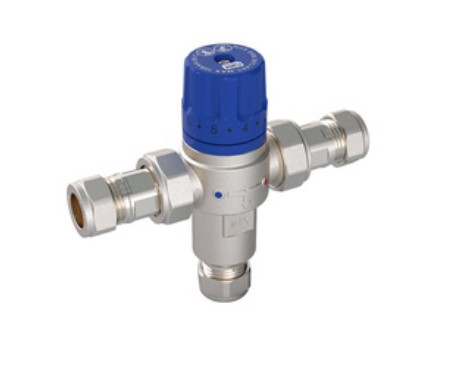
Three specific rules worth locking in:
1. Balanced supply. The hot and cold pressures must match. Otherwise:
- Mains-fed cold + gravity-fed hot → mixer delivers mostly cold water
- Gravity cold + mains hot → mixer delivers mostly hot water
Balanced supply means both hot and cold from the same pressure source — both from mains (combi or unvented) or both from the cistern (open vented indirect).
2. Single check valves when fed from mains. A TMV fed from mains pressure must have single check valves on both the hot and cold supplies. Why?
- Hot and cold come from the same mains, but the hot has passed through a cylinder or heat exchanger
- If pressures vary, cold could push back into the hot side, or hot could push back into the cold — either way, cross-contamination
- Single check valves prevent the reverse flow
3. Fit as close as possible to the outlet. Any pipework between the TMV and the tap is a dead leg containing warm water — ideal conditions for bacterial growth. Short runs from valve to outlet minimise this risk.
The distance rule: pipe from TMV outlet to tap should be as short as possible. Not "under 12m", not "over 12m" — as short as possible. The course material's specific phrasing.
Scalding prevention
Temperature thresholds worth memorising:
| Temperature | Effect |
|---|---|
| 43°C | Safe bathing temperature (TMV3 maximum) |
| 48°C | Pain threshold for most adults |
| 55°C | Third-degree burns in ~30 seconds |
| 60°C | Third-degree burns in ~5 seconds (Legionella kill temp) |
| 65°C | Limescale formation in temporary hard water |
| 70°C+ | Third-degree burns in under 1 second |
The 43°C maximum at bathing outlets isn't just a design preference — it's a genuine safety standard because of how quickly burns form at higher temperatures.
43°C, 48°C, 41°C — three numbers, and the exam picks between them
These get muddled constantly, because they answer different questions.
- 48°C is the legal maximum. Building Regulations Approved Document G3 requires that the hot water supplied to a bath does not exceed 48°C, and that a bath in a new or refurbished property is fitted with a TMV to guarantee it. This is the number most likely to be asked for, because it is the one written into the Regulations.
- 43°C is the recommended maximum for bathing outlets under TMV3 — the design figure you work to, comfortably under the legal ceiling. In practice a bath TMV is set no higher than 48°C, and 43°C or a little below is better.
- 41°C for the vulnerable. In care homes, residential care and other medical facilities, NHS guidance brings showers down to a maximum of 41°C, because the people using them are slower to react to hot water and their skin burns at lower temperatures.
The order to remember: 48 is the law, 43 is the design figure, 41 is for people at risk. If a question asks what the hot water to a bath must not exceed, the answer is 48°C.
Secondary circulation
For properties with long pipe runs from the cylinder to distant outlets, there's a problem: water in the pipe sits cooling between uses. The first draw-off from a distant tap is cold until the stale water has run through. This wastes water, wastes energy, and grows bacteria (dead leg risk).
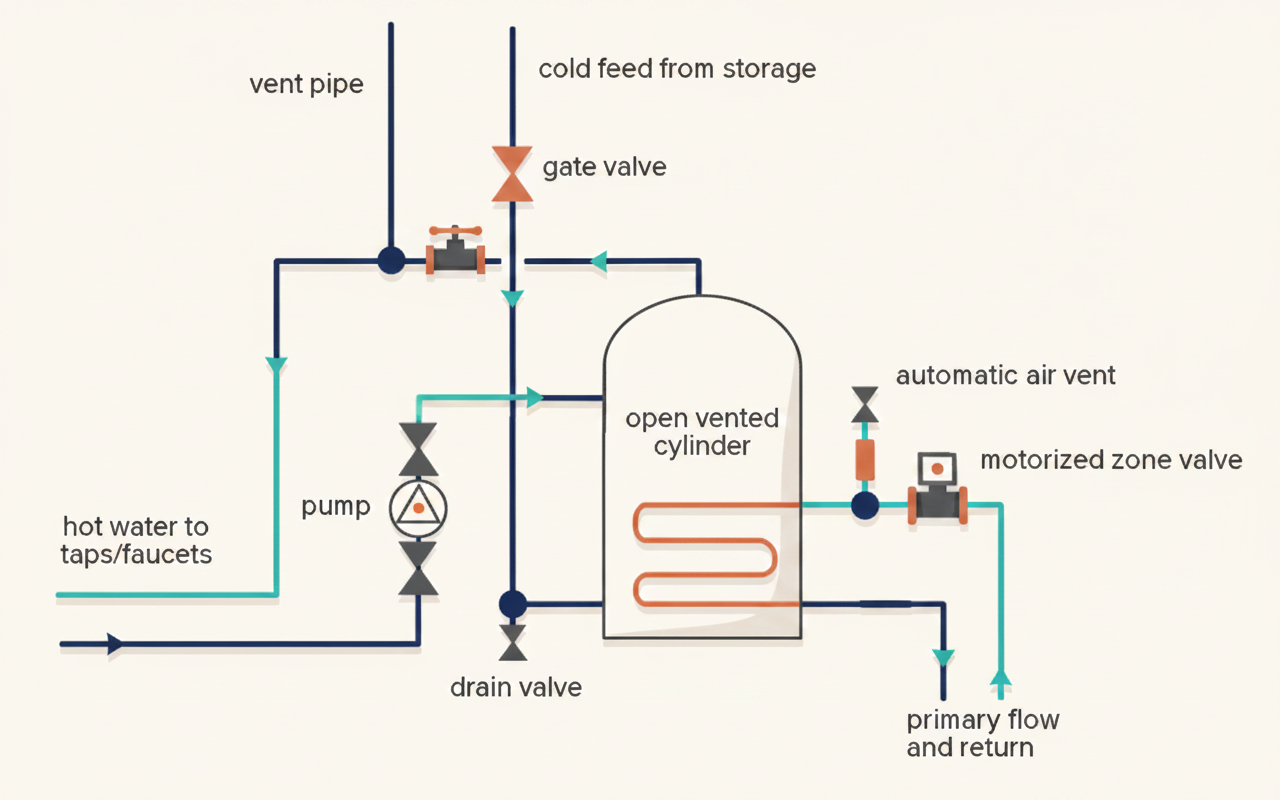
Secondary circulation solves this by continuously circulating hot water through a ring main that runs close to every draw-off.
How it's built:
- A pipe leaves the top of the cylinder and runs past every hot water outlet in turn
- At the furthest point, the pipe loops back and returns to the cylinder
- A pump on the return leg drives the circulation continuously
- Hot water is always present at every outlet
Pump requirements:
- Material: bronze or stainless steel — must be non-corrosive because it's in constant contact with hot water containing oxygen
- NOT low carbon steel, cast iron, aluminium, or brass — all corrode in hot water over time
- Position: on the return leg, facing INTO the cylinder (pumping water back TO the cylinder)
- Cylinder connection: the secondary return enters the cylinder in the top 1/3 — typically through a purpose-made connection or flange — so returning warm water rejoins the warm stratified layer, not the cold bottom
Dead legs and trace heating
A dead leg is a section of hot water pipework that doesn't get regular flow — water sits in it between uses, cooling down and providing ideal conditions for bacterial growth.
The core rule: dead legs should be as short as possible. Level 2 exam questions test this directly — students who see "within 5m" or "within 10m" as answers should pick "as short as possible" every time.
Solutions for long dead legs:
- Install secondary circulation — turns the dead leg into an active circuit (covered above)
- Install trace heating — an electric heating cable wrapped around the pipe that keeps the water warm without needing flow
Trace heating uses electricity to keep pipework warm. It's controlled by a thermostat so it only energises when the pipe temperature drops below a set threshold. Less effective than secondary circulation for large systems but useful for individual remote outlets where installing a secondary circuit isn't practical.
Commissioning — the five stages
Same structure as cold water commissioning, because the Water Regulations specify the same sequence:
- Visual Inspection
- Soundness Testing
- Flushing and Disinfecting
- Performance Testing
- Final Checks and Handing Over
Each stage completes before the next starts. Skipping ahead causes problems.
Visual inspection — before filling, check:
- Pipework supported with clips at correct centres (covered in the processes material)
- No damage to pipework, cylinder, or components
- No open ends
- Correct valve types on correct pipe sections (stop valves on supply; gate valves on distribution; service valves on appliance connections)
- Pipework insulation fitted (1m before and after cylinder under Part L)
Soundness testing — same procedures as cold water:
- Rigid pipe: fill with wholesome water, 30 min stabilisation, 1.5× working pressure for 1 hour
- Plastic pipe Test A: 1 bar/45 min → 1.5× working pressure/15 min → 1/3 working pressure/45 min
- Plastic pipe Test B: 1.5× working pressure/30 min top-up → 30 min observation (0.6 bar tolerance) → 120 min observation (0.2 bar tolerance)
Flushing and disinfecting — for hot water specifically:
- Domestic: flush with wholesome water until it runs clear; run every outlet
- Commercial/healthcare/large installations: chlorine disinfection is often required; follow COSHH procedures; inform water undertaker before discharging disinfected water to sewers
Performance testing — for hot water:
- Pressure at each outlet (pressure gauge)
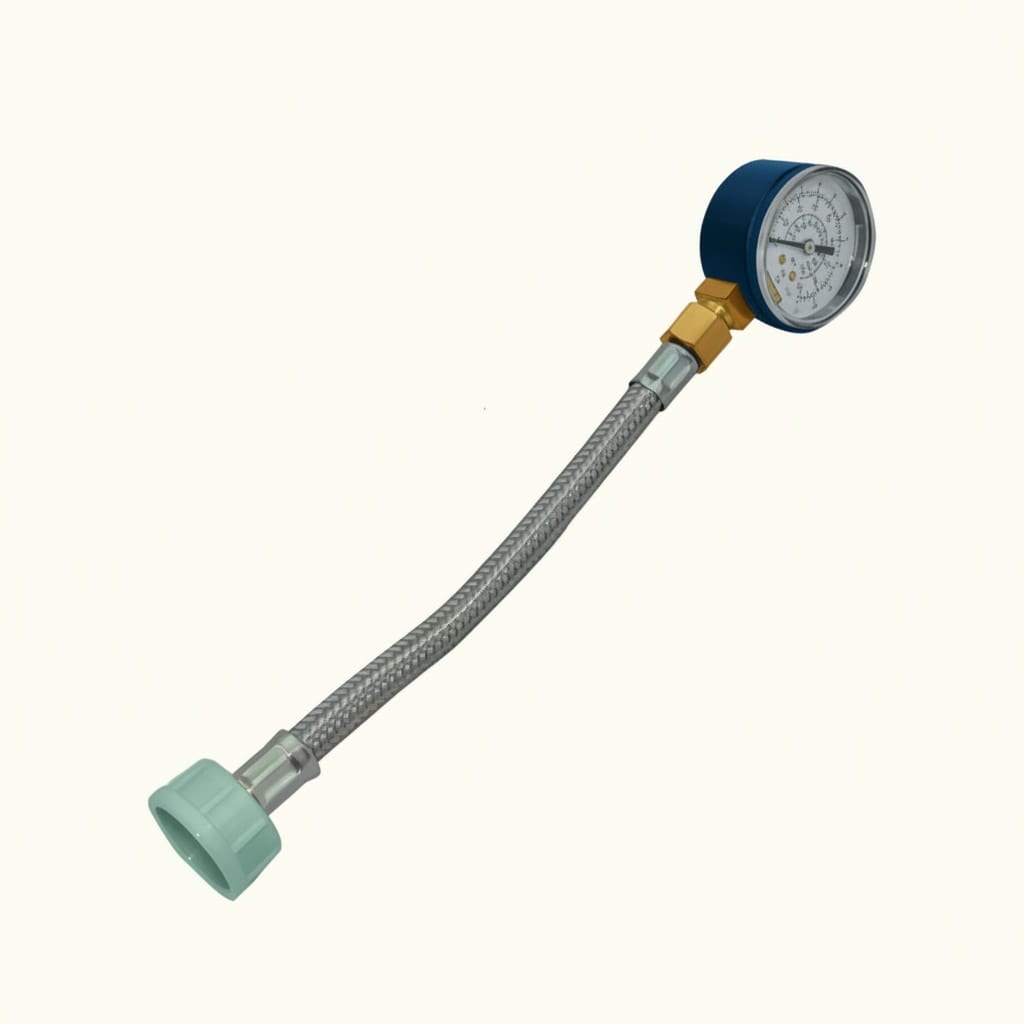
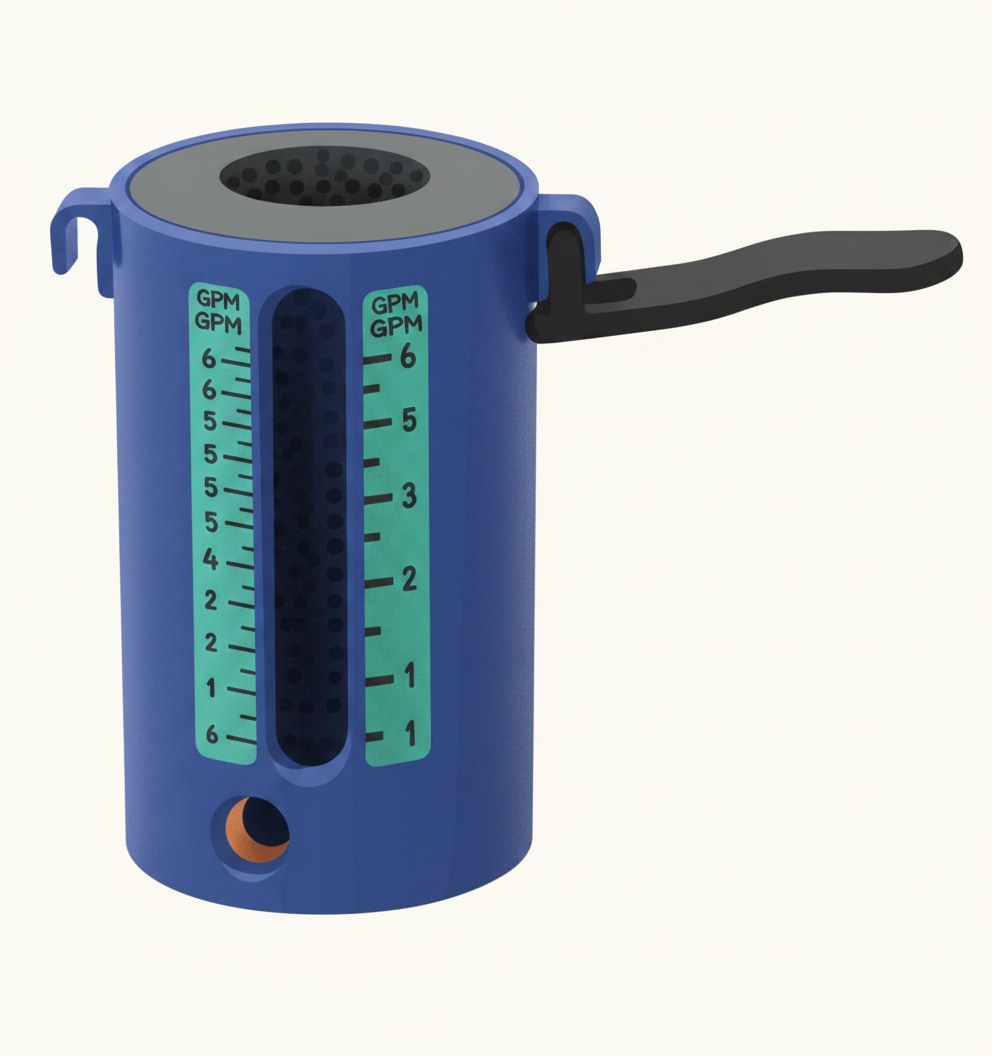
- Flow rate at each outlet (Weir cup)
- Outlet temperature — particularly at TMV outlets, verify the blended water is at the correct set point and doesn't exceed the safety maximum
- Recovery time — time to reheat cylinder after a full draw-off
Final checks and handover:
- Hand over installation certificates, manufacturer documentation, warranty information
- Explain how the system works — location of stop valves, how to isolate appliances, what to do if a problem occurs
- For unvented systems: explain the tundish and what it means if water is visible there (T&P relief has operated — system needs professional attention)
Unvented cylinder commissioning specifics
Unvented cylinders have additional commissioning requirements beyond the standard soundness and flushing:
- Check the expansion vessel charge pressure — the gas side should be pre-charged to slightly below the system's working pressure
- Operate the T&P relief valve manually — confirm it opens, discharges freely, and re-seats. If it doesn't, the valve needs replacement before commissioning can complete.
- Confirm the discharge pipe route — discharges to a safe visible location, falls continuously, no valves
- Test the high-limit (overheat) thermostat — confirm it trips the heat source if it's activated
- Annual service required — legally, unvented cylinders need annual service by a G3-qualified engineer. This is part of the handover — tell the customer when the next service is due.
Fault finding
Common hot water faults and their causes:
No hot water at all:
- Heat source problem — boiler fault, immersion element failed, gas supply off
- Thermostat fault — cylinder thermostat stuck or failed
- Air lock in pipework — particularly common on open vented systems if pipework doesn't slope correctly
Hot water at some outlets but not others:
- Airlock on a specific branch
- Valve closed somewhere in the system
- Dead leg that's cooled but there's no circulation/trace heating to keep it warm
Reduced flow rate at a shower fed through a TMV:
- Strainer on the TMV inlet blocked (most common cause)
- Check valves sticking
- Limescale in the shower rose
- Thermostatic cartridge in the TMV needs replacement
Water not hot enough:
- Cylinder thermostat set too low
- Boiler not reaching target temperature
- Dead leg cooling the water before it reaches the outlet
- Scaling on heating elements reducing heat transfer efficiency
Systematic fault finding: visually inspect, read the manufacturer's manual (most are available online), ask the customer about history of the fault (when started, recent work done, pattern of occurrence), and eliminate possibilities one by one.
Maintenance
Ongoing care for hot water systems:
Annual visual inspections: leaks, loose pipework, insulation integrity, safety valve discharge visibility, bonding integrity on metal pipework.
Annual tasks (or as scheduled):
- Immersion heater — replace anode if cylinder has one; test element resistance; replace thermostat if faulty
- TMVs — clean the strainer; replace thermostatic cartridge if performance is compromised
- Unvented cylinders — full annual service by G3 engineer
- Combi boilers — annual service by Gas Safe engineer
Planned preventative maintenance — components replaced before they fail, scheduled via a maintenance schedule, logged on a maintenance record. More common on large or commercial installations.
Decommissioning
Same principles as other clusters:
- Temporary decommissioning: inform anyone affected; provide alternative hot water source if needed for elderly or vulnerable customers
- Permanent decommissioning: remove appliance, trap (if applicable), and associated pipework back to the branch. Don't leave a dead leg.
- Open-ended pipework on live systems: seal with stop ends — not tape, plugs, or crimping
Common exam traps
Trap 1: Dead legs — "as short as possible". Not "within 12m", not "under 5m". The course material's answer is as short as possible.
Trap 2: Secondary return pump material. Bronze or stainless steel (non-corrosive). Not low carbon steel, not cast iron, not brass, not aluminium.
Trap 3: Secondary return into top 1/3 of cylinder. Through a purpose-made connection or flange. Returns warm water to the warm stratified layer.
Trap 4: TMV fed from mains = single check valves on both hot and cold. Not double check — single. One on each supply.
Trap 5: TMV close to outlet. As short as possible — minimises the dead leg between TMV and tap.
Trap 6: Unvented cylinders need annual service. G3 qualification required to carry out the service.
Trap 7: Maintenance record vs maintenance schedule. Schedule = the plan of what's to be done. Record = the log of what has been done.
Quick revision summary
Before the mock test, eight things you need to be able to produce from memory:
- Storage temperatures: 60°C minimum (Legionella kill), 65°C maximum (limescale threshold)
- Outlet temperatures: 48°C legal maximum to a bath (Building Regs Part G3, TMV required); 43°C recommended maximum at bathing outlets (TMV3, normally set 41–43°C); 41°C maximum for showers in care homes and medical facilities
- Why 60°C and not 55°C: speed of kill — 55°C takes 20–30 minutes, 60°C takes about 2 minutes, 70°C is near instant. Growth band stays 20–45°C
- TMV balanced supply — hot and cold from same pressure source
- Mains-fed TMV: single check valves on BOTH hot and cold
- TMV as close as possible to outlet — minimises dead leg
- Dead legs as short as possible — Legionella risk; fix with secondary circulation or trace heating
- Secondary circulation pump: bronze or stainless steel; enters top 1/3 of cylinder
- Five commissioning stages: Visual → Soundness → Flushing → Performance → Handover
- Unvented cylinders need annual G3 service
📝 10-Question Mock Test
Click an option to see whether you got it right. Explanations appear instantly — no submitting at the end.
TMV3 standard — 43°C maximum at bathing outlets to prevent scalding in vulnerable users. 38°C (A) is safe but often too cool; 55°C (C) is actively dangerous for bathing; 60°C (D) is the storage temperature, not the outlet.
Mains-fed TMVs need single check valves on both the hot and cold supplies — two single checks, not a double check. Prevents cross-contamination when pressures vary.
The course material's specific answer. Long runs between TMV and tap create dead legs of warm water — ideal conditions for bacterial growth. "Under 12m" (B) and "within 130mm" (C) sound plausible but aren't the Water Regs answer; "over 12m" (A) is the wrong direction entirely.
The upper storage limit. Above 65°C, calcium carbonate precipitates out in temporary hard water areas, forming limescale on heating elements and pipework. Below 60°C, Legionella survives. The 60–65°C window is the operating sweet spot.
Converts a dead leg into an active circuit by continuously pumping hot water through it. More powerful circulator (B), bigger cylinder (C), and hotter thermostat (D) don't address the fundamental dead leg issue — they just push the problem around.
Non-corrosive material required for constant contact with hot water containing dissolved oxygen. Stainless steel is also acceptable. Low carbon steel (A), aluminium (C), and cast iron (D) all corrode in hot water over time and would fail prematurely.
The primary concern with dead legs is bacterial growth (Legionella) in stagnant warm water. Water wastage (running the tap until hot water arrives) is a secondary concern. Scalding (A), corrosion (B), and cylinder lifespan (C) aren't the primary dead leg issues.
An electric cable wrapped around the pipework keeps the water warm without needing flow. Alternative to secondary circulation. Options A and D don't describe real techniques; B (increasing pipe size) actually makes the problem worse (more water to sit stagnant).
Fitting is installation — commissioning happens after installation, to verify the system works. The other three (soundness testing, visual inspection, flushing) are all genuine commissioning stages.
The tundish is an air break where discharged water is visibly routed before going to drain. If you see water there, the T&P relief has discharged, meaning the cylinder has overheated or overpressurised. The cause needs identifying and fixing — this isn't normal operation.
How PlumbMate puts this into practice
Temperature control and commissioning content is heavy on specific figures and procedures — ideal spaced-repetition material.
- Flashcards, not essays. One prompt, one answer — the format that research has consistently shown works best for active recall.
- Wrong answers are logged. Every question you get wrong goes into a dedicated collection that resurfaces more frequently in future sessions.
- The 3× rule. You need to get a question right three times before it clears — one lucky guess isn't enough.
- Explanations on every question. Like the ones above, but on every single question in the app.