The first trap students fall into when learning hot water is trying to memorise every possible system as a distinct thing — combi boiler, open vented cylinder, unvented cylinder, multipoint, electric shower, immersion-heated cylinder, and so on. In reality, every hot water system in the UK is built from the same four design choices. Once you understand the choices, you can identify any system you'll ever meet from a diagram — including ones you've never seen before.
This post is the first in the Level 2 hot water sub-cluster. For the others, see the cylinder types, open vented systems, unvented systems, heat sources and temperature control posts.
Four classification axes
Every hot water system is defined by four independent choices. Each choice has two options, which means there are up to 16 possible combinations — but some combinations don't exist in practice, and learning which ones do cuts the memorisation work dramatically.
Axis 1: Storage or instantaneous. Does the system store heated water for later use, or heat water on demand as it's needed?
Axis 2: Centralised or localised. Does a single system feed multiple outlets across the property, or does each outlet have its own dedicated heater?
Axis 3: Open vented or unvented (sealed). Is the system open to atmospheric pressure through a cistern, or sealed and fed at mains pressure?
Axis 4: Direct or indirect. Is the heat source in direct contact with the water being used, or is there a heat exchanger between the heat source and the hot water?
A combi boiler, to take one example, is: instantaneous + centralised + sealed + direct. That single description tells you it has no storage, it feeds the whole property, it's fed from mains, and the heat exchanger heats the actual hot water rather than a primary circuit.
Storage vs instantaneous
Storage systems heat a large volume of water in advance (typically in a cylinder) and keep it hot, ready for use. Hot water cylinders are the classic UK storage system. The water sits there at 60–65°C until a tap is turned on.
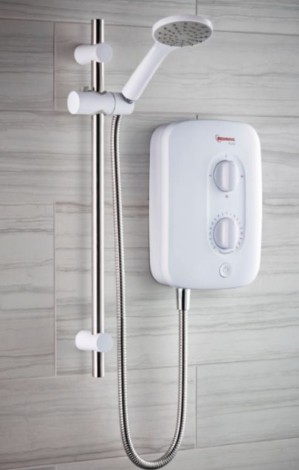
Instantaneous systems heat water as it flows through the appliance, on demand, with no reservoir. Combi boilers, electric showers, and undersink water heaters are all instantaneous.
The trade-offs:
- Storage — cheaper to run in the short term (heat water once, draw off multiple times), but water sits in the cylinder using energy to stay hot; takes up space; Legionella risk from stored water; needs a cold water storage cistern (if open vented).
- Instantaneous — no stored hot water means minimal Legionella risk; no cylinder space required; only heats what's needed; but requires high instantaneous power (combi boilers are typically 24–35kW); flow rate can be limited because heating happens in real time.
A key rule from the course material: instantaneous systems can only be sealed (no cistern in the circuit) and can only be direct (no time for heat transfer through a secondary exchanger). Storage systems can be any combination of the other axes.
Centralised vs localised
Centralised systems have a single hot water source that feeds multiple outlets across the property via a pipework network. A combi boiler serving the whole house is centralised. A cylinder in the airing cupboard feeding the bathroom, kitchen, and WHB is centralised.
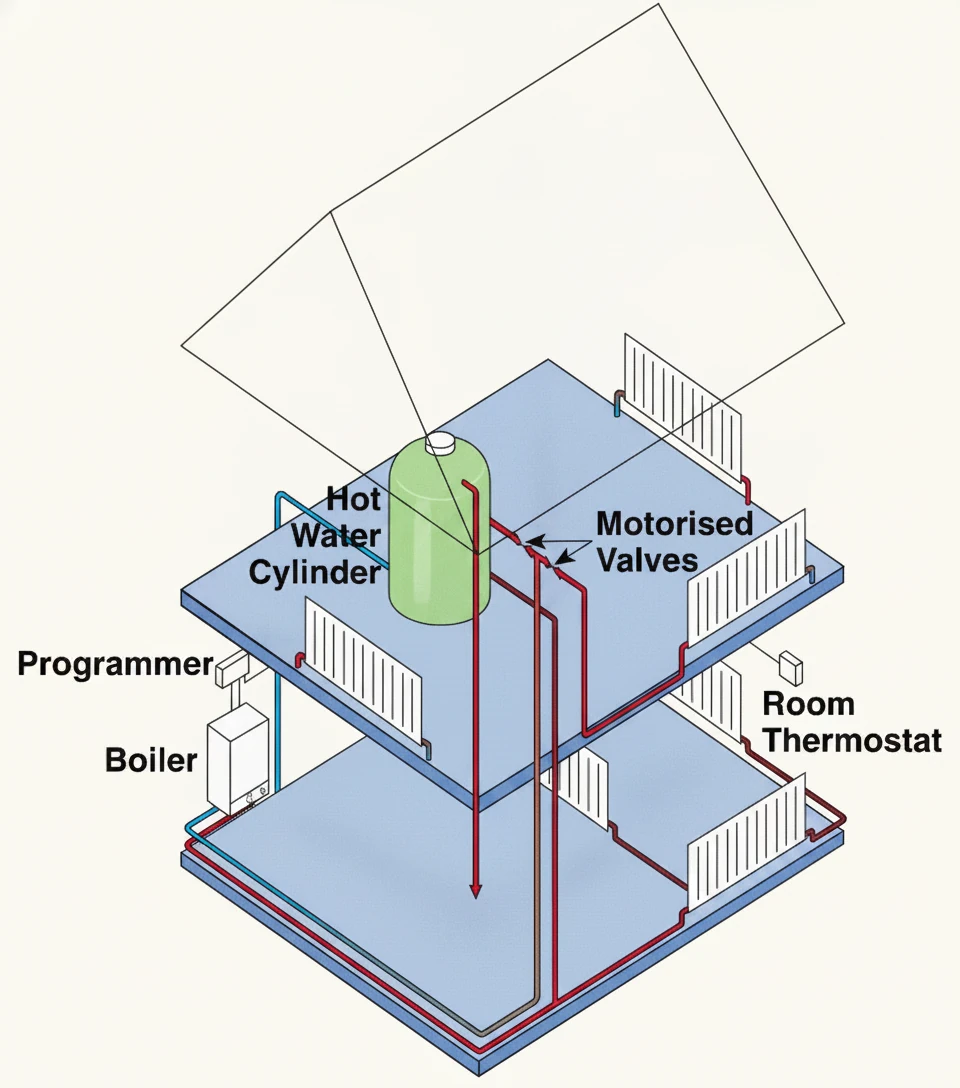
Localised systems put a dedicated heater at each outlet or at a small group of outlets. An electric shower is localised (it heats water for that shower only). An undersink water heater serving a remote sink in a garage or outbuilding is localised. A multipoint water heater serving a small group of outlets in a flat is also localised.
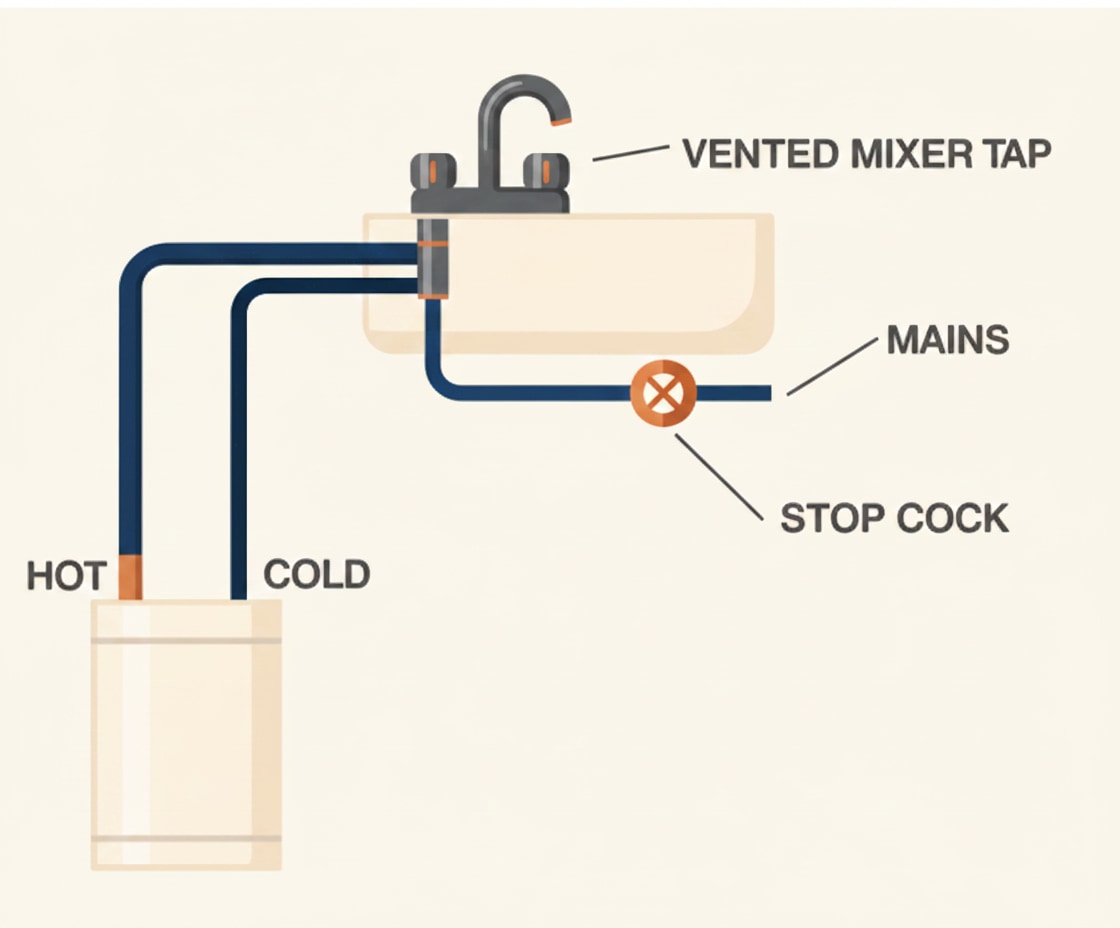
When to use which:
- Centralised is the standard for whole-house hot water — simpler plumbing overall, single maintenance point
- Localised is used when an outlet is far from the centralised system (avoiding long dead legs), in buildings where centralised hot water isn't practical, or for temporary accommodation
Open vented vs unvented (sealed)
Open vented systems are open to the atmosphere, typically fed from a cold water storage cistern (CWSC) in the loft. The cistern sets the pressure on the system by height (gravity) — one metre of height gives roughly 0.1 bar of pressure. Because the system is open, any heated water can expand up the vent pipe back into the cistern without causing a pressure problem.
Unvented (sealed) systems are sealed from the atmosphere and fed at mains pressure. Because the system is sealed, expansion of heated water has to go somewhere — that's what the expansion vessel is for. And because the pressure is mains pressure, the system is much more capable of delivering strong flows through smaller pipework.
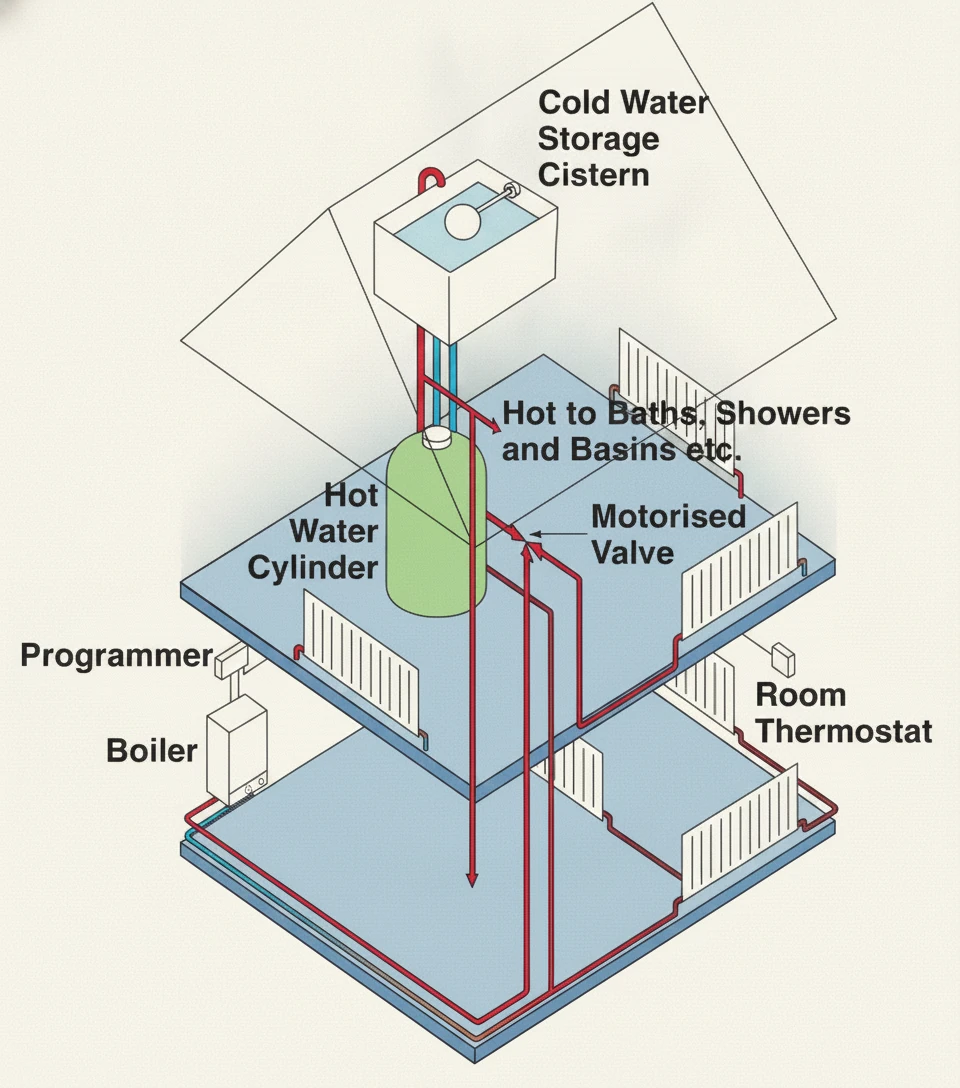
The trade-offs:
- Open vented — proven technology, simple to maintain, cheap to install; but needs loft space, gives low pressure (typical domestic head 2–5m = 0.2–0.5 bar), needs large-bore pipework to deliver acceptable flow rates
- Unvented — high pressure throughout the property, smaller pipework feasible, no loft cistern required; but needs safety components (expansion vessel, T&P relief valve, discharge pipe), installer needs G3 qualification, annual service recommended
Important rule: instantaneous systems can only be sealed. There's no cistern in an instantaneous system because there's nothing to feed by gravity. Combi boilers and electric showers are always sealed.
Direct vs indirect
Direct heating means the heat source is in direct contact with the water you're going to use. An immersion heater in a cylinder (the element sits in the hot water), a combi boiler's heat exchanger (mains water flows directly across the flame-heated metal), or an undersink heater all heat the water directly.
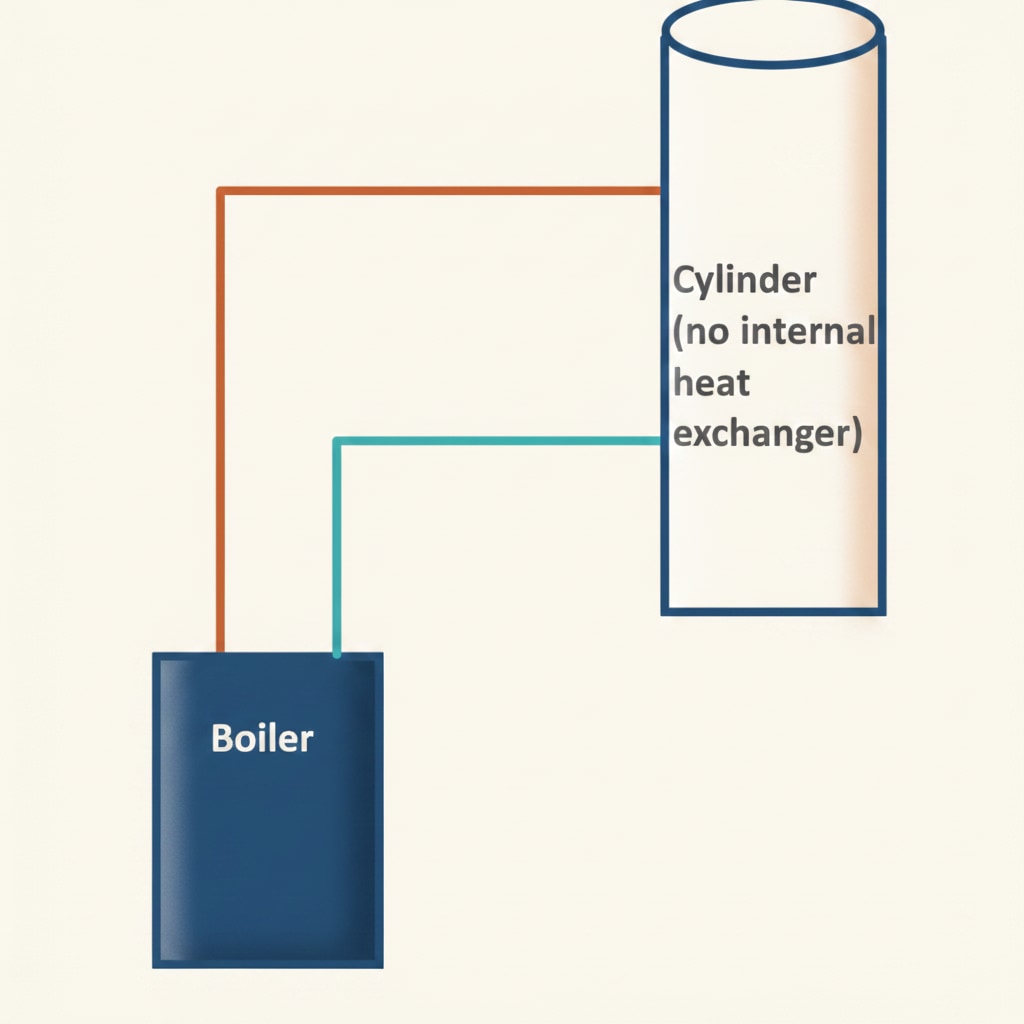
Indirect heating uses a secondary heat exchanger. Water is heated in the boiler (primary circuit), then flows to a cylinder where it transfers heat to the stored water through a coil or annulus (secondary circuit). The primary water that went through the boiler never mixes with the hot water used at the taps.
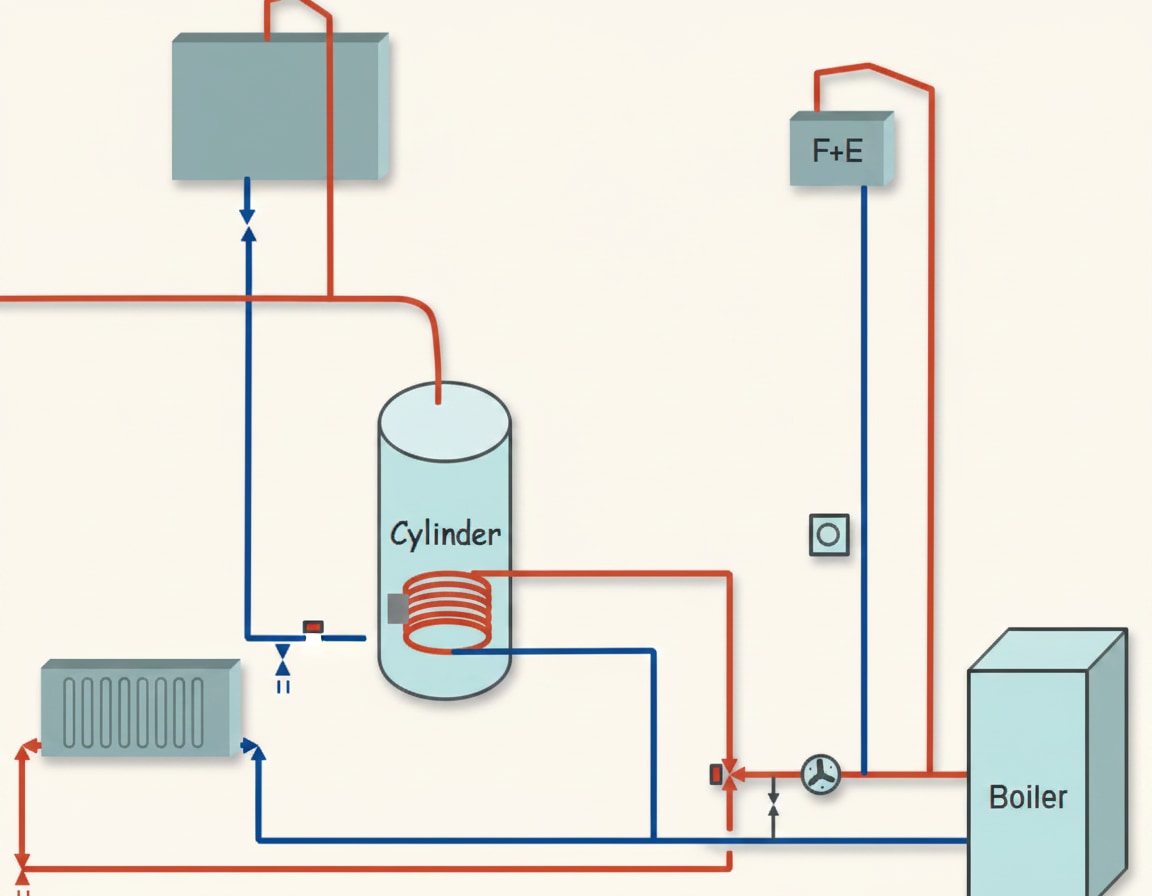
When is indirect used? Whenever the heat source is shared between central heating and hot water. A boiler powering both radiators and a hot water cylinder is indirect — the cylinder gets its heat from the heating primary via a coil, while the radiators get it via the flow-and-return heating circuit.
Key distinction for the exam: an indirect hot water cylinder differs from a direct cylinder due to the presence of a heating coil (or annulus). That's what indirect means — there's a heat exchanger between the heat source and the water you draw from the taps.
Which combinations actually exist
Not every combination of the four axes exists in practice. The combinations you'll meet:
| Example system | Storage? | Centralised? | Vented? | Direct? |
|---|---|---|---|---|
| Combi boiler | Instantaneous | Centralised | Sealed | Direct |
| Unvented cylinder (immersion only) | Storage | Centralised | Sealed | Direct |
| Unvented cylinder with coil | Storage | Centralised | Sealed | Indirect |
| Open vented cylinder with immersion | Storage | Centralised | Vented | Direct |
| Open vented cylinder with coil | Storage | Centralised | Vented | Indirect |
| Single feed indirect cylinder | Storage | Centralised | Vented | Indirect |
| Electric shower | Instantaneous | Localised | Sealed | Direct |
| Multipoint water heater | Instantaneous | Localised | Sealed | Direct |
| Undersink water heater | Instantaneous | Localised | Sealed | Direct |
Note that all instantaneous systems are sealed and direct — there are no exceptions. That's the single biggest shortcut for this topic: if you identify a system as instantaneous, you automatically know it's sealed and direct too.
How to identify a system from a diagram
When you're given a diagram and asked what type of system it is, ask four questions in order:
1. Is there a cylinder? If yes → storage. If no → instantaneous.
2. Is there a cistern feeding the system? If yes → open vented. If no → sealed.
3. Does the cylinder have a coil (or annulus) visible inside it? If yes → indirect. If no → direct.
4. Does the system feed one outlet or many? Many → centralised. One → localised.
Work through the diagram systematically and every question on the exam paper about "what type of system is this?" becomes methodical rather than guesswork.
Advantages and disadvantages summary
Storage systems (open vented or unvented):
- ✓ Back-up supply of water if mains fails (open vented only — the cistern holds water)
- ✓ Can handle high demand (fill a bath quickly)
- ✓ Can combine multiple heat sources (gas + solar + immersion with multi-coil)
- ✗ Takes up space for the cylinder
- ✗ Energy used to keep water hot even when not used
- ✗ Legionella risk (bacterial growth in stored water)
Instantaneous systems (combi boiler, electric shower, multipoint):
- ✓ Minimal space requirement
- ✓ Minimal Legionella risk (no stored water)
- ✓ Only heats what you use
- ✗ No backup if boiler/heater fails
- ✗ Limited peak flow rate (energy-constrained)
- ✗ Combi boilers generally not recommended for homes with more than one bathroom
Open vented systems:
- ✓ Low pressure means lower component stress and fewer safety risks
- ✓ Cheap to install, proven technology
- ✓ Backup water supply in the cistern
- ✗ Low pressure at outlets (weak showers on upper floors)
- ✗ Needs loft space
- ✗ Larger pipework needed to achieve acceptable flow rates
Unvented systems:
- ✓ High pressure at all outlets
- ✓ No loft cistern required
- ✓ Smaller-bore pipework can deliver good flow rates
- ✗ Needs safety components (expansion vessel, T&P relief)
- ✗ Installer needs G3 qualification
- ✗ Annual service recommended
Common exam traps
Trap 1: Instantaneous systems can only be sealed and direct. No instantaneous system is open vented; no instantaneous system is indirect. Both constraints come up in exam questions.
Trap 2: Identifying "direct" vs "indirect". Direct = heat source touches the water you'll use. Indirect = heat source heats primary water, which then heats secondary water through a coil. The presence of a coil is the telltale sign of indirect.
Trap 3: Centralised vs localised. One heater → one or a few outlets = localised. One heater → many outlets across the building = centralised. Multipoint water heaters are localised despite feeding multiple outlets, because "multipoint" just means it can serve more than one tap nearby, not the whole property.
Trap 4: Legionella risk comes from storage. Instantaneous systems have much lower Legionella risk than storage systems because there's no hot water sitting around. Examiners test this as an "advantage of instantaneous" or "disadvantage of storage" question.
Trap 5: Open vented can't handle high mains pressure. Open vented systems operate at gravity pressure from the cistern height. They're not designed to work at mains pressure and can't be converted directly — you'd need to swap out the cylinder and pipework.
Quick revision summary
Before the mock test, six things you need to be able to produce from memory:
- Four classification axes: storage/instantaneous, centralised/localised, open vented/unvented, direct/indirect
- Instantaneous systems can only be sealed AND direct — no exceptions
- Indirect = presence of a heating coil (or annulus) between heat source and stored water
- Open vented = fed from a cistern (gravity pressure); unvented = fed from mains (high pressure)
- Storage systems can combine with any of the other axes
- Legionella risk comes from storage — instantaneous systems have minimal risk
📝 10-Question Mock Test
Click an option to see whether you got it right. Explanations appear instantly — no submitting at the end.
Storage systems work well in low-pressure areas because the gravity pressure from the cistern height is independent of mains pressure. Options A (contamination) and D (environmental) don't describe storage system advantages. Option B is the opposite — storage systems require MORE space than instantaneous.
Stored water sitting at 20–45°C is the ideal environment for Legionella to multiply. Open vented storage systems have the highest risk because the water sits for long periods and can warm up. Option A is wrong because open vented systems actually have a backup (the cistern water). Options C and D don't describe open vented-specific issues.
An immersion heater element sits directly in the water it's heating — no heat exchanger, no coil, no secondary circuit. That's the definition of direct. "Indirect" requires a coil or annulus. "Electrolytic" isn't a valid system type. "Instantaneous" is a storage question (the cylinder = storage), so it's not instantaneous.
The defining feature of an indirect cylinder is the heat exchanger (coil or annulus) that keeps primary water separate from secondary water. Sacrificial anodes (A) appear in some cylinders for corrosion protection regardless of direct/indirect. Vent pipework (B) and expansion vessels (D) are features of open vented/sealed respectively, not direct/indirect.
The element is in direct contact with the water. Indirect (B) would require a heat exchanger. "Radiantly" (C) and "uniformly" (D) aren't valid heating classifications for this question.
One heater + multiple outlets across the property = centralised by definition. Localised (A) has one or a few outlets per heater. Single-point (C) is specifically a single-outlet heater. Instantaneous (D) describes when the water is heated, not where.
Instantaneous systems have no cistern (nothing to be open to atmosphere) and no time for indirect heat transfer. They're always sealed and direct. The other options could be either sealed or vented.
Unvented systems run at mains pressure, which is typically several times higher than the gravity pressure of an open vented system. This gives stronger showers, faster bath filling, and more acceptable flow rates. Option A is actually an open vented advantage; C is true of instantaneous, not sealed/unvented storage; D is false — unvented typically costs more to install.
A multipoint water heater is a single unit that serves multiple outlets in the same area (like several taps in a small flat). It's localised (not centralised) but serves more than one outlet, distinguishing it from a single-point heater. Over-sink and under-sink describe physical positioning, not outlet count.
The Legionella risk in stored hot water is the single most significant health risk associated with storage systems. Options B and D are actually advantages of storage systems (flexibility). Option C (space) is a disadvantage but less significant than the health risk.
How PlumbMate puts this into practice
Hot water classifications are a classic spaced-repetition topic — four axes, specific combinations, and rules about which combinations don't exist.
- Flashcards, not essays. One prompt, one answer — the format that research has consistently shown works best for active recall.
- Wrong answers are logged. Every question you get wrong goes into a dedicated collection that resurfaces more frequently in future sessions.
- The 3× rule. You need to get a question right three times before it clears — one lucky guess isn't enough.
- Explanations on every question. Like the ones above, but on every single question in the app.