Open vented hot water is the traditional UK domestic hot water setup: a cylinder in the airing cupboard, a cistern in the loft, gravity pressure, and a collection of specific pipework rules that students reliably find overwhelming on first encounter. Learn them properly and every diagram question about an open vented system becomes straightforward — the rules are specific and testable, but there aren't that many of them.
This is the third post in the Level 2 hot water sub-cluster. For the others, see the classifications, cylinder types, unvented systems, heat sources and temperature control posts.
What makes a system "open vented"
The defining feature: the system is open to the atmosphere through a vent pipe that rises up and over the cold water storage cistern. Water can expand into and out of the cistern as it heats and cools. Pressure in the system is set by gravity — the height of the cistern above the outlet determines the pressure at that outlet.
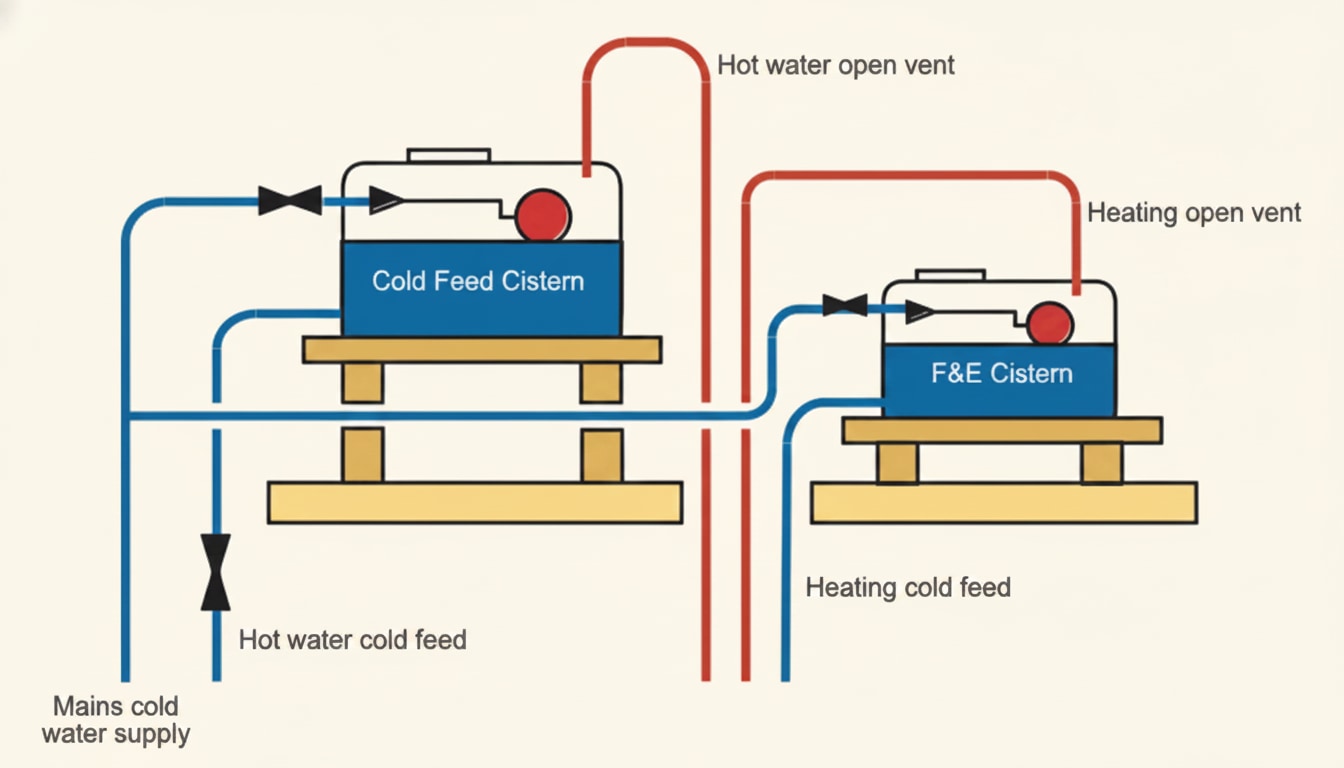
Key consequences:
- Low pressure — a typical domestic cistern is 2–5 metres above the ground floor, giving 0.2–0.5 bar pressure at ground-floor outlets
- Larger bore pipework than a mains-pressure system — 22mm main runs are typical to compensate for the low pressure
- Good flow rates achievable with correctly sized pipework despite the low pressure
- Backup water supply — if the mains fails, the cistern contents keep the hot water system running briefly
- Open to expansion — heated water can expand back up the vent pipe without causing a pressure problem
Cistern sizes
The CWSC that feeds an open vented hot water system has specific minimum sizes depending on what it feeds:
- 110 litres minimum if the cistern feeds the cylinder only
- 220 litres minimum if the cistern feeds both the hot water cylinder AND the cold water outlets (indirect cold water system)
Or the same capacity as the cylinder if a cylinder larger than 110 litres is installed — the cistern must be able to refill the cylinder in a single draw-off without running dry.
Key pipes in an open vented indirect system
An open vented indirect hot water system has four key pipes you need to identify and size:
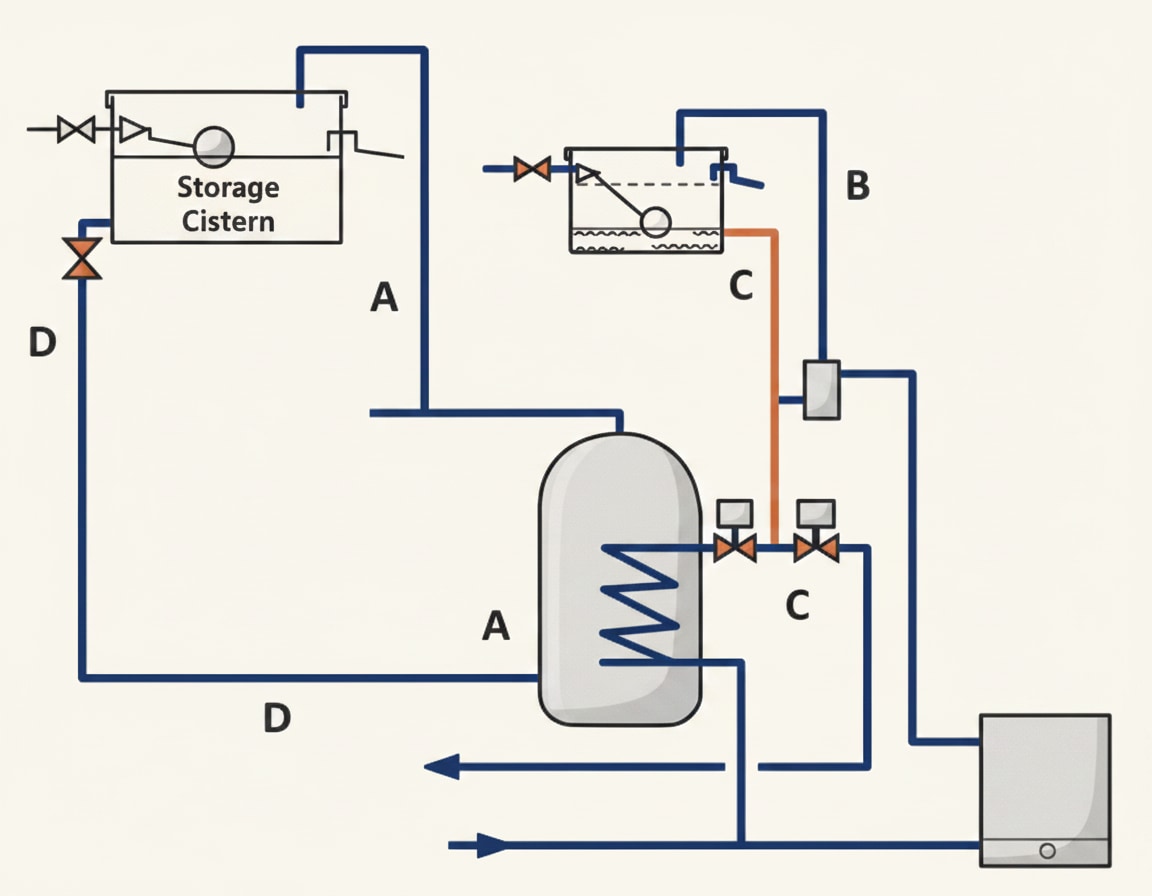
1. Secondary cold feed (CWSC to cylinder)
The pipe that fills the cylinder with water from the CWSC and accommodates expansion back up into the cistern during normal operation.
- Minimum size: 22mm
- Connection: ideally from the base of the CWSC (where practical), entering the cylinder at the base
- Valves: a service valve (gate valve — low pressure) must be fitted between the CWSC and the cylinder so the cylinder can be isolated for maintenance without draining the cistern
- Good practice: fit a drain valve on the bottom of the cold feed to drain the cylinder if needed
2. Secondary open vent (cylinder to over CWSC)
The pipe from the top of the cylinder that rises over the CWSC and terminates above it. Serves as the pressure relief for the secondary (drinking water) side.
- Minimum size: 22mm (the secondary vent should have a minimum internal diameter of 19mm, but is normally installed in 22mm copper)
- Connection: from the top of the cylinder where the hottest water is
- Critical shape: the vent must run horizontally for at least 450mm before rising, with a slight rise along that run to prevent airlocks
- Vent rise: calculated based on cistern height above cylinder (see the calculation below)
- Valves: NONE — this is a safety pipe and must not have any valves fitted
- Offset at cylinder: the vent leaves the top of the cylinder at a slight offset to prevent "one pipe circulation"
Why the 450mm horizontal run? Water in the cylinder forms temperature layers — hottest at the top, coolest at the bottom. This is called stratification. Without the 450mm horizontal run, the hot water at the top of the cylinder would rise up the vent, cool, and fall back down — a phenomenon called parasitic circulation. The horizontal run forces the hot water to stop rising before it can enter the vent properly, preventing this.
3. Primary open vent (boiler flow to over F&E cistern)
Only present on indirect systems (where there's a boiler heating the primary circuit).
- Minimum size: 22mm
- Connection: on the primary flow, close to the boiler
- Purpose: maintains atmospheric pressure on the primary circuit and lets primary water expand into the F&E cistern in fault conditions
- Valves: NONE — must not have any valves fitted (safety pipe)
- Rises to: discharges over the F&E cistern
4. Primary cold feed (F&E cistern to primary circuit)
Only present on double feed indirect systems.
- Minimum size: 15mm
- Purpose: initially fills the primary heating circuit; then accommodates heating water expansion back up into the F&E cistern
- Valves: NONE — must not have any valves fitted (safety and expansion route)
- Connection: connects into the primary return near the boiler
A useful memory aid: the vents and primary cold feed are all safety/expansion routes, and none of them can have valves. The only secondary-side pipe that takes a valve is the secondary cold feed (which needs a service valve for cylinder maintenance).
Vent pipe rise calculation
The secondary open vent doesn't rise to an arbitrary height — it has a specific required minimum rise above the water level in the cistern, based on the height of the cistern above the cylinder.
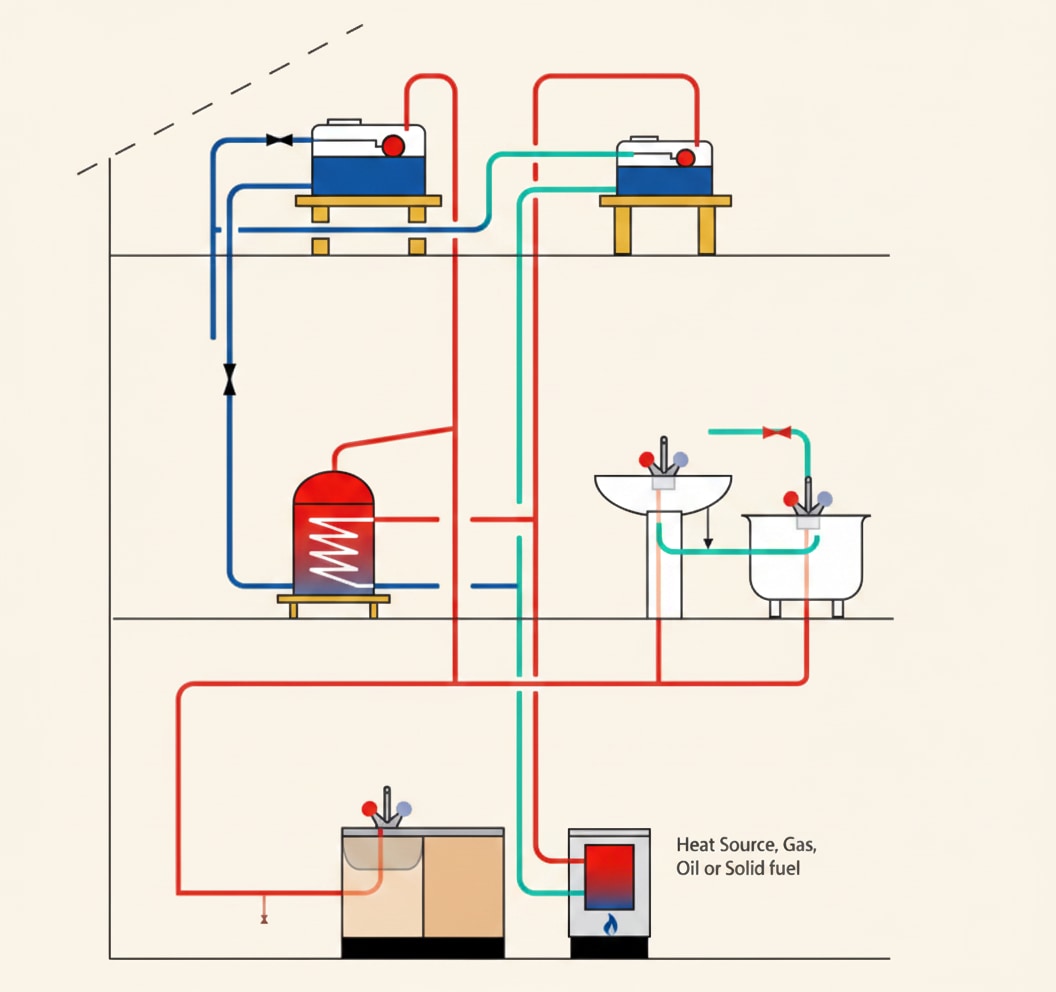
The formula:
Rise (metres) = 0.04 × height in metres + 0.15
where "height" is the vertical distance from the top of the water in the cistern down to the top of the cylinder.
Worked example: if the CWSC is 5m above the cylinder, the vent must rise:
- 0.04 × 5 + 0.15 = 0.20 + 0.15 = 0.35m (350mm) above the water level in the cistern
For a 10m head (the maximum for a Grade 3 cylinder — see below), the vent rise is:
- 0.04 × 10 + 0.15 = 0.40 + 0.15 = 0.55m (550mm) above the water level
The formula accounts for the fact that heated water expands — the taller the system, the more the water can push up the vent as it heats. The vent rise has to exceed that push, or water would spill into the cistern every time the cylinder heats up.
Cylinder grades (working head)
Open vented cylinders are classified by the maximum pressure (head of water) they can handle:
- Grade 1: 25 metres maximum head (commercial, tall buildings)
- Grade 2: 15 metres maximum head (some larger domestic or small commercial)
- Grade 3: 10 metres maximum head (most common domestic)
Grade 3 is by far the most common domestic cylinder because a typical UK house rarely has more than 10m of head between the cistern in the loft and the lowest outlet on the ground floor. Installing a Grade 1 or Grade 2 cylinder where Grade 3 would work is unnecessarily expensive.
For head calculations, remember from the plumbing science unit: 1 metre of water head = 0.1 bar. So Grade 3's 10m maximum head equals 1 bar of static pressure at the lowest point.
Stratification
Hot water in a cylinder forms layers of different temperature:
- Hottest water at the top (where hot draw-off and vent connection are)
- Middle layer of warm water
- Coldest water at the bottom (where cold feed enters)
This is called stratification and it's the reason hot water cylinders work effectively. Heat transfers up (hot water rises due to lower density), so the top of the cylinder stays hot even when cold water enters the bottom to refill what's been used. When you open a hot tap, you draw from the hottest layer at the top.
Key installation consequences of stratification:
- Hot draw-off at the top of the cylinder (where the hottest water is)
- Cold feed at the bottom (so new cold water doesn't mix with the hot layer above)
- Vent at the top (takes expansion from the hot layer)
- Secondary return (if fitted) at the top 1/3 of the cylinder (so returning circulated water rejoins the warm layer, not the cold)
Parasitic circulation
Parasitic circulation is the phenomenon where hot water rises up the vent pipe, cools at the top, falls back down, and circulates continuously — wasting heat from the cylinder.
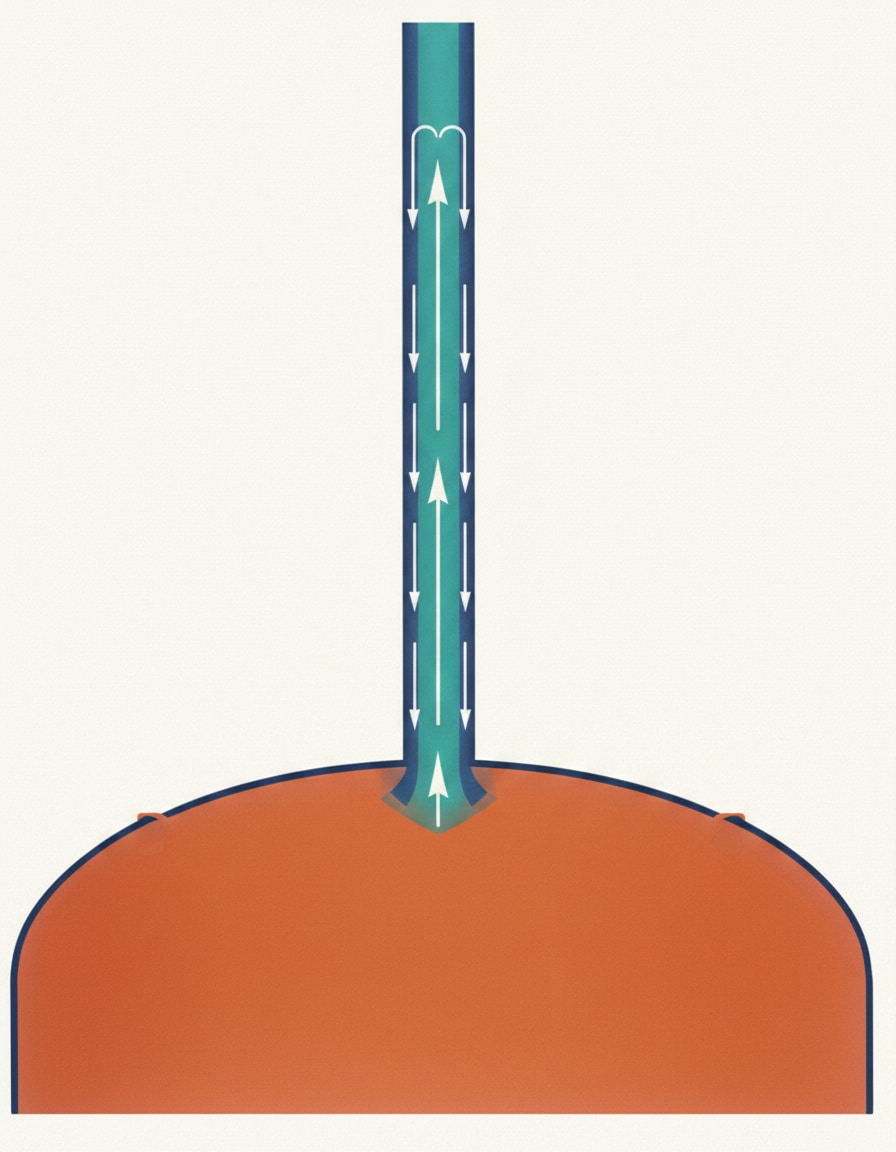
Without prevention, parasitic circulation happens because:
- Hottest water sits at the top of the cylinder
- The vent pipe connects at the top
- Hot water naturally rises up the vent
- At the vent's high point, it cools
- Cooled, denser water falls back down into the cylinder
- More hot water rises to replace it
- The cycle continues indefinitely, pulling heat out of the cylinder
The prevention: 450mm horizontal run. By forcing the vent pipe to run horizontally for at least 450mm before rising, parasitic circulation is broken. Hot water can't rise through a horizontal pipe, so it doesn't climb the vent under normal conditions.
Pipework insulation
Part L of the Building Regulations requires:
- All pipework going into and out of the cylinder insulated for at least 1 metre before and after the cylinder
- In practice, insulate all pipework in the cylinder cupboard for at least 1m from the cylinder
This prevents heat loss from the pipework around the cylinder and supports stratification (uninsulated pipes lose heat, which cools the top layer of water and disrupts stratification).
Additionally, pipework should slope upwards towards the CWSC from the cylinder to minimise airlock risk — trapped air can escape upwards into the cistern rather than being stuck in the pipework.
Cold feed above cold distribution (scald prevention)
A best-practice rule from the cold water cistern regulations that matters for hot water installation:
If the CWSC feeds both the hot water cylinder AND the cold water outlets, the cold feed pipe (to the cylinder) should connect ABOVE the cold distribution pipe (to the cold outlets).
Reason: if the mains water supply to the cistern fails and the cistern drains, the hot water will run out FIRST (the higher-connected cold feed stops working first), leaving cold water at the taps. This prevents a scalding risk where the taps could otherwise deliver superheated water with no cold water to mix with.
Common exam traps
Trap 1: Secondary vent horizontal run. At least 450mm of horizontal run before the vent rises. Not 300mm, not 600mm — specifically 450mm minimum.
Trap 2: Vent rise formula. 0.04 × height + 0.15 (both in metres). Worth memorising the formula rather than trying to derive it.
Trap 3: Cylinder grades and domestic use. Grade 3 (10m max head) is the most common domestic. Students sometimes assume Grade 1 because it's the "highest" rating — it's overkill for typical UK homes.
Trap 4: No valves on vents or primary cold feed. Only the secondary cold feed takes a valve. Vents are safety pipes; primary cold feed is an expansion route; all three must be unobstructed.
Trap 5: Cistern sizes. 110 litres for cylinder only; 220 litres if feeding hot + cold; or same as cylinder capacity if cylinder > 110L.
Trap 6: 1m insulation before and after cylinder. Part L requirement. Not optional. Not "where practical". One metre.
Trap 7: Parasitic circulation prevention. The fix is the 450mm horizontal run, not insulation alone, not a valve on the vent. The horizontal run breaks the convection current.
Quick revision summary
Before the mock test, eight things you need to be able to produce from memory:
- Cistern sizes: 110L (cylinder only), 220L (hot + cold), or same as cylinder if >110L
- Four key pipes: secondary cold feed (22mm), secondary open vent (22mm / 19mm ID min), primary open vent (22mm), primary cold feed (15mm)
- Secondary vent: 450mm horizontal run before rising; no valves; offset at cylinder to prevent one-pipe circulation
- Vent rise formula: 0.04 × height in metres + 0.15
- Cylinder grades: Grade 1 = 25m, Grade 2 = 15m, Grade 3 = 10m (most common domestic)
- Stratification: hot at top, cold at bottom; stratification supports cylinder efficiency
- Parasitic circulation prevented by the 450mm horizontal run
- Insulation 1m before AND after cylinder (Part L)
📝 10-Question Mock Test
Click an option to see whether you got it right. Explanations appear instantly — no submitting at the end.
Minimum 110 litres for a CWSC feeding only the cylinder. Smaller capacities (A, B) wouldn't refill the cylinder quickly enough after a bath draw-off. Larger (D) would be over-specified unless also feeding cold outlets.
Double duty = double capacity. If the cistern feeds both hot and cold, it needs to hold enough water for both demands plus reserve. 110L (A) is only enough for the cylinder alone. 200L (B) is a plausible-looking distractor but not the standard minimum. 300L (D) is over-specified.
Secondary cold feed minimum is 22mm — larger than the 15mm primary cold feed because it has to accommodate bigger flows (filling a bath, filling the cylinder quickly after a draw-off). 15mm (A) is for the primary cold feed. 28mm (C) would be over-specified unless the cylinder is very large.
The specific course material figure. Prevents parasitic circulation by breaking the rising convection current from the hot cylinder top. Shorter runs don't effectively prevent parasitic circulation; longer would work but 450mm is the minimum.
0.04 × 6 + 0.15 = 0.24 + 0.15 = 0.39m. Option A is just the 0.15m fixed component; B misses the 0.15m; D is the figure for 10m head. This one tests whether you can apply the formula rather than just recall it.
Typical UK houses rarely have more than 10m head between loft cistern and ground-floor outlets, so Grade 3 covers the domestic market. Grade 1 (A) is for tall commercial buildings; Grade 2 (B) for larger domestic or small commercial. Grade 4 (D) doesn't exist.
The formation of temperature layers in stored water. Convection (A) is the general principle of fluid movement caused by temperature differences — it's what creates stratification, but isn't the name of the layered effect. Parasitic circulation (C) is the unwanted circulation up the vent. One-pipe circulation (D) is another unwanted circulation issue prevented by the cylinder offset.
Hot water from the top of the cylinder rises up the vent, cools at the top, falls back down — the horizontal run breaks this convection current by preventing hot water from climbing straight up. Option A (airlocks) is partly addressed by the slight rise along the horizontal run, but the primary purpose is parasitic circulation prevention. C and D are unrelated problems.
Part L requires 1m insulation before and after the cylinder on all pipework. Not optional, not "where practical" — a legal requirement. Shorter distances fail to meet the regulation.
The primary open vent is a safety/expansion pipe — any valve on it could prevent the system venting under fault conditions. Secondary cold feed (A) must have a service valve for cylinder maintenance. "Hot distribution pipe" (B) may have service valves on appliance connections. "Gate valve on cylinder" (D) isn't a pipe — it's the valve itself.
How PlumbMate puts this into practice
Open vented hot water pipework is heavy on specific figures — ideal for spaced repetition.
- Flashcards, not essays. One prompt, one answer — the format that research has consistently shown works best for active recall.
- Wrong answers are logged. Every question you get wrong goes into a dedicated collection that resurfaces more frequently in future sessions.
- The 3× rule. You need to get a question right three times before it clears — one lucky guess isn't enough.
- Explanations on every question. Like the ones above, but on every single question in the app.