Unvented cylinders are increasingly the modern UK standard — high-pressure hot water at every tap, no loft cistern, smaller pipework than an open vented system. The trade-off is that an unvented cylinder is effectively a sealed pressure vessel with stored hot water, and if the safety systems fail, the consequences can be serious. That's why installation legally requires a G3 qualification — but Level 2 still expects you to understand how unvented systems work, identify their safety components, and know the advantages and disadvantages compared to open vented.
This is the fourth post in the Level 2 hot water sub-cluster. For the others, see the classifications, cylinder types, open vented systems, heat sources and temperature control posts.
What makes a system "unvented"
The defining feature: the system is sealed from the atmosphere and fed at mains pressure. There's no cold water storage cistern feeding the cylinder. Cold water enters the cylinder directly from the mains; hot water leaves under mains pressure.
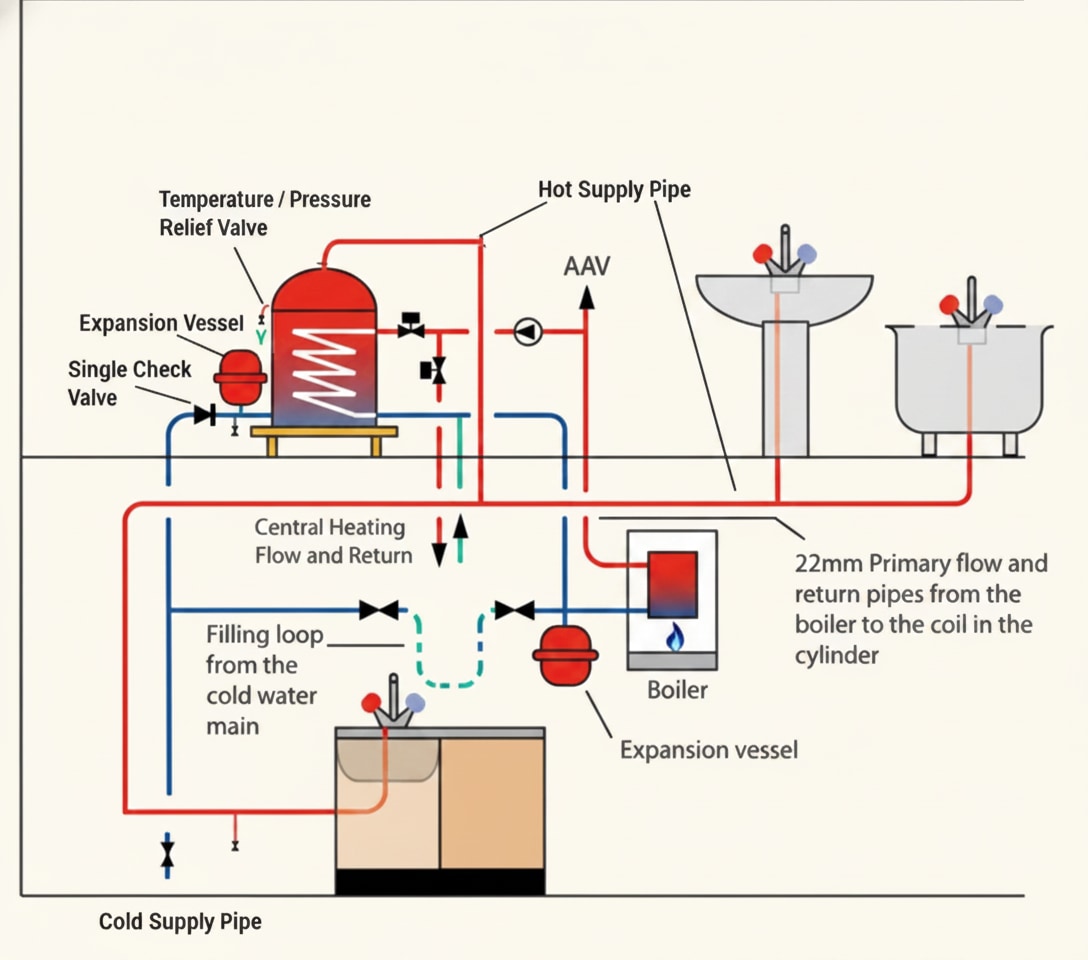
Because the system is sealed, three things become immediately necessary that an open vented system doesn't need:
-
Somewhere for expansion to go — water expands by about 2% when heated from cold to 60–65°C (the 4% often quoted is for heating it from cold all the way to 100°C). In an open vented system, that expansion travels back up the cold feed into the cistern. In a sealed system, it has nowhere to go unless you build it a space.
-
Pressure relief for fault conditions — if the cylinder overheats or overpressurises, the sealed pressure can build to dangerous levels. Open vented systems can't overpressurise (they're open to atmosphere); sealed systems need a mechanical safety release.
-
Multiple tiers of temperature control — because the consequences of a runaway cylinder are more serious in a sealed system, safety isn't left to a single thermostat. Multiple independent temperature controls are required.
Why the higher pressure matters
Unvented cylinders run at mains pressure — typically 2 to 5 bar depending on your location. Compare that to open vented's gravity pressure of 0.2 to 0.5 bar.
Practical consequences:
- Strong flow rates at every outlet — upstairs showers that dribble on open vented systems deliver properly on unvented
- Smaller bore pipework can deliver acceptable flows — 15mm supply pipework is often adequate (compared to 22mm main runs typical on open vented)
- No loft space required — the cylinder sits in the airing cupboard (or wherever's convenient) and doesn't need a cistern above it
- Balanced hot and cold pressures — both hot and cold are at mains pressure, so mixer valves work properly across the full range of outlets
Three tiers of temperature and pressure control
Unvented cylinders legally require a layered safety approach. If one component fails, another catches the problem before it becomes dangerous.
Tier 1: Cylinder thermostat (normal operation). Monitors the cylinder temperature and turns the heat source off when the target temperature is reached (typically 60°C). This is the first line of control and the only one that operates under normal conditions.
Tier 2: High-limit (overheat) thermostat. A separate, independent thermostat set higher than the cylinder thermostat (typically around 80–85°C). If the cylinder thermostat fails and the cylinder keeps heating, this second thermostat cuts the heat source at the safety limit. This is a mandatory backup on unvented cylinders.
Tier 3: Temperature and pressure relief valve (T&P relief). A mechanical safety valve fitted on the cylinder itself. Opens automatically if either the temperature exceeds a safe threshold (around 90°C) OR the pressure exceeds a safe threshold (around 6–8 bar). When it opens, it discharges water from the cylinder through the discharge pipe, relieving the pressure before anything can rupture.
If all three tiers fail, the cylinder could theoretically explode — but the three-layer design makes this essentially impossible with properly installed equipment. Exam questions test the tier structure directly: "what must be used as well as an overheat thermostat as a second tier of temperature control?" The answer is the temperature relief valve.
Expansion vessel
As water heats, it expands. In a sealed system, that expanded volume has to go somewhere — the expansion vessel is where.
How it works: an expansion vessel is a sealed tank containing a rubber diaphragm (or bladder) separating two chambers. One side contains pressurised air or gas; the other side is connected to the hot water system. As the cylinder water heats and expands, the expanded volume pushes into the vessel, compressing the gas on the other side of the diaphragm. When the water cools and contracts, the gas pressure pushes the water back out.
Installation rules:
- Fitted on the cool part of the system — typically on the cold supply to the cylinder, close to the cylinder. Heat damages the rubber diaphragm over time, so the vessel needs to be in the coolest location possible.
- Sized for the system — typically 12–18 litres for a domestic cylinder, calculated from cylinder capacity and maximum working pressure
- Charge pressure — the gas side is pre-charged to slightly below the mains pressure; this needs checking during commissioning and annually during service
Temperature and pressure relief valve (T&P relief)
The critical safety component. Fitted directly on the cylinder — not on the pipework downstream.
Key installation rules:
- Mounted on the cylinder itself — must be able to see the cylinder temperature directly
- Discharges through a dedicated pipe (the discharge pipe — see below)
- Must not have any valves on the inlet side — any restriction could prevent it operating in an emergency
- Typical set points: opens at around 90–95°C or 6–8 bar (whichever is reached first)
The discharge pipe (D1 and D2)
The pipe that takes discharged water from the T&P relief valve to a safe external location.
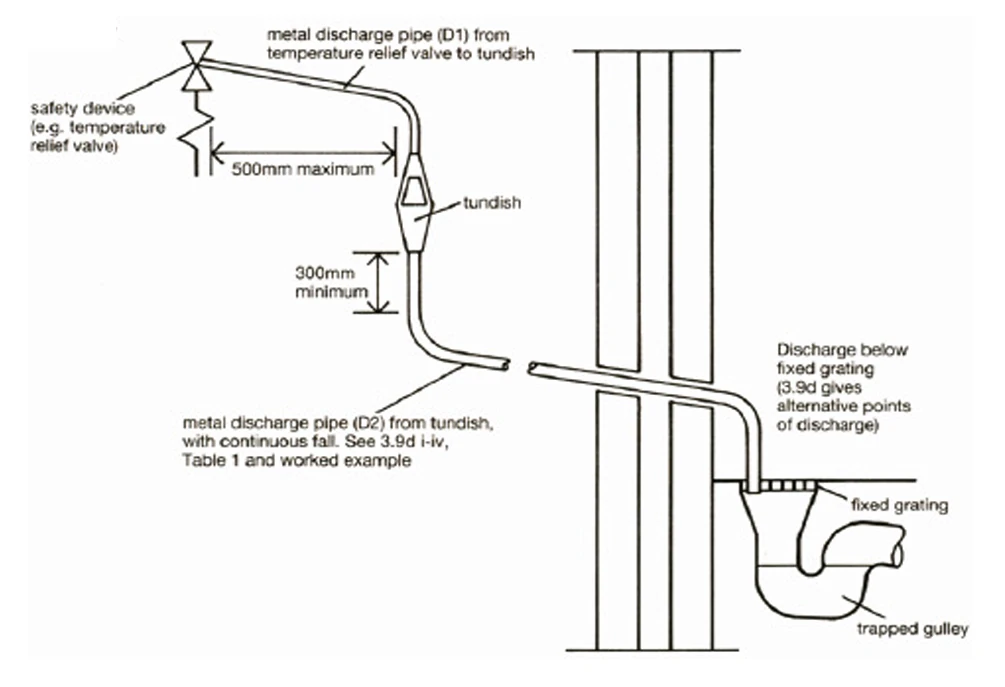
Critical installation rules:
- Must fall continuously — any rise or level section could trap water and restrict flow during emergency discharge
- Must discharge to a safe, visible location outside the building — typically onto an external wall or into a tundish that's connected to the drainage
- Must not be positioned too close to ground level — mud, leaves, and stones could block the outlet
- If discharging below head height, must be caged or turned back to the wall — so anyone standing nearby when the valve operates isn't injured by scalding water
- Minimum 22mm (for domestic installations — G3 specifies sizing based on relief valve capacity)
The discharge pipe is actually split into two parts:
- D1: from the T&P relief valve down to the tundish
- D2: from the tundish down to the external discharge point
Two figures on D2 that Approved Document G3 sets out and that get tested. Paragraph 3.56 says the discharge pipe from the tundish should "have a vertical section of pipe at least 300mm long below the tundish before any elbows or bends", and then be installed with a continuous fall of at least 1 in 200 thereafter. The 300mm matters because the discharge arrives fast and hot: turn it immediately and it backs up into the tundish instead of getting away. Put those alongside the tundish's own position — within 600mm of the safety device, per G3 3.54 — and you have the three numbers for this arrangement: 600mm above, 300mm below, then 1 in 200 all the way out.
The tundish — why the air break matters
A tundish is an air break between D1 and D2 — a small funnel-shaped fitting where the discharge from the T&P relief valve falls through air before entering D2.
Why it's essential:
- Visible indication of discharge — if the T&P relief operates, you can see water running through the tundish, which tells the homeowner or installer that something's wrong
- Prevents siphonage — the air break means D2 can never siphon water back towards the cylinder
- Prevents backflow contamination — if D2 is connected to the drainage system, the tundish ensures drainage water can never travel up into the hot water system
Balanced cold water supply
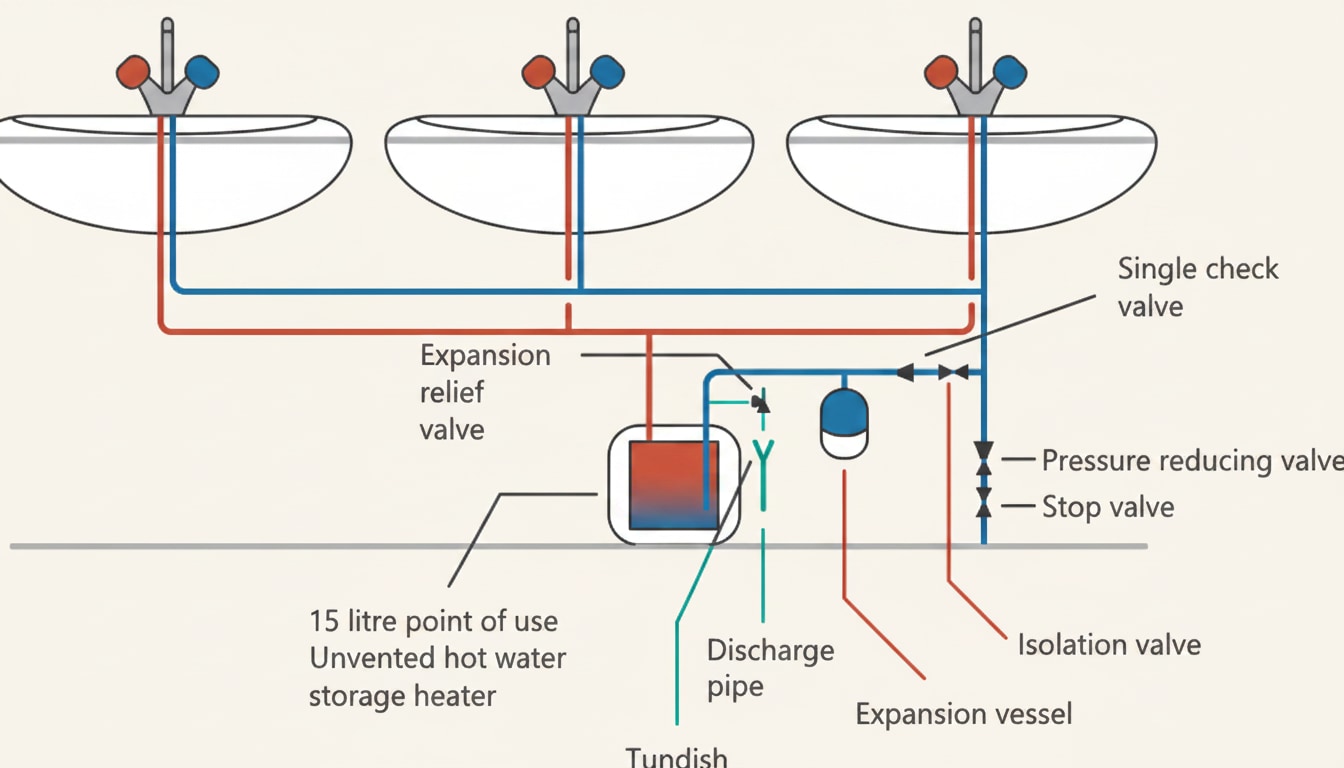
An unvented cylinder system needs the cold water supply to appliances to be at the same pressure as the hot water. Otherwise mixer valves don't work properly — a much higher cold pressure would overwhelm the hot side and deliver all cold water through a mixer.
Two approaches to achieving balanced supply:
- Simplest: connect the cold supply to all mixer-fed appliances after the branch that feeds the unvented cylinder — so both hot and cold are at mains pressure
- Alternative (in mixed systems): use a separate reduced-pressure cold supply that matches the hot pressure, but this is unusual in domestic
Stainless steel construction
Unvented cylinders are typically stainless steel — the material needs to handle:
- Mains pressure continuously (2–5 bar, sometimes higher)
- Cyclic temperature changes (cold water in, hot water out, many times per day)
- Internal pressure surges when appliances close suddenly
Copper cylinders are used occasionally but less commonly than stainless on unvented installations. Protected/glass-lined steel is also used, though stainless is now the default.
G3 qualification
G3 of the Building Regulations covers unvented hot water systems. The legal requirement: anyone installing, servicing, or commissioning an unvented cylinder must hold a G3 qualification.
Why the qualification is required:
- Unvented cylinders are pressure vessels storing hot water — the consequences of incorrect installation or commissioning can be serious
- The specific safety components (T&P relief, expansion vessel, discharge pipe) have strict installation rules
- Annual service is legally required — only a G3-qualified installer can carry it out
Level 2 students: you don't need G3 yet. It's typically added at Level 3 or as a short separate course. What you DO need at Level 2: recognise unvented systems, understand their components, and know the qualification requirement exists.
Advantages and disadvantages
Advantages of unvented over open vented:
- High pressure at all outlets — proper showers on upstairs bathrooms, fast bath filling
- No loft cistern required — saves loft space and removes the freezing risk
- Smaller bore pipework viable — often 15mm supply where open vented would need 22mm
- Balanced hot and cold pressures — mixer valves work properly
- Less pipework and installation complexity in some respects — no CWSC, no F&E cistern, no separate vent pipework
Disadvantages of unvented:
- G3 qualification required for installation and service — installer cost typically higher
- Annual service legally required — ongoing cost
- No backup water supply — if the mains fails, no hot water (open vented cisterns hold some reserve)
- More safety components to maintain — expansion vessel charge pressure, T&P relief, discharge pipe
- Potentially more expensive to install than open vented of equivalent capacity
When each is used
Open vented is still widely installed in:
- Older properties with existing cisterns
- Properties where loft space is abundant
- Where the installer isn't G3 qualified
- Where cost is a primary driver
Unvented is the modern default in:
- New builds
- Properties where high pressure is expected (big bathrooms, power showers)
- Properties with no loft access or limited loft space
- Retrofits where the cold water cistern is being removed
Common exam traps
Trap 1: Second tier temperature control = temperature relief valve. The course material question specifically asks what's used "as well as an overheat thermostat" — the answer is the T&P relief valve as the third/mechanical tier. The three-tier structure is: cylinder thermostat → overheat thermostat → T&P relief.
Trap 2: Expansion vessel location. Fitted on the cool part of the system — typically the cold supply to the cylinder. Heat damages the rubber diaphragm.
Trap 3: Discharge pipe direction. Must fall continuously — no rises, no level sections. Any trap would prevent proper emergency discharge.
Trap 4: Tundish purpose. Air break between D1 and D2 — visible indication of discharge + prevents siphonage + prevents backflow contamination.
Trap 5: Balanced cold supply. Mains pressure cold water feeding appliances that also receive mains pressure hot water. Not just "any cold supply" — specifically balanced to match the hot.
Trap 6: G3 qualification. Required for installation, servicing, AND commissioning. Not optional on any unvented installation.
Trap 7: No cistern on unvented. Fed directly from the mains. No CWSC in the loft, no F&E cistern.
Quick revision summary
Before the mock test, seven things you need to be able to produce from memory:
- Unvented = mains-fed, sealed; no cistern; typically stainless steel construction
- Three-tier safety: cylinder thermostat → overheat thermostat → temperature and pressure relief valve
- Expansion vessel on the cool part of the circuit (cold supply to cylinder)
- Discharge pipe: falls continuously, discharges safely outside; caged if below head height
- Tundish provides air break between D1 and D2; gives visible indication of discharge
- Balanced cold supply so mixers work properly
- G3 qualification required to install, service, or commission
📝 10-Question Mock Test
Click an option to see whether you got it right. Explanations appear instantly — no submitting at the end.
The defining difference. Unvented systems are sealed and mains-fed; open vented systems use a gravity-fed cistern. Options A (material), C (heat source), and D (application) don't describe the defining distinction.
The three-tier safety structure is: cylinder thermostat → overheat thermostat → T&P relief valve. The T&P relief is the mechanical third tier. Options A and B are unrelated safety components; an expansion vessel (D) handles volume expansion, not temperature control.
Heat damages the rubber diaphragm inside the expansion vessel, so it's fitted on the coolest available pipework. Option A (hot outlet) would expose the vessel to the hottest water. C (directly on cylinder) would expose it to cylinder temperature. D (after T&P relief) doesn't make sense — the T&P relief is a one-way emergency discharge.
The tundish serves three purposes: visible indication that the T&P has operated, prevention of siphonage from D2 back up to the cylinder, and backflow protection between drainage and the hot water system. Options A, C and D don't describe its function.
Any rise or level section would trap water and prevent proper emergency discharge. Option A is the opposite (vents rise; discharge pipes fall). Option C is wrong because the tundish is required. Option D is wrong because an isolation valve could stop the emergency discharge when it's needed.
If the T&P relief operates, scalding water at 90°C+ will discharge — anyone standing in front of it could be seriously burned. Below head height means the discharge could hit a person at face or chest level. Caging or turning the pipe back to the wall redirects the discharge safely.
Stainless steel has the strength to handle continuous mains pressure, corrosion resistance for hot water storage, and durability for thousands of temperature cycles. Galvanised steel (A) corrodes in hot water. Copper with lead jointing (B) is illegal on wholesome water systems. UPVC plastic (D) can't handle the pressure or temperature.
G3 of the Building Regulations covers unvented hot water systems. Gas Safe (A) is for gas installations. Part P (C) is electrical. WIAPS (D) is the Water Industry Approved Plumbers Scheme (general registration, not specific to unvented).
The core advantage of mains-fed sealed systems. Option A is actually an open vented advantage. Option B is typically false — unvented is usually more expensive to install. Option D is false — annual service is legally required.
If cold is at mains pressure and hot is at a lower pressure, a mixer valve will deliver mostly cold water because the cold side overwhelms the hot. A balanced supply means both sides are at the same pressure, and the mixer works correctly across its full range. The other options describe unrelated issues.
How PlumbMate puts this into practice
Unvented systems have specific safety components with specific installation rules — exactly the kind of content spaced repetition handles best.
- Flashcards, not essays. One prompt, one answer — the format that research has consistently shown works best for active recall.
- Wrong answers are logged. Every question you get wrong goes into a dedicated collection that resurfaces more frequently in future sessions.
- The 3× rule. You need to get a question right three times before it clears — one lucky guess isn't enough.
- Explanations on every question. Like the ones above, but on every single question in the app.