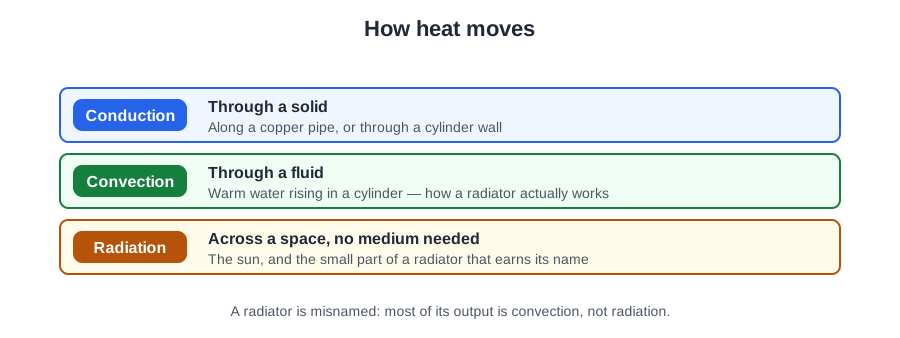
Conduction needs a solid. Convection needs a moving fluid. Radiation needs nothing at all — which is how the sun reaches us across empty space.
The three methods of heat transfer
Heat always moves from hotter to colder, by three methods. That direction is not a rule anybody made; it is simply what heat does, and it means you can never add cold to something — only take heat away.
Conduction — through a solid
Passed from particle to particle. Metals conduct well; plastics do not.
In plumbing: heat passing through the wall of a copper pipe, or through a cylinder coil into the water.
This is why copper is used for heat exchangers and coils, and it is also why a copper pipe burns you long after the torch has gone.
Convection — through a moving liquid or gas
Warm fluid rises, cool fluid falls, and a current forms.
In plumbing: a radiator warming a room, and the hot water sitting at the top of a cylinder.
Convection is the same density effect as gravity circulation in the properties of water lesson — warm fluid is lighter, so it rises, and the movement carries the heat with it.
Radiation — as rays through space
Needing nothing to travel through.
In plumbing: the warmth you feel on your face standing in front of a hot surface, and how the sun heats a solar panel.
That is the distinguishing feature and it is what questions test: radiation crosses a vacuum. Conduction needs a solid to pass through and convection needs a fluid to move, but radiation needs nothing at all.
The word “radiator” is misleading
Worth knowing, because it sounds like a trick and it is a real fact.
Most of a radiator’s output is actually convection, with only a small part genuine radiation. It warms the air against it, that air rises, cooler air is drawn in at the bottom, and a current circulates around the room.
Which is why a radiator with a shelf right above it, or a sofa pushed against it, performs badly: the convection current is what is being blocked.
Temperature measuring devices
- Thermometer — liquid in glass, or digital.
- Thermocouple — produces a small voltage that varies with temperature. You will meet these again on gas appliances.
- Thermostat — measures temperature and switches something on or off. That switching is what makes it a thermostat rather than a thermometer.
- Infrared / laser thermometer — reads a surface temperature without touching it. Useful for checking a pipe or a radiator quickly, and for finding which pipe is the flow.
Temperature scales
- Celsius (°C) — water freezes at 0 and boils at 100. The everyday scale.
- Kelvin (K) — the SI scale, starting at absolute zero, the coldest possible temperature. Water freezes at 273 K.
A rise of 1 K is the same size as a rise of 1 °C, so a difference in temperature can be written either way.
Surfaces and finishes
The surface of an object changes how well it radiates and absorbs heat.
- Dull surfaces — especially dark ones — are good radiators and absorbers of heat. Which is why a solar panel absorber is matt black.
- Shiny surfaces are poor radiators and absorbers, and good reflectors. Which is why foil behind a radiator reflects heat back into the room instead of letting it soak into the wall, and why a cylinder jacket has a shiny face.
The neat part is that it works both ways round: a good absorber is also a good emitter. Matt black takes heat in and gives it out well; shiny does neither, which is exactly what you want on something you are trying to keep hot.
The benefits of insulation
Insulation slows heat transfer down. Its named benefits are:
- Energy efficiency — less fuel is needed to keep the water or the room at the temperature you want.
- Prevention of heat loss — heat stays where it is wanted instead of escaping into a loft or a cupboard.
In plumbing it also does two other jobs worth knowing, and both come up constantly on site:
- It protects pipework in unheated spaces from freezing — lofts, garages, outbuildings.
- It stops condensation forming on cold pipes and dripping onto a ceiling. A “leak” that turns out to be condensation on an uninsulated cold pipe is a call-out you will make more than once.
The line to remember
Conduction needs a solid. Convection needs a moving fluid. Radiation needs nothing at all — it crosses a vacuum, which is how the sun reaches us.
🔢 The numbers worth memorising
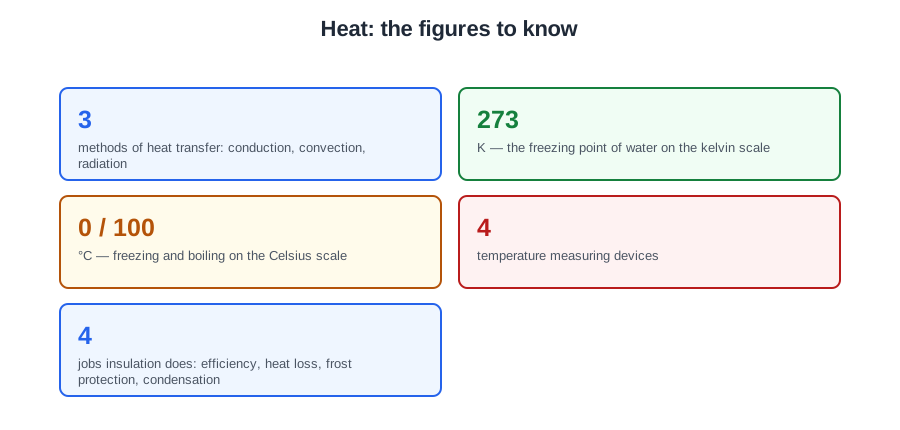
- 3
- methods of heat transfer: conduction, convection, radiation
- 273
- K — the freezing point of water on the kelvin scale
- 0 / 100
- °C — freezing and boiling on the Celsius scale
- 4
- temperature measuring devices
- 4
- jobs insulation does: efficiency, heat loss, frost protection, condensation
⚠️ Where people go wrong
- Saying a radiator works mainly by radiation. Most of its output is convection.
- Thinking radiation needs a medium. It is the one that crosses a vacuum.
- Confusing a thermometer with a thermostat. A thermostat switches something on or off.
- Getting the surfaces backwards. Matt black absorbs and radiates well; shiny reflects.
- Giving only the two named benefits of insulation. Frost protection and stopping condensation matter too.
📝 8-Question Self-Test
Straight from the Level 1 course question bank. Click an option to see whether you got it right — the explanation appears instantly, and there is nothing to submit.
Despite the name, most of a radiator's output is convection — warm air rising and cool air falling.
Radiation travels as rays through space and needs nothing — it crosses a vacuum, which is how the sun reaches us.
Conduction passes heat through a solid, particle to particle. Metals conduct well; plastics do not.
Dull surfaces, especially dark ones, are good radiators and absorbers of heat. That is why a solar panel absorber is matt black.
Shiny surfaces are poor radiators and good reflectors, so foil reflects heat back into the room. A cylinder jacket has a shiny face for the same reason.
Dull surfaces, especially dark ones, are good radiators and absorbers — which is exactly what an absorber plate needs to be.
Conduction is molecule to molecule through a solid. Convection is warmed fluid rising and carrying its heat with it. Radiation goes straight through space and needs nothing in between — which is how the sun reaches us.
Most of what a panel radiator gives out is convection — warmed air rising off it and circulating. A radiator with fins on the back is built to maximise exactly that, which is why the name is misleading.
- Start here: Plumbing Science for Level 1 — the whole unit in one piece
- All 72 Level 1 guides — one per lesson, across all ten units
- The Level 1 glossary — 620 terms in plain English