Most of this lesson is one conversion you will do a hundred times a week, and one fact about the weight of water that decides where a cylinder can go.
Why agreed units exist
Every trade uses agreed units so that a measurement means the same thing to everyone. If you write 22 on a drawing and somebody in another town reads it, both of you have to mean the same 22.
The internationally recognised set is the SI units — from the French Système International, which is why the initials look the wrong way round.
The units
| Quantity | Unit | Symbol |
|---|---|---|
| Length | metre / millimetre | m / mm |
| Time | second | s |
| Temperature | kelvin | K |
| Area | square metre | m² |
| Volume of water | litre | L |
The two you will use every day
Plumbing is measured in millimetres — pipe sizes, clip spacing, tails, insertion depths. Longer runs are in metres.
There are 1000 mm in a metre, so:
- mm to m: divide by 1000. 2400 mm = 2.4 m.
- m to mm: multiply by 1000. 1.8 m = 1800 mm.
The way to keep it straight is to sanity check the answer. Metres are big and millimetres are small, so a number in millimetres should always be bigger than the same measurement in metres. If your conversion made the number smaller when going to millimetres, you divided when you should have multiplied.
This matters because the clip spacing tables in Units 109, 110 and 111 are in metres and everything you mark on a wall is in millimetres. Copper 15 mm horizontal at 1.2 m means a clip every 1200 mm.
A note on temperature
The SI unit is the kelvin, but in practice you will read temperatures in degrees Celsius.
The useful fact: they rise in equal steps. A change of 1 K is the same size as a change of 1 °C — only the starting point differs. Kelvin starts at absolute zero; Celsius starts at the freezing point of water.
So a difference in temperature can be written either way, and you will see both. A boiler with a 20 K temperature difference across it and one with a 20 °C difference are describing exactly the same thing.
Area
Square metres (m²), and it is length × width.
You meet it more than you would expect: radiator sizing works from room area, insulation is sold by the square metre, and underfloor heating is laid out by area.
The fact worth carrying: 1 litre weighs 1 kg
Volume of water is in litres, and 1 litre of water weighs 1 kilogram.
That is a genuinely useful piece of arithmetic, because it turns a volume into a weight instantly and in your head.
A 210 litre cylinder holds over 200 kg of water — closer to a quarter of a tonne once you add the cylinder itself. Which is why the floor under it matters.
The same sum applies to a cold water storage cistern in a loft. A 230 litre cistern full of water weighs about 230 kg sitting on ceiling joists that were never designed to carry it, which is why cisterns are supported on boards spanning several joists rather than resting on one or two.
If you take one number from this lesson onto site, take that one.
🔢 The numbers worth memorising
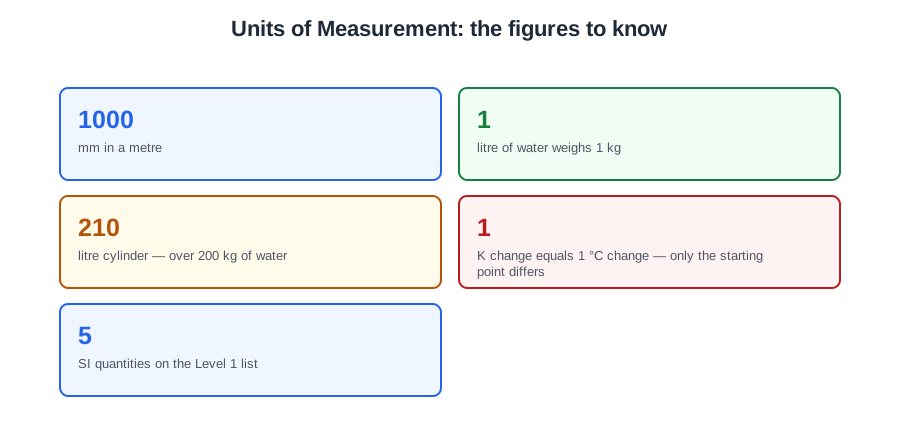
- 1000
- mm in a metre
- 1
- litre of water weighs 1 kg
- 210
- litre cylinder — over 200 kg of water
- 1
- K change equals 1 °C change — only the starting point differs
- 5
- SI quantities on the Level 1 list
⚠️ Where people go wrong
- Multiplying when converting mm to m. Millimetres are smaller, so the number is bigger.
- Thinking kelvin and Celsius rise at different rates. The steps are the same size.
- Forgetting that clip spacing tables are in metres while you mark out in millimetres.
- Underestimating the weight of stored water. A litre is a kilogram, and a cylinder is a quarter of a tonne.
📝 8-Question Self-Test
Straight from the Level 1 course question bank. Click an option to see whether you got it right — the explanation appears instantly, and there is nothing to submit.
The kelvin is the SI unit, though temperatures are read in degrees Celsius in practice.
There are 1000 mm in a metre, so divide by 1000. 2400 ÷ 1000 = 2.4 m.
Construction drawings are dimensioned in millimetres almost without exception, and there are a thousand in a metre. A radiator shown as 1200 is 1200 mm, or 1.2 m.
Time is the second, area is the square metre, and the volume of water is the litre. Flow rate puts the first two together — litres per second. A litre of water also weighs a kilogram.
Area = m2 is one of the named SI units, and it is the one that decides what size radiator a room gets: heat is lost per square metre of each surface.
Length = metre (m) and millimetres (mm). Construction drawings are dimensioned in millimetres almost without exception, and there are a thousand in a metre. Getting this wrong by a factor of a thousand is the classic apprentice error.
Flow rate puts two of the named SI units together: the litre for the volume of water and the second for time. A litre of water also weighs a kilogram.
Construction drawings are dimensioned in millimetres almost without exception, and there are a thousand in a metre. 1200 is 1.2 m. Getting this wrong by a factor of a thousand is the classic apprentice error, and it is always obvious afterwards.
- Start here: Plumbing Science for Level 1 — the whole unit in one piece
- All 72 Level 1 guides — one per lesson, across all ten units
- The Level 1 glossary — 620 terms in plain English